



Build Your Custom Market Intelligence Report
Customize Your ReportVietnam Natural & Herbal Cosmetics Market Insights & Analysis
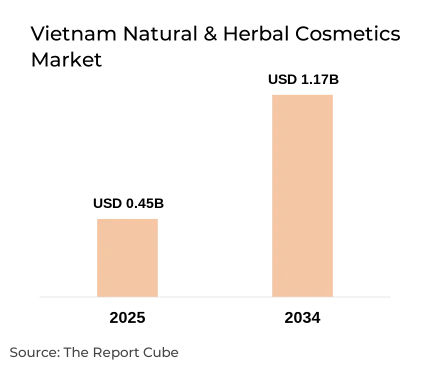
The Vietnam Natural & Herbal Cosmetics Market is anticipated to register a CAGR of 11.20% during 2026–2034. The market size was valued at USD 0.45 billion in 2025 and is projected to reach USD 1.17 billion by 2034.
Vietnam’s natural and herbal cosmetics market is witnessing accelerated expansion, supported by rising consumer awareness around ingredient safety, increasing preference for plant-based formulations, and the country’s rich heritage of herbal medicine. Vietnamese consumers are becoming more label-conscious, with over 68% of urban buyers actively checking ingredient origins before purchasing skincare or haircare products. The growing middle-class population, combined with rising disposable incomes, is driving demand for premium natural and organic cosmetic solutions.
The market benefits from strong domestic sourcing of herbal extracts, essential oils, and botanical actives such as turmeric, green tea, aloe vera, and lemongrass. Local brands leverage traditional knowledge, while multinational companies invest in natural product lines tailored to Southeast Asian skin types. E-commerce growth, social commerce adoption, and influencer-driven brand discovery further strengthen market penetration, particularly among Gen Z and millennial consumers.
Vietnam Natural & Herbal Cosmetics Market Recent Developments
- 2025: Unilever expanded its herbal personal care manufacturing capacity in southern Vietnam to support natural product lines.
- 2025: L’Oréal introduced a Vietnam-specific botanical skincare range using locally sourced plant extracts.
Government Initiatives & Policies
- Vietnam National Green Growth Strategy: Promotes sustainable manufacturing and use of natural raw materials.
- MOH Cosmetic Regulation Framework: Strengthens safety, labeling, and compliance standards for herbal cosmetics.
Vietnam Natural & Herbal Cosmetics Market Dynamics
Key Driver: Rising Demand for Clean, Safe, and Herbal Beauty Products
The primary driver of market growth is increasing consumer demand for clean-label and herbal cosmetics perceived as safer alternatives to synthetic products. Growing concerns regarding skin sensitivity, pollution-related damage, and long-term health impacts of chemical ingredients have accelerated the shift toward natural formulations. In Vietnam, nearly 60% of beauty consumers now associate herbal cosmetics with higher safety and long-term skin benefits. This perception strongly influences purchase behavior, particularly among women aged 25–45. Additionally, cultural familiarity with traditional herbal remedies enhances trust in plant-based cosmetic products, supporting consistent market demand.
Book your FREE 30-minute expert consultation today
Contact UsIndustry Trends: Premiumization and Localization of Herbal Formulations
Premium natural and organic cosmetics are emerging as a major industry trend. Consumers increasingly favor products with certified organic ingredients, cruelty-free claims, and eco-friendly packaging. Brands are localizing formulations by incorporating indigenous herbs and botanicals, improving product relevance and differentiation. Online-first natural brands are leveraging live-stream commerce, beauty influencers, and educational content to drive engagement. The use of refill packs and biodegradable packaging is also increasing, aligning with sustainability-driven purchasing decisions among younger consumers.
Major Challenge: Price Sensitivity and Certification Constraints
Despite strong growth, price sensitivity remains a challenge in mass-market segments. Certified organic ingredients and compliance with international quality standards increase production costs, limiting affordability. Smaller local brands often face difficulties obtaining organic certifications and scaling production while maintaining consistency. Additionally, fragmented regulatory understanding among small manufacturers can lead to compliance delays, restricting faster market entry and expansion.
Opportunity: Expansion of Online-First and Export-Oriented Natural Brands
The rapid expansion of digital retail platforms presents a significant opportunity. Online retail already contributes over 42% of natural cosmetic sales in Vietnam. Direct-to-consumer models allow brands to educate customers, build trust, and offer personalized solutions. Moreover, Vietnam’s growing reputation as a natural ingredient sourcing hub creates export opportunities across Asia-Pacific markets. Strategic partnerships with regional distributors and wellness retailers can further enhance international market access.
Vietnam Natural & Herbal Cosmetics Market Segment-wise Analysis
By Product Type:
- Skin Care
- Hair Care
- Makeup & Color Cosmetics
- Bath & Body
Skin care dominates the market, accounting for approximately 39% market share in 2025. Facial creams, serums, and herbal cleansers are widely adopted due to daily usage and visible efficacy. Hair care follows, supported by demand for herbal shampoos and scalp treatments addressing hair fall and pollution damage. Bath and body products show steady growth, while natural makeup remains a niche but fast-expanding category.
By Distribution Channel:
- Specialty Beauty Stores
- Pharmacies & Drug Stores
- Online Retail
- Supermarkets & Hypermarkets
Online retail leads distribution with nearly 42% market share, driven by social commerce and mobile-first shopping behavior. Specialty beauty stores support premium discovery, while pharmacies enhance trust for dermatology-aligned herbal products. Supermarkets remain relevant for mass natural product lines.
Need insights for a specific region within this market?
Request Regional DataRegional Projection of Vietnam Natural & Herbal Cosmetics Industry
- North Vietnam
- Central Vietnam
- South Vietnam
- Rest of Vietnam
South Vietnam leads the market, contributing approximately 44% of total revenue, supported by higher urbanization, income levels, and strong retail infrastructure in Ho Chi Minh City. The region also hosts key manufacturing hubs and logistics centers. North Vietnam follows, driven by rising demand in Hanoi and surrounding provinces. Central Vietnam shows moderate growth, supported by tourism-driven retail demand and local herbal sourcing. Continued urban expansion and digital penetration are expected to sustain regional growth through 2034.
Why Choose This Report?
- Provides a comprehensive overview of market size, trends, and growth drivers.
- Delivers accurate, data-driven segmentation and regional insights.
- Enhances understanding of consumer preferences and herbal ingredient demand.
- Offers competitive benchmarking and strategic positioning analysis.
- Consolidates market intelligence to reduce research time.
- Supports customized market entry and expansion strategies.
- Identifies challenges and untapped growth opportunities.
- Backed by real consumer behavior and search trend analysis.
Table of Contents
- Introduction
- Objective of the Study
- Natural & Herbal Cosmetics Definition
- Market Segmentation
- Study Variables
- Research Methodology
- Secondary Data Points
- Breakdown of Secondary Sources
- Primary Data Points
- Breakdown of Primary Interviews
- Secondary Data Points
- Executive Summary
- Market Dynamics
- Drivers
- Challenges
- Opportunity Assessment
- Recent Trends and Developments
- Regulatory and Policy Landscape
- Vietnam Natural & Herbal Cosmetics Market Overview (2026–2034)
- Market Size, By Value (USD Million)
- Market Share, By Product Type
- Skin Care
- Hair Care
- Makeup & Color Cosmetics
- Bath & Body
- Natural Fragrances
- Other Natural & Herbal Cosmetics
- Market Share, By Ingredient Type
- Herbal Extracts
- Plant-Based Oils
- Essential Oils
- Vitamins & Antioxidants
- Organic Certified Ingredients
- Other Natural Ingredients
- Market Share, By Form
- Creams & Lotions
- Serums & Oils
- Powders
- Gels
- Sprays
- Market Share, By Distribution Channel
- Specialty Beauty Stores
- Pharmacies & Drug Stores
- Online Retail
- Supermarkets & Hypermarkets
- Direct-to-Consumer (D2C)
- Market Share, By End User
- Women
- Men
- Unisex
- Market Share, By Price Tier
- Mass Natural
- Premium Natural
- Organic Luxury
- Market Share, By Company
- Competition Characteristics
- Revenue Shares & Analysis
- Market Share, By Region
- North Vietnam Natural & Herbal Cosmetics Market
- Market Size, By Value
- Market Share, By Product Type
- Market Share, By Distribution Channel
- Central Vietnam Natural & Herbal Cosmetics Market
- Market Size, By Value
- Market Share, By Product Type
- Market Share, By Distribution Channel
- South Vietnam Natural & Herbal Cosmetics Market
- Market Size, By Value
- Market Share, By Product Type
- Market Share, By Distribution Channel
- Rest of Vietnam Natural & Herbal Cosmetics Market
- Market Size, By Value
- Market Share, By Product Type
- Market Share, By Distribution Channel
- North Vietnam Natural & Herbal Cosmetics Market
- Competitive Outlook and Company Profiles
- The Body Shop
- Company Overview
- Natural & Herbal Portfolio
- Strategic Alliances/Partnerships
- Recent Developments
- L’Oréal (Natural Lines)
- Company Overview
- Natural & Herbal Portfolio
- Strategic Alliances/Partnerships
- Recent Developments
- Unilever (Herbal & Natural Lines)
- Company Overview
- Natural & Herbal Portfolio
- Strategic Alliances/Partnerships
- Recent Developments
- Local Herbal Beauty Brands
- Company Overview
- Product Portfolio
- Strategic Alliances/Partnerships
- Recent Developments
- Online-First Natural Brands
- Company Overview
- D2C Portfolio
- Strategic Alliances/Partnerships
- Recent Developments
- Others
- Company Overview
- Business Segments
- Strategic Alliances/Partnerships
- Recent Developments
- The Body Shop
- Contact Us / Disclaimer
Top Key Players & Market Share Outlook
- The Body Shop
- L’Oréal (Natural & Herbal Lines)
- Unilever (Herbal & Natural Lines)
- Local Herbal Beauty Brands (Vietnam-based players)
- Online-First Natural Brands
- Others (Regional & Emerging Natural & Herbal Cosmetic Companies)
Frequently Asked Questions






