


Build Your Custom Market Intelligence Report
Customize Your ReportKey Takeaways
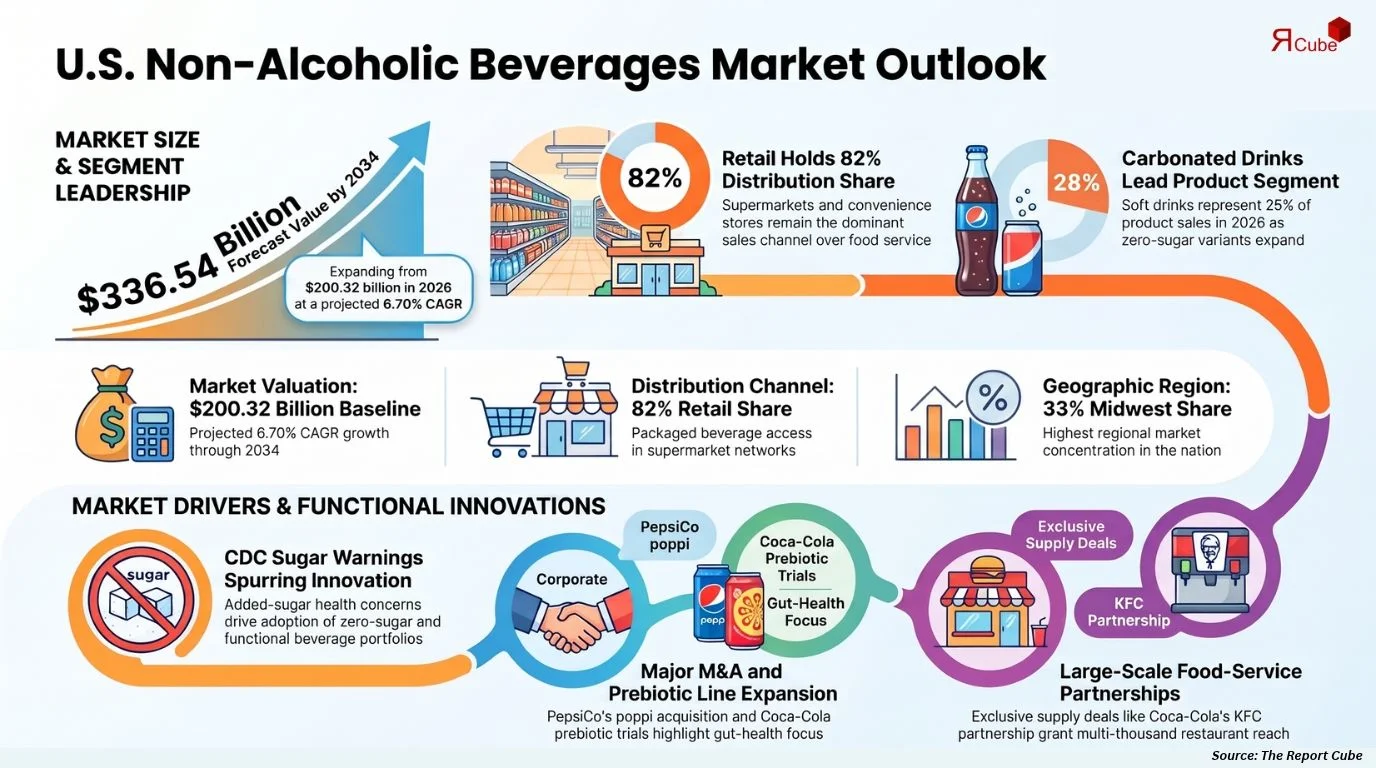
- U.S. Non-alcoholic Beverages Market is valued at USD 200.32 billion in 2026.
- The market is projected to reach USD 336.54 billion by 2034 at a 6.70% CAGR.
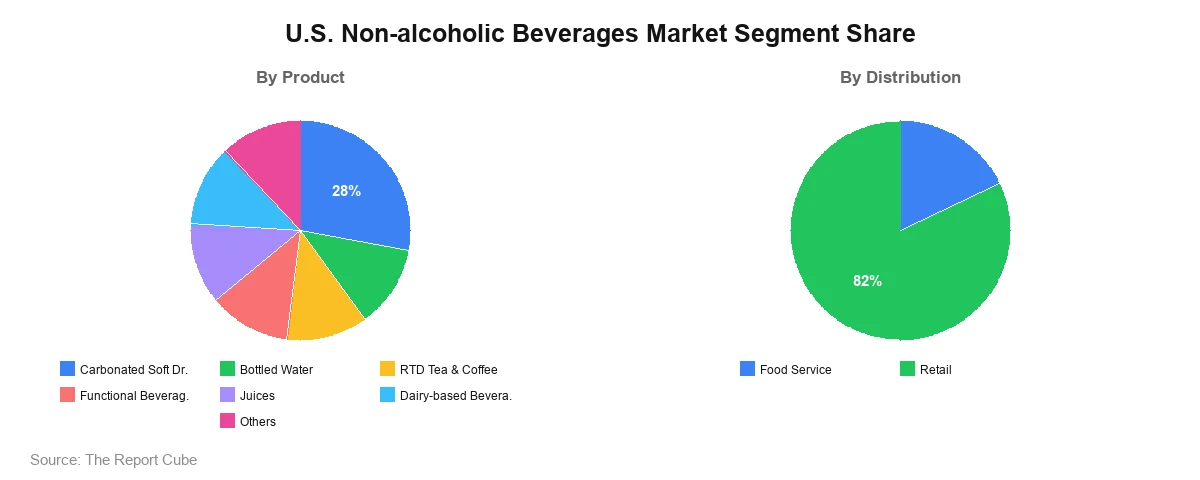
- Carbonated soft drinks lead the product segment with a 28% share in 2026.
- Retail leads the distribution segment with an 82% share in 2026.
- Midwest is the leading region with a 33% share in 2026.
- Nestlé, PepsiCo, Unilever, Keurig Dr Pepper and The Coca-Cola Company are key players.
- Zero-sugar and prebiotic beverage launches are an important product trend.
Market Overview
Non-alcoholic beverages are drinks that contain no alcohol or only trace amounts, including carbonated soft drinks, bottled water, ready-to-drink tea and coffee, functional beverages, juices and dairy-based drinks. They serve hydration, refreshment, nutrition and convenience needs through retail stores, restaurants, and other food-service outlets, and are produced by multinational and regional manufacturers.
The U.S. Non-alcoholic Beverages Market Analysis points to demand shaped by health awareness, convenient hydration and product reformulation. The CDC identifies added sugars as a dietary concern, encouraging manufacturers to expand zero-sugar, reduced-sugar and functional portfolios. Established bottling, retail and restaurant networks support access, with sparkling soft drinks accounting for 36.2% of measured dollar sales in 2024.
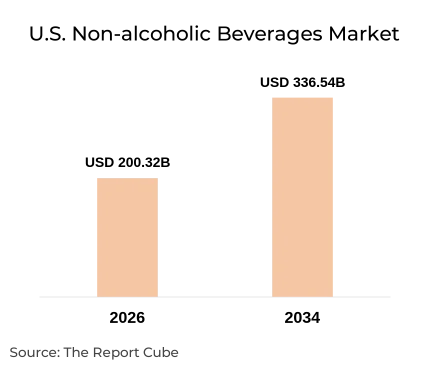
The market is valued at USD 200.32 billion in 2026 and is expected to reach USD 336.54 billion by 2034. Retail channels account for most sales, while manufacturers are widening zero-sugar, prebiotic, hydration and protein offerings across established brands. The market is projected to grow at a CAGR of 6.70% during 2026–2034.
U.S. Non-alcoholic Beverages Market Dynamics
The U.S. non-alcoholic beverages market is shaped by consumer preferences, demand for convenient hydration, functional product innovation and established retail and food-service distribution. Health awareness, product reformulation, brand competition and investment in new categories influence pricing, adoption and competitive positioning among manufacturers.
|
Factor |
Type |
Specific Impact on Market |
Magnitude |
|---|---|---|---|
|
Health-oriented and functional beverage demand |
Driver |
Encourages zero-sugar, reduced-sugar, hydration and functional product portfolios |
High |
|
Food-service beverage partnerships |
Opportunity |
Enables large-scale restaurant distribution and supply agreements |
Medium–High |
|
Sugar-related health concerns |
Challenge |
Increases reformulation requirements and pressure on traditional sweetened products |
Medium–High |
|
Prebiotic and protein beverage expansion |
Trend |
Extends established brands into functional, hydration and protein categories |
High |
|
Competition and changing preferences |
Challenge |
Raises innovation and marketing investment needs |
Medium |
U.S. Non-alcoholic Beverages Market Growth Drivers
Health-related consumption shifts are pushing manufacturers toward zero-sugar and functional portfolios. According to the CDC, added sugars are an important dietary concern, and sugary drinks contribute to intake. This supports U.S. Non-alcoholic Beverages Market Growth through reformulated carbonated drinks, hydration products and beverages positioned around reduced sugar and added nutritional functions.
Distribution infrastructure also sustains demand. An SEC-filed 2024 U.S. beverage landscape presentation reported sparkling soft drinks at 36.2% of dollar sales across measured liquid refreshment categories. Established bottling, retail and restaurant systems give manufacturers broad nationwide consumer access and support the continued commercialization of new products, flavors and package formats.
U.S. Non-alcoholic Beverages Market Opportunities
Functional categories offer room for differentiated products. The Coca-Cola Company’s October 2026 announcement describes testing of prebiotic-fiber beverages alongside expansion of protein and hydration offerings. These activities indicate openings for manufacturers targeting gut health, protein intake, active lifestyles and everyday hydration, although consumer acceptance of such products remains to be demonstrated.
Food-service partnerships present a second opportunity. Coca-Cola’s October 2026 partnership with KFC is scheduled to bring Coca-Cola products to approximately 3,600 U.S. restaurants beginning in January 2027. The arrangement illustrates the commercial potential of exclusive restaurant distribution and large-scale food-service supply agreements for beverage manufacturers operating in the food-service channel.
U.S. Non-alcoholic Beverages Industry Challenges
Health concerns around sugar-sweetened beverages create commercial and reputational pressure. According to the CDC, frequent consumption is associated with obesity, type 2 diabetes and cardiovascular disease. Manufacturers therefore face reformulation requirements, reduced-sugar product development costs and the need to expand healthier alternatives without weakening established brand positioning and consumer loyalty.
Competition is a second constraint. Multinational companies, private-label products and emerging functional brands compete on flavors, ingredients, nutritional claims and formats, raising innovation and marketing expenditure. CDC research also documents differences in beverage consumption across demographic and geographic groups, requiring manufacturers to adjust product positioning and distribution to local consumer patterns.
Need Specific Data, Let’s Customize the Report for You
Request CustomizationU.S. Non-alcoholic Beverages Market Trends
U.S. Non-alcoholic Beverages Market Trends include the integration of functional ingredients into established carbonated brands. In October 2026, The Coca-Cola Company announced a regional test of Coca-Cola Zero Sugar, Sprite Zero Sugar and Fresca containing 6 grams of prebiotic fiber per serving, reflecting movement toward zero-sugar formulations with added functional benefits.
Product diversification across hydration and protein beverages is a second direction. Coca-Cola’s announced 2027 pipeline includes new zero-sugar Powerade flavors, vitaminwater products and Core Power protein innovations, showing how established manufacturers are extending their portfolios beyond traditional soft drinks into hydration, protein and functional categories across the U.S. market.
U.S. Non-alcoholic Beverages Market Segment Analysis
The U.S. Non-alcoholic Beverages Market Share is distributed across product categories and distribution channels, each shaped by consumption occasions and purchasing patterns. Leading-segment shares below are based on the supplied 2026 estimates.
By Product
- Carbonated Soft Drinks
- Bottled Water
- RTD Tea & Coffee
- Functional Beverages
- Juices
- Dairy-based Beverages
- Others
Carbonated soft drinks lead the product segment with an estimated 28% share in 2026, supported by established brands, extensive bottling networks and broad availability across retail and restaurant channels. The Coca-Cola Company, PepsiCo, Keurig Dr Pepper and Jones Soda Co. supply products in this category, which is also shifting toward zero-sugar variants. Bottled water follows as a staple hydration category, while RTD tea and coffee serve convenience-oriented consumption. Functional beverages, including energy and hydration products from companies such as Red Bull and Coca-Cola’s Powerade and vitaminwater lines, are driven by health and activity-related demand. Juices address fruit-based and nutrition-oriented preferences, and dairy-based beverages, including Coca-Cola’s Core Power protein drinks, are supported by protein interest. Other products complete the segment.
By Distribution
- Food Service
- Retail
Retail leads the distribution segment with an estimated 82% share in 2026, reflecting the reach of supermarkets, convenience outlets and other stores through which packaged beverages are purchased for home and on-the-go consumption. Established bottling and retail networks support this position across carbonated, water, juice and ready-to-drink categories. Food service follows, driven by restaurant and quick-service demand for fountain and packaged beverages, and by partnerships such as Coca-Cola’s arrangement with KFC covering approximately 3,600 U.S. restaurants from January 2027. Food-service supply agreements give manufacturers volume access, while retail remains the primary channel for packaged products.
Regional Analysis
|
Region |
Estimated Market Share |
Key Growth Factors |
Industry Trends |
|---|---|---|---|
|
West |
- |
Regional drivers require validation |
- |
|
Southwest |
- |
Regional drivers require validation |
- |
|
North |
- |
Regional drivers require validation |
- |
|
Midwest |
33% |
Largest supplied regional share; drivers require validation |
Retail-led packaged beverage consumption, consistent with national distribution |
The Midwest leads the U.S. Non-alcoholic Beverages Market with an estimated 33% share of the national market in 2026 based on the supplied regional allocation. Detailed state-level demand data for the region was not supplied, so the underlying growth factors require validation before publication. National retail-led distribution shapes demand across all regions.
The West, Southwest and North regions share the remaining 67% of the market, although individual shares were not supplied. Regional differences in beverage consumption across demographic and geographic groups are documented by the CDC, indicating that product positioning and distribution may vary by region. Regional allocations should be validated before relying on them.
Market Share & Competitive Landscape
The U.S. Non-alcoholic Beverages Market includes multinational beverage manufacturers, food and beverage groups and specialist brands. The table summarizes the supplied companies by general capability and relevant segment. It does not represent numerical market share.
|
Company |
Competitive Strength |
Primary Segment Served |
|---|---|---|
|
Nestlé |
Global food and beverage portfolio with coffee and ready-to-drink capabilities |
RTD tea and coffee, bottled water |
|
PepsiCo |
Large beverage brand portfolio with bottling and distribution scale |
Carbonated soft drinks, functional beverages |
|
Unilever |
Global consumer goods group with nutrition and hydration brands |
Functional beverages |
|
Keurig Dr Pepper Inc. |
North American beverage brands and coffee systems |
Carbonated soft drinks, RTD beverages |
|
The Coca-Cola Company |
Global brand reach, bottler network and zero-sugar innovation |
Carbonated soft drinks, hydration, protein beverages |
|
Jones Soda Co. |
Specialty brand with differentiated flavors |
Carbonated soft drinks |
|
Danone S.A |
Dairy and plant-based product expertise |
Dairy-based beverages |
|
Suntory Beverage & Food Ltd |
International beverage portfolio |
Soft drinks, ready-to-drink beverages |
|
Asahi Group Holdings, Ltd. |
Diversified beverage and food operations |
Soft drinks, bottled water |
|
Red Bull |
Specialized energy drink brand |
Functional beverages |
Key Companies in the U.S. Non-alcoholic Beverages Market
The Coca-Cola Company: The Coca-Cola Company is headquartered in Atlanta, Georgia, and has operated since 1886 through a beverage portfolio. In October 2026 it announced prebiotic-fiber zero-sugar tests, a 2027 pipeline spanning Powerade, vitaminwater and Core Power, and a KFC partnership covering about 3,600 U.S. restaurants. Its strength is brand reach and distribution.
PepsiCo: PepsiCo is headquartered in Purchase, New York, and operates a global food and beverage business. In 2025 the company agreed to acquire prebiotic soda brand poppi, extending its carbonated and functional beverage portfolio in the United States. Its competitive strength lies in beverage brands, bottling and distribution scale.
Recent Developments
|
Year / Month |
Company |
Development |
|---|---|---|
|
March 2025 |
PepsiCo |
Agreed to acquire poppi, a prebiotic soda brand, expanding its functional carbonated beverage portfolio. |
|
October 2026 |
The Coca-Cola Company |
Announced a regional test of Coca-Cola Zero Sugar, Sprite Zero Sugar and Fresca with 6 grams of prebiotic fiber per serving. |
|
October 2026 |
The Coca-Cola Company |
Announced a KFC partnership to supply about 3,600 U.S. restaurants from January 2027 (announced plan, not yet in effect). |
|
October 2026 |
The Coca-Cola Company |
Announced a 2027 pipeline of zero-sugar Powerade flavors, vitaminwater products and Core Power protein innovations (announced plan). |
U.S. Non-alcoholic Beverages Market Future Outlook
The U.S. Non-alcoholic Beverages Market Forecast indicates expansion from USD 200.32 billion in 2026 to USD 336.54 billion by 2034 at a 6.70% CAGR, based on supplied estimates. Growth is expected to depend on functional and zero-sugar product development, retail and food-service distribution, and manufacturers’ ability to align formulations with changing health priorities and consumer preferences across the forecast period.
Technology and portfolio investment is likely to center on prebiotic, protein and hydration beverages, supported by announced pipelines and restaurant partnerships. Risks include health concerns tied to sugar-sweetened products, reformulation costs and intense competition from multinational, private-label and emerging brands. The projected values remain supplied assumptions, and actual outcomes depend on regulation, consumer acceptance, capital spending and ongoing manufacturer execution.
U.S. Non-alcoholic Beverages Market Report Coverage
This U.S. Non-alcoholic Beverages Market Report summarizes the supplied valuation, forecast assumptions, segmentation, regional framework and competitive ecosystem.
|
Parameter |
Details |
|---|---|
|
Market Name |
U.S. Non-alcoholic Beverages Market |
|
Market Size 2026 |
USD 200.32 billion |
|
Market Size 2034 |
USD 336.54 billion |
|
Forecast Period |
2026–2034 |
|
CAGR |
6.70% |
|
Base Year |
2026 |
|
Historical Years |
2021–2025 |
|
Forecast Years |
2026–2034 |
|
Segments Covered |
By Product; By Distribution; By Region |
|
Regions Covered |
West, Southwest, North, Midwest |
|
Key Companies |
Nestlé, PepsiCo, Unilever, Keurig Dr Pepper Inc., The Coca-Cola Company, Jones Soda Co., Danone S.A, Suntory Beverage & Food Ltd, Asahi Group Holdings, Ltd., Red Bull |
|
Customization |
Available as per client requirements |
Why Choose This U.S. Non-alcoholic Beverages Market Report?
- Market scope covering carbonated, water, tea and coffee, functional, juice and dairy-based beverages.
- Clear presentation of the supplied 2026 valuation, 2034 forecast and 6.70% CAGR.
- Segmentation across seven product categories and two distribution channels.
- Regional framework covering the West, Southwest, North and Midwest.
- Competitive profiling of ten supplied beverage manufacturers and brands.
- Trend insights on zero-sugar, prebiotic, hydration and protein beverages.
- Context on health considerations and food-service partnerships relevant to product planning.
Table of Contents
- Introduction
- Objective of the Study
- Product Definition
- Market Segmentation
- Study Variables
- Research Methodology
- Secondary Data Points
- Companies Interviewed
- Primary Data Points
- Breakdown of Primary Interviews
- Secondary Data Points
- Executive Summary
- Market Dynamics
- Drivers
- Challenges
- Opportunity Assessment
- Recent Trends and Developments
- Policy and Regulatory Landscape
- U.S. Non-alcoholic Beverages Market Overview and Forecast Analysis (2021-2034)
- Market Size, By Value, By Growth Rate (CAGR/USD Billions)
- Demand – Supply Trends
- Market Share, By Product
- Carbonated Soft Drinks
- Bottled Water
- RTD Tea & Coffee
- Functional Beverages
- Juices
- Dairy-based Beverages
- Others
- Market Share, By Distribution
- Food Service
- Retail
- Market Share, By Region
- West
- Southwest
- North
- Midwest
- Market Share, By Competitors
- Competition Characteristics
- Revenue Shares
- Carbonated Soft Drinks U.S. Non-alcoholic Beverages Market Overview, 2021-2034F
- By Value (USD Million)
- By Distribution – Market Size & Forecast 2021-2034, USD Million
- Food Service
- Retail
- Bottled Water U.S. Non-alcoholic Beverages Market Overview, 2021-2034F
- By Value (USD Million)
- By Distribution – Market Size & Forecast 2021-2034, USD Million
- Food Service
- Retail
- RTD Tea & Coffee U.S. Non-alcoholic Beverages Market Overview, 2021-2034F
- By Value (USD Million)
- By Distribution – Market Size & Forecast 2021-2034, USD Million
- Food Service
- Retail
- Functional Beverages U.S. Non-alcoholic Beverages Market Overview, 2021-2034F
- By Value (USD Million)
- By Distribution – Market Size & Forecast 2021-2034, USD Million
- Food Service
- Retail
- Juices U.S. Non-alcoholic Beverages Market Overview, 2021-2034F
- By Value (USD Million)
- By Distribution – Market Size & Forecast 2021-2034, USD Million
- Food Service
- Retail
- Dairy-based Beverages U.S. Non-alcoholic Beverages Market Overview, 2021-2034F
- By Value (USD Million)
- By Distribution – Market Size & Forecast 2021-2034, USD Million
- Food Service
- Retail
- Others U.S. Non-alcoholic Beverages Market Overview, 2021-2034F
- By Value (USD Million)
- By Distribution – Market Size & Forecast 2021-2034, USD Million
- Food Service
- Retail
- Competitive Outlook (Company Profile – Partial List)
- Nestlé
- Company Overview
- Business Segments
- Strategic Alliances/Partnerships
- Recent Developments
- PepsiCo
- Company Overview
- Business Segments
- Strategic Alliances/Partnerships
- Recent Developments
- Unilever
- Company Overview
- Business Segments
- Strategic Alliances/Partnerships
- Recent Developments
- Keurig Dr Pepper Inc.
- Company Overview
- Business Segments
- Strategic Alliances/Partnerships
- Recent Developments
- The Coca-Cola Company
- Company Overview
- Business Segments
- Strategic Alliances/Partnerships
- Recent Developments
- Jones Soda Co.
- Company Overview
- Business Segments
- Strategic Alliances/Partnerships
- Recent Developments
- Danone S.A
- Company Overview
- Business Segments
- Strategic Alliances/Partnerships
- Recent Developments
- Suntory Beverage & Food Ltd
- Company Overview
- Business Segments
- Strategic Alliances/Partnerships
- Recent Developments
- Asahi Group Holdings
- Company Overview
- Business Segments
- Strategic Alliances/Partnerships
- Recent Developments
- Ltd.
- Company Overview
- Business Segments
- Strategic Alliances/Partnerships
- Recent Developments
- Red Bull
- Company Overview
- Business Segments
- Strategic Alliances/Partnerships
- Recent Developments
- Nestlé
- Contact Us & Disclaimer
Top Key Players & Market Share Outlook
- Nestlé
- PepsiCo
- Unilever
- Keurig Dr Pepper Inc.
- The Coca-Cola Company
- Jones Soda Co.
- Danone S.A
- Suntory Beverage & Food Ltd
- Asahi Group Holdings, Ltd.
- Red Bull
Frequently Asked Questions