



Build Your Custom Market Intelligence Report
Customize Your ReportGlobal Non-Injectable Insulin Market Statistics and Insights
Market Insight
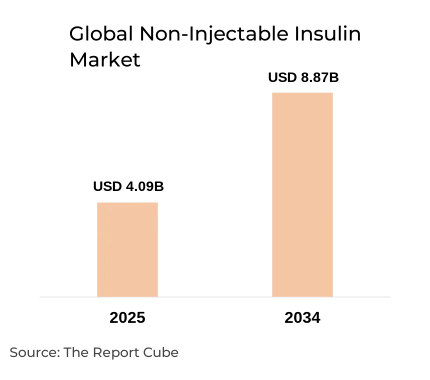
- The Global Non-Injectable Insulin Market was valued at USD 4.09 billion in 2025.
- The Global Non-Injectable Insulin Market is projected to reach USD 8.87 billion by 2034.
- The Global Non-Injectable Insulin Market is anticipated to register a CAGR of 8.98% during 2026–34.
By Distribution Channel
- Hospital pharmacies dominate the market, commanding approximately 38% of total revenue.
Competitive Landscape
- More than 10 companies are actively engaged in producing Global Non-Injectable Insulin Market products.
- Top 5 companies acquired around 62% of the market share.
- Novo Nordisk, Sanofi, Eli Lilly and Company, MannKind Corporation, AstraZeneca, and others.
By Patient Demographics
- Adult patients lead the segment, accounting for nearly 45% of total market share.
Global Non-Injectable Insulin Market Insights & Analysis
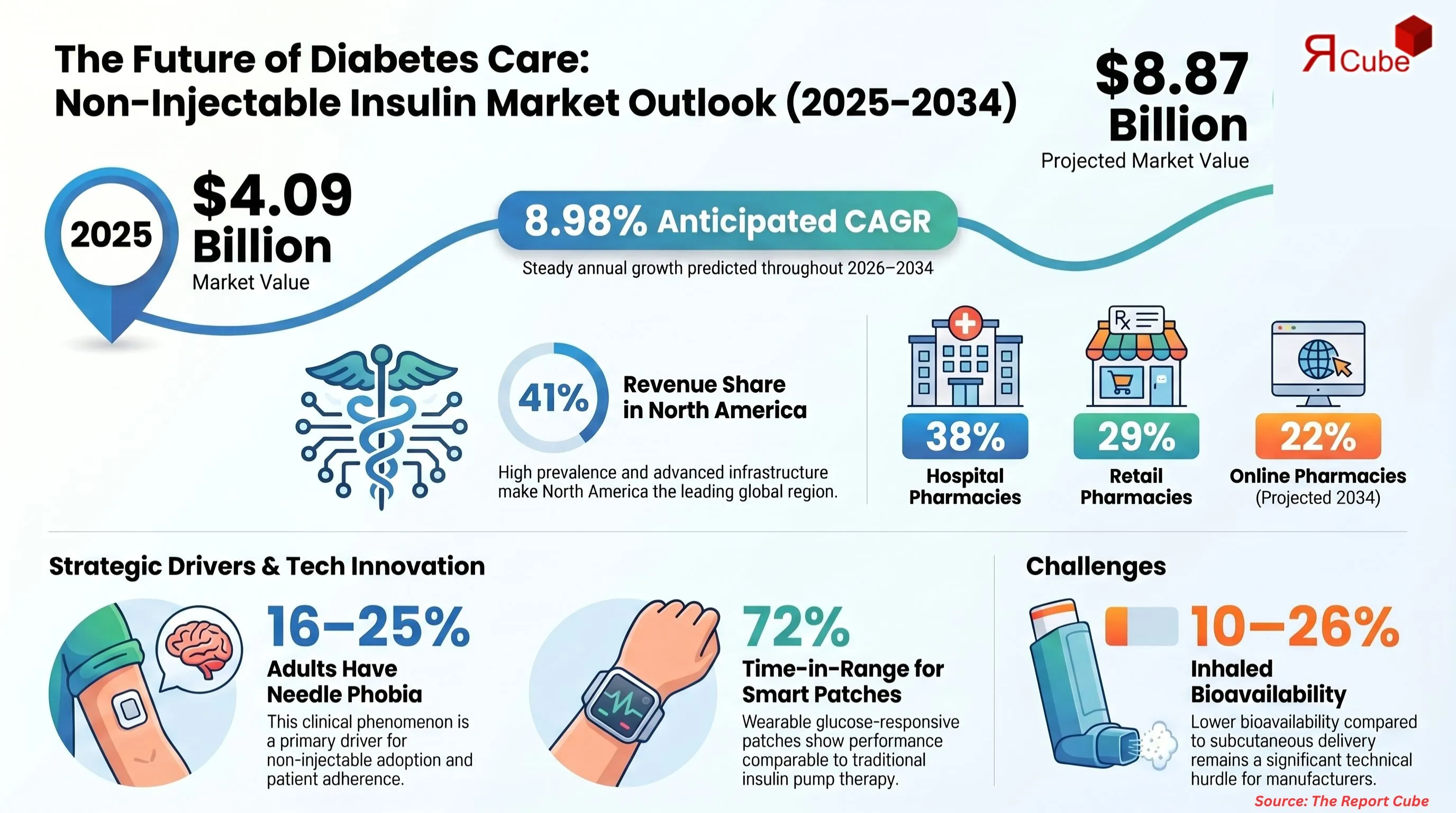
The Global Non-Injectable Insulin Market is anticipated to register a 8.98% CAGR during 2026–2034. The market size was valued at USD 4.09 billion in 2025 and is projected to reach USD 8.87 billion by 2034. The market's expansion is underpinned by the accelerating global prevalence of diabetes, with the International Diabetes Federation estimating over 537 million adults living with the condition as of 2024, a number projected to surpass 783 million by 2045.
Non-injectable insulin delivery systems, spanning inhaled, oral, transdermal, and buccal routes, are gaining clinical and commercial traction as they offer an effective alternative to the needle-based delivery that remains a significant barrier to patient adherence. Regulatory momentum is amplifying this outlook, with the U.S. Food and Drug Administration (FDA) granting Priority Review designation to multiple non-injectable formulations. Additionally, the National Institutes of Health (NIH) allocated over USD 280 million in 2024 toward next-generation diabetes therapeutics, a considerable portion directed at non-invasive drug delivery platforms.
Global Non-Injectable Insulin Market Dynamics
Key Market Driver: Rising Needle Phobia Accelerating Adoption
A clinically documented phenomenon, needle phobia, or trypanophobia, affects an estimated 16–25% of adults globally and is directly correlated with poor diabetes management outcomes. Studies published in the journal Diabetes Care indicate that patients with needle phobia are 2.4 times more likely to delay insulin initiation, leading to prolonged hyperglycemia and elevated complication risks. Non-injectable formulations, particularly MannKind Corporation's AFREZZA (inhaled insulin), have demonstrated statistically significant improvements in patient adherence rates, with clinical trials reporting up to 32% better glycemic control adherence compared to subcutaneous regimens. This creates a compelling medical and commercial case for non-injectable insulin delivery, especially in markets with aging populations and rising type 2 diabetes burden.
Major Industry Challenge: Bioavailability and Dosing Precision Constraints
One of the most persistent technical obstacles in the non-injectable insulin segment is achieving bioavailability and pharmacokinetic profiles equivalent to subcutaneous delivery. Pulmonary and oral routes are particularly susceptible to variability caused by lung capacity, gastrointestinal enzyme degradation, and mucosal permeability differences across patient populations. For instance, inhaled insulin bioavailability typically ranges between 10–26%, compared to approximately 55–77% for subcutaneous delivery, necessitating significantly higher formulation doses. This increases manufacturing complexity, elevates raw material requirements, and introduces dosing unpredictability, particularly in pediatric and geriatric cohorts. Regulatory agencies, including the European Medicines Agency (EMA), have required extended post-market surveillance studies for several non-injectable products due to pulmonary safety concerns, adding timeline uncertainty for market entrants.
Emerging Trend Shaping Outlook: Smart Wearable Transdermal Insulin Patches
Transdermal insulin delivery via microneedle arrays and glucose-responsive smart patches is emerging as the next frontier in non-injectable insulin therapy. Companies including Roche and Nuo Therapeutics are advancing microneedle patch systems capable of real-time glucose monitoring and automated insulin release, effectively merging continuous glucose monitoring (CGM) with closed-loop delivery. Preliminary clinical data from a 2024 Stanford University trial indicated that glucose-responsive transdermal patches maintained time-in-range (TIR) above 72% for type 1 diabetic patients over a 12-week period, comparable to conventional pump therapy. These innovations are expected to attract significant venture capital and pharmaceutical R&D investment through 2034, fundamentally reshaping outpatient diabetes management.
Need Specific Data, Let’s Customize the Report for You
Request CustomizationGlobal Non-Injectable Insulin Market Segment-wise Analysis
The Global Non-Injectable Insulin Market is segmented across distribution channels and patient demographics, each carrying distinct demand dynamics and growth trajectories. Understanding these segments is essential for stakeholders seeking to identify high-value opportunity pockets and align product portfolios with evolving healthcare infrastructure and demographic shifts across both developed and emerging economies.
By Distribution Channel
- Hospital Pharmacies
- Retail Pharmacies
- Online Pharmacies
- Specialty Pharmacies
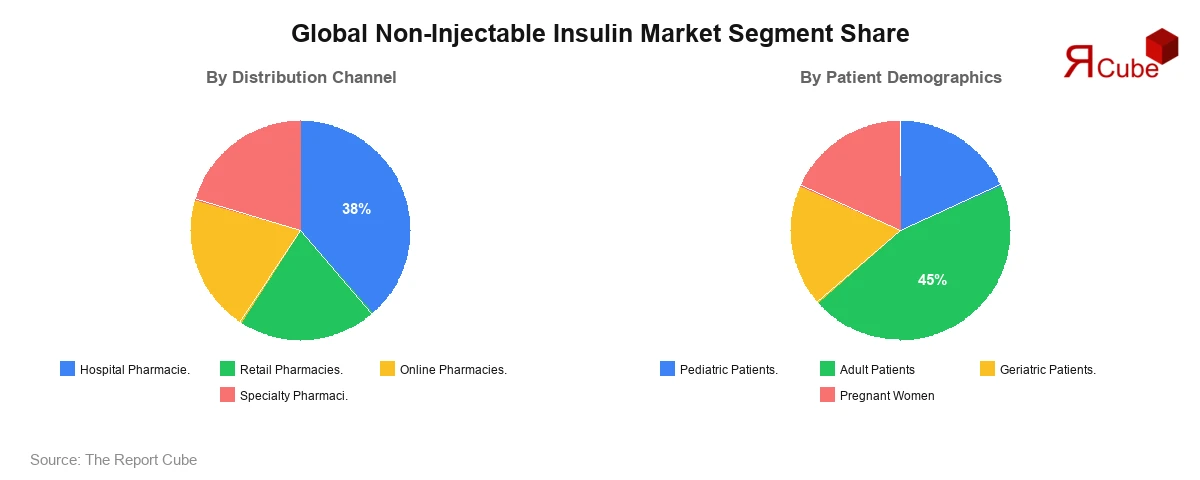
Hospital pharmacies command the largest revenue share in the Global Non-Injectable Insulin Market, accounting for approximately 38% of total 2025 revenues. Their dominance is attributable to the high volume of newly diagnosed diabetic patients who initiate therapy under clinical supervision, particularly for inhaled insulin formulations such as AFREZZA, which require initial spirometry assessment.
Retail pharmacies hold a significant secondary position at around 29% market share, driven by the convenience of refill prescriptions and the growing availability of non-injectable formulations on standard pharmacy formularies in North America and Europe. Online pharmacies are the fastest-growing sub-segment, fueled by post-pandemic digitization of healthcare retail, telehealth integration, and subscription-based insulin delivery models, projected to capture nearly 22% market share by 2034. Specialty pharmacies, at approximately 11% share, serve niche but high-value patient populations requiring complex regimens, including pregnant women and pediatric patients who require precision dosing and pharmacist counseling.
By Patient Demographics
- Pediatric Patients
- Adult Patients
- Geriatric Patients
- Pregnant Women
Adult patients constitute the dominant demographic segment, representing approximately 45% of total market demand. This cohort encompasses type 2 diabetic individuals aged 18–64 who are increasingly prescribed non-injectable insulin alternatives due to lifestyle convenience, occupational considerations, and adherence concerns associated with needle-based therapy. Geriatric patients form the second-largest group, accounting for an estimated 27% of market volume, driven by the higher prevalence of type 2 diabetes among individuals aged 65 and above, a demographic that faces dexterity challenges making self-injection difficult.
Pediatric patients, while representing a smaller segment at approximately 16%, are increasingly benefiting from inhaled insulin research adapted for younger physiologies. Pregnant women account for the remaining 12% share; though a specialized group, they represent a high-urgency clinical need given the risks of gestational diabetes and the preference for minimally invasive therapies to reduce maternal anxiety.
Regional Projection of Global Non-Injectable Insulin Market
- North America
- Europe
- Asia Pacific
- Latin America
- Middle East & Africa
North America leads the Global Non-Injectable Insulin Market, holding approximately 41% of global revenue in 2025. This dominance is driven by the highest per-capita diabetes prevalence among developed nations, with the CDC estimating over 37 million Americans living with diabetes, combined with advanced healthcare infrastructure, favorable FDA regulatory pathways, and strong insurer reimbursement frameworks for novel drug delivery systems. Europe follows as the second-largest region, supported by robust EMA approval pipelines and strong public health funding. Asia Pacific is the fastest-growing region, propelled by rapidly expanding diabetic populations in China and India, rising healthcare expenditure, and growing awareness of non-invasive insulin delivery modalities.
Global Non-Injectable Insulin Market: Recent Development (2025)
- Novo Nordisk reported a 14% operating margin increase following Phase III oral insulin trial success in Q1 2025.
- MannKind Corporation expanded AFREZZA distribution into 12 new international markets throughout early 2025.
- Eli Lilly announced a USD 500 million R&D allocation for non-injectable insulin platforms and transdermal delivery systems.
- AstraZeneca finalized a co-development agreement with a biotech firm for glucose-responsive buccal insulin formulation.
Global Non-Injectable Insulin Market Future Outlook (2034)
By 2034, the Global Non-Injectable Insulin Market is projected to reach USD 8.87 billion, advancing at a CAGR of 8.98% from 2026 through 2034. Growth will be propelled by convergence of AI-driven drug formulation optimization, advanced biomaterial science enabling more permeable transdermal membranes, and precision dosing algorithms embedded in smart wearable delivery devices.
The integration of artificial intelligence with real-time pharmacokinetic monitoring is expected to resolve longstanding bioavailability challenges, enabling personalized insulin titration outside clinical settings. Emerging markets in Southeast Asia, Sub-Saharan Africa, and Latin America will represent significant untapped opportunity as healthcare infrastructure matures. Strategic mergers, licensing agreements, and pipeline acquisitions will define competitive positioning, with leading players investing heavily to capture first-mover advantage in oral and transdermal segments.
Why Choose This Report?
- Provides a comprehensive overview of the overall market analysis, encompassing key trends, consumer behavior analysis, and risk assessment to support strategic decision-making.
- Provides accurate, up-to-date insights into market size, segmentation, and emerging opportunities, helping to minimize risk & capitalizing on growth.
- Gives deep understanding of target audience preferences, investment habits, and communication channels for enhanced product development & marketing effectiveness.
- Delivers competitive analysis & benchmarking, uncovering the strengths & weaknesses of market competitors to guide strategies.
- Consolidate comprehensive market intelligence, reducing reasoning & streamlining research efforts.
- Facilitates customized market segmentation & risk mitigation strategies, fine-tuned to the business objectives.
- Aids in identifying both market challenges & untapped opportunities within the industry to drive long-term business growth.
- Provides valuable information based on actual customer data & search trends.
Table of Contents
- Introduction
- Objective of the study
- Product Definition
- Market Segmentation
- Study Variables
- Research Methodology
- Secondary Data Points
- Companies Interviewed
- Primary Data Points
- Breakdown of Primary Interviews
- Secondary Data Points
- Executive Summary
- Market Dynamics
- Drivers
- Challenges
- Opportunity Assessment
- Recent Trends and Developments
- Policy and Regulatory Landscape
- Global Non-Injectable Insulin Market Overview and Forecast Analysis (2021-2034)
- Market Size, By Value, By growth rate (CAGR/USD Billions)
- Demand - Supply Trends
- Market Share, By Application
- Type 1 Diabetes
- Type 2 Diabetes
- Gestational Diabetes
- Prediabetes
- Market Share, By Therapeutic Use
- Blood Sugar Control
- Weight Management
- Cardiovascular Health
- Metabolic Syndrome
- Market Share, By Formulation Type
- Oral Tablets
- Inhalable Insulin
- Sublingual Insulin
- Transdermal Patches
- Market Share, By Distribution Channel
- Hospital Pharmacies
- Retail Pharmacies
- Online Pharmacies
- Specialty Pharmacies
- Market Share, By Patient Demographics
- Pediatric Patients
- Adult Patients
- Geriatric Patients
- Pregnant Women
- Market Share, By Region
- North America
- Europe
- Asia-Pacific
- Latin America
- Middle East & Africa
- Market Share, By Company
- Revenue Shares
- Competition Characteristics
- North America Non-Injectable Insulin Market Overview (2021-2034)
- Market Size, By Value (in USD Billions)
- Market Share, By Application
- Market Share, By Therapeutic Use
- Market Share, By Formulation Type
- Market Share, By Distribution Channel
- Market Share, By Patient Demographics
- By Country
- The US
- Canada
- Mexico
- The US Non-Injectable Insulin Market Overview (2021-2034)
- Market Share, By Application
- Market Share, By Therapeutic Use
- Market Share, By Formulation Type
- Market Share, By Distribution Channel
- Market Share, By Patient Demographics
- Canada Non-Injectable Insulin Market Overview (2021-2034)
- Market Share, By Application
- Market Share, By Therapeutic Use
- Market Share, By Formulation Type
- Market Share, By Distribution Channel
- Market Share, By Patient Demographics
- Mexico Non-Injectable Insulin Market Overview (2021-2034)
- Market Share, By Application
- Market Share, By Therapeutic Use
- Market Share, By Formulation Type
- Market Share, By Distribution Channel
- Market Share, By Patient Demographics
- South America Non-Injectable Insulin Market Overview (2021-2034)
- Market Size, By Value (in USD Billions)
- Market Share, By Application
- Market Share, By Therapeutic Use
- Market Share, By Formulation Type
- Market Share, By Distribution Channel
- Market Share, By Patient Demographics
- By Country
- Brazil
- Argentina
- Rest of South America
- Brazil Non-Injectable Insulin Market Overview (2021-2034)
- Market Share, By Application
- Market Share, By Therapeutic Use
- Market Share, By Formulation Type
- Market Share, By Distribution Channel
- Market Share, By Patient Demographics
- Argentina Non-Injectable Insulin Market Overview (2021-2034)
- Market Share, By Application
- Market Share, By Therapeutic Use
- Market Share, By Formulation Type
- Market Share, By Distribution Channel
- Market Share, By Patient Demographics
- Europe Non-Injectable Insulin Market Overview (2021-2034)
- Market Size, By Value (in USD Billions)
- By Application
- By Therapeutic Use
- By Formulation Type
- By Distribution Channel
- By Patient Demographics
- By Country
- Germany
- The UK
- France
- Spain
- Italy
- Rest of Europe
- Germany Non-Injectable Insulin Market Overview (2021-2034)
- Market Share, By Application
- Market Share, By Therapeutic Use
- Market Share, By Formulation Type
- Market Share, By Distribution Channel
- Market Share, By Patient Demographics
- France Non-Injectable Insulin Market Overview (2021-2034)
- Market Share, By Application
- Market Share, By Therapeutic Use
- Market Share, By Formulation Type
- Market Share, By Distribution Channel
- Market Share, By Patient Demographics
- The UK Non-Injectable Insulin Market Overview (2021-2034)
- Market Share, By Application
- Market Share, By Therapeutic Use
- Market Share, By Formulation Type
- Market Share, By Distribution Channel
- Market Share, By Patient Demographics
- Spain Non-Injectable Insulin Market Overview (2021-2034)
- Market Share, By Application
- Market Share, By Therapeutic Use
- Market Share, By Formulation Type
- Market Share, By Distribution Channel
- Market Share, By Patient Demographics
- Italy Non-Injectable Insulin Market Overview (2021-2034)
- Market Share, By Application
- Market Share, By Therapeutic Use
- Market Share, By Formulation Type
- Market Share, By Distribution Channel
- Market Share, By Patient Demographics
- The Middle East & Africa Non-Injectable Insulin Market Overview (2021-2034)
- Market Size, By Value (in USD Billions)
- By Application
- By Therapeutic Use
- By Formulation Type
- By Distribution Channel
- By Patient Demographics
- By Country
- The UAE
- Saudi Arabia
- South Africa
- Rest of the Middle East & Africa
- The UAE Non-Injectable Insulin Market Overview (2021-2034)
- Market Share, By Application
- Market Share, By Therapeutic Use
- Market Share, By Formulation Type
- Market Share, By Distribution Channel
- Market Share, By Patient Demographics
- Saudi Arabia Non-Injectable Insulin Market Overview (2021-2034)
- Market Share, By Application
- Market Share, By Therapeutic Use
- Market Share, By Formulation Type
- Market Share, By Distribution Channel
- Market Share, By Patient Demographics
- South Africa Non-Injectable Insulin Market Overview (2021-2034)
- Market Share, By Application
- Market Share, By Therapeutic Use
- Market Share, By Formulation Type
- Market Share, By Distribution Channel
- Market Share, By Patient Demographics
- Asia-Pacific Non-Injectable Insulin Market Overview (2021-2034)
- Market Size, By Value (in USD Billions)
- By Application
- By Therapeutic Use
- By Formulation Type
- By Distribution Channel
- By Patient Demographics
- By Country
- China
- India
- Japan
- South Korea
- Australia
- Rest of Asia-Pacific
- China Non-Injectable Insulin Market Overview (2021-2034)
- Market Share, By Application
- Market Share, By Therapeutic Use
- Market Share, By Formulation Type
- Market Share, By Distribution Channel
- Market Share, By Patient Demographics
- India Non-Injectable Insulin Market Overview (2021-2034)
- Market Share, By Application
- Market Share, By Therapeutic Use
- Market Share, By Formulation Type
- Market Share, By Distribution Channel
- Market Share, By Patient Demographics
- Japan Non-Injectable Insulin Market Overview (2021-2034)
- Market Share, By Application
- Market Share, By Therapeutic Use
- Market Share, By Formulation Type
- Market Share, By Distribution Channel
- Market Share, By Patient Demographics
- South Korea Non-Injectable Insulin Market Overview (2021-2034)
- Market Share, By Application
- Market Share, By Therapeutic Use
- Market Share, By Formulation Type
- Market Share, By Distribution Channel
- Market Share, By Patient Demographics
- Austraila Non-Injectable Insulin Market Overview (2021-2034)
- Market Share, By Application
- Market Share, By Therapeutic Use
- Market Share, By Formulation Type
- Market Share, By Distribution Channel
- Market Share, By Patient Demographics
- Competitive Outlook (Company Profile - Partial List)
- Novo Nordisk
- Company Overview
- Business Segments
- Strategic Alliances/Partnerships
- Recent Developments
- Sanofi
- Company Overview
- Business Segments
- Strategic Alliances/Partnerships
- Recent Developments
- Boehringer Ingelheim
- Company Overview
- Business Segments
- Strategic Alliances/Partnerships
- Recent Developments
- Bristol-Myers Squibb
- Company Overview
- Business Segments
- Strategic Alliances/Partnerships
- Recent Developments
- MannKind Corporation
- Company Overview
- Business Segments
- Strategic Alliances/Partnerships
- Recent Developments
- Eli Lilly and Company
- Company Overview
- Business Segments
- Strategic Alliances/Partnerships
- Recent Developments
- AstraZeneca
- Company Overview
- Business Segments
- Strategic Alliances/Partnerships
- Recent Developments
- Pfizer
- Company Overview
- Business Segments
- Strategic Alliances/Partnerships
- Recent Developments
- Roche
- Company Overview
- Business Segments
- Strategic Alliances/Partnerships
- Recent Developments
- Others
- Novo Nordisk
- Disclaimer
Top Key Players & Market Share Outlook
- Novo Nordisk
- Sanofi
- Boehringer Ingelheim
- Bristol-Myers Squibb
- MannKind Corporation
- Eli Lilly and Company
- AstraZeneca
- Pfizer
- Roche
- Others
Frequently Asked Questions