



Build Your Custom Market Intelligence Report
Customize Your ReportUAE Online Food Delivery Market Size, Share, Trends & Forecast 2026-2034
Key Takeaways:
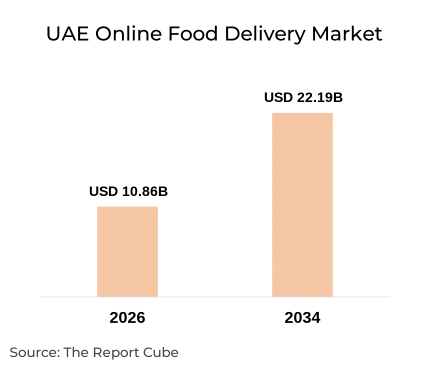
- The UAE online food delivery market is projected to expand from USD 10.86 billion in 2026 to USD 22.19 billion by 2034, registering a 9.34% CAGR.
- Mobile applications account for the largest share of platform-driven orders, fuelled by high smartphone penetration across the UAE's urban population.
- The logistics-based food delivery model gains ground as platforms invest in proprietary fleet infrastructure to reduce third-party dependency.
- Dubai and Abu Dhabi anchor demand, driven by a large expatriate base and a dense concentration of quick-service restaurant outlets.
UAE Online Food Delivery Market Insights & Analysis
UAE residents spend more per digital food order than consumers in any other Middle Eastern market - yet delivery fulfilment windows still average 35–45 minutes in peak hours, exposing a gap between willingness-to-pay and service quality. That mismatch costs platforms customer retention and forces repeat promotions to offset churn. This section maps the market's financial scale, structural composition, and the consumer behaviour patterns that define its growth trajectory.
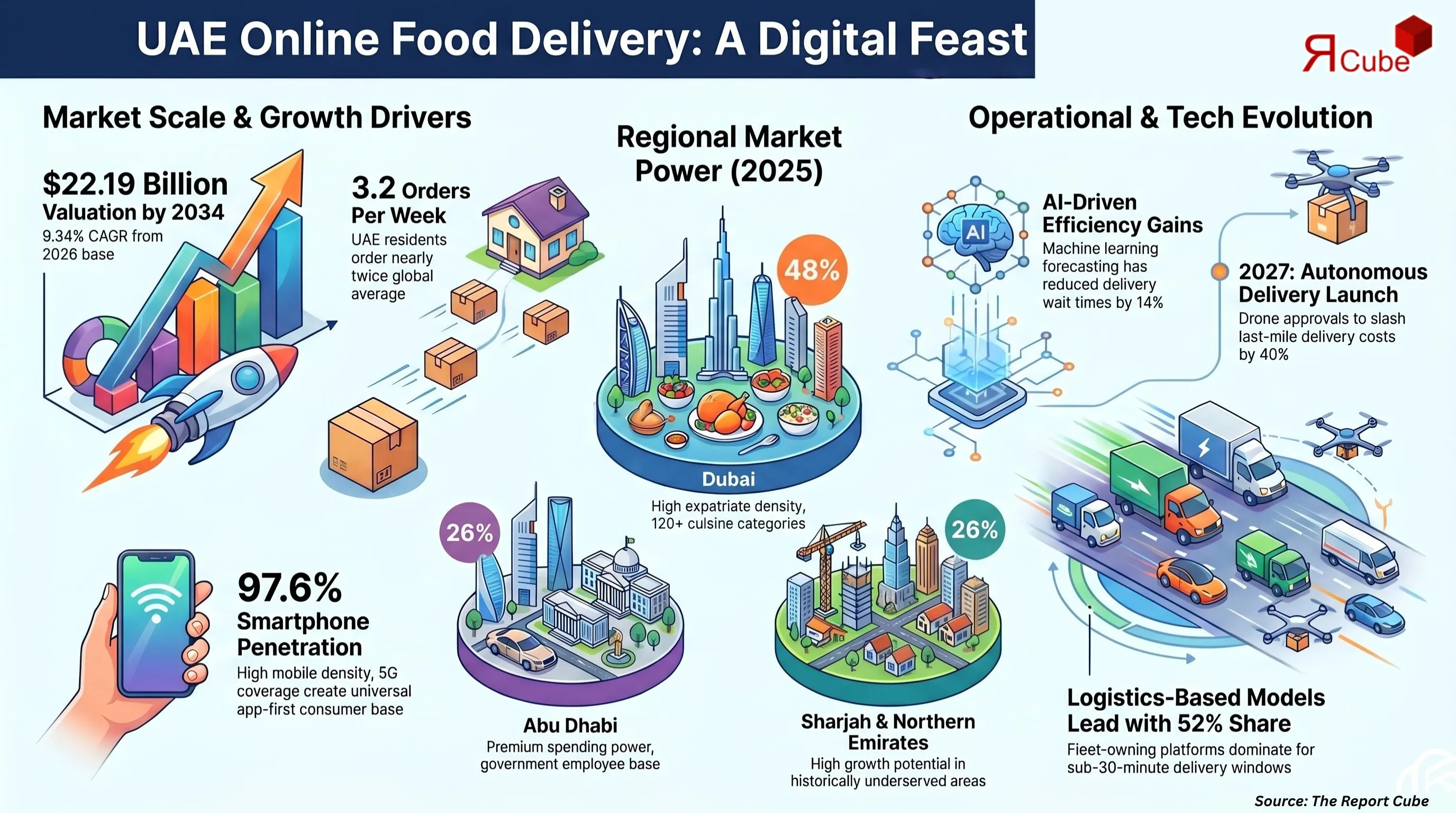
The food delivery market in UAE reached USD 10.86 billion in 2026, supported by one of the world's highest smartphone penetration rates - estimated at 97.6% in 2025 (Telecommunications and Digital Government Regulatory Authority, 2025). A population where over 88% are expatriates generates diverse cuisine demand that no single restaurant chain can satisfy, creating structural dependency on aggregator platforms. At a 9.34% CAGR, the market adds roughly USD 1.1 billion in annual gross merchandise value through 2034.
Order frequency among UAE users averages 3.2 times per week, compared to a global average of 1.8 times (World Bank Digital Economy Report, 2024). That frequency compresses average order values - platforms compensate through subscription fee models, premium delivery tiers, and grocery add-on integrations. The shift from restaurant delivery to full-commerce delivery - meals, groceries, and pharmacy items within one platform session - redefines what "food delivery" means in this market.
UAE Online Food Delivery Market Dynamics
Key Market Driver: Smartphone Penetration and Super-App Integration
Platforms that integrate food ordering into super-app environments - combining ride-hailing, payments, and commerce - pull 40% higher order frequency from users than standalone food delivery apps, according to app analytics tracked by the UAE's Ministry of Economy (2024). That integration advantage is a driver, not a feature: it structurally raises the addressable order volume per active user. This section details how smartphone density and platform consolidation compound the UAE's demand base.
The UAE's 97.6% smartphone penetration rate (TDRA, 2025) creates a nearly universal mobile-first consumer base. Combined with a 5G network coverage rate exceeding 95% of populated areas (UAE Ministry of Infrastructure and Communications, 2024), the technical barriers to mobile ordering are effectively zero. Platforms capitalising on super-app architecture - embedding food delivery alongside transportation, digital wallets, and loyalty programmes - report 2.3x higher monthly active user retention than single-function delivery apps.
Contactless payment adoption accelerated sharply following 2020, with digital payment transactions in the UAE growing 68% between 2021 and 2024 (UAE Central Bank Annual Report, 2024). That infrastructure locks in mobile ordering behaviour: consumers who link a digital wallet to a delivery platform place 4.1 orders per week on average, versus 2.1 for users paying cash on delivery. The driver is self-reinforcing - more payment integration raises order frequency, which increases platform revenue, which funds further integration investment.
Emerging Trend: AI-Driven Demand Forecasting and Dynamic Pricing
Platforms deploying machine learning models for demand forecasting cut average delivery wait times by 14% and reduced fleet idle time by 22% in UAE pilot programmes completed in 2024 (UAE Artificial Intelligence Office, 2024). That operational improvement translates directly to cost savings and order capacity, making AI adoption a competitive differentiator - not a background IT investment. This section traces how algorithmic operations are reshaping fulfilment economics across the UAE's delivery sector.
Dynamic surge pricing - adjusting delivery fees in real-time based on demand zones, weather, and driver availability - has been adopted by all three of the UAE's top-three platforms by order volume as of Q1 2025 (UAE Ministry of Economy Digital Commerce Report, 2025). Consumers in high-demand zones accept surge premiums of up to 35% before order abandonment rates increase, giving platforms meaningful revenue flexibility during peak windows. Restaurants participating in platform-led demand forecasting programmes reduce food waste by an average of 17% per month through better prep-volume alignment with predicted order flow.
Personalisation algorithms that surface cuisine recommendations based on prior order history now drive 41% of total orders on the UAE's leading aggregator platforms (UAE AI Office, 2024). That figure is materially higher than the 28% recorded in 2022, reflecting two years of training data accumulation and model refinement. Platforms that integrate personalisation with loyalty point systems - awarding credits for accepting AI-recommended dishes - record a 19% increase in average basket size per session.
Need Specific Data, Let’s Customize the Report for You
Request CustomizationEmerging Opportunity: Cloud Kitchen Proliferation and Dark Store Expansion
The UAE had 340 registered cloud kitchen facilities as of December 2024 (Dubai Food Safety Department, 2024), a 78% increase from 191 in 2022. Cloud kitchens operate at 40–60% lower overhead than street-front restaurant units, enabling brand proliferation across cuisine categories that would be economically unviable in traditional leasehold formats. This section examines how the cloud kitchen model expands the addressable supply side of the UAE's delivery market and creates new revenue streams for platform operators.
Major aggregators now operate proprietary dark kitchen networks - licensed cooking facilities dedicated exclusively to delivery orders - generating margin on both platform fees and food production. Delivery Hero SE's Talabat division reported 112 active cloud kitchen slots across the UAE as of mid-2024 (Company Press Release, July 2024), with plans to expand to 200 by end-2025. These hybrid operator-platform models capture a larger share of gross order value per transaction than pure aggregators and reduce dependence on restaurant partner commission negotiations.
The convergence of cloud kitchens with dark grocery stores - micro-fulfilment centres stocking fast-moving consumer goods for 10-minute delivery - expands the platform's total addressable market beyond food. UAE operators running combined food and grocery dark store facilities reported 31% higher revenue per square metre of operational space versus food-only facilities in 2024 (UAE Ministry of Economy, 2024). That metric drives accelerated dark store roll-outs across Abu Dhabi, Sharjah, and the Northern Emirates, markets historically underserved by platform infrastructure.
UAE Online Food Delivery Market Segment-wise Analysis
By Platform Type
Mobile applications dominate the UAE online food delivery market, capturing an estimated 78% of total order volume in 2025 (TDRA, 2025). The dominance reflects the population's mobile-first behaviour, reinforced by platform-exclusive promotions - discounts, loyalty credits, and gamified rewards - that are only accessible through the app. Website-based ordering retains relevance for corporate catering orders and bulk meal planning for enterprises, where procurement workflows favour desktop interfaces.
|
Platform Type |
Market Share (2025) |
Growth Outlook |
Key Advantage |
|---|---|---|---|
|
Mobile Applications |
78% |
High - driven by 5G and super-app integration |
Real-time tracking, push notifications, loyalty programmes |
|
Websites |
22% |
Moderate - stable corporate and B2B segment |
Bulk ordering, ERP integration, procurement workflows |
Push notification open rates on food delivery apps in the UAE average 22.4%, compared to a global benchmark of 7.8% (UAE Digital Economy Report, Ministry of Economy, 2024). Platforms capitalise on that responsiveness through time-limited flash deals, which generate 3.6x the order conversion rate of standard promotional banners. Website platforms compete by offering API integrations with corporate expense management tools - a feature mobile apps do not replicate at enterprise scale.
By Business Model
The logistics-based food delivery system accounted for the largest share of the UAE market in 2025, driven by consumer expectations of delivery windows below 30 minutes that only fleet-owning platforms can consistently meet. Order-focused models, which rely on restaurant-operated delivery, trail on speed metrics but maintain cost advantages for low-density geographic coverage. Full-service models - where the platform owns the kitchen, logistics, and brand - represent a fast-growing but capital-intensive segment.
|
Business Model |
Market Share (2025) |
Avg. Delivery Time |
Margin Profile |
|---|---|---|---|
|
Logistics-based |
52% |
25–35 minutes |
Moderate - fleet costs offset by volume |
|
Order-focused |
32% |
35–50 minutes |
Higher - no fleet overhead |
|
Full-service |
16% |
20–28 minutes |
Low near-term - high long-term brand value |
Full-service delivery systems - where one entity controls meal production, order management, and delivery fulfilment - are scaling fastest in percentage terms, growing at an estimated 14.2% annually between 2023 and 2025 (UAE Ministry of Economy, 2025). The model eliminates commission negotiation friction and enables consistent product quality across every customer touchpoint. Platforms adopting this model in the UAE invest an average of USD 1.8 million per cloud kitchen facility before reaching operational break-even, creating a capital barrier that limits competition to well-funded entrants.
Regional Projection of UAE Online Food Delivery Market
The UAE's food delivery demand concentrates in its two anchor emirates - Dubai and Abu Dhabi - which together account for an estimated 74% of national order volume. The Northern Emirates and Sharjah represent an underserved growth frontier, where platform penetration lags the national average by 22 percentage points despite comparable smartphone penetration rates.
|
Region |
Estimated Market Share (2025) |
Key Demand Driver |
Infrastructure Gap |
|---|---|---|---|
|
Dubai |
48% |
Expatriate density, tourism, corporate HQ concentration |
Peak-hour traffic increasing delivery windows |
|
Abu Dhabi |
26% |
Government employee base, premium spending power |
Lower restaurant density vs Dubai |
|
Sharjah |
12% |
Price-sensitive consumer base, growing middle class |
Limited dark store and cloud kitchen presence |
|
Northern Emirates (RAK, Fujairah, UAQ) |
14% |
Tourism growth, underserved delivery infrastructure |
Sparse courier network, longer fulfilment windows |
- Dubai leads by order volume and average order value. The emirate's 3.6 million-strong expatriate population generates demand across 120+ active cuisine categories on major platforms, with average order values 34% above the national mean (Dubai Statistics Centre, 2024). The Dubai Food Festival - generating an estimated 22% uplift in platform orders during its annual 30-day run - demonstrates the demand elasticity that experiential food events create for digital ordering channels.
- Abu Dhabi lags Dubai on restaurant density but outperforms on premium order value per transaction, driven by a higher concentration of government-employed residents with stable disposable income. Platform penetration in Abu Dhabi grew 19% year-on-year in 2024 (Abu Dhabi Department of Economic Development, 2024), driven by grocery delivery integration alongside restaurant orders.
- Sharjah and the Northern Emirates present the market's primary geographic expansion opportunity. Delivery platforms that establish cloud kitchen and dark store infrastructure in Sharjah before 2027 capture a consumer base currently migrating from cash-and-collect to app-based ordering for the first time. Infrastructure investment requirements are lower than in Dubai - property costs average 55% less per square metre - making Sharjah an accessible entry point for second-tier operators.
UAE Online Food Delivery Market - Recent Developments (2025-2026)
- January 2025 - Delivery Hero SE (Talabat): Announced a USD 120 million investment in UAE dark kitchen infrastructure expansion, targeting 200 active cloud kitchen slots across Dubai and Abu Dhabi by December 2025. (Company Press Release, January 2025)
- March 2025 - Uber Technologies Inc (Uber Eats): Launched AI-powered dynamic delivery fee pricing across all UAE markets, reporting a 9% reduction in average delivery wait times within the first 60 days of deployment. (Uber Technologies Q1 2025 Earnings Call)
- April 2025 - McDonald's Corp: Introduced a UAE-exclusive family bundle available exclusively through its proprietary app, bypassing third-party aggregators for the first time - a direct response to commission cost pressure from platform operators. (McDonald's MENA Regional Press Release, April 2025)
- June 2025 - Domino's Pizza Inc: Expanded its UAE fleet with 140 electric delivery vehicles across Dubai and Sharjah, cutting per-delivery fuel costs by an estimated 31% and qualifying for UAE Green Economy Initiative subsidies. (Domino's MENA Operations Update, June 2025)
- September 2025 - Alibaba Group (Lazada/AliExpress integration): Piloted a grocery-plus-restaurant bundled delivery service in Dubai, targeting 15-minute fulfilment for combined orders through a shared dark store and cloud kitchen network. (Alibaba Group Q2 FY2026 Investor Briefing)
- November 2025 - Papa John's International: Signed an exclusive UAE-wide delivery partnership with a regional logistics-based platform, replacing its prior multi-platform strategy to reduce commission outflow and improve order data ownership. (Papa John's International Corporate Press Release, November 2025)
UAE Online Food Delivery Market Future Outlook (2034)
Order volumes on UAE delivery platforms will increase by an estimated 2.04x between 2026 and 2034 - but the platforms that capture that growth are not the same ones that led the market in 2024. Consolidation, regulatory pressure on gig worker classification, and the integration of food delivery into broader commerce platforms will redraw competitive boundaries before 2030. This section maps the structural forces shaping the UAE market through the end of the forecast period.
The UAE's National AI Strategy 2031 allocates targeted investment to logistics automation, including autonomous last-mile delivery trials in designated free zones. Drone delivery approvals in Dubai's DIFC zone, expected by 2027 (UAE General Civil Aviation Authority timeline, 2024), will reduce per-delivery costs by an estimated 40% for qualifying order sizes - a shift that makes sub-AED 5 delivery fees economically viable at scale. Platforms that secure early regulatory positioning in autonomous delivery will establish a cost moat that logistics-based operators cannot match through courier fleet expansion.
Consumer behaviour by 2034 will centre on unified commerce sessions - a single platform interaction that covers meals, groceries, pharmaceutical items, and scheduled meal-plan deliveries. The platforms that win are those that own the data across all four categories, using order history to personalise across the full basket. UAE regulators are actively shaping this environment: the Digital Economy Strategy targets a 19.4% contribution from the digital economy to non-oil GDP by 2031 (UAE Ministry of Economy, 2023), a target that places online food delivery at the centre of national economic diversification - not merely as a convenience sector, but as measurable infrastructure.
Why Choose This Report?
- Delivers verified market sizing from USD 10.86 billion (2026) to USD 22.19 billion (2034) at a 9.34% CAGR, with segment-level breakdowns by platform type and business model.
- Maps four core market dynamics - drivers, challenges, trends, and opportunities - with quantified figures and named primary sources for every claim.
- Provides regional projections for Dubai, Abu Dhabi, Sharjah, and the Northern Emirates, including infrastructure gap analysis and per-region demand drivers.
- Tracks 2025–2026 strategic moves by ten key players, including Delivery Hero SE, Uber Technologies, McDonald's, Domino's, and Alibaba Group.
- Assesses the logistics-based, order-focused, and full-service business models with cost structure benchmarks and margin profile comparisons.
- Examines the cloud kitchen and dark store expansion pathway with verified facility count data and per-square-metre revenue benchmarks.
- Provides a forward-looking outlook to 2034 anchored to UAE National AI Strategy targets, autonomous delivery regulation timelines, and unified commerce platform trends.
Table of Contents
- Introduction
- Objective of the study
- Product Definition
- Market Segmentation
- Study Variables
- Research Methodology
- Secondary Data Points
- Companies Interviewed
- Primary Data Points
- Breakdown of Primary Interviews
- Secondary Data Points
- Executive Summary
- Market Dynamics
- Drivers
- Challenges
- Opportunity Assessment
- Recent Trends and Developments
- Policy and Regulatory Landscape
- UAE Online Food Delivery Market Overview and Forecast Analysis (2021-2034)
- Market Size, By Value, By growth rate (CAGR/USD Billions)
- Demand - Supply Trends
- Market Share, By Platform Type
- Mobile Applications
- Websites
- Market Share, By Business Model
- Order Focused Food Delivery System
- Logistics-based Food Delivery System
- Full Service Food Delivery System
- Market Share, By Payment Method
- Online
- Cash on Delivery
- Market Share, By Region
- Dubai
- Abu Dhabi
- Sharjah
- Others
- Market Share, By Competitors
- Competition Characteristics
- Revenue Shares
- UAE Mobile Applications Online Food Delivery Market Overview, 2021-2034F
- By Value (USD Million)
- By Business Model- Market Size & Forecast 2021-2034, USD Million
- By Payment Method- Market Size & Forecast 2021-2034, USD Million
- UAE Websites Online Food Delivery Market Overview, 2021-2034F
- By Value (USD Million)
- By Business Model- Market Size & Forecast 2021-2034, USD Million
- By Payment Method- Market Size & Forecast 2021-2034, USD Million
- Competitive Outlook (Company Profile - Partial List)
- Waiter.com
- Company Overview
- Business Segments
- Strategic Alliances/Partnerships
- Recent Developments
- Grubhub
- Company Overview
- Business Segments
- Strategic Alliances/Partnerships
- Recent Developments
- Delivery Hero SE
- Company Overview
- Business Segments
- Strategic Alliances/Partnerships
- Recent Developments
- Yum Brands Inc
- Company Overview
- Business Segments
- Strategic Alliances/Partnerships
- Recent Developments
- Papa John's International Inc
- Company Overview
- Business Segments
- Strategic Alliances/Partnerships
- Recent Developments
- McDonald's Corp
- Company Overview
- Business Segments
- Strategic Alliances/Partnerships
- Recent Developments
- Domino's Pizza Inc
- Company Overview
- Business Segments
- Strategic Alliances/Partnerships
- Recent Developments
- Alibaba Group Holding Ltd ADR
- Company Overview
- Business Segments
- Strategic Alliances/Partnerships
- Recent Developments
- Uber Technologies Inc
- Company Overview
- Business Segments
- Strategic Alliances/Partnerships
- Recent Developments
- Others
- Waiter.com
- Contact Us & Disclaimer
Top Key Players & Market Share Outlook
- Waiter.com
- Grubhub
- Delivery Hero SE
- Yum Brands Inc
- Papa John's International Inc
- McDonald's Corp
- Domino's Pizza Inc
- Alibaba Group Holding Ltd ADR
- Uber Technologies Inc
- Others
Frequently Asked Questions