


Build Your Custom Market Intelligence Report
Customize Your ReportKey Takeaways
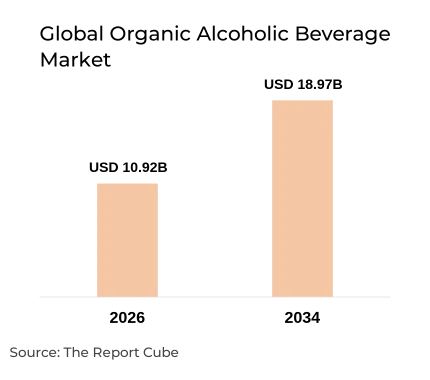
- Organic Alcoholic Beverage Market is valued at USD 10.92 billion in 2026.
- Market is projected to reach USD 18.97 billion by 2034 at a 7.15% CAGR.
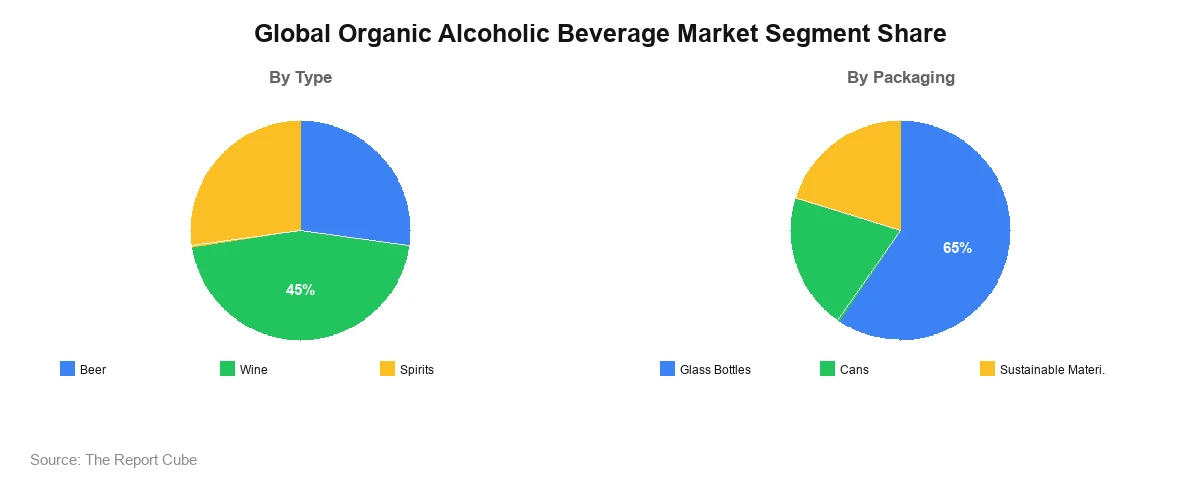
- Wine leads the type segment with an estimated 45% share in 2026.
- Glass bottles lead the packaging segment with an estimated 65% share in 2026.
- Europe is the leading region with an estimated 35% share in 2026.
- Bacardi, Diageo, Heineken, Pernod Ricard and Constellation Brands are among the supplied key players.
- Verifiable organic claims under USDA, EU and JAS certification are an important market theme.
Market Overview
Organic alcoholic beverages are beer, wine and spirits made from agricultural ingredients produced under recognized organic standards and processed within alcohol-specific production and labelling rules. Products are sold through retail shelves, online platforms and on-premise venues, and certification schemes such as USDA Organic, EU Organic and JAS Organic define the claims producers may make.
The Organic Alcoholic Beverage Market is valued at USD 10.92 billion in 2026 and is projected to reach USD 18.97 billion by 2034. Demand is shaped by formal certification frameworks, including USDA and Alcohol and Tobacco Tax and Trade Bureau requirements in the United States and European Commission rules for organic wine. Europe holds an estimated 35% share in 2026.
Health-conscious consumers, environmentalists and luxury drinkers form the supplied target audiences, with verified organic claims and sustainable packaging influencing product selection. This Organic Alcoholic Beverage Market Analysis shows a structure led by wine and glass bottles, while the market is projected to grow at a CAGR of 7.15% during 2026–2034.
Global Organic Alcoholic Beverage Market Dynamics
Organic Alcoholic Beverage Market Growth depends on certification frameworks, labelling compliance, production standards and consumer attention to verified organic claims. Regulation shapes supply and pricing, while public-health guidance limits how producers can position products. These sources describe operating conditions, not the supplied forecast.
|
Factor |
Type |
Specific Impact on Market |
Magnitude |
|---|---|---|---|
|
Formal organic certification frameworks |
Driver |
Provides a defined route to compliant organic claims under USDA and TTB requirements |
Medium–High (qualitative) |
|
Organic wine production rules |
Driver |
Supports verified differentiation of certified organic wine in the European framework |
Medium (qualitative) |
|
Certified organic and export-ready products |
Opportunity |
Allows producers to prepare traceability, documentation and labelling for destination markets |
Medium (qualitative) |
|
Labelling and certification complexity |
Challenge |
Adds review, documentation and ingredient-threshold compliance work for producers and importers |
Medium–High (qualitative) |
|
Alcohol-related health risks |
Challenge |
Restricts health-oriented positioning of organic alcoholic beverages |
Medium (qualitative) |
|
Verifiable organic claims |
Trend |
Increases the importance of traceable ingredients and compliant label information |
High (qualitative) |
Global Organic Alcoholic Beverage Market Growth Drivers
Formal certification frameworks give producers a defined route to organic claims. According to the U.S. Department of Agriculture, organic alcoholic beverages must meet applicable USDA organic requirements alongside Alcohol and Tobacco Tax and Trade Bureau regulations. These rules establish compliance conditions rather than consumer demand, but they support credible differentiation for beer, wine and spirits sold with organic labels.
Established production rules for organic wine add a second driver. The European Commission specifies that organic wine must be made from organic grapes and yeast and follow additional winemaking restrictions. This gives wine producers a recognized standard for verified differentiation, which is relevant because wine is the leading type segment with an estimated 45% share in 2026.
Global Organic Alcoholic Beverage Market Opportunities
Producers can evaluate organic beer, wine and spirits for markets where they can meet production, certification and labelling requirements. USDA and European Union frameworks provide defined pathways for compliant organic claims, although they do not guarantee consumer demand or commercial success. Health-conscious consumers, environmentalists and luxury drinkers represent the supplied audience groups for such products.
Businesses can strengthen ingredient traceability, documentation and label review processes to prepare for organic requirements in destination markets. USDA guidance notes that organic alcohol labels must meet certification and Alcohol and Tobacco Tax and Trade Bureau requirements, while trade arrangements may impose destination-specific labelling conditions, making export readiness a practical area for investment.
Global Organic Alcoholic Beverage Industry Challenges
Organic labelling and certification requirements add compliance work. USDA and Alcohol and Tobacco Tax and Trade Bureau rules distinguish among organic label categories, ingredient thresholds and sulfite conditions, and labels require applicable review. Producers and importers seeking to market organic claims in the United States must therefore manage documentation, ingredient sourcing and label approval alongside production.
Alcohol-related health risks constrain how products can be positioned. The World Health Organization identifies alcohol as a psychoactive, toxic and dependence-producing substance and states that even low levels of consumption carry health risks. Organic certification does not remove these risks, so companies must avoid implying that organic alcoholic beverages are inherently safer or healthier.
Need Specific Data, Let’s Customize the Report for You
Request CustomizationGlobal Organic Alcoholic Beverage Market Trends
Organic Alcoholic Beverage Market Trends point toward greater emphasis on verifiable organic claims. USDA guidance requires applicable claims to meet certification and labelling standards, with review by certifying agents and the Alcohol and Tobacco Tax and Trade Bureau, which makes traceable ingredients and compliant label information important operating considerations for producers marketing organic alcohol in the United States.
Organic winemaking standards are also becoming more clearly defined. European Commission rules cover organic grapes and yeast and restrict certain winemaking practices, creating a regulatory basis for distinguishing certified organic wine from products that rely on sustainability-oriented marketing language. Packaging is a related area, with glass bottles holding an estimated 65% share in 2026 alongside cans and sustainable materials.
Organic Alcoholic Beverage Market Segment Analysis
Segmentation of the Organic Alcoholic Beverage Market covers type, packaging, certification, target audience and distribution channel. Organic Alcoholic Beverage Market Share is reported below only where supplied, and the remaining categories require validation before publication.
By Type
- Beer
- Wine
- Spirits
Wine leads the By Type segment with an estimated 45% share in 2026, supported by European Commission organic winemaking rules covering organic grapes and yeast, which give producers a recognized basis for verified differentiation. Beer follows, with brewers such as Heineken N.V., Kirin Holdings Company Limited and The Boston Beer Company Inc. operating within the broader category. Spirits represent the third segment, with Bacardi Limited, Diageo plc and Pernod Ricard active in the wider spirits category. Demand across all three types depends on compliance with USDA organic requirements and Alcohol and Tobacco Tax and Trade Bureau rules in the United States, as well as consumer attention to verified organic claims. The supplied data do not identify a fastest-growing type, and organic-specific company volumes require validation.
By Packaging
- Glass Bottles
- Cans
- Sustainable Materials
Glass bottles lead the By Packaging segment with an estimated 65% share in 2026, reflecting the established use of glass for wine and spirits and its association with premium presentation. Cans follow as a lighter, portable format suited to beer and ready-to-drink styles, supported by convenience-led retail and on-premise channels. Sustainable materials form the third segment and align with the environmental priorities of consumers who prefer reduced-impact packaging. Demand for each format depends on beverage type, retail channel and brand positioning, while organic labelling rules apply regardless of the container used. The supplied data do not identify a fastest-growing packaging format, so growth differences require validation.
Regional Analysis
The Organic Alcoholic Beverage Market is assessed across North America, South America, Europe, the Middle East & Africa and Asia-Pacific. Only the Europe share was supplied; other regional shares are not shown to avoid unsupported estimates.
|
Region |
Estimated Market Share |
Key Growth Factors |
Industry Trends |
|---|---|---|---|
|
North America |
- |
USDA organic requirements and TTB labelling rules for organic alcohol |
Emphasis on compliant labels and traceable ingredients |
|
South America |
- |
Regional growth factors not supplied |
Requires validation |
|
Europe |
35% (2026) |
European Commission organic wine production rules |
Clearer separation of certified organic wine from sustainability marketing claims |
|
Middle East & Africa |
- |
Regional growth factors not supplied |
Requires validation |
|
Asia-Pacific |
- |
JAS Organic certification relevant in applicable markets |
Requires validation |
Europe is the leading region with an estimated 35% share in 2026. The European Commission’s organic wine rules, which require organic grapes and yeast and restrict certain winemaking practices, provide a defined production framework that supports differentiation of certified organic wine for producers and importers operating across the region’s national markets.
North America is anchored by the USDA organic framework and Alcohol and Tobacco Tax and Trade Bureau rules, which govern labelling and certification for organic alcohol sold in the United States. Asia-Pacific includes markets where JAS Organic certification is relevant, while South America and the Middle East & Africa have no supplied share data and require validation.
Market Share & Competitive Landscape
The Organic Alcoholic Beverage Market includes global spirits groups, brewers, wine producers and independent craft brewers. The table summarizes the supplied companies by general capability and does not represent numerical market share. Organic-specific portfolios and regional sales require validation.
|
Company |
Competitive Strength |
Primary Segment Served |
|---|---|---|
|
Bacardi Limited |
Global spirits portfolio and international distribution |
Spirits |
|
Constellation Brands |
Diversified beverage alcohol portfolio spanning wine, beer and spirits |
Wine, beer and spirits |
|
Diageo plc |
Large-scale global spirits portfolio and distribution network |
Spirits |
|
E. & J. Gallo Winery |
Large-scale wine production and distribution |
Wine |
|
Heineken N.V. |
Multinational brewing operations and distribution reach |
Beer |
|
Kirin Holdings Company Limited |
Japan-based beverage group with brewing operations |
Beer |
|
MillerCoors |
Large U.S. brewing operations and distribution |
Beer |
|
Pernod Ricard |
Global spirits and wine portfolio |
Spirits and wine |
|
Sierra Nevada Brewing Co. |
Independent U.S. craft brewing |
Beer |
|
The Boston Beer Company Inc. |
U.S. brewer with a multi-brand beer portfolio |
Beer |
Key Companies in the Organic Alcoholic Beverage Market
Diageo plc: Diageo plc is headquartered in London, United Kingdom, and operates as a global spirits and beverage alcohol company with a portfolio sold in markets worldwide. Organic-specific activity during 2024–2025 could not be verified for this report. Its relevance rests on scale in spirits, one of the three supplied type segments.
Heineken N.V.: Heineken N.V. is headquartered in Amsterdam, Netherlands, and operates as a multinational brewer with a presence across many countries. Organic-specific activity during 2024–2025 could not be verified for this report. Its relevance lies in brewing scale within beer, one of the three supplied type segments.
Market Future Outlook
The Organic Alcoholic Beverage Market Forecast indicates expansion from USD 10.92 billion in 2026 to USD 18.97 billion by 2034 at a CAGR of 7.15%, based on supplied estimates. Growth is expected to depend on producers’ ability to meet certification and labelling requirements, expand verified organic ranges across beer, wine and spirits, and align packaging and distribution with consumer preferences in online, retail and on-premise channels.
Risks include complex labelling rules, destination-specific export conditions and public-health considerations, since the World Health Organization states that even low levels of alcohol consumption carry health risks. Companies will need to avoid implying that organic products are inherently healthier. The projected values remain supplied assumptions, and actual outcomes depend on regulation, supplier execution, consumer demand, certification access and market conditions.
Organic Alcoholic Beverage Market Report Coverage
This Organic Alcoholic Beverage Market Report summarizes the supplied valuation, forecast assumptions, segmentation, regional framework and competitive ecosystem.
|
Parameter |
Details |
|---|---|
|
Market Name |
Organic Alcoholic Beverage Market |
|
Market Size 2026 |
USD 10.92 billion |
|
Market Size 2034 |
USD 18.97 billion |
|
Forecast Period |
2026–2034 |
|
CAGR |
7.15% |
|
Base Year |
2026 |
|
Historical Years |
2021-2025 |
|
Forecast Years |
2026–2034 |
|
Segments Covered |
By Type; By Packaging; By Certification; By Target Audience; By Distribution Channel |
|
Regions Covered |
North America, South America, Europe, Middle East & Africa, Asia-Pacific |
|
Key Companies |
Bacardi Limited, Constellation Brands, Diageo plc, E. & J. Gallo Winery, Heineken N.V., Kirin Holdings Company Limited, MillerCoors, Pernod Ricard, Sierra Nevada Brewing Co., The Boston Beer Company Inc. |
|
Customization |
Available as per client requirements |
Why Choose This Organic Alcoholic Beverage Market Report?
- Market coverage of organic beer, wine and spirits across retail, online and on-premise channels.
- Clear presentation of the supplied 2026 valuation, 2034 forecast and 7.15% CAGR.
- Segmentation across type, packaging, certification, target audience and distribution channel.
- Regional framework covering North America, South America, Europe, Middle East & Africa and Asia-Pacific.
- Competitive profiling of ten supplied beverage alcohol producers and brewers.
- Trend insights on organic certification, labelling compliance and verifiable organic claims.
- Regulatory context drawn from USDA, European Commission and World Health Organization sources.
Table of Contents
- Introduction
- Objective of the Study
- Product Definition
- Market Segmentation
- Study Variables
- Research Methodology
- Secondary Data Points
- Companies Interviewed
- Primary Data Points
- Breakdown of Primary Interviews
- Secondary Data Points
- Executive Summary
- Market Dynamics
- Drivers
- Challenges
- Opportunity Assessment
- Recent Trends and Developments
- Policy and Regulatory Landscape
- Global Organic Alcoholic Beverage Market Overview and Forecast Analysis (2021-2034)
- Market Size, By Value, By Growth Rate (CAGR/USD Billions)
- Demand – Supply Trends
- Market Share, By Type
- Beer
- Wine
- Spirits
- Market Share, By Packaging
- Glass Bottles
- Cans
- Sustainable Materials
- Market Share, By Certification
- USDA Organic
- EU Organic
- JAS Organic
- Market Share, By Target Audience
- Health-Conscious Consumers
- Environmentalists
- Luxury Drinkers
- Market Share, By Distribution Channel
- Online Retailers
- Supermarkets and Hypermarkets
- Bars and Restaurants
- Market Share, By Region
- North America
- South America
- Europe
- The Middle East & Africa
- Asia-Pacific
- Market Share, By Competitors
- Competition Characteristics
- Revenue Shares
- Beer Global Organic Alcoholic Beverage Market Overview, 2021-2034F
- By Value (USD Million)
- By Packaging – Market Size & Forecast 2021-2034, USD Million
- Glass Bottles
- Cans
- Sustainable Materials
- Wine Global Organic Alcoholic Beverage Market Overview, 2021-2034F
- By Value (USD Million)
- By Packaging – Market Size & Forecast 2021-2034, USD Million
- Glass Bottles
- Cans
- Sustainable Materials
- Spirits Global Organic Alcoholic Beverage Market Overview, 2021-2034F
- By Value (USD Million)
- By Packaging – Market Size & Forecast 2021-2034, USD Million
- Glass Bottles
- Cans
- Sustainable Materials
- Competitive Outlook (Company Profile – Partial List)
- Bacardi Limited
- Company Overview
- Business Segments
- Strategic Alliances/Partnerships
- Recent Developments
- Constellation Brands
- Company Overview
- Business Segments
- Strategic Alliances/Partnerships
- Recent Developments
- Diageo plc
- Company Overview
- Business Segments
- Strategic Alliances/Partnerships
- Recent Developments
- E. & J. Gallo Winery
- Company Overview
- Business Segments
- Strategic Alliances/Partnerships
- Recent Developments
- Heineken N.V.
- Company Overview
- Business Segments
- Strategic Alliances/Partnerships
- Recent Developments
- Kirin Holdings Company Limited
- Company Overview
- Business Segments
- Strategic Alliances/Partnerships
- Recent Developments
- MillerCoors
- Company Overview
- Business Segments
- Strategic Alliances/Partnerships
- Recent Developments
- Pernod Ricard
- Company Overview
- Business Segments
- Strategic Alliances/Partnerships
- Recent Developments
- Sierra Nevada Brewing Co.
- Company Overview
- Business Segments
- Strategic Alliances/Partnerships
- Recent Developments
- The Boston Beer Company Inc.
- Company Overview
- Business Segments
- Strategic Alliances/Partnerships
- Recent Developments
- Bacardi Limited
- Contact Us & Disclaimer
Top Key Players & Market Share Outlook
- Bacardi Limited
- Constellation Brands
- Diageo plc
- E. & J. Gallo Winery
- Heineken N.V.
- Kirin Holdings Company Limited
- MillerCoors
- Pernod Ricard
- Sierra Nevada Brewing Co.
- The Boston Beer Company Inc.
Frequently Asked Questions