


Build Your Custom Market Intelligence Report
Customize Your ReportKey Highlights
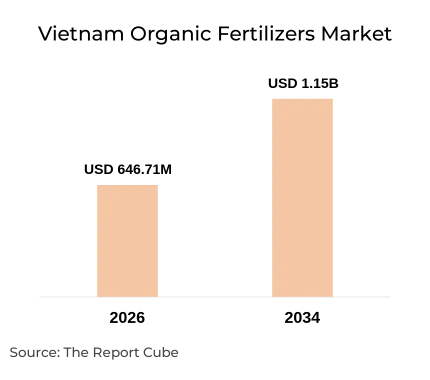
- The Vietnam Organic Fertilizers Market is estimated at USD 646.71 million in 2026.
- The market is projected to reach USD 1,147.30 million by 2034.
- Expected CAGR is 7.43% during 2026–2034.
- Organic residues lead the product segment with an estimated 63.20% share in 2026.
- The Mekong Delta leads regional demand with an estimated 31.00% share in 2026.
- Government programmes promoting organic fertilizer production and agricultural waste recycling are the major growth driver.
- Competition includes established fertilizer manufacturers, specialist microbial producers and waste-management firms such as Que Lam Group, Song Gianh Corporation, PVFCCo and BIWASE.
Market Outlook
The Vietnam Organic Fertilizers Market covers fertilizers made from plant residues, animal manure, compost and beneficial microorganisms. These products improve soil organic matter and nutrient availability, supporting sustainable production across rice, horticulture and plantation crops. The market includes conventional organic fertilizers, organic-mineral blends and microbial-enriched biofertilizers.
Vietnam’s agriculture offers abundant rice straw, livestock manure, crop residues and processing waste, which manufacturers can convert into commercial fertilizer. Demand comes from rice cultivation, fruit and vegetable growers, and coffee, pepper, tea and cashew producers. Government support for circular agriculture and better fertilizer management encourages domestic production and product differentiation, including liquid and crop-specific formulations.
The Vietnam Organic Fertilizers Market is estimated at USD 646.71 million in 2026 and is forecast to reach USD 1,147.30 million by 2034, a CAGR of 7.43%. Growth depends on sustainable farming adoption, domestic manufacturing and soil-improvement demand, while farmer awareness, quality consistency, pricing and distribution efficiency shape uptake. Established manufacturers and specialist microbial producers will compete on formulation quality and dealer reach.
Government Regulations
Vietnam’s government has introduced a development programme through 2030 that encourages the use of agricultural residues, livestock waste and other organic materials for fertilizer production, and it promotes wider application of organic fertilizers in farming. Fertilizer production, registration and distribution are governed by national fertilizer management regulations, a framework documented in the FAO’s FAOLEX database Manufacturers must meet requirements for product registration, quality control and labelling, which raises operating standards for smaller producers. These measures favour companies with laboratory testing, standardised formulations and compliant distribution networks. At the same time, support for waste recycling and circular agriculture lowers barriers for investors in composting, fermentation and microbial fertilizer plants. Companies able to document quality and regulatory compliance are best positioned to benefit from policy support.
Vietnam Organic Fertilizers Market Dynamics
The Vietnam Organic Fertilizers Market is shaped by sustainability initiatives, availability of organic raw materials, changing fertilizer practices and growing domestic manufacturing capability. Policy support for waste recycling creates opportunities, while competition from chemical fertilizers and quality inconsistency can slow adoption.
|
Factor |
Type |
Specific Impact on Market |
Magnitude |
|---|---|---|---|
|
Government organic fertilizer programmes |
Driver |
Supports domestic production capacity and wider use |
High |
|
Availability of agricultural waste |
Driver |
Provides local raw materials for compost and microbial products |
Medium–High |
|
Export-oriented crop production |
Opportunity |
Creates demand for crop-specific organic formulations |
Medium |
|
Competition from chemical fertilizers |
Challenge |
Concentrated nutrients and established distribution slow switching |
High |
|
Product quality consistency |
Challenge |
Variable composition affects farmer confidence |
Medium–High |
|
Circular agriculture and microbial formulations |
Trend |
Drives waste-to-fertilizer models and biofertilizer growth |
Medium–High |
Growth Drivers: Government Initiatives Supporting Organic Fertilizer Production
Vietnam’s government has launched initiatives to raise organic fertilizer output and promote its use across agriculture. The development programme through 2030 encourages using agricultural residues and livestock waste as manufacturing inputs. These measures support domestic capacity, improve availability of commercial products and motivate agricultural enterprises to adopt sustainable nutrient management, creating opportunities for investors in processing and microbial formulations.
Market Opportunities: Demand from Export-Oriented Agricultural Production
Rice, coffee, pepper, cashew, tea and tropical fruit industries give manufacturers scope to develop crop-specific organic fertilizer solutions. Export-oriented production needs effective soil management and consistent crop quality. Suppliers can offer tailored formulations and application guidance, and partnerships with agricultural cooperatives and commercial farms can accelerate product adoption and strengthen long-term customer relationships.
Industry Challenges: Competition from Conventional Chemical Fertilizers
Chemical fertilizers remain important because of concentrated nutrient content, established distribution and rapid nutrient availability. Organic products need different application practices and longer periods to show gains in soil organic matter. Farmers prioritizing immediate yields and predictable costs may hesitate, so manufacturers must demonstrate agronomic and economic benefits to improve competitiveness and win broader acceptance.
Need Specific Data, Let’s Customize the Report for You
Request CustomizationMarket Trends: Growing Adoption of Circular Agricultural Production
Converting agricultural residues and livestock waste into usable fertilizer is becoming a key development area in Vietnam. Circular models connect farms, livestock operators, waste-processing facilities and manufacturers, supporting localized supply chains. They also create opportunities for industrial composting and waste-to-fertilizer technologies, helping producers improve resource use while reducing the burden of unmanaged agricultural waste.
Vietnam Organic Fertilizers Market Segment Analysis
The Vietnam Organic Fertilizers Market is segmented by product type, product subsegment, form and application. Regional segmentation is covered in the regional analysis. Segment shares below are supplied 2026 estimates.
By Product Type
- Organic Residues
- Biofertilizers
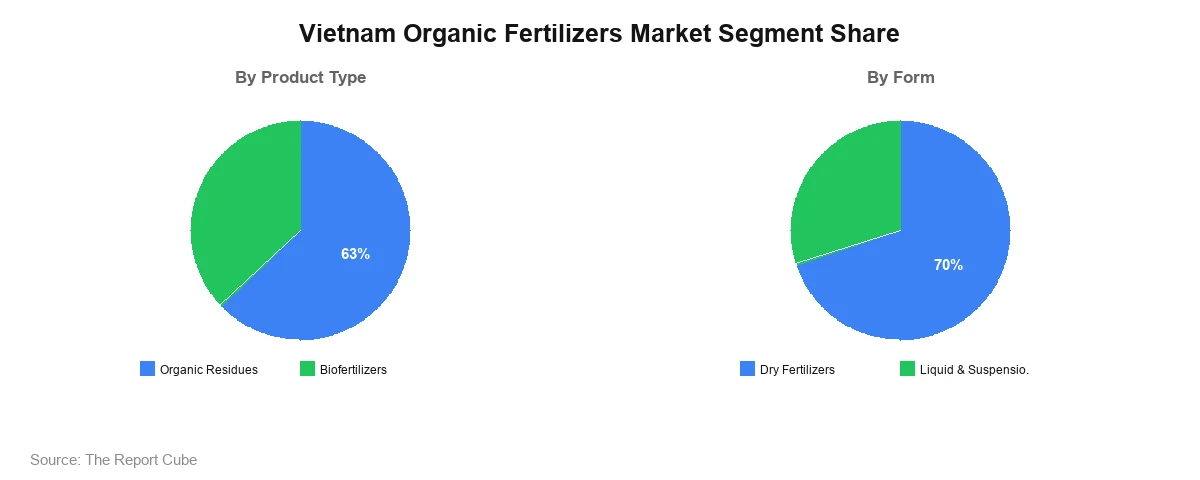
Organic residues lead with an estimated 63% share in 2026, supported by the availability of manure, crop residues and compostable waste and their established role in soil organic matter management. Their share is expected to ease as microbial products gain traction. Biofertilizers, the second segment, are projected to grow faster, driven by interest in biological nutrient management and nitrogen-fixing and nutrient-absorption-enhancing formulations. Both segments are commercially important, serving rice, horticulture and plantation crops.
By Form
- Dry Fertilizers (Granules, Powder & Pellets)
- Liquid & Suspension Concentrates
Dry fertilizers lead with an estimated 70% share in 2026, reflecting their suitability for conventional soil application, storage and transport. Granules, powders and pellets fit established fertilizer distribution systems and serve varied agricultural requirements. Liquid and suspension concentrates are the second segment and are expected to grow faster, supported by horticulture, fertigation and specialized nutrient application. Manufacturers are likely to focus on formulation stability and application efficiency to expand liquid product adoption.
Vietnam Organic Fertilizers Market Regional Analysis
Regional demand in the Vietnam Organic Fertilizers Market reflects crop concentration, farming practices and availability of organic raw materials. The Mekong Delta leads, while the Central Highlands benefits from coffee and pepper cultivation. Shares below are supplied 2026 estimates.
|
Region |
Estimated Market Share |
Key Growth Factors |
Industry Trends |
|---|---|---|---|
|
Northern Vietnam |
20% |
Rice, vegetables, fruit and livestock activity |
Localized compost production |
|
North Central & Central Coast |
- |
Soil-quality improvement for rice, vegetables and fruit |
Crop-specific formulations for cooperatives |
|
Central Highlands |
- |
Coffee, pepper and plantation crops |
Demand for microbial and specialized products |
|
Southeast Vietnam |
- |
Commercial horticulture and logistics infrastructure |
Organized distribution to commercial farms |
|
Mekong Delta |
- |
Rice, fruit and agricultural processing |
Waste recycling and local manufacturing |
Northern Vietnam: Northern Vietnam generates demand through rice, vegetable and fruit cultivation and livestock activity. Available agricultural and livestock waste creates potential for localized compost and organic fertilizer production. Soil-improvement needs and rising interest in sustainable practices are expected to support adoption, offering manufacturers opportunities to build regional supply chains that link farms, livestock operators and processing facilities for steady raw-material supply.
Competitive Landscape
The Vietnam Organic Fertilizers Market includes established fertilizer manufacturers, specialist organic producers and companies developing biological inputs. Competition is shaped by product quality, manufacturing capacity, microbial formulation technology, distribution networks and ties to agricultural cooperatives. No verified company-level market-share ranking is available.
|
Company |
Competitive Strength |
Primary Segment Served |
|---|---|---|
|
Que Lam Group |
Organic fertilizer specialization |
Organic microbial fertilizers |
|
Song Gianh Corporation |
Organic and microbial product portfolio |
Biological and organic fertilizers |
|
PVFCCo |
Established manufacturing and distribution |
Phu My Organic products |
|
Binh Dien Fertilizer |
Established agricultural dealer network |
Dau Trau fertilizer portfolio |
|
Baconco |
Fertilizer manufacturing experience |
Agricultural fertilizer products |
|
BIWASE |
Waste management and resource recovery |
Organic waste processing and compost |
PetroVietnam Fertilizer and Chemicals Corporation (PVFCCo): PVFCCo is an established Vietnamese fertilizer manufacturer operating under the Phu My brand. Its portfolio includes organic fertilizer products such as Phu My Organic formulations. Long manufacturing experience and an extensive distribution infrastructure give it a competitive advantage in reaching farmers nationwide..
Song Gianh Corporation: Song Gianh Corporation manufactures fertilizers, including organic and microbial formulations containing organic matter, humic substances and beneficial microorganisms. Its product development activities support participation in the organic segment, and its microbial focus positions it to address growing demand for biological nutrient management..
Recent Developments and Updates
- June 2025: Vietnam’s organic fertilizer production capacity was reported at approximately 4.7 million tonnes annually, indicating expansion of manufacturing infrastructure that supports domestic supply of organic fertilizer products (reported by Nhan Dan).
- End of 2025: Organic fertilizer capacity was reported at approximately 5 million tonnes annually, strengthening domestic supply potential and supporting wider commercial availability for farmers (reported by Nhan Dan).
- 2026: Government reporting highlighted organic fertilizer production facilities and product availability, supporting industry formalization. Details of individual announcements require verification against original official publications.
Vietnam Organic Fertilizers Market Future Outlook
The Vietnam Organic Fertilizers Market is expected to expand through 2034, supported by interest in sustainable production, agricultural waste utilization and domestic manufacturing. Microbial-enriched, liquid and crop-specific formulations should drive differentiation, with fruits and vegetables and biofertilizers growing faster than the market as a whole. The market is projected to reach USD 1,147.30 million by 2034.
Government initiatives are expected to remain central, while manufacturers focus on quality, capacity and partnerships with cooperatives and commercial farms. Adoption will depend on cost-effective products with consistent performance. Competition from chemical fertilizers, farmer awareness and reliable raw-material supply will influence the pace of growth. The forecast is an analytical scenario, sensitive to policy, input prices and investment.
Vietnam Organic Fertilizers Market Report Coverage
This report summarizes supplied valuation, forecast, segmentation, regional framework and competitive ecosystem for the Vietnam Organic Fertilizers Market, with estimates identified as supplied.
|
Parameter |
Details |
|---|---|
|
Market Name |
Vietnam Organic Fertilizers Market |
|
Market Size (Base Year) |
USD 646.71 Million |
|
Market Size (Forecast Year) |
USD 1,147.30 Million |
|
CAGR |
7.43% |
|
Base Year |
2026 |
|
Historical Period |
2021–2025 |
|
Forecast Period |
2026–2034 |
|
Geographic Scope |
Vietnam |
|
Segmentation |
Product Type, Product Subsegment, Form, Application |
|
Regions Covered |
Northern Vietnam, North Central & Central Coast, Central Highlands, Southeast Vietnam |
|
Key Companies |
Que Lam Group, Song Gianh Corporation, PVFCCo, Binh Dien Fertilizer, Baconco, BIWASE |
|
Customization |
Available as per requirement |
Why Choose This Vietnam Organic Fertilizers Market Report?
- Presents the 2026 valuation, 2034 forecast and 7.43% CAGR with stated assumptions.
- Segments the market by product type, subsegment, form and application.
- Reviews drivers, opportunities, challenges and trends with a dynamics table.
- Provides regional assessment across five Vietnamese regions with supplied shares.
- Profiles key companies by capability and primary segment served.
- Highlights opportunities in biofertilizers, liquid formulations and waste-to-fertilizer models.
- Supports investment, product development and distribution decisions for manufacturers.
Table of Contents
- Introduction
- Objective of the Study
- Product Definition
- Market Segmentation
- Study Variables
- Research Methodology
- Secondary Data Points
- Companies Interviewed
- Primary Data Points
- Breakdown of Primary Interviews
- Secondary Data Points
- Executive Summary
- Market Dynamics
- Drivers
- Challenges
- Opportunity Assessment
- Recent Trends and Developments
- Policy and Regulatory Landscape
- Vietnam Organic Fertilizers Market Overview and Forecast Analysis (2021-2034)
- Market Size, By Value, By Growth Rate (CAGR/USD Millions)
- Demand – Supply Trends
- Market Share, By Product Type
- Organic Residues
- Farmyard Manure
- Crop Residues
- Green Manure
- Compost
- Other Organic Residues
- Biofertilizers
- Azotobacter
- Rhizobium
- Azospirillum
- Blue-Green Algae
- Azolla
- Mycorrhiza
- Other Biofertilizers
- Organic Residues
- Market Share, By Form
- Dry Fertilizers
- Liquid Fertilizers
- Market Share, By Application
- Grains and Cereals
- Fruits and Vegetables
- Oilseeds and Pulses
- Turf and Ornamentals
- Other Crops
- Market Share, By Region
- Northern Vietnam
- North Central and Central Coast
- Central Highlands
- Southeast Vietnam
- Market Share, By Competitors
- Competition Characteristics
- Revenue Shares
- Organic Residues Vietnam Organic Fertilizers Market Overview, 2021-2034F
- By Value (USD Million)
- By Form – Market Size & Forecast 2021-2034, USD Million
- Dry Fertilizers
- Liquid Fertilizers
- Biofertilizers Vietnam Organic Fertilizers Market Overview, 2021-2034F
- By Value (USD Million)
- By Form – Market Size & Forecast 2021-2034, USD Million
- Dry Fertilizers
- Liquid Fertilizers
- Competitive Outlook (Company Profile – Partial List)
- Que Lam Group
- Company Overview
- Business Segments
- Strategic Alliances/Partnerships
- Recent Developments
- Song Gianh Corporation
- Company Overview
- Business Segments
- Strategic Alliances/Partnerships
- Recent Developments
- PVFCCo
- Company Overview
- Business Segments
- Strategic Alliances/Partnerships
- Recent Developments
- Binh Dien Fertilizer
- Company Overview
- Business Segments
- Strategic Alliances/Partnerships
- Recent Developments
- Baconco
- Company Overview
- Business Segments
- Strategic Alliances/Partnerships
- Recent Developments
- BIWASE
- Company Overview
- Business Segments
- Strategic Alliances/Partnerships
- Recent Developments
- Que Lam Group
- Contact Us & Disclaimer
Top Key Players & Market Share Outlook
- Que Lam Group
- Song Gianh Corporation
- PVFCCo
- Binh Dien Fertilizer
- Baconco
- BIWASE
Frequently Asked Questions