



Build Your Custom Market Intelligence Report
Customize Your ReportGCC Paper Bag Market Size, Share, Trends & Forecast 2026-2034
Key Takeaways:
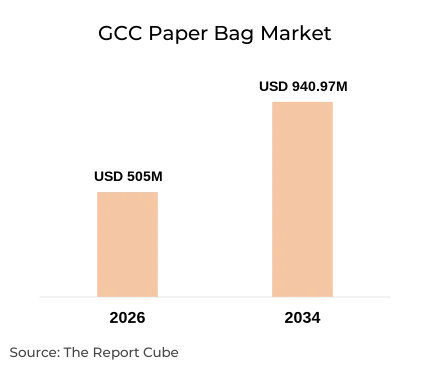
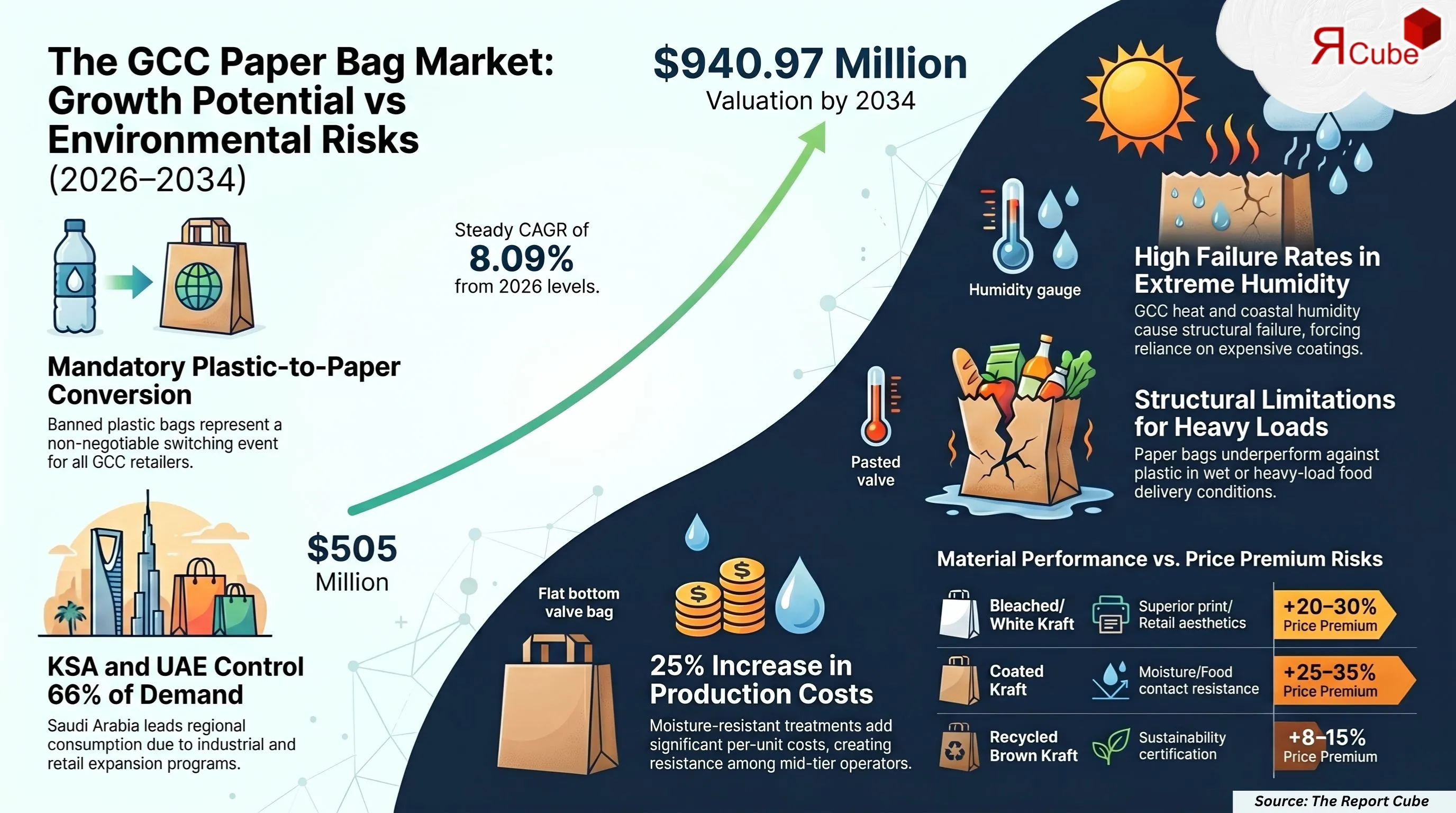
- The GCC Paper Bag Market is projected to grow from USD 505 million in 2026 to USD 940.97 million by 2034, at a CAGR of 8.09%.
- Kraft paper bags dominate material demand, with brown kraft and recycled brown kraft segments capturing the highest combined volume share.
- Saudi Arabia and the UAE collectively account for the majority of regional consumption, supported by expanding retail, food service, and pharmaceutical sectors.
- GCC-wide single-use plastic bans and Vision 2030-aligned sustainability mandates are the primary regulatory forces accelerating adoption of paper-based packaging.
GCC Paper Bag Market Insights & Analysis
Paper bags are no longer a secondary packaging choice in the GCC, they are now a compliance requirement. Regulatory pressure across all six member states, combined with a surge in organized retail and food delivery infrastructure, means paper bag demand is being driven by two forces at once: government mandates eliminating plastic alternatives, and a consumer base that has shifted expectations toward visible sustainability. The GCC Paper Bag Market is forecast to grow at 8.09% CAGR between 2026 and 2034, reaching USD 940.97 million, a trajectory that reflects structural demand rather than cyclical growth.
Saudi Arabia's Vision 2030 program has directly accelerated packaging localization, prompting investment in domestic paper bag manufacturing and reducing import dependency across the Kingdom. The UAE's plastic reduction roadmap, enforced since 2024, has pushed food and beverage retailers, pharmacies, and supermarkets toward kraft-based alternatives at scale. Qatar, Bahrain, and Kuwait are following with phased bans of their own, expanding the addressable market across the entire region by 2027.
Simultaneously, the GCC's e-commerce sector, growing at double-digit rates, is amplifying demand for flat-bottom and pasted valve bags suited to bulk and direct-to-consumer fulfilment. The combination of policy-driven substitution and channel-driven volume growth positions this market for sustained expansion well beyond 2034.
GCC Paper Bag Market Dynamics
Key Market Driver: Single-Use Plastic Bans Across GCC Member States
Plastic bans are creating a non-negotiable switching event for packaging buyers. Saudi Arabia's Phase 2 plastic restrictions and the UAE's single-use plastics regulation enforce compliance timelines that retailers and food service operators cannot defer. The GCC Paper Bag Market is the direct downstream beneficiary: every banned plastic bag represents a mandated paper bag conversion. With six member states at varying phases of enforcement, the regulatory pipeline continues to feed new conversion volume through at least 2028.
Saudi Arabia's National Environment Strategy (2021–2030) targets a 70% reduction in single-use plastic consumption, creating an estimated conversion opportunity of 4.2 billion bags annually across organized retail alone (Saudi Green Initiative, 2023). UAE Federal Law No. 12/2024 mandates phased plastic exits across food, retail, and pharmaceutical packaging, with paper explicitly listed as the preferred substitution material.
Major Industry Challenge: Moisture Sensitivity and Structural Limitations of Paper Bags
Paper bags fail where plastic succeeds: wet, humid, or heavy-load conditions. The GCC's climate, extreme heat, humidity in coastal zones, and the demands of food delivery, puts paper bags under physical stress that accelerates failure rates compared to European or North American conditions. End-users in food service and grocery report moisture-related bag failure as the top reason for reverting to plastic or hybrid alternatives. This limitation caps adoption in certain high-moisture product categories and forces manufacturers to invest in coatings, wax treatments, and lamination, raising unit costs and partially offsetting the sustainability argument.
Coated kraft bags reduce moisture penetration by up to 40% but add 18–25% to per-unit cost (Mondi plc, 2023 Sustainability Report). In the GCC's competitive food delivery sector, where margin pressure is acute, this cost differential creates resistance among mid-tier operators.
Emerging Trend: Customization and Branded Packaging as a Revenue Channel
Paper bags are becoming branded real estate. GCC retailers, luxury outlets, and food chains are treating paper bags not as commodity packaging but as a brand-touch marketing surface. High-quality printing, embossing, and custom dimensions for flat-bottom and pasted open-mouth formats are now standard specification requests from premium and mid-market retail chains in Dubai, Riyadh, and Doha. This trend is shifting the value chain toward higher-margin SKUs and driving supplier investment in short-run digital printing capabilities.
Hotpack Packaging Industries and Falcon Pack have both announced print customization capacity expansions in 2024, targeting the UAE and Saudi retail sectors specifically where branded bag demand has grown at roughly twice the commodity rate since 2022.
Need Specific Data, Let’s Customize the Report for You
Request CustomizationEmerging Opportunity: Industrial and Agricultural Segment Expansion via Pasted Valve and Sewn Open Mouth Formats
Beyond retail, industrial buyers are converting. Cement, fertilizer, and agri-chemical producers across Saudi Arabia, Qatar, and Oman are adopting pasted valve and sewn open-mouth kraft paper bags as replacements for woven polypropylene sacks under new procurement sustainability criteria. Saudi Aramco's supply chain decarbonization policy and several GCC government agricultural procurement programs now require bidders to demonstrate a packaging sustainability plan, making paper bags a prerequisite for supplier qualification.
The industrial paper bag sub-segment is smaller in unit count but generates higher per-unit revenue and margin than retail paper bags, making it a strategically attractive growth vector for manufacturers like Al Zaini Converting Industries and Segezha Group PJSC.
GCC Paper Bag Market Segment-wise Analysis
By Bag Type
Bag type selection in the GCC is driven by end-use application, fill material, and the filling/sealing line specifications of the buyer's operations. Flat-bottom bags lead in retail because they stand upright on shelves and support premium branding. Pasted valve bags dominate industrial fills, cement, flour, and chemical powders, because the valve self-seals on filling, eliminating secondary closure steps. Pinched bottom open mouth and sewn open mouth formats serve agri-commodity and construction material sectors, where durability per unit cost is the primary purchase criterion.
|
Bag Type |
Primary End-Use |
Key GCC Demand Driver |
Growth Outlook |
|---|---|---|---|
|
Flat Bottom |
Premium retail, food service |
UAE/KSA branded retail expansion |
High |
|
Pasted Valve |
Cement, flour, chemicals, animal feed |
Saudi industrial localization programs |
High |
|
Pinched Bottom Open Mouth |
Food grains, rice, flour |
GCC food security stockpiling |
Moderate |
|
Pasted Open Mouth |
Institutional food, agriculture |
Qatar, Oman procurement mandates |
Moderate |
|
Sewn Open Mouth |
Fertilizers, agri-chemicals |
KSA agricultural sector modernization |
Moderate–High |
Flat-bottom formats are forecast to register the fastest retail growth rate through 2034, driven by the premiumization of GCC grocery retail and food-to-go channels. Pasted valve will lead volume growth in absolute terms, underpinned by Saudi Arabia's cement and agri-industrial output expansion under Vision 2030 infrastructure programs.
By Material Type
Material type determines structural performance, sustainability profile, and cost. Brown kraft dominates by volume because it offers the best strength-to-cost ratio and is available from multiple regional and international suppliers. Bleached/white kraft commands a price premium in retail for its print quality and visual cleanliness. Coated kraft addresses moisture performance gaps critical to the GCC's food service sector. Recycled brown kraft is the fastest-growing sub-segment, accelerating in response to retailer and brand-owner sustainability commitments that require recycled content percentages in packaging specifications.
|
Material Type |
Share Outlook (2026) |
Key Performance Attribute |
Price Premium vs. Brown Kraft |
|---|---|---|---|
|
Brown Kraft |
42% |
High tensile strength, cost-efficient |
— (baseline) |
|
Bleached/White Kraft |
25% |
Superior print surface, retail aesthetics |
+20–30% |
|
Coated Kraft |
18% |
Moisture resistance, food contact compliance |
+25–35% |
|
Recycled Brown Kraft |
15% |
Recycled content, sustainability certification |
+8–15% |
Recycled brown kraft is expected to more than double its share by 2034 as GCC sustainability procurement frameworks tighten. Saudi Arabia's Green Procurement Policy and the UAE's Circular Economy Policy (2021) both incentivize public sector buyers to mandate minimum recycled content thresholds, a regulatory pull that will redefine the material mix over the forecast period.
Regional Projection of GCC Paper Bag Market
The GCC Paper Bag Market spans six distinct economies with different regulatory calendars, retail maturity levels, and industrial compositions. Saudi Arabia and the UAE together account for an estimated 65–70% of regional demand in 2026, but Qatar, Kuwait, Bahrain, and Oman are forecast to grow at faster individual rates through 2030 as their plastic restriction programs move from announcement to enforcement.
|
Region |
Estimated 2026 Share |
Key Growth Driver |
Regulatory Milestone |
|---|---|---|---|
|
Saudi Arabia |
38% |
Vision 2030 industrial & retail expansion |
Phase 2 plastic restrictions, 2024 |
|
UAE |
28% |
Branded retail, e-commerce fulfilment |
Federal Law No. 12/2024 |
|
Qatar |
12% |
Post-World Cup retail infrastructure |
National plastic ban, 2025 phased rollout |
|
Kuwait |
10% |
Food service sector growth |
Plastic bag levy + ban, 2025 |
|
Oman |
7% |
Agri-industrial packaging conversion |
Sustainability Vision 2040 |
|
Bahrain |
5% |
Retail and pharmaceutical packaging |
Plastic regulation, 2025 |
- Saudi Arabia remains the dominant market by value and volume. The Kingdom's cement, fertilizer, flour milling, and agri-food processing sectors create a large structural demand base for industrial paper bags, particularly pasted valve formats. Vision 2030's localization mandates are pushing major FMCG brands to source paper packaging locally, reducing import share.
- UAE is the technology and branding leader. Dubai and Abu Dhabi's premium retail, hospitality, and food delivery sectors are driving adoption of high-specification flat-bottom and coated kraft bags. The UAE's early enforcement of plastic bans, ahead of all other GCC states, gives it the deepest conversion experience and makes it the reference market for the region.
- Qatar's post-2022 retail infrastructure, built to support World Cup visitor volumes, has created a durable organized retail base that is now converting to paper packaging under the country's 2025 plastic restriction calendar.
- Kuwait, Oman, and Bahrain are at earlier stages of plastic-to-paper conversion but present high growth potential precisely because the conversion has not yet peaked, the regulation-driven switch is underway, and early supplier positioning is critical.
GCC Paper Bag Market, Recent Developments (2025)
- Mondi plc announced a new kraft paper supply agreement with a GCC-based converter in Q1 2025, targeting the Saudi retail and industrial segment under a multi-year contract (Mondi Investor Relations, March 2025).
- Al Zaini Converting Industries secured a supply contract with a major Saudi agricultural cooperative for sewn open-mouth bags under the Kingdom's National Food Security Program in February 2025.
- Middle East Paper Company (MEPCO) invested in a new pulp processing line in H1 2025 to increase recycled content integration into its kraft paper output, targeting a 35% recycled content benchmark by 2026.
- Falcon Pack Industries LLC launched a custom digital print service for short-run flat-bottom paper bags in March 2025, aimed at UAE and Qatar SME food brands seeking branded packaging without minimum order constraints.
GCC Paper Bag Market Future Outlook (2034)
The GCC Paper Bag Market will not revert to plastic. The structural drivers, regulatory mandates, retail formalization, industrial sustainability compliance, and consumer preference, are reinforcing rather than cyclical. By 2034, the market at USD 940.97 million will look fundamentally different from today: dominated by higher-value coated and recycled kraft formats, served by a more localized manufacturer base, and shaped by digital print and smart packaging integration that turns bags into data-capture and marketing tools.
Three forces will define the 2026–2034 growth arc. First, the full enforcement of GCC plastic bans across all six states will complete the retail and food service conversion by 2028, after which growth will shift from substitution-driven to volume-driven. Second, Saudi Arabia's Vision 2030 industrial programs will continue expanding the agri-industrial buyer base for pasted valve and sewn open-mouth formats through new food processing zones, fertilizer complexes, and agricultural output targets. Third, mandatory recycled content standards, expected from UAE and Saudi procurement frameworks by 2027, will push the recycled brown kraft segment from niche to mainstream, creating a parallel investment wave in local recycled fibre infrastructure.
Technology adoption will also shape the competitive structure. AI-driven demand forecasting, QR code integration for brand traceability, and automated converting lines that reduce per-unit cost are all investment priorities being disclosed by leading players in 2024–2025 filings. Manufacturers that scale these capabilities first will capture disproportionate share of the premium retail and food service segments, the highest-margin channels in the market.
GCC Paper Bag Market Report Coverage
|
Report Features |
Details |
|---|---|
|
Market Size (Value, 2026) |
USD 505 million |
|
Market Size (Value, 2034) |
USD 940.97 million |
|
Forecast Period |
2026-2034 |
|
CAGR |
8.09% |
|
Base Year |
2026 |
|
Historical Data |
2021-2025 |
|
Customization |
Available |
|
Segments Covered |
By Bag Type, By Material Type, By Ply Thickness, By End User |
|
Regions Covered |
Saudi Arabia, UAE, Qatar, Kuwait, Oman, Bahrain |
|
Key Companies |
Huhtamaki Flexibles UAE, Gulf East Paper & Plastic Industries LLC, Hotpack Packaging Industries LLC, Falcon Pack Industries LLC, Al Zaini Converting Industries, Mondi plc, BreezPack FZ-LLC, MEPCO, Segezha Group PJSC |
|
Report Format |
PPT, PDF & Excel |
Why Choose This Report?
- Covers all six GCC member states with country-level regulatory timelines, not just UAE and Saudi Arabia as proxies for the full region.
- Tracks plastic ban enforcement calendars and their direct volume conversion impact on each bag type and material segment through 2034.
- Provides industrial and retail demand modelling separately, avoiding the common error of treating the GCC paper bag market as a single homogeneous demand pool.
- Maps 9 named competitors with capacity, certification status, and recent strategic moves, not generic company profiles.
- Identifies recycled brown kraft as a structurally accelerating sub-segment ahead of mandatory recycled content thresholds expected from UAE and Saudi procurement frameworks by 2027.
- Includes a dedicated regional outlook for Qatar, Kuwait, Oman, and Bahrain, markets typically omitted or aggregated in competitor reports.
- Delivers actionable segment-level data: per-unit pricing benchmarks, material cost differentials, and end-use buyer conversion resistance points.
Table of Contents
- Introduction
- Objective of the study
- Product Definition
- Market Segmentation
- Study Variables
- Research Methodology
- Secondary Data Points
- Companies Interviewed
- Primary Data Points
- Breakdown of Primary Interviews
- Secondary Data Points
- Executive Summary
- Market Dynamics
- Drivers
- Challenges
- Opportunity Assessment
- Recent Trends and Developments
- Policy and Regulatory Landscape
- GCC Paper Bag Market Overview and Forecast Analysis (2021-2034)
- Market Size, By Value, By growth rate (CAGR/USD Millions)
- Demand - Supply Trends
- Market Share, By Bag Type
- Flat Bottom
- Pasted Valve
- Pinched Bottom Open Mouth
- Pasted Open Mouth
- Sewn Open Mouth
- Market Share, By Material Type
- Brown Kraft
- Bleached/White Kraft
- Coated Kraft
- Recycled Brown Kraft
- Market Share, By Ply Thickness
- 1-Ply
- 2-Ply
- 3-Ply
- 4-Ply
- Market Share, By End User
- Retail
- Agriculture and Animal Feed
- Food Service
- Cosmetics and Personal Care
- E-Commerce
- Other End Users
- Market Share, By Country
- Saudi Arabia
- UAE
- Qatar
- Kuwait
- Oman
- Bahrain
- Market Share, By Company
- Revenue Shares
- Competition Characteristics
- Saudi Arabia Paper Bag Market Overview, 2021-2034F
- Market Size, By Value (in USD Billions)
- By Bag Type
- By Material Type
- By Ply Thickness
- By End User
- UAE Paper Bag Market Overview, 2021-2034F
- Market Size, By Value (in USD Billions)
- By Bag Type
- By Material Type
- By Ply Thickness
- By End User
- Qatar Paper Bag Market Overview, 2021-2034F
- Market Size, By Value (in USD Billions)
- By Bag Type
- By Material Type
- By Ply Thickness
- By End User
- Kuwait Paper Bag Market Overview, 2021-2034F
- Market Size, By Value (in USD Billions)
- By Bag Type
- By Material Type
- By Ply Thickness
- By End User
- Oman Paper Bag Market Overview, 2021-2034F
- Market Size, By Value (in USD Billions)
- By Bag Type
- By Material Type
- By Ply Thickness
- By End User
- Competitive Outlook (Company Profile - Partial List)
- Huhtamaki Flexibles UAE
- Company Overview
- Business Segments
- Strategic Alliances/Partnerships
- Recent Developments
- Gulf East Paper & Plastic Industries LLC
- Company Overview
- Business Segments
- Strategic Alliances/Partnerships
- Recent Developments
- Hotpack Packaging Industries LLC
- Company Overview
- Business Segments
- Strategic Alliances/Partnerships
- Recent Developments
- Falcon Pack Industries LLC
- Company Overview
- Business Segments
- Strategic Alliances/Partnerships
- Recent Developments
- Al Zaini Converting Industries
- Company Overview
- Business Segments
- Strategic Alliances/Partnerships
- Recent Developments
- Mondi plc
- Company Overview
- Business Segments
- Strategic Alliances/Partnerships
- Recent Developments
- BreezPack FZ-LLC
- Company Overview
- Business Segments
- Strategic Alliances/Partnerships
- Recent Developments
- Middle East Paper Company (MEPCO)
- Company Overview
- Business Segments
- Strategic Alliances/Partnerships
- Recent Developments
- Segezha Group PJSC
- Company Overview
- Business Segments
- Strategic Alliances/Partnerships
- Recent Developments
- Others
- Huhtamaki Flexibles UAE
- Contact Us & Disclaimer
Top Key Players & Market Share Outlook
- Huhtamaki Flexibles UAE
- Gulf East Paper & Plastic Industries LLC
- Hotpack Packaging Industries LLC
- Falcon Pack Industries LLC
- Al Zaini Converting Industries
- Mondi plc
- BreezPack FZ-LLC
- Middle East Paper Company (MEPCO)
- Segezha Group PJSC
- Others
Frequently Asked Questions






