



Build Your Custom Market Intelligence Report
Customize Your ReportEurope Pet Tech Market Size, Share, Trends & Forecast 2026-2034
Key Takeaways:
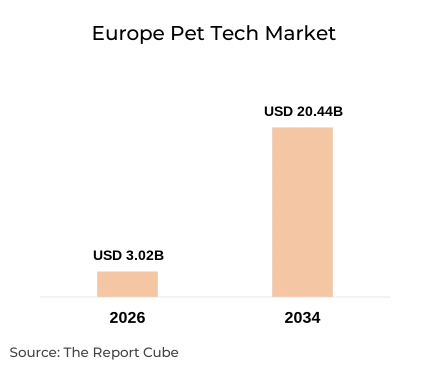
- Europe Pet Tech Market is projected to rise from USD 3.02 billion in 2026 to USD 20.44 billion by 2034, at a CAGR of 27.00%.
- GPS-based pet tracking adoption is accelerating across Germany, the UK, and France, driven by rising pet ownership rates.
- Behaviour monitoring applications are gaining traction as pet owners seek data-driven health management tools.
- RFID technology holds a steady base in the identification segment, backed by EU mandatory microchipping regulations.
Europe Pet Tech Market Insights & Analysis
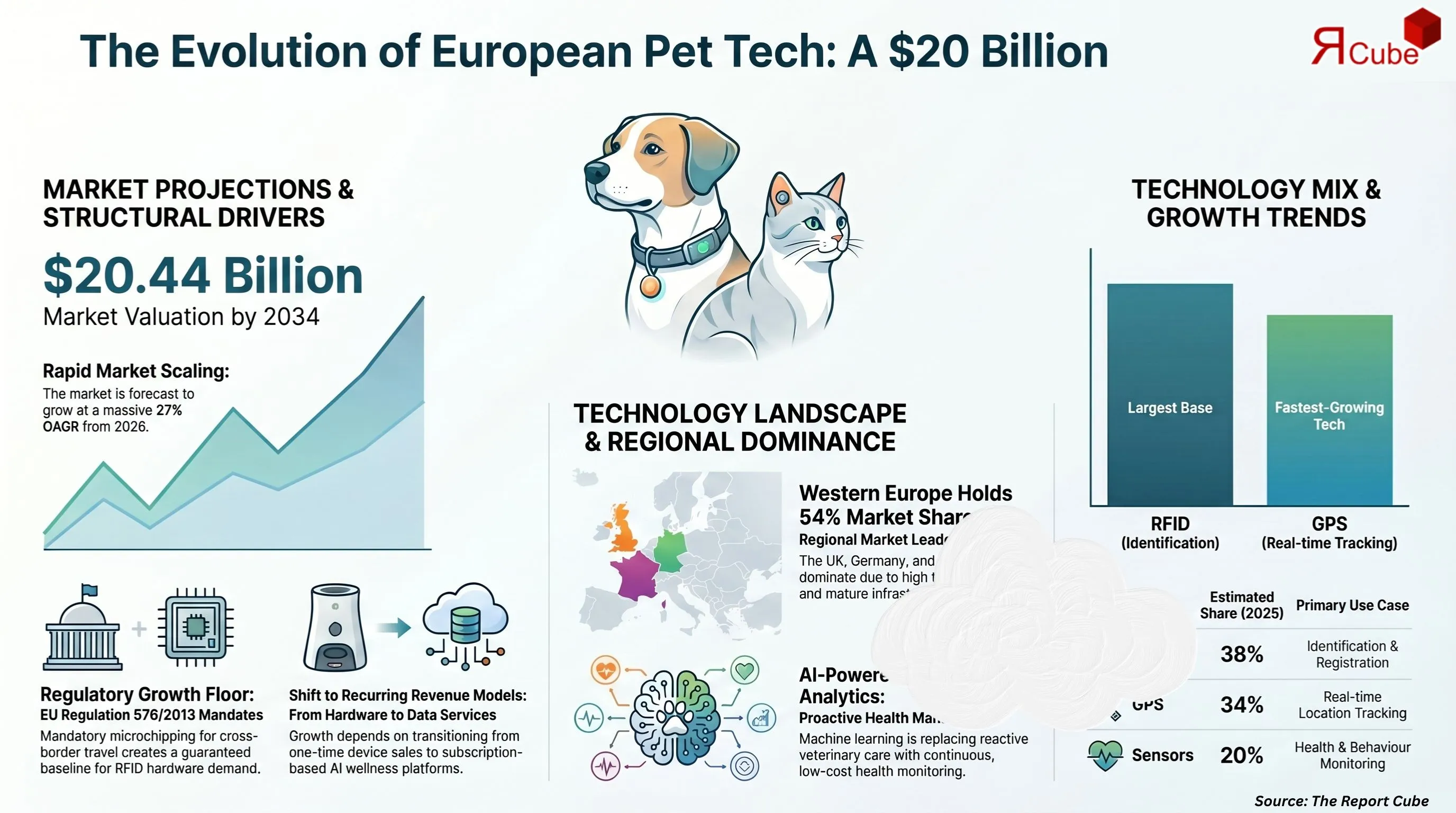
Pet owners across Europe are spending more on technology-driven care - and spending faster than almost any other consumer segment on the continent. The Europe Pet Tech Market stood at USD 3.02 billion in 2026. At a CAGR of 27.00%, it is forecast to reach USD 20.44 billion by 2034. That pace puts pet tech among the fastest-scaling digital consumer markets in Europe - outpacing many segments in smart home and wearables. This section unpacks the structural forces behind that trajectory and establishes the analytical frame for each segment and region discussed below.
Pet humanisation is the primary cultural driver. European households increasingly treat pets as family members, allocating discretionary spend toward connected collars, AI-assisted nutrition platforms, and remote health monitoring - categories that barely existed a decade ago. The UK, Germany, and the Netherlands lead in smart pet device penetration, each supported by a combination of high broadband access, tech-literate consumers, and a mature e-commerce infrastructure.
EU regulatory alignment further reinforces demand. Council Regulation (EU) 576/2013 requires microchipping of dogs travelling across member states, creating a mandatory baseline for RFID adoption that no other global region replicates at scale (European Commission, 2023). That regulatory floor has accelerated manufacturer investment in interoperable, multi-standard RFID tags compatible with both EU databases and private veterinary platforms.
Subscription-based pet wellness platforms - led by players like Tails.com and KatKin - are building recurring revenue streams on top of embedded sensor data and machine-learning nutrition models. These platforms extend the addressable market beyond hardware into software and data services, diversifying margins and increasing lifetime customer value. For this market's CAGR to hold through 2034, the shift from one-time device sales to recurring digital services is not a trend to monitor - it is a prerequisite.
Europe Pet Tech Market Dynamics
Key Market Driver: EU Mandatory Microchipping and Cross-Border Travel Regulations
Microchipping requirements are not a soft nudge - they are enforceable law. EU Regulation 576/2013 mandates ISO-standard microchipping for all dogs entering or transiting member states, with non-compliance blocking travel and triggering fines (European Commission, 2023). That legal baseline guarantees a floor of RFID hardware demand that grows in direct proportion to pet population growth. Europe's registered pet dog population exceeded 90 million in 2023 (FEDIAF, 2023), and the number of annual cross-border pet movements is rising year-on-year as post-pandemic travel normalises. Every new dog registered under EU rules represents a mandatory RFID tag sale - and often a gateway purchase that introduces owners to the broader connected pet ecosystem. Manufacturers and platform operators that align product design to EU database interoperability standards gain a durable first-mover advantage over non-compliant imports.
Major Industry Challenge: Fragmented Data Standards Across Member States
Pet tech platforms cannot scale across Europe the way a US company scales across states - because the data infrastructure is not uniform. Each EU member state operates a separate national pet registry with distinct database formats, API architectures, and access protocols. A GPS collar sold in France logs location data in one format; that data does not automatically port to a German veterinary platform or a Dutch insurance underwriter. For companies like Tractive - which operates pan-European subscription models - this fragmentation raises integration costs, slows product localisation, and creates gaps in the data continuity that AI-based health monitoring requires. Until a unified European Pet Identity Framework is adopted, cross-border data portability will remain a structural constraint on the market's full-stack ambitions.
Emerging Trend: AI-Powered Behaviour Analytics Replacing Reactive Veterinary Care
Reactive vet visits are expensive and stressful for pets and owners. Behaviour-monitoring platforms now use accelerometer arrays, audio analysis, and machine-learning models to detect early indicators of anxiety, pain, and chronic conditions - flagging them before a crisis visit is needed. Barkibu's AI-driven triage platform, for instance, logged over 1 million digital vet consultations across Spain and Southern Europe by 2024 (Barkibu Press Release, 2024), demonstrating that behaviour-led diagnostics can scale economically. This trend is shifting veterinary economics from episodic high-cost interventions to continuous low-cost monitoring - a model that benefits pet tech hardware and software providers equally, while creating new data assets that insurers and pharma firms are beginning to license.
Need Specific Data, Let’s Customize the Report for You
Request CustomizationEmerging Opportunity: Pet Insurance Integration with Real-Time Health Data
Pet insurance penetration in Europe is rising but remains concentrated in Scandinavia and the UK. The gap between insured and uninsured pet populations across Germany, France, Italy, and Spain represents a high-value distribution channel for pet tech platforms. Insurers offering dynamic premium models - where premiums adjust based on real-time activity and health data from connected devices - are already piloting integrations with GPS collar providers and nutrition platforms. Germany Pet Insurance Market - shares consumer base and data infrastructure with health-monitoring pet tech Butternut Box and KatKin, both of which collect dietary and health response data at scale, are structurally positioned to white-label their data pipelines to insurance underwriters - creating a revenue stream outside traditional B2C subscriptions.
Europe Pet Tech Market Segment-wise Analysis
By Technology
RFID holds the largest installed base within Europe's pet tech market, anchored by EU microchipping mandates. Its market share across identification applications was estimated at approximately 38% in 2025, driven by mandatory compliance purchases and the relatively low unit cost of passive RFID chips compared to active GPS devices (FEDIAF, 2023).
|
Technology |
Estimated Share (2025) |
Growth Outlook |
Primary Use Case |
|---|---|---|---|
|
RFID |
38% |
Steady - regulatory floor |
Identification, database registration |
|
GPS |
34% |
High - fastest-growing segment |
Real-time location tracking |
|
Sensors |
20% |
High - behaviour and health monitoring |
Accelerometers, temperature, audio |
|
Others |
8% |
Moderate |
NFC, biometric readers |
GPS technology is the fastest-growing segment within the category. Tractive - headquartered in Austria - is the clear pan-European leader, with over 1 million active subscribers across Europe by 2024 (Tractive, 2024). Its subscription model monetises hardware at point-of-sale and generates recurring revenue from cloud-based location services. Sensors - including accelerometers, temperature sensors, and audio classifiers - form the backbone of behaviour monitoring platforms and are forecast to gain share through 2034 as AI-driven health analytics mature. The "Others" category includes NFC-based veterinary access tags and early-stage biometric identification systems, which remain niche but attract R&D investment from veterinary device manufacturers.
By Application
Identification and Tracking is the anchor application segment, supported by regulatory demand and the widest consumer awareness. Behaviour Monitoring and Control is the highest-growth application sub-segment, reflecting the shift toward proactive and preventive pet health management.
|
Application |
Estimated Share (2025) |
Key Technology |
Growth Driver |
|---|---|---|---|
|
Identification and Tracking |
45% |
RFID, GPS |
EU regulations, lost pet prevention |
|
Behaviour Monitoring and Control |
32% |
Sensors, AI analytics |
Pet humanisation, vet cost reduction |
|
Safety and Security |
23% |
GPS, geofencing |
Urban pet owner demand |
Safety and Security applications - including geofencing alerts and smart home pet access systems - are growing at above-average rates in urban markets where apartment living limits outdoor pet freedom. Manufacturers are bundling geofencing with activity monitoring in single-device SKUs, reducing the cost of entry and expanding the addressable consumer base.
Regional Projection of Europe Pet Tech Market
European pet tech demand is geographically uneven - concentrated in Western Europe but growing fastest in Central and Eastern Europe as disposable incomes rise and e-commerce infrastructure matures.
|
Region |
Estimated Share (2025) |
Key Driver |
Key Gap |
|---|---|---|---|
|
Western Europe (UK, Germany, France) |
54% |
High pet ownership, tech adoption |
Market saturation risk post-2030 |
|
Northern Europe (Scandinavia, Netherlands) |
18% |
High insurance penetration, early adoption |
Small absolute pet population |
|
Southern Europe (Spain, Italy, Portugal) |
16% |
Rising pet humanisation, platform growth |
Lower per-capita spend vs. North |
|
Central & Eastern Europe |
12% |
Rising disposable income, EU accession |
Fragmented retail infrastructure |
- Western Europe dominates in both volume and value. The UK market benefits from a mature pet insurance sector and high willingness-to-pay for subscription wellness platforms. Germany's market is driven by a strong veterinary care tradition and early corporate adoption of RFID-based clinic management systems. France rounds out the top three, with urban pet density in Paris driving above-average GPS collar adoption.
- Northern Europe punches above its weight in per-capita terms. Sweden and Denmark have pet insurance penetration rates above 40% - the highest in Europe - creating a natural distribution channel for health-monitoring hardware and platform integrations (FEDIAF, 2023).
- Southern Europe is the growth story of the next five years. Spain saw a 31% increase in registered pet dogs between 2018 and 2023 (Spanish Ministry of Agriculture, 2023), and Barkibu's rapid expansion from Madrid across the Iberian Peninsula illustrates how digital-first platforms can capture newly tech-receptive pet owner cohorts.
- Central and Eastern Europe is the long-tail opportunity. EU accession requirements for microchipping in newer member states are accelerating RFID adoption, and rising urban middle-class incomes are producing the first cohort of high-spend connected pet owners in markets like Poland, Czech Republic, and Hungary.
Europe Pet Tech Market: Recent Developments (2025-2026)
- Tractive (Q1 2026): Launched GPS 4 LTE-M collar with AI-powered sleep tracking and vet-alert notifications for European markets; expanded subscription tiers to include monthly health score reports.
- Tails.com (Q4 2025): Secured Series C funding to expand AI nutrition personalisation into Germany and the Netherlands; integrated with three European veterinary EHR systems.
- KatKin (Q3 2025): Introduced biosensor-enabled cat food subscription trials in the UK, linking real-time digestive data to nutrition adjustments via a proprietary app.
- Butternut Box (Q1 2026): Partnered with a UK pet insurer to offer activity-data-linked premium discounts; announced expansion into France and Germany.
- Barkibu (Q4 2025): Reached 1.5 million digital consultations milestone; launched multilingual AI vet triage in French, German, and Italian.
- EU Commission (Q2 2025): Published a consultation document on harmonising national pet registries into a single European Pet Identity Database - a development that would remove the cross-border data fragmentation constraint identified as the market's primary structural challenge.
Europe Pet Tech Market Future Outlook (2034)
The trajectory to USD 20.44 billion by 2034 rests on three convergent forces - none of which is speculative. First, pet ownership in Europe is structurally rising: FEDIAF projects European pet population growth of 1.8% annually through 2030, driven by urbanisation, single-person households, and post-pandemic lifestyle shifts (FEDIAF, 2023). More pets mean more addressable hardware units. Second, average revenue per user in subscription-based pet tech platforms is expanding as companies layer AI diagnostics, insurance integration, and nutrition personalisation on top of base hardware margins. Third, regulatory alignment - if the EU harmonises national pet registries as proposed - will unlock cross-border platform scalability that current fragmentation prevents.
The competitive landscape will consolidate. Tractive, Tails.com, and Butternut Box have the subscription infrastructure and data depth to absorb smaller hardware-only players. Expect 3–5 major M&A transactions between 2026 and 2030 as platform operators acquire sensor manufacturers to internalise supply chains and reduce hardware costs. The entry of large European telecoms into pet IoT - leveraging LTE-M and NB-IoT network buildouts - will further accelerate GPS collar affordability, bringing the technology within reach of mid-market consumers who currently find subscription costs prohibitive. By 2034, Europe's pet tech market will not be a devices market with a software layer on top - it will be a data and services market that ships hardware as the acquisition channel.
Europe Pet Tech Market Report Coverage
|
Report Features |
Details |
|---|---|
|
Market Size (Value, 2026) |
USD 3.02 Billion |
|
Market Size (Value, 2034) |
USD 20.44 Billion |
|
Forecast Period |
2026-2034 |
|
CAGR |
27.00% |
|
Base Year |
2026 |
|
Historical Data |
2021–2025 |
|
Customization |
Available |
|
Segments Covered |
By Technology, By Application, By End uses |
|
Regions Covered |
Western Europe, Northern Europe, Southern Europe, Central & Eastern Europe |
|
Key Companies |
Tractive, Tails.com, KatKin, Butternut Box, Barkibu, Others |
|
Report Format |
PPT, PDF & Excel |
Why Choose This Report?
- Covers all three application verticals - Identification and Tracking, Behaviour Monitoring, and Safety and Security - with dedicated segment tables and growth outlooks.
- Includes EU regulatory analysis of Council Regulation (EU) 576/2013 and its direct impact on RFID adoption curves through 2034.
- Profiles six key players - Tractive, Tails.com, KatKin, Butternut Box, Barkibu, and others - with recent development timelines and strategic positioning notes.
- Maps four distinct European sub-regions with share estimates, key drivers, and addressable gaps per region.
- Identifies the EU pet registry harmonisation initiative as a structural market catalyst - and models its impact on cross-border platform scalability.
- Flags the pet insurance integration opportunity as an under-covered revenue channel in competing reports.
- Delivered in PPT, PDF, and Excel formats; customisation available for additional segments or country-level breakdowns.
Table of Contents
- Introduction
- Objective of the study
- Product Definition
- Market Segmentation
- Study Variables
- Research Methodology
- Secondary Data Points
- Companies Interviewed
- Primary Data Points
- Breakdown of Primary Interviews
- Secondary Data Points
- Executive Summary
- Market Dynamics
- Drivers
- Challenges
- Opportunity Assessment
- Recent Trends and Developments
- Policy and Regulatory Landscape
- Europe Pet Tech Market Overview and Forecast Analysis (2021-2034)
- Market Size, By Value, By growth rate (CAGR/USD Billions)
- Demand - Supply Trends
- Market Share, By Technology
- RFID
- GPS
- Sensors
- Others
- Market Share, By Applications
- Identification and Tracking
- Behaviour Monitoring and Control
- Safety and Security
- Medical Diagnosis and Treatment
- Others
- Market Share, By End uses
- Household
- Commercial
- Market Share, By Country
- Western Europe
- Northern Europe
- Southern Europe
- Central & Eastern Europe
- Market Share, By Company
- Revenue Shares
- Competition Characteristics
- Western Europe Pet Tech Market Overview, 2021-2034F
- Market Size, By Value (in USD Billions)
- By Technology
- By Applications
- By End uses
- Northern Europe Pet Tech Market Overview, 2021-2034F
- Market Size, By Value (in USD Billions)
- By Technology
- By Applications
- By End uses
- Southern Europe Pet Tech Market Overview, 2021-2034F
- Market Size, By Value (in USD Billions)
- By Technology
- By Applications
- By End uses
- Competitive Outlook (Company Profile - Partial List)
- Tractive
- Company Overview
- Business Segments
- Strategic Alliances/Partnerships
- Recent Developments
- Tails.com
- Company Overview
- Business Segments
- Strategic Alliances/Partnerships
- Recent Developments
- KatKin
- Company Overview
- Business Segments
- Strategic Alliances/Partnerships
- Recent Developments
- Butternut Box
- Company Overview
- Business Segments
- Strategic Alliances/Partnerships
- Recent Developments
- Barkibu
- Company Overview
- Business Segments
- Strategic Alliances/Partnerships
- Recent Developments
- Others
- Tractive
- Contact Us & Disclaimer
Top Key Players & Market Share Outlook
- Tractive
- Tails.com
- KatKin
- Butternut Box
- Barkibu
- Others
Frequently Asked Questions






