



Build Your Custom Market Intelligence Report
Customize Your ReportGlobal PFAS Testing Market Key Highlights
By Offering:
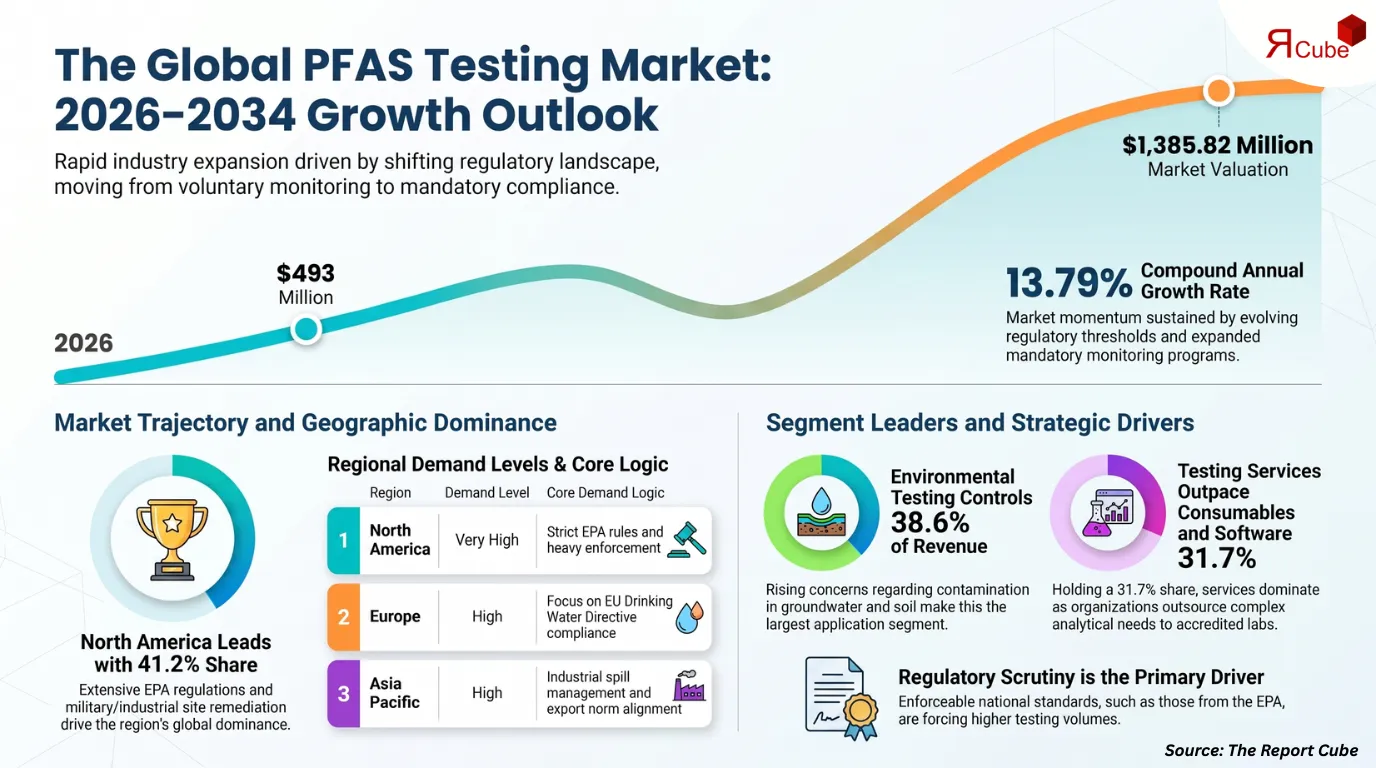
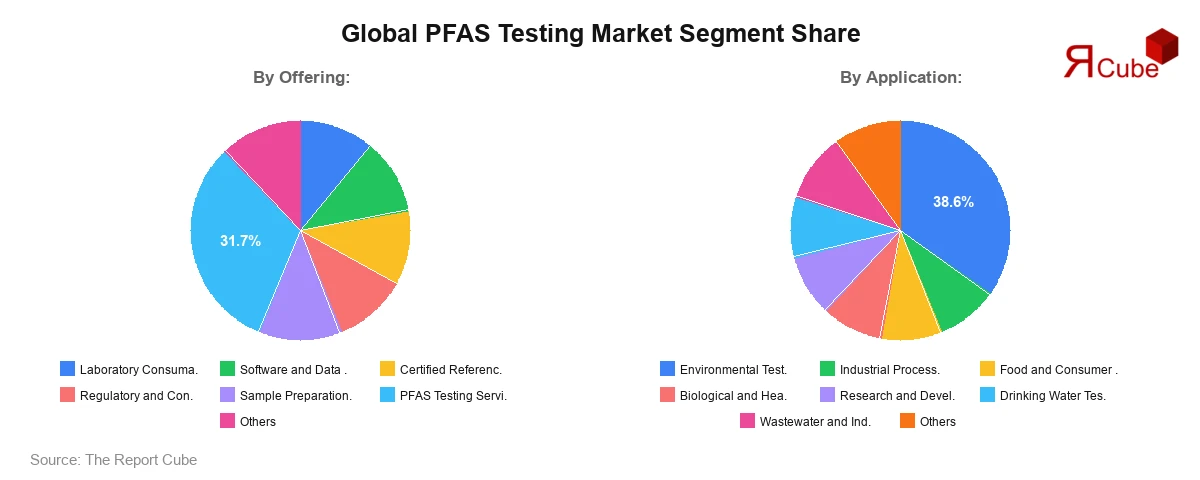
PFAS Testing Services segment leads the market with approximately 31.7% share.
By Application:
Environmental Testing dominates the market with nearly 38.6% of total revenue.
Regional Outlook:
North America dominates the Global PFAS Testing Market with around 41.2% market share.
Global PFAS Testing Market Insights & Analysis
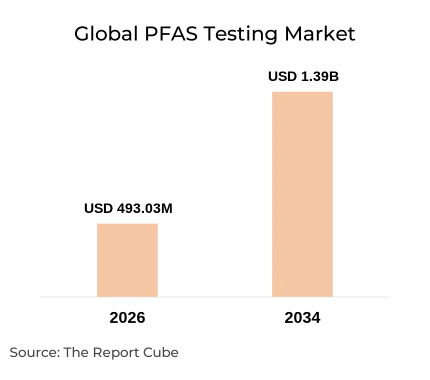
The Global PFAS Testing Market is anticipated to register a CAGR of around 13.79% during the forecast period of 2026-2034. The market size is valued at USD 493.03 million in 2026 and is projected to reach approximately USD 1,385.82 million by 2034. Market momentum is primarily supported by the worldwide focus on identifying and controlling per- and polyfluoroalkyl substances (PFAS) across water resources, industrial facilities, agricultural land, food products, and consumer goods. Governments continue introducing lower regulatory thresholds for PFAS compounds while broadening mandatory monitoring programs for municipal water systems, wastewater treatment plants, landfills, airports, military facilities, and manufacturing operations. These regulatory developments have substantially increased laboratory testing volumes as both public agencies and private industries seek reliable analytical data to demonstrate compliance and evaluate environmental liabilities. Continuous improvements in liquid chromatography tandem mass spectrometry (LC-MS/MS), high-resolution mass spectrometry (HRMS), and total organic fluorine analysis are also enhancing analytical sensitivity, allowing laboratories to quantify PFAS compounds at increasingly lower concentrations.
Industry participants are strengthening analytical capabilities through laboratory expansion, automation, quality management systems, and the introduction of certified reference materials that improve testing accuracy and reproducibility. Accredited laboratories are broadening their service portfolios to support environmental investigations, drinking water surveillance, industrial process validation, food safety programs, and biological sample analysis using standardized methods such as EPA 1633, EPA 533, EPA 537.1, ASTM, and ISO protocols. Investments in digital laboratory information management systems, automated sample preparation, and advanced analytical instrumentation are reducing turnaround times while improving operational efficiency. At the same time, remediation projects addressing historical PFAS contamination continue to generate recurring demand for long-term monitoring services across North America, Europe, and Asia Pacific. As regulatory expectations evolve and industries adopt more comprehensive environmental stewardship practices, demand for high-quality PFAS testing services is expected to remain strong throughout the forecast period.
Global PFAS Testing Market Impact Analysis
| Factor | Type | Specific Impact on Market | Magnitude | Business Implication |
|---|---|---|---|---|
| Increasing Regulatory Scrutiny | Regulatory | Stricter PFAS limits in water, soil, food and products globally | High | Drives mandatory testing volumes across public and private labs |
| Growing Public Health Awareness | Consumer | Heightened concern about exposure to so called forever chemicals | High | Stimulates demand for testing in utilities, industry and brands |
| Advances in Analytical Methods | Technological | Improved LC MS and non targeted tools expand analyte coverage | High | Enables premium testing services and differentiated offerings |
| High Testing Cost and Complexity | Market | Specialized equipment and expertise keep per sample prices high | Medium | Encourages consolidation toward large capable testing networks |
| Emerging Portable and Rapid Tests | Technological | Development of field kits for screening in remote environments | Medium | Opens new segments in on site monitoring and screening work |
| Regional Policy and Funding Gaps | Environmental | Uneven adoption of PFAS rules slows uptake in some regions | Medium | Creates phased entry opportunities aligned to policy rollout |
| Expansion in Emerging Economies | Market | Asia and other regions invest in monitoring infrastructure | High | Supports long term growth from new laboratories and contracts |
Global PFAS Testing Market Dynamics
Key Driver: Expanding Regulatory Enforcement for PFAS Monitoring Across Environmental and Industrial Sectors
Strengthening environmental regulations continue to reshape the Global PFAS Testing Market by making routine analytical monitoring an essential compliance requirement rather than a voluntary practice. Regulatory agencies across major economies are expanding the number of regulated PFAS compounds while introducing stricter limits for drinking water, wastewater discharge, soil contamination, biosolids, and industrial emissions. These evolving standards have encouraged municipalities, manufacturers, utilities, airports, defense facilities, and waste management operators to conduct more frequent laboratory testing using validated analytical methods. Compliance obligations are also extending across supply chains, prompting manufacturers to verify PFAS content in raw materials, finished products, and production processes before commercial distribution.
The growing number of environmental investigations and legal settlements associated with PFAS contamination has further accelerated demand for accredited testing services. Industrial organizations are increasing baseline environmental assessments, operational monitoring, and post-remediation verification to reduce financial and regulatory risks. Environmental consulting firms are similarly expanding sampling and laboratory programs to support site investigations and remediation planning. These factors continue to reinforce the long-term outlook for PFAS analytical services while encouraging laboratories to expand capacity, strengthen quality assurance systems, and invest in advanced analytical technologies.
Industry Trends: Advanced Analytical Technologies Improve Testing Accuracy and Laboratory Productivity
Analytical laboratories are rapidly adopting highly sensitive technologies capable of detecting a broader spectrum of PFAS compounds at ultra-trace concentrations. Liquid Chromatography Tandem Mass Spectrometry (LC-MS/MS) remains the preferred analytical platform for routine compliance testing because of its precision, reproducibility, and compatibility with recognized regulatory methods. At the same time, High-Resolution Mass Spectrometry (HRMS), Non-Targeted Analysis (NTA), Combustion Ion Chromatography (CIC), and Total Organic Fluorine (TOF) analysis are becoming increasingly important for identifying emerging PFAS compounds that are not covered by conventional targeted testing methods.
Laboratories are also modernizing operations through automation, digital workflow management, and laboratory information management systems that improve sample traceability, quality control, and reporting efficiency. Certified reference materials, isotope-labeled analytical standards, and standardized calibration protocols are supporting greater consistency across accredited laboratories worldwide. These technological advancements are enabling testing providers to process larger sample volumes while maintaining analytical reliability, creating measurable improvements in operational efficiency and strengthening confidence in regulatory decision-making.
Book your FREE 30-minute expert consultation today
Contact UsMajor Challenge: Analytical Complexity and Rising Compliance Costs
PFAS analysis remains one of the most technically demanding segments of environmental laboratory testing because of the extensive number of compounds, extremely low detection limits, and rigorous quality assurance requirements. Accredited laboratories must invest in advanced analytical instruments, contamination-controlled facilities, certified reference materials, and highly trained specialists to generate reliable analytical results. These requirements increase operating costs while creating financial barriers for smaller laboratories seeking to expand their PFAS testing capabilities.
Frequent revisions to regulatory guidance further increase operational complexity by requiring laboratories to validate new analytical methods, update laboratory accreditation, and continuously train technical personnel. Differences between regional regulatory frameworks can also complicate multinational testing programs, particularly for organizations operating across multiple jurisdictions. Maintaining consistent analytical performance while adapting to evolving compliance requirements remains a significant operational challenge for testing providers throughout the global market.
Opportunity: Expanding Environmental Remediation Programs Create Long-Term Testing Demand
Large-scale remediation initiatives targeting PFAS-contaminated groundwater, surface water, industrial sites, military installations, airports, and landfill facilities are creating sustained opportunities for analytical laboratories worldwide. Every remediation program requires detailed site characterization, baseline sampling, treatment verification, and long-term environmental monitoring, resulting in recurring demand for laboratory services throughout the project lifecycle. Increasing public investment in water infrastructure modernization is also encouraging municipalities to strengthen routine PFAS surveillance programs for drinking water and wastewater systems.
Commercial opportunities continue to expand beyond environmental applications as manufacturers increase PFAS testing across food products, pharmaceuticals, medical devices, electronics, consumer goods, and industrial materials to meet evolving regulatory expectations and customer quality requirements. Growth in accredited laboratory networks across Asia Pacific, Latin America, and the Middle East is improving access to advanced analytical services while supporting international harmonization of testing standards. Continued innovation in laboratory automation, digital data management, and analytical instrumentation is expected to further enhance testing efficiency and create new revenue opportunities across the PFAS Testing Market through 2034.
Global PFAS Testing Market Segment-wise Analysis
By Offering:
- Laboratory Consumables
- Software and Data Management Solutions
- Certified Reference Materials and Standards
- Regulatory and Consulting Services
- Sample Preparation Products
- PFAS Testing Services
- Others
PFAS Testing Services represented approximately 31.7% of the Global PFAS Testing Market in 2026, making it the leading offering segment. The segment continues to expand as regulatory agencies require routine PFAS analysis across drinking water, groundwater, wastewater, industrial discharge, biosolids, and consumer products. Public utilities, environmental consulting firms, chemical manufacturers, airports, and defense organizations increasingly rely on accredited laboratories to perform highly sensitive analytical testing using standardized methods such as EPA 1633, EPA 533, EPA 537.1, ASTM, and ISO protocols. Since PFAS analysis requires advanced instrumentation, strict quality control, and highly trained personnel, outsourcing testing to certified laboratories has become the preferred approach for many organizations.
Laboratory service providers are expanding testing capacity through investments in high-throughput analytical platforms, automated sample preparation systems, and digital laboratory information management systems to meet growing sample volumes. Demand is also increasing from environmental remediation projects, where continuous monitoring is required throughout investigation, treatment, and post-remediation phases. As governments continue tightening PFAS regulations and expanding monitoring requirements, the PFAS Testing Services segment is expected to maintain its leading market position over the forecast period.
By Application:
- Environmental Testing
- Industrial Process Testing
- Food and Consumer Product Testing
- Biological and Healthcare Testing
- Research and Development
- Drinking Water Testing
- Wastewater and Industrial Effluent Testing
- Others
Environmental Testing accounted for nearly 38.6% of the Global PFAS Testing Market revenue in 2026, making it the largest application segment. Rising concerns regarding PFAS contamination in groundwater, rivers, lakes, soil, sediments, and industrial discharge have significantly increased environmental monitoring activities worldwide. National environmental agencies and local authorities are implementing comprehensive sampling programs to identify contaminated sites, assess ecological risks, and establish remediation priorities. These initiatives have substantially increased demand for laboratory analysis across municipal utilities, industrial facilities, waste management sites, and environmental consulting projects.
The segment is also benefiting from increasing investments in groundwater restoration, landfill monitoring, industrial site assessments, and long-term remediation programs. Environmental testing laboratories are adopting advanced LC-MS/MS and High-Resolution Mass Spectrometry technologies to accurately detect trace concentrations of regulated and emerging PFAS compounds. Growing regulatory oversight and continuous expansion of environmental compliance programs are expected to sustain strong demand for environmental PFAS testing services throughout the forecast period.
Regional Projection of Global PFAS Testing Industry
- North America
- Europe
- Asia Pacific
- Middle East and Africa
- South America
North America held approximately 41.2% of the Global PFAS Testing Market in 2026 and remains the largest regional market. The region benefits from one of the world's most comprehensive regulatory frameworks governing PFAS contamination, supported by continuous updates to drinking water standards, industrial discharge regulations, and environmental monitoring requirements. Federal, state, and provincial agencies have expanded PFAS surveillance across municipal water systems, military facilities, airports, manufacturing sites, and hazardous waste locations, creating sustained demand for accredited laboratory testing services.
The region also has a well-established ecosystem of analytical laboratories, environmental consulting firms, instrument manufacturers, and certified reference material suppliers. Continuous investments in environmental remediation projects, combined with increasing legal and corporate accountability for PFAS contamination, are driving long-term testing demand across both public and private sectors. Ongoing technological advancements in analytical instrumentation, laboratory automation, and standardized testing methodologies further strengthen North America's leadership position and are expected to support steady market growth through 2034.
Need insights for a specific region within this market?
Request Regional DataRegional Analysis of Global PFAS Testing Market
The PFAS testing market shows distinct regional patterns driven by regulations, industrial contamination, and testing capacity expansion.
| Region | Demand Level | Key Areas | System Dominance | Core Demand Logic | Growth Nature |
|---|---|---|---|---|---|
| North America | Very High | US, Canada | LC‑MS, HRMS labs | Strict EPA rules, heavy enforcement | Regulation-led, stable growth |
| Europe | High | Germany, Nordics, France | Accredited water labs | EU limits, drinking water focus | Compliance-driven expansion |
| Asia Pacific | High | China, Japan, Australia | Emerging PFAS labs | Industrial spills, export norms | Fast, catch‑up growth |
| Middle East & Africa | Medium | GCC, South Africa | Centralized reference labs | Oil, desalination risk control | Gradual, project‑led growth |
| South America | Medium | Brazil, Mexico | Regional contract labs | Industrial hotspots, export needs | Policy‑linked, uneven growth |
Government Initiatives & Policies
- United States EPA National Primary Drinking Water Regulation (2025 Implementation): The U.S. Environmental Protection Agency is implementing enforceable national drinking water standards for multiple PFAS compounds while expanding monitoring, reporting, and remediation activities under the Safe Drinking Water Act.
- European Union Drinking Water Directive Implementation (2025): EU member states continue implementing the revised Drinking Water Directive, introducing mandatory monitoring requirements and stricter limits for PFAS in public drinking water supplies to strengthen public health protection.
Global PFAS Testing Industry Recent Developments
- 2025: Pace Analytical Services received U.S. Department of Defense accreditation for multiple PFAS analytical methods, including ASTM D8421, ASTM D8535, and EPA 8327. The accreditation strengthens the company's capabilities in supporting military installations, environmental remediation projects, and regulatory compliance programs involving complex PFAS-contaminated sites.
- 2025: Perma-Fix Environmental Services expanded its proprietary PFAS treatment technology to address additional contaminated waste streams, including wastewater concentrates and industrial leachate. The expansion enhances treatment flexibility for industrial facilities, municipalities, and remediation contractors managing increasingly complex PFAS contamination challenges.
- 2025: LGC Standards introduced new 13C-labeled PFAS certified reference materials designed specifically for EPA Method 1633 analytical workflows. The newly launched standards improve calibration accuracy, laboratory reproducibility, quality assurance, and trace-level PFAS quantification across environmental testing laboratories.
Why Choose This Report?
- Provides a comprehensive overview of the overall market analysis, encompassing key trends, consumer behavior analysis, and risk assessment to support strategic decision-making.
- Provides accurate, up-to-date insights into market size, segmentation, and emerging opportunities, helping to minimize risk while capitalizing on growth opportunities.
- Gives deep understanding of target audience preferences, investment habits, and communication channels for enhanced product development and marketing effectiveness.
- Delivers competitive analysis and benchmarking, uncovering the strengths and weaknesses of market competitors to guide strategic business decisions.
- Consolidates comprehensive market intelligence, reducing research efforts while improving operational efficiency.
- Facilitates customized market segmentation and risk mitigation strategies that align with evolving business objectives.
- Aids in identifying both market challenges and untapped opportunities within the PFAS testing industry to drive sustainable long-term business growth.
- Provides valuable information based on actual customer demand, regulatory developments, technology trends, and industry search behavior.
Table of Contents
- Introduction
- Objective of the Study
- Product and Category Definition
- Market Segmentation
- Study Variables
- Research Methodology
- Secondary Data Points
- Breakdown of Secondary Sources
- Primary Data Points
- Breakdown of Primary Interviews
- Secondary Data Points
- Executive Summary
- Market Dynamics
- Emerging Opportunities
- Adoption Trends
- Demand Drivers
- Disruption Analysis (Challenges)
- Industry Analysis & Strategic Insights
- Supply/Value Chain Analysis
- Pricing Analysis
- Go-To-Market (GTM) Strategy
- BCG Matrix
- Recent Trends and Developments
- Regulatory and Policy Landscape
- Region-wise Policies
- Government Initiatives
- Global PFAS Testing Market Overview and Forecast Analysis (2021-2034)
- Market Size, By Value, By Growth Rate (CAGR/USD Billion)
- PFAS Testing Market, By Offering
- Laboratory Consumables
- Software and Data Management Solutions
- Certified Reference Materials and Standards
- Regulatory and Consulting Services
- Sample Preparation Products
- PFAS Testing Services
- Others
- PFAS Testing Market, By Testing Method
- ISO Methods
- ASTM Methods
- EPA 537 / 537.1
- Proprietary/In-House Methods
- EPA 1633
- EPA 533
- Others
- PFAS Testing Market, By Technology
- Gas Chromatography-Mass Spectrometry (GC-MS)
- Non-Targeted Analysis (NTA)
- Total Organic Fluorine (TOF) Analysis
- Combustion Ion Chromatography (CIC)
- High-Resolution Mass Spectrometry (HRMS)
- LC-MS/MS
- Others
- PFAS Testing Market, By PFAS Type
- Fluoropolymers
- Short-Chain PFAS
- Ultra-Short-Chain PFAS
- Long-Chain PFAS
- Others
- PFAS Testing Market, By Sample Type
- Wastewater
- Food & Beverage
- Groundwater
- Biological Samples
- Air Emissions
- Industrial Effluents
- Soil & Sediment
- Consumer Products
- Biosolids & Sludge
- Drinking Water
- Others
- PFAS Testing Market, By Application
- Environmental Testing
- Industrial Process Testing
- Food and Consumer Product Testing
- Biological and Healthcare Testing
- Research and Development
- Drinking Water Testing
- Wastewater and Industrial Effluent Testing
- Others
- Market Share, By Region
- North America
- Europe
- Asia Pacific
- Middle East and Africa
- South America
- Market Share, By Company
- Revenue Shares and Analysis
- Competitive Landscape
- North America PFAS Testing Market Overview and Forecast Analysis (2021-2034)
- Market Size, By Value, By Growth Rate (CAGR/USD Billion/Million)
- Market Share, By Offering
- Market Share, By Testing Method
- Market Share, By Technology
- Market Share, By PFAS Type
- Market Share, By Sample Type
- Market Share, By Application
- Market Share, By Country
- United States
- Canada
- Mexico
- Rest of North America
- Europe PFAS Testing Market Overview and Forecast Analysis (2021-2034)
- Market Size, By Value, By Growth Rate (CAGR/USD Billion/Million)
- Market Share, By Offering
- Market Share, By Testing Method
- Market Share, By Technology
- Market Share, By PFAS Type
- Market Share, By Sample Type
- Market Share, By Application
- Market Share, By Country
- Germany
- United Kingdom
- France
- Italy
- Spain
- Netherlands
- Russia
- Poland
- Belgium
- Sweden
- Rest of Europe
- Asia Pacific PFAS Testing Market Overview and Forecast Analysis (2021-2034)
- Market Size, By Value, By Growth Rate (CAGR/USD Billion/Million)
- Market Share, By Offering
- Market Share, By Testing Method
- Market Share, By Technology
- Market Share, By PFAS Type
- Market Share, By Sample Type
- Market Share, By Application
- Market Share, By Country
- China
- India
- Japan
- South Korea
- Australia
- Indonesia
- Thailand
- Malaysia
- Vietnam
- Philippines
- Singapore
- New Zealand
- Rest of Asia Pacific
- Middle East and Africa PFAS Testing Market Overview and Forecast Analysis (2021-2034)
- Market Size, By Value, By Growth Rate (CAGR/USD Billion/Million)
- Market Share, By Offering
- Market Share, By Testing Method
- Market Share, By Technology
- Market Share, By PFAS Type
- Market Share, By Sample Type
- Market Share, By Application
- Market Share, By Country
- Saudi Arabia
- United Arab Emirates
- South Africa
- Egypt
- Nigeria
- Morocco
- Turkey
- Rest of Middle East and Africa
- South America PFAS Testing Market Overview and Forecast Analysis (2021-2034)
- Market Size, By Value, By Growth Rate (CAGR/USD Billion/Million)
- Market Share, By Offering
- Market Share, By Testing Method
- Market Share, By Technology
- Market Share, By PFAS Type
- Market Share, By Sample Type
- Market Share, By Application
- Market Share, By Country
- Brazil
- Argentina
- Chile
- Colombia
- Peru
- Rest of South America
- Competitive Analysis, 2026
- Market Share of Key Players
- Competitive Mapping for Each Segment and Companies Operating Regionally
- North America PFAS Testing Companies Share and Competitive Analysis, 2026
- Europe PFAS Testing Companies Share and Competitive Analysis, 2026
- Asia Pacific PFAS Testing Companies Share and Competitive Analysis, 2026
- Middle East and Africa PFAS Testing Companies Share and Competitive Analysis, 2026
- South America PFAS Testing Companies Share and Competitive Analysis, 2026
- Company Profile (Partial List)
- Bureau Veritas
- Company Overview
- Product Portfolio
- Strategic Alliances/Partnerships
- Recent Developments
- SGS SA
- Company Overview
- Product Portfolio
- Strategic Alliances/Partnerships
- Recent Developments
- Enthalpy Analytical
- Company Overview
- Product Portfolio
- Strategic Alliances/Partnerships
- Recent Developments
- Eurofins Scientific
- Company Overview
- Product Portfolio
- Strategic Alliances/Partnerships
- Recent Developments
- Battelle Memorial Institute
- Company Overview
- Product Portfolio
- Strategic Alliances/Partnerships
- Recent Developments
- Montrose Environmental Group
- Company Overview
- Product Portfolio
- Strategic Alliances/Partnerships
- Recent Developments
- Pace Analytical Services
- Company Overview
- Product Portfolio
- Strategic Alliances/Partnerships
- Recent Developments
- Intertek Group plc
- Company Overview
- Product Portfolio
- Strategic Alliances/Partnerships
- Recent Developments
- ALS Limited
- Company Overview
- Product Portfolio
- Strategic Alliances/Partnerships
- Recent Developments
- GEL Laboratories
- Company Overview
- Product Portfolio
- Strategic Alliances/Partnerships
- Recent Developments
- Restek Corporation
- Company Overview
- Product Portfolio
- Strategic Alliances/Partnerships
- Recent Developments
- AccuStandard
- Company Overview
- Product Portfolio
- Strategic Alliances/Partnerships
- Recent Developments
- Cambridge Isotope Laboratories
- Company Overview
- Product Portfolio
- Strategic Alliances/Partnerships
- Recent Developments
- Zepto Matrix
- Company Overview
- Product Portfolio
- Strategic Alliances/Partnerships
- Recent Developments
- Absolute Standards
- Company Overview
- Product Portfolio
- Strategic Alliances/Partnerships
- Recent Developments
- Wellington Laboratories
- Company Overview
- Product Portfolio
- Strategic Alliances/Partnerships
- Recent Developments
- LGC Standards
- Company Overview
- Product Portfolio
- Strategic Alliances/Partnerships
- Recent Developments
- Chiron AS
- Company Overview
- Product Portfolio
- Strategic Alliances/Partnerships
- Recent Developments
- Others (Partial List)
- Bureau Veritas
- Contact Us and Disclaimer
Top Key Players & Market Share Outlook
- Bureau Veritas
- SGS SA
- Enthalpy Analytical
- Eurofins Scientific
- Battelle Memorial Institute
- Montrose Environmental Group
- Pace Analytical Services
- Intertek Group plc
- ALS Limited
- GEL Laboratories
- Restek Corporation
- AccuStandard
- Cambridge Isotope Laboratories
- Zepto Matrix
- Absolute Standards
- Wellington Laboratories
- LGC Standards
- Chiron AS
Frequently Asked Questions






