



Build Your Custom Market Intelligence Report
Customize Your ReportChina Plant-Based Food Market Key Highlights
By Product Type:
Plant-Based Dairy segment leads the market with around 34% market share.
By Distribution Channel:
Off-Trade segment dominates the market with nearly 62% of revenue.
Regional Outlook:
East region dominates the China Plant-Based Food market with approximately 38% share.
China Plant-Based Food Market Insights & Analysis
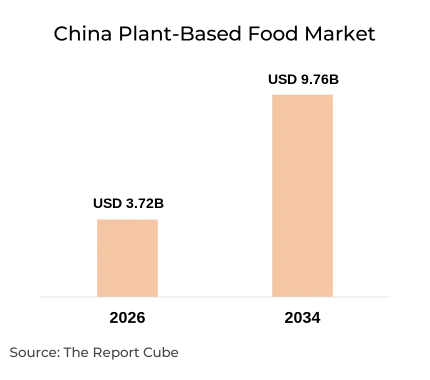
The China Plant-Based Food Market is anticipated to register a CAGR of around 12.8% during the forecast period 2026-2034. The market size is valued at USD 3.72 billion in 2026 and is projected to reach USD 9.76 billion by 2034. Growth in this market is strongly supported by rising urbanization, increasing disposable income, and shifting dietary patterns among younger consumers. In major cities such as Shanghai and Beijing, more than 28% of millennials now actively seek plant-based alternatives at least once a week, reflecting a clear behavioral transition toward healthier and sustainable food choices.
Investment activity across the alternative protein ecosystem has also intensified. Domestic startups and global players are expanding manufacturing capabilities and product portfolios to capture demand. For instance, several companies have introduced localized flavors such as plant-based pork dumplings and soy-based hotpot ingredients tailored to Chinese cuisine. At the same time, government-backed sustainability goals and carbon neutrality targets are encouraging food producers to explore plant-based innovation. Retail expansion, combined with rapid growth in e-commerce grocery platforms, has further strengthened market penetration across tier-1 and tier-2 cities, making plant-based food products more accessible to a broader consumer base.
China Plant-Based Food Market Dynamics
Key Driver: Rising Health Awareness and Demand for Functional Nutrition
The primary growth driver of the China plant-based food market is the rising awareness of health and wellness among consumers. Increasing cases of lifestyle-related conditions such as obesity and cardiovascular diseases have encouraged individuals to adopt plant-based diets. Surveys conducted in 2025 indicate that nearly 41% of urban consumers associate plant-based foods with improved digestion and long-term health benefits. This shift has significantly increased demand for products rich in protein, fiber, and micronutrients.
Additionally, functional nutrition is gaining traction, where consumers seek added benefits such as immunity support and energy enhancement. Companies are responding by fortifying plant-based beverages and snacks with vitamins, probiotics, and plant proteins. This evolution has transformed plant-based products from niche alternatives into mainstream dietary options, thereby driving consistent growth in consumption across multiple demographics.
Book your FREE 30-minute expert consultation today
Contact UsIndustry Trends: Localization and Product Innovation Driving Consumer Adoption
One of the most notable trends shaping the China plant-based food market is product localization. Companies are increasingly designing products that align with traditional Chinese cuisine, such as plant-based meat fillings for dumplings and soy-based alternatives for stir-fry dishes. This approach has significantly improved consumer acceptance, as taste and familiarity remain key purchasing factors.
Another important trend is rapid innovation in ingredient technology. The use of pea protein, oat extracts, and fermentation-based techniques has enhanced product texture and flavor profiles. In 2025, more than 35% of new product launches in China’s alternative protein segment incorporated hybrid protein blends, improving nutritional value and cost efficiency. These innovations are helping companies differentiate their offerings while maintaining competitive pricing in a rapidly expanding market.
Major Challenge: Price Sensitivity and Supply Chain Limitations
Price sensitivity remains a major challenge in the China plant-based food market. Plant-based products are often priced 20-40% higher than conventional meat and dairy products due to higher production costs and limited economies of scale. This price gap restricts adoption among middle-income and rural consumers, where affordability plays a critical role in purchasing decisions.
In addition, supply chain constraints related to raw materials such as high-quality plant proteins and specialized ingredients create operational challenges. Domestic sourcing of premium ingredients is still developing, leading to dependency on imports in some cases. These factors can result in price volatility and inconsistent product availability, limiting the overall scalability of plant-based food production in China.
Opportunity: Expansion of E-Commerce and Foodservice Integration
The rapid growth of e-commerce platforms presents a strong opportunity for the China plant-based food market. Online grocery platforms and direct-to-consumer channels have expanded product reach beyond metropolitan areas, enabling companies to target consumers in smaller cities. By 2025, online sales accounted for nearly 29% of plant-based food purchases in China, reflecting a significant shift toward digital retail.
Furthermore, partnerships with foodservice providers such as quick-service restaurants and café chains are accelerating market penetration. Plant-based menu options are increasingly featured in urban dining outlets, allowing consumers to experience these products before purchasing them in retail formats. This integration between retail and foodservice channels is expected to play a crucial role in driving long-term market growth.
China Plant-Based Food Market Segment-wise Analysis
By Product Type:
- Plant-Based Dairy
- Yogurt
- Cheese
- Frozen Desserts and Ice Creams
- Other Plant-Based Dairy
- Meat Substitutes
- Tofu
- Tempeh
- Textured Vegetable Protein
- Other
- Plant-Based Nutrition and Snack Bars
- Plant-Based Bakery Products
- Plant-Based Beverages
- Packaged Milk
- Packaged Smoothies
- Coffee
- Tea
- Other
The plant-based dairy segment holds a leading share of approximately 34% in 2026, driven by strong demand for lactose-free and cholesterol-free alternatives. Products such as plant-based milk and yogurt have gained widespread popularity among urban consumers, particularly among younger demographics.
Oat milk and soy milk dominate this segment, accounting for over 60% of plant-based dairy consumption. The rise of café culture and premium beverage chains has further fueled demand, with plant-based milk increasingly used in coffee and specialty drinks. Continuous product innovation, including flavored and fortified variants, has enhanced consumer appeal and expanded the segment’s market share.
By Distribution Channel:
- On-Trade
- Off-Trade
- Supermarkets and Hypermarkets
- Convenience Stores
- Online Stores
- OtherS
The off-trade segment dominates the China plant-based food market, contributing nearly 62% of total revenue. Supermarkets and hypermarkets remain key distribution points, supported by the rapid expansion of organized retail chains. Online platforms have also emerged as a major contributor, with significant growth in direct-to-consumer sales.
In 2025, online channels recorded a growth rate exceeding 18%, driven by convenience and wider product availability. Retailers are increasingly dedicating shelf space to plant-based products, improving visibility and accessibility for consumers. This strong retail infrastructure continues to support sustained growth in the segment.
Regional Projection of China Plant-Based Food Industry
- North
- Northeast
- East
- South Central
- Southwest
- Northwest
The East region leads the China plant-based food market, accounting for approximately 38% of the total share. This dominance is driven by higher urbanization rates, greater consumer awareness, and strong retail infrastructure in cities such as Shanghai and Hangzhou. The region also benefits from a high concentration of food innovation hubs and manufacturing facilities, enabling faster product development and distribution. Consumer spending on premium and health-focused food products is significantly higher in this region compared to others.
Additionally, the presence of international brands and advanced e-commerce networks has further accelerated adoption, making East China the primary growth engine for the market.
Government Initiatives & Policies
- China National Nutrition Plan 2030: Government initiative promoting plant-rich diets and reducing animal protein consumption to improve public health outcomes.
- China Food Industry Green Development Plan (2025 Update): Policy supporting sustainable food production, encouraging plant-based innovation, low-carbon food systems, and alternative protein adoption across manufacturing sectors.
China Plant-Based Food Industry Recent Developments
- 2025: China Mengniu Dairy expanded high-value protein offerings, including whey-based and functional ingredients, while strengthening partnerships with beverage and bakery chains to capture demand for protein-rich products.
- 2025: Oatly (China Operations) optimized its China strategy by canceling a new facility and focusing on efficiency improvements at its existing plant to meet demand and reduce operational losses.
Need insights for a specific region within this market?
Request Regional DataWhy Choose This Report?
- Provides a comprehensive overview of the overall market analysis, encompassing key trends, consumer behavior analysis, and risk assessment to support strategic decision-making.
- Provides accurate, up-to-date insights into market size, segmentation, and emerging opportunities, helping to minimize risk & capitalizing on growth.
- Gives deep understanding of target audience preferences, investment habits, and communication channels for enhanced product development & marketing effectiveness.
- Delivers competitive analysis & benchmarking, uncovering the strengths & weaknesses of market competitors to guide strategies.
- Consolidate comprehensive market intelligence, reducing reasoning & streamlining research efforts.
- Facilitates customized market segmentation & risk mitigation strategies, fine-tuned to the business objectives.
- Aids in identifying both market challenges & untapped opportunities within the industry to drive long-term business growth.
- Provides valuable information based on actual customer data & search trends.
Table of Contents
- Introduction
- Objective of the Study
- Product and Category Definition
- Market Segmentation
- Study Variables
- Research Methodology
- Secondary Data Points
- Breakdown of Secondary Sources
- Primary Data Points
- Breakdown of Primary Interviews
- Secondary Data Points
- Executive Summary
- Market Dynamics
- Drivers
- Challenges
- Opportunity Assessment
- Recent Trends and Developments
- Regulatory and Policy Landscape
- China Plant-Based Food Market Overview (2021-2034)
- Market Size, By Value (USD Billion)
- Market Share, By Product Type
- Plant-Based Dairy
- Yogurt
- Cheese
- Frozen Desserts and Ice Creams
- Other Plant-Based Dairy
- Meat Substitutes
- Tofu
- Tempeh
- Textured Vegetable Protein
- Other
- Plant-Based Nutrition and Snack Bars
- Plant-Based Bakery Products
- Plant-Based Beverages
- Packaged Milk
- Packaged Smoothies
- Coffee
- Tea
- Other
- Other Product Types
- Plant-Based Dairy
- Market Share, By Ingredient Source
- Soy
- Almond
- Pea
- Oat
- Wheat
- Rice
- Coconut
- Other Ingredient Sources
- Market Share, By Form
- Refrigerated and Chilled
- Frozen
- Shelf-Stable and Ambient
- Ready-To-Eat and Ready-To-Cook
- Market Share, By Distribution Channel
- On-Trade
- Off-Trade
- Supermarkets and Hypermarkets
- Convenience Stores
- Online Stores
- Others
- Market Share, By Region
- North
- Northeast
- East
- South Central
- Southwest
- Northwest
- Market Share, By Company
- Revenue Shares and Analysis
- Competitive Landscape
- North China Plant-Based Food Market
- Market Size, By Value (USD Billion/Million)
- Market Share, By Product Type
- Market Share, By Ingredient Source
- Market Share, By Form
- Market Share, By Distribution Channel
- Northeast China Plant-Based Food Market
- Market Size, By Value (USD Billion/Million)
- Market Share, By Product Type
- Market Share, By Ingredient Source
- Market Share, By Form
- Market Share, By Distribution Channel
- East China Plant-Based Food Market
- Market Size, By Value (USD Billion/Million)
- Market Share, By Product Type
- Market Share, By Ingredient Source
- Market Share, By Form
- Market Share, By Distribution Channel
- South Central China Plant-Based Food Market
- Market Size, By Value (USD Billion/Million)
- Market Share, By Product Type
- Market Share, By Ingredient Source
- Market Share, By Form
- Market Share, By Distribution Channel
- Southwest China Plant-Based Food Market
- Market Size, By Value (USD Billion/Million)
- Market Share, By Product Type
- Market Share, By Ingredient Source
- Market Share, By Form
- Market Share, By Distribution Channel
- Northwest China Plant-Based Food Market
- Market Size, By Value (USD Billion/Million)
- Market Share, By Product Type
- Market Share, By Ingredient Source
- Market Share, By Form
- Market Share, By Distribution Channel
- Competitive Outlook and Company Profiles
- Starfield (Shenzhen Starfield Food)
- Company Overview
- Product Portfolio
- Strategic Alliances/Partnerships
- Recent Developments
- Vitasoy International
- Company Overview
- Product Portfolio
- Strategic Alliances/Partnerships
- Recent Developments
- Zhenmeat
- Company Overview
- Product Portfolio
- Strategic Alliances/Partnerships
- Recent Developments
- Youkuai Group (Zrou)
- Company Overview
- Product Portfolio
- Strategic Alliances/Partnerships
- Recent Developments
- OmniFoods
- Company Overview
- Product Portfolio
- Strategic Alliances/Partnerships
- Recent Developments
- Dali Foods Group (Doubendou)
- Company Overview
- Product Portfolio
- Strategic Alliances/Partnerships
- Recent Developments
- Inner Mongolia Yili Group
- Company Overview
- Product Portfolio
- Strategic Alliances/Partnerships
- Recent Developments
- China Mengniu Dairy
- Company Overview
- Product Portfolio
- Strategic Alliances/Partnerships
- Recent Developments
- Nongfu Spring
- Company Overview
- Product Portfolio
- Strategic Alliances/Partnerships
- Recent Developments
- Hey Maet
- Company Overview
- Product Portfolio
- Strategic Alliances/Partnerships
- Recent Developments
- Whole Perfect Food (Qishan)
- Company Overview
- Product Portfolio
- Strategic Alliances/Partnerships
- Recent Developments
- Ningbo Sulian Food
- Company Overview
- Product Portfolio
- Strategic Alliances/Partnerships
- Recent Developments
- Shuangta Food
- Company Overview
- Product Portfolio
- Strategic Alliances/Partnerships
- Recent Developments
- Oatly (China Operations)
- Company Overview
- Product Portfolio
- Strategic Alliances/Partnerships
- Recent Developments
- Beyond Meat
- Company Overview
- Product Portfolio
- Strategic Alliances/Partnerships
- Recent Developments
- Plant-Tec (Meat Zero)
- Company Overview
- Product Portfolio
- Strategic Alliances/Partnerships
- Recent Developments
- Others
- Starfield (Shenzhen Starfield Food)
- Contact Us and Disclaimer
Top Key Players & Market Share Outlook
- Starfield (Shenzhen Starfield Food)
- Vitasoy International
- Zhenmeat
- Youkuai Group (Zrou)
- OmniFoods
- Dali Foods Group (Doubendou)
- Inner Mongolia Yili Group
- China Mengniu Dairy
- Nongfu Spring
- Hey Maet
- Whole Perfect Food (Qishan)
- Ningbo Sulian Food
- Shuangta Food
- Oatly (China Operations)
- Beyond Meat (China)
- Plant-Tec (Meat Zero)
Frequently Asked Questions