



Build Your Custom Market Intelligence Report
Customize Your ReportKey Takeaways
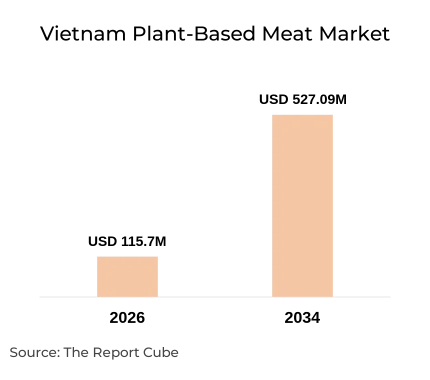
- Vietnam Plant-Based Meat Market valued at USD 115.70 million in 2026, reflecting accelerating consumer shift toward alternative proteins.
- Industry projected to reach USD 527.09 million by 2034 at a 20.87% CAGR across the forecast period.
- Chicken leads the By Meat Type segment, driven by its cultural familiarity and product versatility in Vietnamese cuisine.
- Restaurants and catering industry represents the dominant distribution channel, anchoring commercial plant-based protein adoption.
- Online retail is the fastest-growing distribution channel, fueled by expanding e-commerce penetration among urban Vietnamese consumers.
- Vissan JSC, Vinasoy, Beyond Meat, and Impossible Foods are among the key players shaping Vietnam's plant-based protein landscape.
- Plant-based product launches targeting Buddhist dietary observance and flexitarian consumers are accelerating category growth.
Market Overview
A comprehensive Vietnam Plant-Based Meat Market Analysis reveals the market was valued at USD 115.70 million in 2026 and is projected to reach USD 527.09 million by 2034 at a 20.87% CAGR. Rising health consciousness, urbanization, and a large Buddhist population with traditional meat-free dietary practices are collectively sustaining strong domestic demand for plant-based protein alternatives. Government programs promoting sustainable food production under Vietnam's Green Growth Strategy further support market expansion.
Vietnam's restaurant and foodservice sector is actively integrating plant-based meat options as consumer awareness of protein sustainability grows. The country's strategic positioning within Southeast Asia's food manufacturing corridor attracts global suppliers including Beyond Meat and Impossible Foods, while domestic leaders Vissan JSC and Vinasoy leverage established retail distribution networks. Growing interest in clean-label formulations and sustainably sourced ingredients is prompting supplier-level innovation across product categories targeting both institutional buyers and urban retail consumers.
Market Size & Forecast
|
Metric |
Details |
|---|---|
|
Market Size (2026) |
USD 115.70 Million |
|
Market Size (2034) |
USD 527.09 Million |
|
CAGR (2026–2034) |
20.87% |
|
Base Year |
2026 |
|
Historical Years |
2021–2025 |
|
Forecast Years |
2026–2034 |
The Vietnam Plant-Based Meat Market Size is estimated at USD 115.70 million in 2026 and is forecast to reach USD 527.09 million by 2034 at a 20.87% CAGR. This growth rate far exceeds the broader Southeast Asian food and beverage average, driven by a uniquely favorable combination of Buddhist dietary demand, rapid urban foodservice expansion, and increasing retail sophistication across Ho Chi Minh City and Hanoi.
Market Dynamics
The Vietnam Plant-Based Meat Market Growth is underpinned by a convergence of demographic, cultural, and structural factors reshaping Vietnam's protein consumption patterns. Rising urban incomes, expanding restaurant infrastructure, and Buddhist dietary traditions sustaining routine meat-free consumption days create a consistently large addressable base. Simultaneously, increasing government emphasis on sustainable food systems reinforces institutional adoption across the foodservice value chain.
|
Factor |
Type |
Specific Impact on Market |
Magnitude |
|---|---|---|---|
|
Buddhist dietary observance and flexitarian adoption |
Driver |
Creates large, recurring demand for meat alternatives across restaurant and retail channels |
High |
|
Urbanization and rising disposable income |
Driver |
Expands addressable consumer base in Ho Chi Minh City, Hanoi, and secondary urban centers |
High |
|
High price premium versus conventional meat |
Restraint |
Limits penetration among price-sensitive rural and lower-income consumer segments |
Medium |
|
Foodservice and HoReCa channel expansion |
Opportunity |
Accelerates commercial-scale plant-based protein integration in restaurants and catering operations |
High |
|
Raw material import dependency |
Challenge |
Exposes manufacturers to currency and supply chain volatility for soy and wheat protein inputs |
Medium |
|
Clean-label and health-positioned product innovation |
Trend |
Drives premiumization and new product launches from both domestic and international brands |
High |
- Growth Drivers: Vietnam's substantial Buddhist population observes regular meat-free days - an established cultural driver generating consistent plant-based protein demand well before modern flexitarian trends emerged. Urbanization is simultaneously broadening the consumer base, with Ho Chi Minh City and Hanoi residents demonstrating higher willingness to adopt premium alternative protein products.
- Market Opportunities: Vietnam's rapidly expanding foodservice sector, including international quick-service restaurant chains and domestic casual dining brands, is actively piloting plant-based menu items to attract health-conscious urban diners. Online retail channels present additional growth potential as platforms such as Shopee and Lazada extend reach to consumers beyond established modern trade retail networks.
- Industry Challenges: Domestic production remains partly reliant on imported soy protein concentrates and textured vegetable protein, exposing manufacturers to exchange rate volatility and international supply disruptions. Regulatory frameworks governing novel food ingredients and labeling for plant-based meat products continue to evolve, creating compliance uncertainty for both domestic producers and international brands entering the Vietnam market.
Need Specific Data, Let’s Customize the Report for You
Request CustomizationMarket Trends
- Emerging Trends: Vietnam Plant-Based Meat Market Trends include growing demand for Buddhist-diet-specific product ranges alongside mainstream flexitarian launches. Domestic brands are releasing locally flavored plant-based meat variants - including pho-compatible formats and bánh mì fillings - designed for traditional Vietnamese culinary applications and restaurant menus.
- Technology Trends: High-moisture extrusion technology and mycoprotein fermentation are entering Vietnam's plant-based protein manufacturing landscape, enabling closer textural and flavor replication of conventional chicken and pork. Digital flavor mapping platforms are allowing product development teams at Vinasoy and regional contract manufacturers to optimize seasoning profiles for Vietnamese consumer taste preferences.
- Consumer / Buyer Trends: Urban Vietnamese consumers aged 25–40 are the primary adopters of plant-based meat products, motivated by health positioning and environmental awareness rather than strict vegetarianism. Restaurant buyers increasingly specify clean-label credentials and recognizable ingredient lists when sourcing plant-based proteins for menu integration across casual dining and fast-food formats.
Vietnam Plant-Based Meat Market Segment Analysis
Vietnam's plant-based meat market serves distinct consumption segments shaped by culinary tradition, buyer purchasing behavior, distribution infrastructure, and product format preferences across urban and emerging provincial markets.
By Meat Type
- Chicken
- Beef
- Pork
- Others
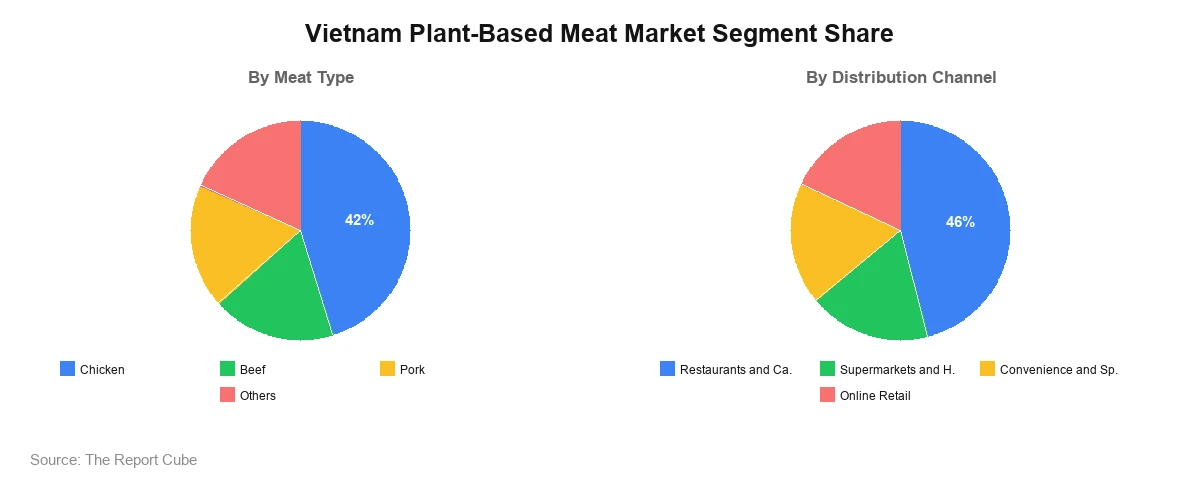
Chicken leads the By Meat Type segment, commanding an estimated 42% Vietnam Plant-Based Meat Market Share in 2026. Beyond Meat and Impossible Foods supply premium chicken-alternative SKUs through organized foodservice and modern retail, while Vissan JSC produces locally formulated plant-based chicken products suited to Vietnamese cooking applications. Pork-based alternatives hold approximately 31% share, reflecting strong cultural demand for pork substitutes among Buddhist dietary consumers and flexitarian restaurant operators. Beef alternatives account for roughly 17% of the segment, primarily serving Western-style quick-service restaurant chains. The Others category - covering seafood-style and mixed protein formats - represents the remaining 10%, growing as product developers experiment with locally relevant culinary applications.
By Distribution Channel
- Restaurants and Catering Industry
- Supermarkets and Hypermarkets
- Convenience and Specialty Stores
- Online Retail
Restaurants and the catering industry dominate the By Distribution Channel segment with an estimated 46% share in 2026, driven by foodservice operators sourcing plant-based proteins for menu diversification and cost management. Vinamilk's food ingredients division and Impossible Foods supply institutional quantities to hotel chains, catering companies, and restaurant groups. Supermarkets and hypermarkets, including WinMart and Aeon, hold approximately 28% channel share as modern trade retail expands plant-based shelf space. Convenience and specialty stores account for roughly 14%, with health-focused specialty retailers stocking premium imported SKUs. Online retail, representing the remaining 12%, is the fastest-growing distribution channel as Shopee Mall and Lazada expand ambient and chilled plant-based product assortments across Vietnam's urban consumer base.
Regional Analysis
|
Region |
Estimated Market Share |
Key Growth Factors |
Consumer Trends |
|---|---|---|---|
|
Southern Vietnam |
48% |
Ho Chi Minh City foodservice concentration, retail modernity, international brand presence |
Health-positioned plant-based adoption, restaurant pilot programs, online retail penetration |
|
Northern Vietnam |
34% |
Hanoi urban consumer base, institutional foodservice, rising middle-class demand |
Flexitarian interest, Buddhist diet observance, modern trade retail expansion |
|
Central Vietnam |
18% |
Da Nang tourism infrastructure, coastal hospitality sector growth |
Foodservice-driven demand, emerging retail interest, Buddhist dietary demand |
- Southern Vietnam - Accounting for approximately 48% of national plant-based meat demand, Ho Chi Minh City anchors this region's dominant position. International quick-service chains, premium restaurant operators, and modern retail formats including Aeon and WinMart have established plant-based protein shelf space, with Beyond Meat and Impossible Foods maintaining their strongest Vietnamese market presence in this region.
- Northern Vietnam - Hanoi's expanding urban middle class and active foodservice sector drive the region's 34% market share. Buddhist observance days generate recurring institutional demand from both restaurant operators and community catering services. Domestic brands Vissan JSC and Vinasoy hold their strongest distribution presence in this region through established wholesale and modern trade relationships.
- Central Vietnam - Da Nang's growing tourism industry and coastal hospitality infrastructure account for the region's 18% market share, with hotels and resort catering services driving plant-based protein procurement. Retail penetration remains lower relative to the northern and southern markets, but specialty health food stores and tourist-oriented restaurant concepts are accelerating category awareness.
Market Share & Competitive Landscape
Vietnam's plant-based meat competitive landscape combines global ingredient innovators with established domestic food manufacturers that hold deep distribution networks and existing consumer brand equity across Vietnamese retail and foodservice channels.
|
Company |
Competitive Strength |
Primary Segment Served |
|---|---|---|
|
Vissan JSC |
Domestic distribution network, established brand trust, local flavor formulation |
Retail, restaurants, catering |
|
Vinasoy |
Soy processing expertise, cost-competitive manufacturing, national distribution |
Retail, foodservice, ingredient supply |
|
Vinamilk |
Cold chain infrastructure, retail reach, product diversification capability |
Supermarkets, convenience stores |
|
Beyond Meat |
Global brand recognition, advanced textural formulation, foodservice partnerships |
Premium restaurants, modern trade retail |
|
Impossible Foods |
Heme-based flavor technology, restaurant chain partnerships, health positioning |
QSR, casual dining, specialty retail |
|
Others |
Emerging regional and contract manufacturers expanding plant-based production capacity |
Varied across channels |
Key Companies in the Vietnam Plant-Based Meat Market
Vissan JSC
Vissan JSC, headquartered in Ho Chi Minh City, Vietnam, is one of the country's largest processed meat manufacturers with over five decades of domestic food industry operations. In 2024, Vissan expanded its plant-based product line under its existing retail brand architecture, targeting Buddhist dietary consumers and urban flexitarian households through modern trade and wet market distribution channels. Its established cold chain logistics represent a significant competitive advantage in Vietnam's fragmented distribution landscape.
Beyond Meat
Beyond Meat, headquartered in El Segundo, California, USA, is a globally recognized plant-based meat innovator operating across more than 80 countries. In 2025, the company intensified its Southeast Asian foodservice strategy, strengthening partnerships with international quick-service restaurant chains operating in Vietnam's major urban markets. Beyond Meat's proprietary pea protein extrusion technology and established food safety certifications position it as the premium-tier reference brand for foodservice operators seeking plant-based protein menu integration.
Recent Developments
|
Year |
Company |
Development |
|---|---|---|
|
2025 |
Beyond Meat |
Expanded Southeast Asia foodservice partnerships, increasing restaurant distribution presence across Vietnam's major urban centers |
|
2025 |
Impossible Foods |
Strengthened Vietnam market entry strategy, engaging quick-service restaurant chains in Ho Chi Minh City for menu integration pilots |
Market Future Outlook
The Vietnam Plant-Based Meat Market Forecast projects the sector reaching USD 527.09 million by 2034 at a 20.87% CAGR, sustained by expanding urban middle-class consumption, Buddhist dietary demand, and deepening foodservice integration. Vissan JSC and Vinasoy are expected to invest in high-moisture extrusion capacity to close the textural gap between domestic plant-based products and imported premium alternatives. International brands will continue prioritizing Vietnam as a Southeast Asian expansion market through 2034.
Advancement in flavor replication technologies, including fermentation-derived protein systems and AI-assisted recipe formulation, will improve product quality and expand the consumer base beyond current early adopters. Regulatory clarity under Vietnam's updated novel food frameworks and ASEAN food safety harmonization will reduce compliance friction for new market entrants. Growing sustainability certification requirements from international restaurant chains operating in Vietnam will further accelerate certified plant-based protein procurement across the foodservice channel.
Vietnam Plant-Based Meat Market Report Coverage
This Vietnam Plant-Based Meat Market Report covers market sizing, segmentation, competitive profiling, and regional demand analysis across the 2026–2034 forecast period.
|
Report Attribute |
Details |
|---|---|
|
Market Name |
Vietnam Plant-Based Meat Market |
|
Market Size (2026) |
USD 115.70 Million |
|
Market Size (2034) |
USD 527.09 Million |
|
Forecast Period |
2026–2034 |
|
CAGR |
20.87% |
|
Base Year |
2026 |
|
Historical Years |
2021–2025 |
|
Forecast Years |
2026–2034 |
|
Segments Covered |
By Product Type, By Source, By Meat Type, By Distribution Channel |
|
Regions Covered |
Northern Vietnam, Central Vietnam, Southern Vietnam |
|
Key Companies |
Vissan JSC, Vinasoy, Vinamilk, Beyond Meat, Impossible Foods, Others |
|
Report Format |
PDF, Excel, PPT |
|
Customization |
Available as per client requirements |
Why Choose This Vietnam Plant-Based Meat Market Report?
- Comprehensive coverage of Vietnam's rapidly expanding plant-based protein industry across all key segments and channels.
- Accurate market sizing from USD 115.70 million in 2026 through the 2034 forecast horizon.
- Detailed segmentation by meat type (Chicken, Beef, Pork, Others) and distribution channel with share estimates.
- Regional insights covering Northern, Central, and Southern Vietnam with demand drivers and channel trends.
- Competitive profiling of domestic leaders and global brands shaping Vietnam's plant-based protein landscape.
- Analysis of Buddhist dietary demand and flexitarian consumer trends driving structural category growth.
- Forecast data supporting strategic investment, market entry planning, and foodservice partnership decisions.
- Research aligned with Vietnam's Green Growth Strategy and sustainable food system development objectives.
Table of Contents
- Introduction
- Objective of the Study
- Product Definition
- Market Segmentation
- Study Variables
- Research Methodology
- Secondary Data Points
- Companies Interviewed
- Primary Data Points
- Breakdown of Primary Interviews
- Secondary Data Points
- Executive Summary
- Market Dynamics
- Drivers
- Challenges
- Opportunity Assessment
- Recent Trends and Developments
- Policy and Regulatory Landscape
- Vietnam Plant-Based Meat Market Overview and Forecast Analysis (2021-2034)
- Market Size, By Value, By Growth Rate (CAGR/USD Millions)
- Demand – Supply Trends
- Market Share, By Product Type
- Burger Patties
- Sausages
- Nuggets and Strips
- Ground Meat
- Meatballs
- Others
- Market Share, By Source
- Soy
- Wheat
- Peas
- Others
- Market Share, By Meat Type
- Chicken
- Beef
- Pork
- Others
- Market Share, By Distribution Channel
- Restaurants and Catering Industry
- Supermarkets and Hypermarkets
- Convenience and Specialty Stores
- Online Retail
- Market Share, By Region
- Northern Vietnam
- Central Vietnam
- Southern Vietnam
- Market Share, By Competitors
- Competition Characteristics
- Revenue Shares
- Burger Patties Vietnam Plant-Based Meat Market Overview, 2021-2034F
- By Value (USD Million)
- By Source – Market Size & Forecast 2021-2034, USD Million
- Soy
- Wheat
- Peas
- Others
- Sausages Vietnam Plant-Based Meat Market Overview, 2021-2034F
- By Value (USD Million)
- By Source – Market Size & Forecast 2021-2034, USD Million
- Soy
- Wheat
- Peas
- Others
- Nuggets and Strips Vietnam Plant-Based Meat Market Overview, 2021-2034F
- By Value (USD Million)
- By Source – Market Size & Forecast 2021-2034, USD Million
- Soy
- Wheat
- Peas
- Others
- Ground Meat Vietnam Plant-Based Meat Market Overview, 2021-2034F
- By Value (USD Million)
- By Source – Market Size & Forecast 2021-2034, USD Million
- Soy
- Wheat
- Peas
- Others
- Meatballs Vietnam Plant-Based Meat Market Overview, 2021-2034F
- By Value (USD Million)
- By Source – Market Size & Forecast 2021-2034, USD Million
- Soy
- Wheat
- Peas
- Others
- Others Vietnam Plant-Based Meat Market Overview, 2021-2034F
- By Value (USD Million)
- By Source – Market Size & Forecast 2021-2034, USD Million
- Soy
- Wheat
- Peas
- Others
- Competitive Outlook (Company Profile - Partial List)
- Vissan JSC
- Company Overview
- Business Segments
- Strategic Alliances/Partnerships
- Recent Developments
- Vinasoy
- Company Overview
- Business Segments
- Strategic Alliances/Partnerships
- Recent Developments
- Vinamilk
- Company Overview
- Business Segments
- Strategic Alliances/Partnerships
- Recent Developments
- Beyond Meat
- Company Overview
- Business Segments
- Strategic Alliances/Partnerships
- Recent Developments
- Impossible Foods
- Company Overview
- Business Segments
- Strategic Alliances/Partnerships
- Recent Developments
- Others
- Vissan JSC
- Contact Us & Disclaimer
Top Key Players & Market Share Outlook
- Vissan JSC
- Vinasoy
- Vinamilk
- Beyond Meat
- Impossible Foods
- Others
Frequently Asked Questions






