




Build Your Custom Market Intelligence Report
Customize Your ReportGlobal Plywood Market Insights & Analysis
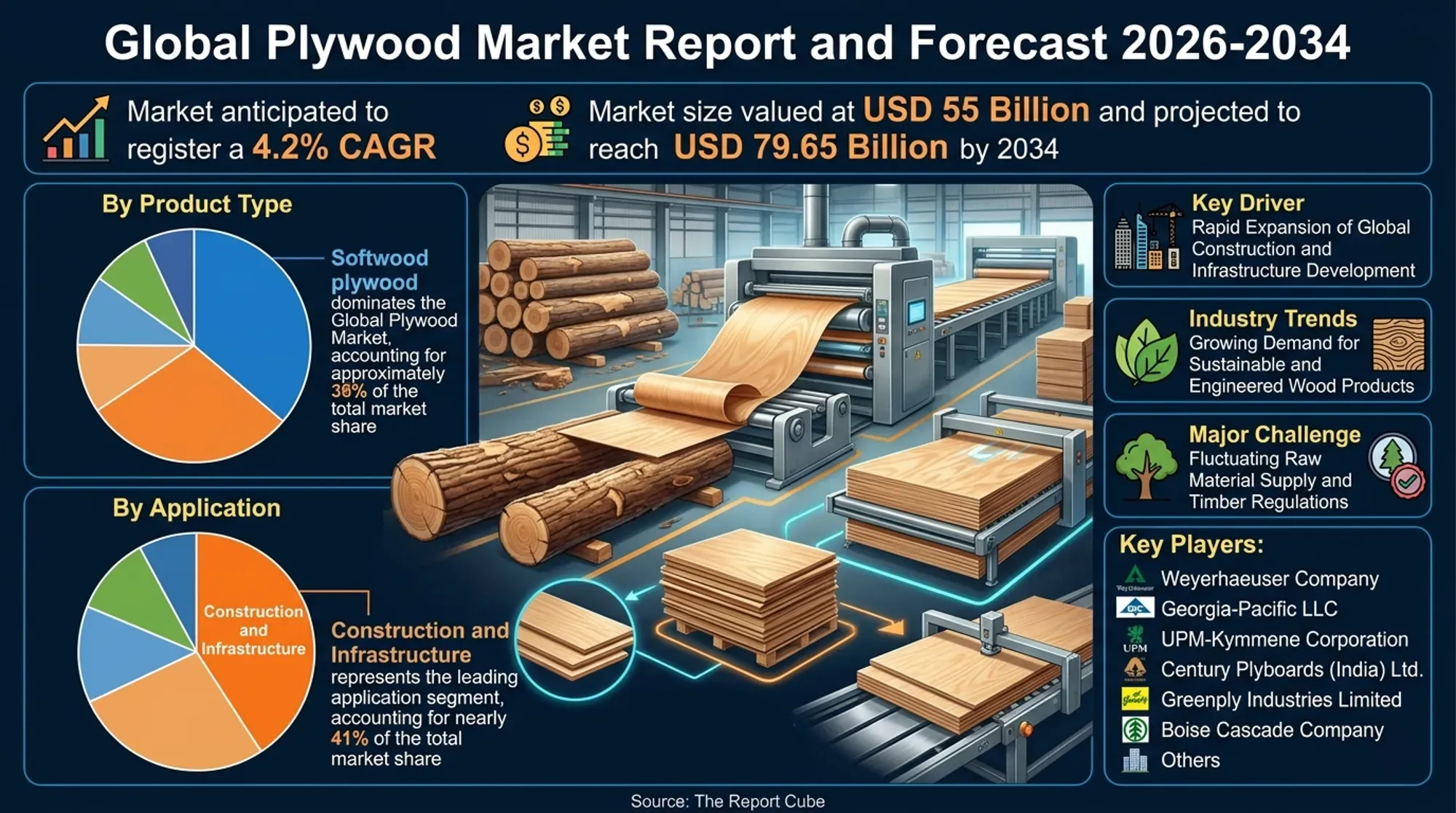
The Global Plywood Market is anticipated to register a 4.2% during 2026-2034. The market size was valued at USD 55 Billion and is projected to reach USD 79.65 Billion by 2034.
The Global Plywood Market is expected to experience steady growth over the coming years, supported by rising demand across construction, furniture manufacturing, and infrastructure development sectors. Plywood, known for its durability, versatility, and cost-effectiveness, remains one of the most widely used engineered wood products worldwide. Its layered wood veneer structure provides superior strength and stability compared to traditional solid wood, making it ideal for structural and decorative applications. Increasing urbanization, particularly in emerging economies across Asia Pacific and Latin America, is significantly boosting the demand for residential and commercial construction materials, thereby supporting the expansion of the plywood market.
In addition, the growing furniture manufacturing industry is contributing substantially to plywood consumption globally. Manufacturers increasingly prefer plywood due to its lightweight characteristics, resistance to cracking, and adaptability for interior design applications such as cabinets, wardrobes, flooring, and wall paneling. The rising popularity of modular furniture and ready-to-assemble furniture products has further increased the utilization of plywood in furniture production. Rapid growth in real estate development and renovation projects across developed regions such as North America and Europe also strengthens market expansion.
Furthermore, technological advancements in wood processing and manufacturing are improving plywood quality and performance characteristics. Modern production technologies allow manufacturers to produce moisture-resistant, fire-retardant, and high-strength plywood variants for specialized applications. Sustainability initiatives are also encouraging the use of engineered wood products like plywood as an environmentally responsible alternative to solid timber. With increasing investments in infrastructure, rising consumer spending on home interiors, and expanding construction activities worldwide, the Global Plywood Market is projected to maintain consistent growth throughout the forecast period.
Global Plywood Market Recent Developments
- 2025: Weyerhaeuser Company expanded engineered wood production capacity to meet rising demand from residential construction and infrastructure projects.
- 2025: Greenply Industries Limited launched eco-friendly plywood manufactured using sustainable wood sourcing and low-emission adhesive technologies.
Government Initiatives & Policies
- EU Forest Strategy for 2030: Promotes sustainable forestry and responsible wood product manufacturing across European countries.
- National Mission for Sustainable Housing (India): Encourages environmentally sustainable construction materials including engineered wood products.
Global Plywood Market Dynamics
Key Driver: Rapid Expansion of Global Construction and Infrastructure Development
The rapid growth of global construction and infrastructure activities represents one of the primary drivers of the Global Plywood Market. Plywood is widely used in construction applications such as flooring, roofing, wall sheathing, and formwork due to its high structural strength and durability. Increasing urbanization and population growth are fueling housing demand worldwide, particularly in developing economies such as India, China, Indonesia, and Brazil. Governments in these countries are investing heavily in residential housing, transportation infrastructure, and smart city projects, which significantly increases the demand for building materials including plywood.
Additionally, large-scale infrastructure projects such as highways, bridges, airports, and commercial complexes require durable construction materials capable of handling structural loads and environmental stress. Plywood offers cost advantages compared to solid wood and can be easily shaped or customized for various structural applications. The expansion of prefabricated construction systems also increases plywood utilization in modular building components.
In developed regions like North America and Europe, renovation and remodeling activities contribute substantially to plywood demand. Homeowners increasingly invest in interior improvements such as flooring upgrades, wall paneling, and custom furniture installations. As construction activity continues to expand globally and urban populations grow steadily, plywood remains a critical material supporting modern infrastructure development.
Industry Trends: Growing Demand for Sustainable and Engineered Wood Products
Sustainability has become a major trend influencing the Global Plywood Market. Governments and environmental organizations are promoting responsible forest management and the use of sustainable wood materials to reduce environmental impact. As a result, manufacturers are increasingly adopting certified timber sourcing practices such as Forest Stewardship Council (FSC) certification. These practices ensure that raw materials used in plywood production originate from responsibly managed forests.
Book your FREE 30-minute expert consultation today
Contact UsAnother important trend involves technological advancements in engineered wood manufacturing. Modern plywood production technologies enable manufacturers to create high-performance products with enhanced durability, moisture resistance, and fire resistance. These improved performance characteristics expand plywood applications in industries such as transportation, marine construction, and industrial packaging.
Additionally, the increasing adoption of modular and prefabricated construction methods is boosting plywood demand globally. Modular construction requires lightweight and durable materials that can be easily transported and assembled. Plywood’s structural strength and adaptability make it ideal for modular construction panels and prefabricated housing systems. As sustainable construction practices and modern building technologies continue to evolve, the demand for advanced plywood products is expected to grow significantly.
Major Challenge: Fluctuating Raw Material Supply and Timber Regulations
One of the key challenges affecting the Global Plywood Market is the fluctuation in raw material supply, particularly timber and wood veneers. Plywood production depends heavily on the availability of high-quality wood, and restrictions on logging activities can significantly affect supply chains. Many countries have implemented strict forestry regulations to prevent deforestation and promote sustainable forest management. While these policies are essential for environmental protection, they can also limit timber availability and increase production costs for plywood manufacturers.
In addition, global supply chain disruptions and transportation costs can affect the availability of raw materials used in plywood manufacturing. Price fluctuations for timber, adhesives, and other raw materials may lead to increased production expenses, which can impact product pricing in the market.
Furthermore, competition from alternative materials such as medium density fiberboard (MDF), particleboard, and composite panels also poses a challenge to the plywood industry. These alternatives sometimes offer lower production costs and comparable functionality for certain applications. However, plywood continues to maintain its market position due to superior durability and strength.
Opportunity: Rising Demand from Furniture Manufacturing and Interior Design
The furniture manufacturing sector presents significant growth opportunities for the Global Plywood Market. Plywood is widely used in furniture production due to its high load-bearing capacity, smooth surface finish, and resistance to warping. Furniture manufacturers prefer plywood for producing cabinets, wardrobes, tables, and decorative interior panels.
The increasing popularity of modular furniture and customized interior design solutions is accelerating plywood consumption globally. Urban households increasingly prefer space-efficient furniture designs that maximize functionality within limited living spaces. Plywood is particularly suitable for modular furniture manufacturing because it can be easily cut, shaped, and laminated to create aesthetically appealing products.
Additionally, growth in e-commerce and online furniture retail platforms is driving higher demand for ready-to-assemble furniture products. These products rely heavily on plywood and engineered wood panels due to their lightweight structure and durability during transportation. Rising consumer spending on home renovation and interior decoration further strengthens market opportunities for plywood manufacturers worldwide.
Global Plywood Market Segment-wise Analysis
By Product Type:
- Softwood Plywood
- Hardwood Plywood
- Tropical Plywood
- Decorative Plywood
Softwood plywood dominates the Global Plywood Market, accounting for approximately 36% of the total market share. This segment is widely used in construction and structural applications such as roofing, flooring, and wall sheathing. Softwood plywood is manufactured using softwood species such as pine, fir, and spruce, which provide excellent strength-to-weight ratios and durability. Due to its structural reliability and cost efficiency, softwood plywood remains the preferred choice for large-scale construction projects.
Hardwood plywood is also widely used in furniture manufacturing and decorative applications due to its attractive surface finish and superior strength. Decorative plywood products are gaining popularity in interior design and architectural applications where aesthetic appeal is essential. Meanwhile, tropical plywood is commonly utilized in regions where tropical hardwood species are readily available. Overall, softwood plywood continues to lead the market due to its extensive use in structural construction and infrastructure projects worldwide.
By Application:
- Furniture Manufacturing
- Construction and Infrastructure
- Flooring
- Packaging
Construction and Infrastructure represents the leading application segment in the Global Plywood Market, accounting for nearly 41% of the total market share. Plywood is extensively used in construction for wall sheathing, concrete formwork, flooring panels, and roofing structures. The material’s strength, flexibility, and ease of installation make it highly suitable for residential and commercial building projects.
Furniture manufacturing is another major application segment driven by the rapid expansion of the global furniture industry. Plywood is widely used in the production of cabinets, wardrobes, office furniture, and interior decorative elements. Its ability to maintain dimensional stability and support heavy loads makes it an ideal material for long-lasting furniture products.
The flooring segment also contributes significantly to plywood consumption due to its durability and resistance to moisture. Additionally, plywood is widely used in packaging applications such as crates and pallets for transporting industrial goods. These diverse applications across multiple industries continue to strengthen the demand for plywood globally.
Regional Projection of Global Plywood Industry
- North America
- Europe
- Asia Pacific
- Middle East and Africa
Asia Pacific leads the Global Plywood Market, accounting for approximately 46% of the total market share. The region’s dominance is primarily driven by rapid urbanization, large-scale infrastructure development, and expanding furniture manufacturing industries in countries such as China, India, Indonesia, and Vietnam. These countries are experiencing strong growth in residential construction, which significantly increases demand for plywood and other engineered wood products.
China remains the largest producer and consumer of plywood globally due to its massive construction industry and extensive furniture manufacturing sector. India is also emerging as a major market due to increasing housing demand and government initiatives supporting infrastructure development. In addition, Southeast Asian countries such as Indonesia and Malaysia are major plywood exporters supplying international markets.
North America and Europe also represent significant plywood markets driven by renovation projects and sustainable construction initiatives. Meanwhile, the Middle East and Africa are experiencing growing demand due to infrastructure expansion and urban development. However, Asia Pacific continues to dominate the global plywood industry due to its strong manufacturing capacity, abundant timber resources, and rapidly expanding construction sector.
Need insights for a specific region within this market?
Request Regional DataWhy Choose This Report?
- Provides a comprehensive overview of the overall market analysis, encompassing key trends, consumer behavior analysis, and risk assessment to support strategic decision-making.
- Provides accurate, up-to-date insights into market size, segmentation, and emerging opportunities, helping to minimize risk & capitalizing on growth.
- Gives deep understanding of target audience preferences, investment habits, and communication channels for enhanced product development & marketing effectiveness.
- Delivers competitive analysis & benchmarking, uncovering the strengths & weaknesses of market competitors to guide strategies.
- Consolidate comprehensive market intelligence, reducing reasoning & streamlining research efforts.
- Facilitates customized market segmentation & risk mitigation strategies, fine-tuned to the business objectives.
- Aids in identifying both market challenges & untapped opportunities within the industry to drive long-term business growth.
- Provides valuable information based on actual customer data & search trends.
Table of Contents
- Introduction
- Objective of the Study
- Product and Category Definition
- Market Segmentation
- Study Variables
- Research Methodology
- Secondary Data Points
- Breakdown of Secondary Sources
- Primary Data Points
- Breakdown of Primary Interviews
- Secondary Data Points
- Executive Summary
- Market Dynamics
- Drivers
- Challenges
- Opportunity Assessment
- Recent Trends and Developments
- Regulatory and Policy Landscape
- Global Plywood Market Overview (2026-2034)
- Market Size, By Value (USD Billion)
- Market Share, By Product Type
- Softwood Plywood
- Hardwood Plywood
- Tropical Plywood
- Decorative Plywood
- Marine Plywood
- Market Share, By Grade Type
- Structural Grade
- Exterior Grade
- Interior Grade
- Market Share, By Thickness
- Less than 8 mm
- 8–18 mm
- Above 18 mm
- Market Share, By Application
- Furniture Manufacturing
- Construction and Infrastructure
- Flooring
- Packaging
- Transportation
- Others
- Market Share, By Distribution Channel
- Direct Sales
- Distributors and Wholesalers
- Retail Stores
- Online Channels
- Market Share, By Region
- North America
- Europe
- Asia Pacific
- Middle East and Africa
- South America
- Market Share, By Company
- Revenue Shares and Analysis
- Competitive Landscape
- North America Plywood Market
- Market Size, By Value (USD Billion/Million)
- Market Share, By Product Type
- Market Share, By Grade Type
- Market Share, By Thickness
- Market Share, By Application
- Europe Plywood Market
- Market Size, By Value (USD Billion/Million)
- Market Share, By Product Type
- Market Share, By Grade Type
- Market Share, By Thickness
- Market Share, By Application
- Asia Pacific Plywood Market
- Market Size, By Value (USD Billion/Million)
- Market Share, By Product Type
- Market Share, By Grade Type
- Market Share, By Thickness
- Market Share, By Application
- Middle East and Africa Plywood Market
- Market Size, By Value (USD Billion/Million)
- Market Share, By Product Type
- Market Share, By Grade Type
- Market Share, By Thickness
- Market Share, By Application
- South America Plywood Market
- Market Size, By Value (USD Billion/Million)
- Market Share, By Product Type
- Market Share, By Grade Type
- Market Share, By Thickness
- Market Share, By Application
- Competitive Outlook and Company Profiles
- Weyerhaeuser Company
- Company Overview
- Product Portfolio
- Strategic Alliances/Partnerships
- Recent Developments
- Georgia-Pacific LLC
- Company Overview
- Product Portfolio
- Strategic Alliances/Partnerships
- Recent Developments
- UPM-Kymmene Corporation
- Company Overview
- Product Portfolio
- Strategic Alliances/Partnerships
- Recent Developments
- Century Plyboards (India) Ltd.
- Company Overview
- Product Portfolio
- Strategic Alliances/Partnerships
- Recent Developments
- Greenply Industries Limited
- Company Overview
- Product Portfolio
- Strategic Alliances/Partnerships
- Recent Developments
- Boise Cascade Company
- Company Overview
- Product Portfolio
- Strategic Alliances/Partnerships
- Recent Developments
- Weyerhaeuser Company
- Contact Us and Disclaimer
Top Key Players & Market Share Outlook
-
Weyerhaeuser Company
-
Georgia-Pacific LLC
-
UPM-Kymmene Corporation
-
Century Plyboards (India) Ltd.
-
Greenply Industries Limited
-
Boise Cascade Company
-
Others
Frequently Asked Questions






