



Build Your Custom Market Intelligence Report
Customize Your ReportSaudi Arabia Port Infrastructure Market Statistics and Insights
Market Insight
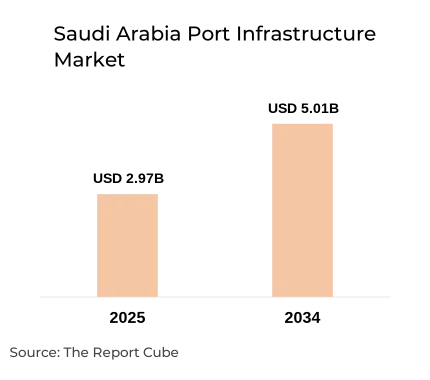
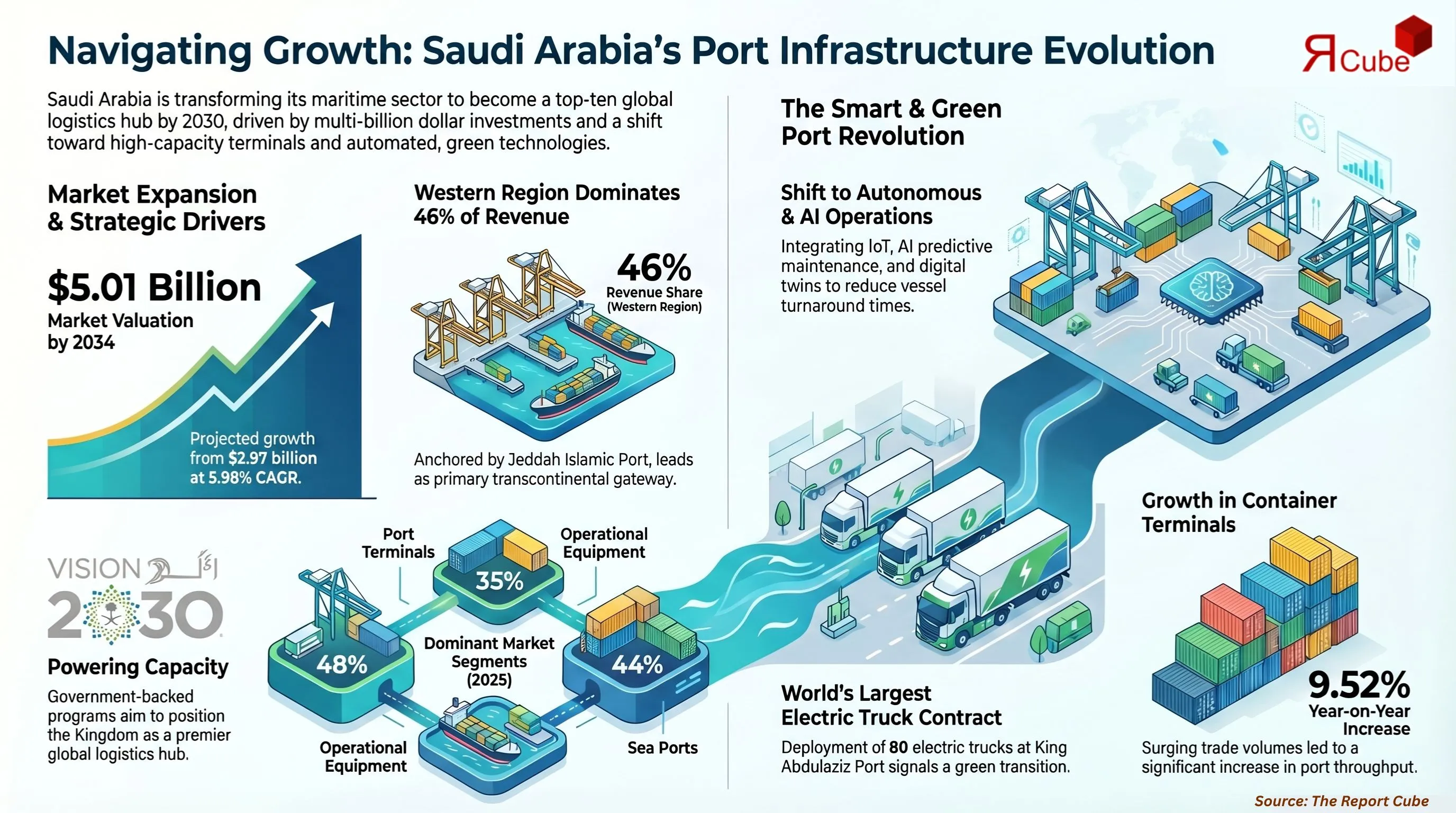
- The Saudi Arabia Port Infrastructure Market was valued at USD 2.97 billion in 2025.
- The market is projected to reach USD 5.01 billion by 2034 globally.
- The market is anticipated to register a robust 5.98% CAGR through 2034.
By Elements
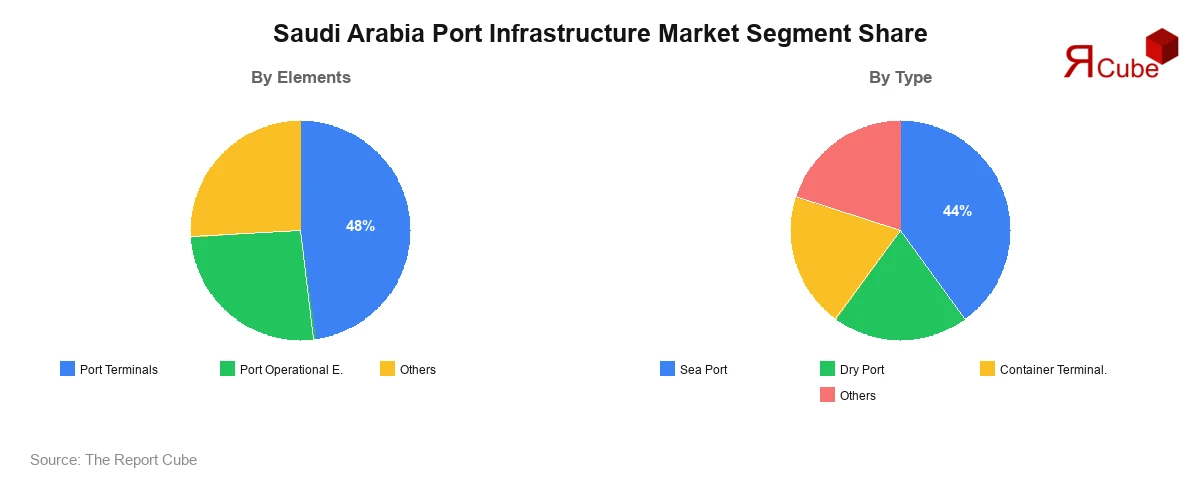
- Port Terminals dominate the segment, commanding approximately 48% market share.
Competitive Landscape
- More than 10 companies are actively engaged in producing Saudi Arabia Port Infrastructure Market solutions.
- Top 5 companies acquired around 55% of the market share.
- PSA International Pte Ltd, Hutchison Port Holdings Management Pte. Limited, DP World Limited, China Merchants Port Holdings Co. Ltd, COSCO SHIPPING Ports Limited, and others.
By Type
- Sea Port leads with the highest contribution, holding around 44% of total revenue share.
Saudi Arabia Port Infrastructure Market Insights & Analysis
The Saudi Arabia Port Infrastructure Market is anticipated to register a 5.98% CAGR during 2026–2034. The market size was valued at USD 2.97 billion in 2025 and is projected to reach USD 5.01 billion by 2034. Saudi Arabia's port infrastructure sector is undergoing a structural transformation propelled by Vision 2030 and the National Industrial Development and Logistics Program (NIDLP). The Kingdom's dual coastline, spanning the Red Sea to the west and the Arabian Gulf to the east, grants unparalleled access to transcontinental shipping lanes, making it a pivotal node in global maritime commerce.
Government-backed capital deployment has been decisive in shaping market trajectories. The Saudi Ports Authority (Mawani) committed USD 79 million toward a major logistics zone at King Abdulaziz Port in Dammam in April 2025, as part of a broader SR10 billion initiative to establish 20 integrated logistics hubs. Furthermore, investments in the maritime sector have surpassed SR25 billion (USD 6.66 billion), channeled through public-private partnerships with global operators. These financial commitments are reinforcing port capacity, expanding terminal throughput, and catalyzing widespread adoption of automation and smart port technologies across the Kingdom's principal port facilities.
Saudi Arabia Port Infrastructure Market Dynamics
Key Market Driver: Vision 2030 Propelling Port Capacity Expansion
Saudi Arabia's ambitious Vision 2030 agenda is the foremost catalyst accelerating port infrastructure investments. The National Transport and Logistics Strategy, a sub-framework of Vision 2030, envisions the Kingdom as a top-ten global logistics hub by the end of the decade. Mawani's port development roadmap includes expansions at Jeddah Islamic Port, King Abdulaziz Port in Dammam, and King Fahd Industrial Port in Yanbu.
In June 2024, King Abdulaziz Port reported a 9.7% increase in crane capacity as part of a SR7 billion investment package, including the deployment of automated quay cranes and rubber-tired gantry cranes. Transshipment container volumes surged 4.74% to 166,791 TEUs in mid-2024, while August 2025 recorded a 9.52% year-on-year increase in total port throughput, reaching 750,634 TEUs, underscoring the direct impact of infrastructure upgrades on operational performance and trade volumes.
Major Industry Challenge: Regulatory Compliance Across Multinational Maritime Standards
One of the most significant challenges confronting the Saudi Arabia Port Infrastructure Market is navigating complex and evolving international maritime regulatory frameworks. Saudi ports must adhere to International Maritime Organization (IMO) conventions, including MARPOL environmental regulations, the International Ship and Port Facility Security (ISPS) Code, and Safety of Life at Sea (SOLAS) standards. Achieving compliance across diverse port typologies, from bulk cargo and container terminals to industrial and cruise facilities, demands continuous investment in safety infrastructure, environmental management systems, and workforce training. The simultaneous integration of these frameworks with domestic regulatory mandates from the Saudi Ports Authority creates operational complexity, particularly for greenfield port developments and existing terminals undergoing phased modernization. Non-compliance risks include shipping line defection, reputational damage, and access restrictions to international trade corridors, making regulatory alignment a critical operational priority.
Emerging Trend Shaping Outlook: Smart Port Technology and Electrification Reshaping Operations
The adoption of smart port technologies is rapidly redefining operational benchmarks across Saudi Arabia's port ecosystem. In June 2024, Saudi Global Ports, a subsidiary of the Public Investment Fund, signed the world's largest single electric truck contract, procuring 80 electric trucks from China's SANY for King Abdulaziz Port in Dammam. This electrification initiative, part of a SR7 billion investment, represents a watershed moment in green port infrastructure.
Parallel to electrification, the Smart Ports Initiative and the Logisti 2 platform are embedding IoT sensors, AI-driven predictive maintenance, blockchain-based documentation systems, and real-time cargo tracking into port management workflows. These technologies are reducing vessel turnaround times, minimizing idle equipment periods, and enhancing port gate security. By 2034, fully automated terminals with digital twin capabilities are expected to constitute a significant share of new terminal developments, setting Saudi ports apart as technology-forward maritime infrastructure hubs in the Middle East.
Need Specific Data, Let’s Customize the Report for You
Request CustomizationSaudi Arabia Port Infrastructure Market Segment-wise Analysis
Saudi Arabia's port infrastructure market exhibits a rich segmentation landscape shaped by infrastructure typology and port classification. The "By Elements" dimension reveals distinct investment preferences between terminal hardware, operational equipment, and ancillary infrastructure, while the "By Type" dimension underscores the strategic diversification of Saudi Arabia's port ecosystem beyond traditional seaports toward dry ports and specialized container terminals.
By Elements
- Port Terminals
- Port Operational Equipment
- Others
Port Terminals represent the largest and most capital-intensive sub-segment, accounting for approximately 48% of total market revenue in 2025. This dominance is driven by large-scale greenfield and brownfield terminal construction projects at Jeddah Islamic Port, King Abdulaziz Port in Dammam, and King Fahd Industrial Port in Yanbu. Terminal expansions are being designed to accommodate ultra-large container vessels (ULCVs) and specialized bulk cargo carriers, requiring deep-draft berths, extended quay lengths, and advanced yard management systems.
Port Operational Equipment holds the second-largest share at approximately 35%, fueled by procurement of automated cranes, electric cargo-handling machinery, and port management software platforms. The introduction of automated quay cranes and rubber-tired gantry cranes at King Abdulaziz Port exemplifies this investment trend. The "Others" sub-segment, comprising logistics zones, warehousing facilities, and ancillary port services infrastructure, constitutes the remaining share, though it is experiencing accelerated growth as 17 new logistics zones under development at Jeddah and Dammam are brought online progressively through 2034.
By Type
- Sea Port
- Dry Port
- Container Terminals
- Others
Sea Ports constitute the foundational pillar of Saudi Arabia's port infrastructure, commanding approximately 44% of total market revenue. The Kingdom's principal seaports, Jeddah Islamic Port on the Red Sea and King Abdulaziz Port on the Arabian Gulf, collectively handle a dominant share of the country's import, export, and transshipment volumes. Jeddah Islamic Port alone functions as the largest port in the Kingdom, serving as the primary maritime gateway linking Saudi Arabia with European, African, and Asian markets. Container Terminals represent the fastest-growing sub-segment, driven by surging containerized trade volumes, August 2025 recorded 750,634 TEUs processed at Saudi ports, a 9.52% year-on-year increase.
Dedicated container terminal investments, including Maersk's SR1.3 billion commitment at Jeddah Port, are enabling higher throughput efficiency and improved vessel scheduling. Dry Ports are gaining strategic relevance as inland logistics extensions, particularly in Riyadh and Dammam, bridging seaport connectivity with industrial zones and manufacturing clusters. Others, covering specialized industrial and bulk cargo ports, contribute a stable share aligned with the Kingdom's continued oil and petrochemical export volumes.
Port–Logistics–Warehousing Integration Mapping
| Port | Nearby Logistics Zones | Connected Industrial Cities | Connectivity | Demand | Industries |
|---|---|---|---|---|---|
| Jeddah Islamic Port | Jeddah Logistics Park | Jeddah Industrial City | Strong | High | Retail, FMCG |
| King Abdullah Port | KAEC SEZ | KAEC Industrial Zone | Strong | High | Manufacturing |
| Dammam Port | Dammam Logistics Zone | Jubail Industrial City | Strong | Very High | Petrochemicals |
| Yanbu Port | Yanbu Industrial Cluster | Yanbu Industrial City | Moderate | Medium | Chemicals |
Cargo Mix & Demand Structure Analysis
| Cargo Type | Market Position | Growth Trend | Key Ports | Strategic Importance |
|---|---|---|---|---|
| Container Cargo | Dominant | Fast Growing | Jeddah, KAEC | Trade diversification |
| Liquid Bulk | Very High | Stable | Ras Tanura, Jubail | Oil exports backbone |
| Dry Bulk | Moderate | Growing | Dammam, Yanbu | Construction demand |
| Ro-Ro | Niche | Moderate Growth | Jeddah | Automotive imports |
Regional Projection of Saudi Arabia Port Infrastructure Market
The Saudi Arabia Port Infrastructure Market is primarily a domestic market, with regional analysis centered on the Kingdom's key port clusters:
- Western Region
- Eastern Region
- Central Region
- Northern Region
- Southern Region
The Western Region, anchored by Jeddah Islamic Port and King Abdullah Port, commands the largest market share at approximately 46%, owing to its role as the primary gateway for imports, exports, and transshipment traffic linking Europe, Africa, and Asia. Jeddah's port cluster benefits from established shipping line networks, proximity to global trade corridors, and sustained government capital expenditure in terminal modernization and logistics zone development.
Saudi Arabia Port-wise Capacity & Utilization Analysis
| Port Name | Capacity Position | Utilization Level | Expansion Status | Key Operator |
|---|---|---|---|---|
| Jeddah Islamic Port | Very High | High | Ongoing Expansion | Mawani |
| King Abdullah Port | High | Moderate-High | Rapid Expansion | Private Operator |
| Dammam Port | High | High | Modernization | Mawani / PSA |
| Jubail Industrial Port | Medium | High | Stable | Govt |
| Yanbu Industrial Port | Medium | Moderate | Expansion Planned | Govt |
Saudi Arabia Port Infrastructure Market: Recent Development (2025)
- Mawani invested USD 79 million in a Dammam logistics zone, boosting port capacity significantly.
- Maersk committed SR1.3 billion at Jeddah Port, its largest global investment, generating USD 250 million economic impact.
- Saudi Global Ports procured 80 electric trucks from SANY, forming the world's largest single electric truck contract.
- Evergreen Marine launched the ARPG service at King Abdulaziz Port, expanding Asia-Middle East connectivity routes.
Saudi Arabia Port Infrastructure Market Future Outlook (2034)
The Saudi Arabia Port Infrastructure Market is poised for sustained expansion, projected to register a 5.98% CAGR and reach USD 5.01 billion by 2034. This trajectory will be shaped by the convergence of large-scale terminal investments, technology-led operational transformation, and Vision 2030's logistics diversification agenda. Green port infrastructure, encompassing electrified cargo-handling equipment, renewable energy integration, and emissions-reduction protocols, will define next-generation port development across Jeddah, Dammam, and Yanbu.
AI-driven port management systems, including digital twin simulations, predictive berth scheduling, and autonomous vessel guidance platforms, are set to become standard operating infrastructure at Tier-1 Saudi ports. The continued development of 20 logistics hubs under the SR10 billion Mawani initiative, alongside growing public-private partnership pipelines, will unlock long-term investment inflows and cement Saudi Arabia's position as the preeminent maritime infrastructure hub in the Middle East and North Africa region.
Why Choose This Report?
- Provides a comprehensive overview of the overall market analysis, encompassing key trends, consumer behavior analysis, and risk assessment to support strategic decision-making.
- Provides accurate, up-to-date insights into market size, segmentation, and emerging opportunities, helping to minimize risk & capitalizing on growth.
- Gives deep understanding of target audience preferences, investment habits, and communication channels for enhanced product development & marketing effectiveness.
- Delivers competitive analysis & benchmarking, uncovering the strengths & weaknesses of market competitors to guide strategies.
- Consolidate comprehensive market intelligence, reducing reasoning & streamlining research efforts.
- Facilitates customized market segmentation & risk mitigation strategies, fine-tuned to the business objectives.
- Aids in identifying both market challenges & untapped opportunities within the industry to drive long-term business growth.
- Provides valuable information based on actual customer data & search trends.
Table of Contents
- Introduction
- Objective of the study
- Product Definition
- Market Segmentation
- Study Variables
- Research Methodology
- Secondary Data Points
- Companies Interviewed
- Primary Data Points
- Breakdown of Primary Interviews
- Secondary Data Points
- Executive Summary
- Market Dynamics
- Transshipment Competitiveness vs UAE (Jebel Ali Benchmarking)
- Impact of Mega Projects (NEOM, Red Sea, Oxagon) on Port Demand
- Containerization Shift vs Bulk Cargo Dependency
- Maritime Trade Lane Diversification (Asia–Europe–Africa Flows)
- Port-led Free Zone & Logistics Zone Demand Creation
- Market Drivers
- Challenges
- Opportunity Assessment
- Recent Trends and Developments
- Policy and Regulatory Landscape
- Port Performance & Operational Benchmarking
- Vessel Turnaround Time Analysis
- Crane Productivity (Moves per Hour)
- Berth Occupancy Rates
- Port Congestion & Dwell Time Analysis
- Digitalization Index (Automation, Smart Port Adoption)
- Investment & PPP Landscape
- Public-Private Partnership (PPP) Model Analysis
- Concession Agreements & Terminal Operator Structures
- Foreign Direct Investment (FDI) Trends in Ports
- Role of Global Operators (DP World, PSA, COSCO)
- Port Privatization & Commercialization Strategy
- Technology & Smart Port Transformation
- AI-based Port Operations & Predictive Maintenance
- Digital Twin & Port Simulation Systems
- Automation in Cargo Handling Equipment
- Blockchain in Trade Documentation
- IoT-enabled Port Logistics
- Port–Warehousing–Logistics Integration
- Port-led Logistics Zone Development
- Inland Connectivity (Rail, Road, Dry Ports)
- Impact on Warehousing Demand Clusters
- Port-centric Industrial Real Estate Growth
- Last-mile & Distribution Linkages
- Market Mapping
- Port Network Mapping & Strategic Corridor Analysis
- Red Sea vs Arabian Gulf Trade Flow Positioning
- Port-wise Throughput Capacity (TEUs, Bulk, Liquid Cargo)
- Port-led Industrial Cluster Development Mapping
- Integration with National Logistics Corridors & Dry Ports
- Saudi Arabia Port Infrastructure Market Overview (2021-2034)
- Market Size, By Value (in USD Billions)
- Market Share, By Elements
- Port Terminals
- Port Operational Equipment
- Others
- Market Share, By Cargo Type
- Container Cargo
- Dry Bulk
- Liquid Bulk (Oil, Chemicals)
- Ro-Ro (Vehicles)
- Market Share, By Infrastructure Type
- Greenfield vs Brownfield Development
- Expansion vs Modernization Projects
- Market Share, By Type
- Sea Port
- Dry Port
- Container Terminals
- Others
- Market Share, By Thrust
- Portable
- Mid-range
- High Power
- Market Share, By Region
- Western Region
- Eastern Region
- Central Region
- Southern Region
- Red Sea Ports Cluster Analysis (Jeddah, KAEC, Yanbu)
- Eastern Province Ports Cluster Analysis (Dammam, Jubail, Ras Tanura)
- Emerging Port Developments & Secondary Nodes
- Regional Market Share by Cargo Type
- Sustainability & Green Port Initiatives
- Decarbonization Strategies in Port Operations
- Electrification of Port Equipment
- Green Hydrogen & Alternative Fuels
- ESG Compliance & Regulatory Push
- Market Share, By Competitors
- Terminal Operator Market Share (by Throughput)
- Global vs Local Operator Positioning
- Concession Portfolio Mapping
- Strategic Partnerships & JV Structures
- Competition Characteristics
- TEU Capacity Expansion Targets (2030 Vision)
- Demand–Supply Gap Analysis (Port Capacity vs Trade Volume)
- Investment Hotspots (Port-wise)
- Risk Analysis (Oil Dependence, Trade Volatility, Competition)
- Strategic Recommendations for Investors & Developers
- Competitive Outlook (Company Profile - Partial List)
- PSA International Pte Ltd
- Company Overview
- Business Segments
- Strategic Alliances/Partnerships
- Recent Developments
- Hutchison Port Holdings Management Pte. Limited
- Company Overview
- Business Segments
- Strategic Alliances/Partnerships
- Recent Developments
- DP World Limited
- Company Overview
- Business Segments
- Strategic Alliances/Partnerships
- Recent Developments
- China Merchants Port Holdings Co. Ltd
- Company Overview
- Business Segments
- Strategic Alliances/Partnerships
- Recent Developments
- COSCO SHIPPING Ports Limited
- Company Overview
- Business Segments
- Strategic Alliances/Partnerships
- Recent Developments
- MSC Mediterranean Shipping Company S.A
- Company Overview
- Business Segments
- Strategic Alliances/Partnerships
- Recent Developments
- Others
- PSA International Pte Ltd
- Contact Us & Disclaimer
Top Key Players & Market Share Outlook
- PSA International Pte Ltd
- Hutchison Port Holdings Management Pte. Limited
- DP World Limited
- China Merchants Port Holdings Co. Ltd
- COSCO SHIPPING Ports Limited
- MSC Mediterranean Shipping Company S.A
- Others
Frequently Asked Questions






