



Build Your Custom Market Intelligence Report
Customize Your ReportKey Highlights
- The North America Prefabricated Building Energy-Retrofit Facade Systems Market is valued at an estimated USD 192.00 million in the base year 2026 using eligible supplier and installation revenue.
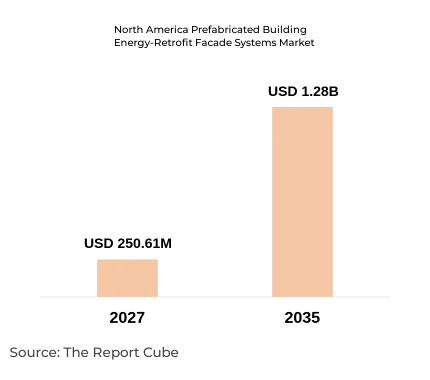
- The modeled market reaches USD 1,282.35 million by 2035 as qualifying industrialized building envelope projects expand.
- Forecast market CAGR is 22.64% during 2027–2035, based on the full eight intervals between the scenario endpoints.
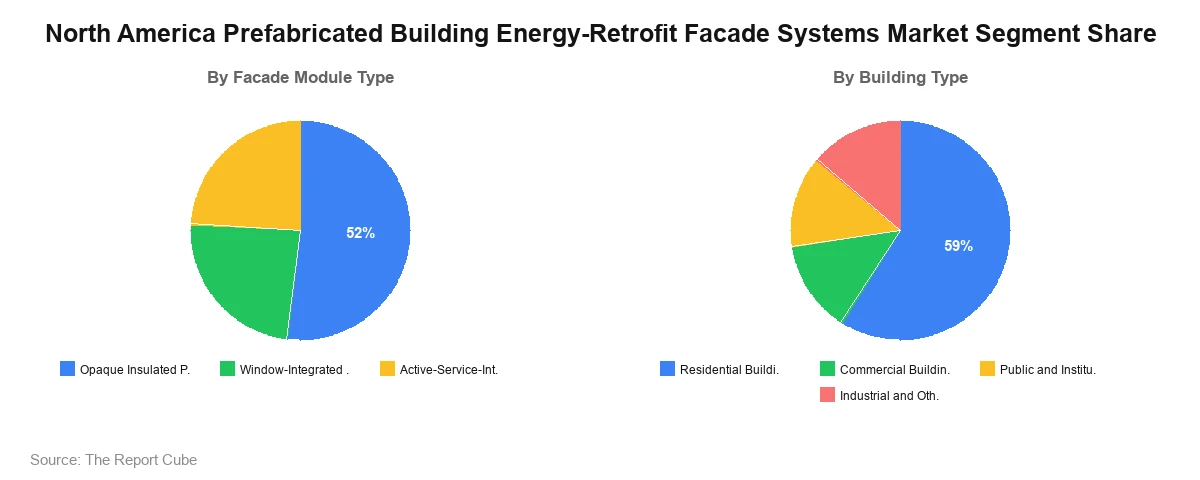
- Opaque Insulated Panels lead the facade-module mix at 52.0% in 2026. Active-Service-Integrated Panels register the highest modeled module CAGR of 23.94%.
- North America holds 12.0% of the modeled global value in 2026. Revenue is assigned to the building receiving the retrofit.
- Improving insulation and thermal performance of existing buildings is the central demand mechanism for prefab facade retrofit services.
- In June 2026, the European Commission BUILD UP platform reported an EUR 23 million serial refurbishment project in Hagen, Germany.
Market Outlook
The North America Prefabricated Building Energy-Retrofit Facade Systems Market is estimated at USD 192.00 million in 2026 on a narrowly defined supplier revenue basis. The scope includes factory-built facade modules installed on existing buildings plus non-overlapping design and installation work. New-build cladding, conventional site-built insulated facade work and separately priced rooftop installations are excluded. Potential purchasers include housing providers, public building owners and retrofit contractors. Market size represents an analyst-led procurement scenario, not an observed count of qualifying national refurbishment sales.
The market's development reflects deep-energy retrofit programs and interest in shorter occupied-building construction periods. Factory production may support predictable quality and reduce the time occupants experience facade construction. Germany's dena has documented serial refurbishment activity, while the European Commission described a sizable 2026 industrialized housing project in Hagen. These examples show that the delivery approach is practical in some settings. Transferability across North America still depends on building dimensions, local building approvals, weather exposure and whether projects can achieve credible lifetime energy and maintenance benefits.
The modeled market reaches USD 1,282.35 million in 2035, with a forecast CAGR of 22.64% during 2027–2035. Annual projections reflect differing adoption assumptions rather than a fixed annual growth rate or a supplier order book. Contractors must balance standardized factory production with irregular existing building conditions. Building-specific permits, regional climate zones and owner financing could delay installation. Reported values should therefore be used for planning and scenario sensitivity, subject to validation from actual project award values, installed panel quantities and attributable supplier revenues.
Government Regulations
Building retrofit approvals depend on the destination country's energy performance regulations, fire safety rules and local construction permit processes. There is no common international license specifically for factory-produced retrofit facade panels. In North America, facade suppliers must confirm structural anchorage, fire behavior, moisture management, weather protection, accessibility and thermal performance against applicable building codes. Product conformity documents and installation plans are typically needed for site authorization, but requirements differ by material and jurisdiction. German serial refurbishment support and United States industrialized retrofit initiatives encourage innovation without establishing globally uniform technical certification. Public incentives may be restricted to eligible projects, verified energy outcomes or local financing rules. The quoted forecast cannot be derived directly from compliance rules or aggregate public retrofit funding.
North America Prefabricated Building Energy-Retrofit Facade Systems Market Dynamics
The market depends on the economics of improving existing building envelopes and on the ability to produce panels efficiently while meeting site-specific requirements. Policy, owner funding and contractor capacity shape the conversion of technical concepts into paid projects. The four factors below are qualitative assessments of commercial influence, not measured statistical contributions to the forecast.
| Factor | Type | Specific Impact on Market | Impact Magnitude |
|---|---|---|---|
| Energy-efficiency upgrades to existing buildings | Driver | Owners consider insulating facade modules to improve thermal performance and reduce on-site construction impact | High |
| Project geometry, financing and approvals | Challenge | Site variation and funding restrictions raise engineering costs and affect project timing | High |
| Industrialized serial refurbishment | Trend | Digital surveys and workshop assembly shift portions of renovation off site | Medium–High |
| Scaling multi-family housing portfolio retrofits | Opportunity | Repeatable panel designs create potential for higher volume and turnkey project delivery | High |
Market Drivers: Demand for better building-stock energy efficiency
Owners of existing buildings face heat loss, high heating or cooling demand and pressure to improve energy ratings. Across North America, housing providers, public building owners and retrofit contractors can commission factory-made facade panels instead of relying entirely on site-assembled envelope work. Financial authorization remains essential for project delivery. Owner approval governs contract timing. Energy assessments can support project selection.
Germany's dena supports serial refurbishment and also reported nearly 70 completed qualifying projects in 2024, with further projects being built or prepared. This provides evidence of practical interest, not a market-wide sales census. In North America, deep-energy retrofit programs and interest in shorter occupied-building construction periods may also support panel orders when energy savings, financing terms and occupied-building access align.
Need Specific Data, Let’s Customize the Report for You
Request CustomizationMarket Challenges: Site customization and project financing barriers
Each existing building has different geometry, structural constraints, fire requirements and opening positions. Prefabricated facade modules must fit actual site conditions while preserving moisture control and safe attachment. Across North America, building-specific permits, regional climate zones and owner financing may also require additional design iterations or funding approvals. Such requirements can reduce the cost advantages expected from repeated factory production.
Digitally measured buildings still need detailed checks of substrate condition, window interfaces and construction tolerances. Project owners must coordinate contractors, residents and design approvals before fabrication. A delayed approval can stop an entire installation sequence. The model therefore treats fast adoption as conditional rather than assuming that announced programs become paid facade contracts immediately. Panel dimensions require accurate site measurements.
Recent Market Trends: Serial prefabrication with shorter on-site installation
Industrialized refurbishment shifts parts of existing building renovation from occupied construction sites into controlled workshops. Teams use digital surveys and also panelized production to prepare insulation, windows and service interfaces in advance. Across North America, repeatable panel layouts can often reduce scaffolding time and disruption, while integrating windows and active building services demands careful coordination between design and installation teams.
A June 2026 BUILD UP case described ecoworks' EUR 23 million Hagen refurbishment across twelve buildings and 192 apartments. The project illustrates a move toward factory-supported renovation rather than conventional sequential site trades. Its overall investment is not the same as qualifying facade revenue, since other building works and energy systems may be included. Factory acceptance checks remain commercially important.
Future Market Opportunities: Scaling energy retrofits across multifamily housing portfolios
Multi-family housing portfolios offer a repeatable addressable market for prefabricated envelope upgrades. Housing operators can group similar blocks, standardize facade interfaces and coordinate installation schedules across properties. In North America, replicable pilot projects and industrialized panel manufacturing may create opportunities for panel producers, survey specialists and installation partners. Contracts depend on funded projects and measured building needs. Payback remains important.
In Germany, dena's Energiesprong program helps project owners and suppliers organize serial renovation pathways. Broader replication would require finance, reliable factories, standardized specifications and verified thermal performance. Outside Germany, local building rules and climate demands can alter panel design. A strong project pipeline may support supplier expansion, but announced renovation plans are not guaranteed shipments. Customer acceptance remains a prerequisite.
North America Prefabricated Building Energy-Retrofit Facade Systems Market Segmentation Analysis
By Facade Module Type
- Opaque Insulated Panels
- Window-Integrated Panels
- Active-Service-Integrated Panels
- Factory-integrated ventilation
- energy or active-service elements
Opaque Insulated Panels account for 52.0% of modeled 2026 facade retrofit revenue across North America, equivalent to USD 99.84 million. Their broad use in insulated external envelope upgrades reflects relatively straightforward panel functions and common thermal objectives. The allocation is based on the research scenario rather than measured supplier contract data, and actual projects may also use different wall assemblies.
Active-Service-Integrated Panels are assigned the highest facade module forecast CAGR of 23.94% during 2027–2035. Their modeled 2026 value is USD 32.64 million. Combining prefabricated envelope units with ventilation or other building services may increase installation integration and value per project. However, controls, commissioning and maintenance must be designed for each existing building. Product qualification and building conditions govern actual orders.
By Building Type
- Residential Buildings
- Multi-family residential
- single-family residential
- Commercial Buildings
- Office
- retail
- hospitality
- Public and Institutional Buildings
- Education
- healthcare
- government
- Industrial and Other Buildings
- Factory
- warehouse
- other
Residential Buildings lead the modeled building-type allocation across North America with 59.0% of 2026 market value, or USD 113.28 million. Apartment blocks and other housing assets can offer repeated window dimensions, wall layouts and energy upgrade priorities. The estimate allocates qualifying facade revenue to property use rather than counting the entire residential refurbishment budget. Customer specifications can alter realized demand.
Industrial and Other Buildings show the fastest modeled primary building-type CAGR at 22.88% over 2027–2035. Revenue for this category is estimated at USD 15.36 million in 2026. Demand can often develop where facade work must also be completed around active existing building operations. Tendering, access restrictions and return on investment assessments determine how quickly those opportunities become successfully delivered projects.
North America Prefabricated Building Energy-Retrofit Facade Systems Market Regional Analysis
Global revenue is allocated by the location of the existing building receiving the eligible facade retrofit, not the supplier's headquarters or panel factory. The five regional allocations sum to the worldwide modeled total. Germany is included in Europe and therefore must not be added again. Shares represent scenario allocations, not verified regional market censuses.
| Region | Estimated Market Share | Key Growth Factors | Industry Trends |
|---|---|---|---|
| North America | 12.0% | Deep retrofit pilots and institutional energy upgrades | Factory-supported envelope work and contractor-led pilots |
| South America | 3.0% | Apartment refurbishment and selective facade modernization | Project financing and local production remain decisive |
| Europe | 65.0% | EPBD renovation policy, German serial refurbishment programs | Industrialized renovation of existing housing portfolios |
| Middle East and Africa | 5.0% | Cooling-load reduction and building envelope improvement | Climate-dependent facade specification and installation |
| Asia-Pacific | 15.0% | Urban buildings and demand for faster retrofit processes | Factory production with locally tailored building systems |
Europe is the largest modeled 2026 regional market at USD 1,040.00 million, representing 65.0% of the global estimate. This allocation reflects the source scenario's concentration of serial retrofit activity rather than verified invoices. Germany alone contributes USD 353.60 million to the European model. Documented demand context includes the European building energy performance framework and dena's serial refurbishment initiative. An ecoworks project in Hagen reported by BUILD UP in June 2026 demonstrates how existing multifamily buildings can be renovated using industrialized methods. However, the published EUR 23 million total includes more than qualifying facade supplier revenue and cannot prove the modeled regional market size.
Competitive Landscape
Industrialized energy retrofit supply involves engineering consultants, system providers, prefabrication factories, contractors, installers and upstream insulation or window suppliers. ecoworks, B&O and RENOWATE are associated with serial retrofit project delivery, while Sto, Schüco, Kingspan and other material suppliers occupy different positions in the facade value chain. The list below preserves the uploaded screening candidates, not a substantiated revenue ranking. Some companies sell only intermediate materials, so their corporate sales cannot be equated with eligible installed retrofit facade revenue. Differentiation depends on speed, thermal results, contractual accountability and installation capability.
| Company | Competitive Strength or Screened Capability | Primary Segment Served |
|---|---|---|
| ecoworks | Industrialized Energiesprong-style serial refurbishment delivery | Turnkey prefabricated building envelope retrofits |
| B&O Bau / B&O Seriell | Serial refurbishment execution and housing portfolio specialization | Factory-led retrofit project delivery |
| RENOWATE | Integrated industrialized housing refurbishment | Multi-family serial building renovation |
| Niersberger Group | Building refurbishment contracting and prefabrication | Serial retrofit services |
| Saint-Gobain pre.formance | Building envelope systems and industrialized construction methods | Facade systems, screening eligibility applies |
| Sto SE & Co. KGaA | Facade finishing, insulation and system products | Facade materials and system supply |
| Kingspan Group | Insulated panel manufacturing expertise | Upstream panel supplier, finished retrofit sales unverified |
| ROCKWOOL Group | Stone-wool insulation products | Upstream insulation supplier, finished retrofit sales unverified |
| Schüco International | Window and facade system design and supply | Facade/window system supplier, inclusion depends on contract |
| Etex Group | Building boards and facade system materials | Upstream facade boards, finished retrofit sales unverified |
Recent Developments and Updates
- 2024 - dena: Reported nearly 70 completed serial refurbishment projects, 30 under construction and 180 in planning or preparation in Germany. These are project counts, not global supplier revenue.
- June 2026 - European Commission BUILD UP: Reported an EUR 23 million industrialized refurbishment program in Hagen encompassing twelve existing residential buildings and 192 apartments.
- September 2026 - German federal program: The supplied research notes refer to support for serial non-residential refurbishment. Exact project-level eligibility should be checked against current program documentation before publication.
North America Prefabricated Building Energy-Retrofit Facade Systems Market Future Outlook
Between 2027 and 2035, the market could grow from USD 250.61 million to USD 1,282.35 million in the scenario. Expansion depends on the number of existing buildings that receive full factory-prefabricated envelope renovations, the realized price per qualifying facade project and the scope of included design and installation services. Standardization can improve supplier productivity in similar multi-family buildings, but irregular facade dimensions can reduce expected factory economies. Building codes and public incentives may affect the speed of investment decisions differently across national markets.
For North America, adoption could increase where housing operators bundle similar properties into larger renovation programs and specify measurable thermal performance. Contractors and manufacturers would need adequate capacity for site surveys, engineering, panel production, transport and installation. Financing structures and occupant disruption remain key commercial constraints. The published examples from Germany show the feasibility of industrialized refurbishment, not a guarantee that the modeled revenue trajectory will materialize elsewhere. Both faster expansion and delays are possible, and buyers should validate forecasts against actual awarded contracts.
North America Prefabricated Building Energy-Retrofit Facade Systems Market Report Coverage
| Parameter | Details |
|---|---|
| Report Title | NORTH AMERICA PREFABRICATED BUILDING ENERGY-RETROFIT FACADE SYSTEMS MARKET |
| Market Geography | North America |
| Currency | USD million, nominal |
| Base Year | 2026 |
| Historical Period | 2021–2025 |
| Forecast Period | 2027–2035 |
| 2026 Market Size | USD 192.00 million, scenario estimate |
| 2035 Market Size | USD 1,282.35 million, scenario estimate |
| CAGR 2022–2026 | 28.31% during 2022–2026, modeled |
| CAGR 2027–2035 | 22.64% during 2027–2035 |
| Main Segmentation Categories | Facade Module Type, Building Type |
| Companies Profiled | ecoworks, B&O Bau / B&O Seriell, RENOWATE, Niersberger Group, Saint-Gobain pre.formance, Sto SE & Co. KGaA, Kingspan Group, ROCKWOOL Group, Schüco International, Etex Group |
Why Choose This North America Prefabricated Building Energy-Retrofit Facade Systems Market Report?
- Compare consistent modeled annual supplier revenue from 2021 through 2035 and distinguish historical backcasts from commercial observations.
- Review the two selected segment dimensions alongside the complete five-dimensional taxonomy without double counting nested subsegments.
- Compare five regional shares and Germany within Europe using the same revenue denominator.
- Identify how fabrication economics, project finance, building age and design approvals may affect delivery schedules.
- Screen ten companies across contractors, systems integrators and upstream material suppliers without invented company market shares.
- Separate verified European serial refurbishment milestones and regulation from unverified market-size forecasts.
Table of Contents
- Introduction
- Objective of the Study
- Product Definition
- Market Segmentation
- Study Variables
- Research Methodology
- Secondary Data Points
- Companies Interviewed
- Primary Data Points
- Breakdown of Primary Interviews
- Secondary Data Points
- Executive Summary
- Market Dynamics
- Drivers
- Challenges
- Opportunity Assessment
- Recent Trends and Developments
- Policy and Regulatory Landscape
- North America Prefabricated Building Energy-Retrofit Facade Systems Market Overview and Forecast Analysis (2021-2034)
- Market Size, By Value, By Growth Rate (CAGR/USD Millions)
- Demand – Supply Trends
- Market Share, By Facade Module Type
- Opaque Insulated Panels
- Window-Integrated Panels
- Active-Service-Integrated Panels (Factory-integrated ventilation, energy or active-service elements)
- Market Share, By Structural Frame
- Timber-Based Frames (Mass timber, engineered wood)
- Steel Frames
- Concrete and Mineral Composite Frames (Concrete, mineral composite)
- Aluminium and Other Frames (Aluminium, hybrid other)
- Market Share, By Thermal Insulation
- Mineral-Fibre Insulation (Stone wool, glass wool)
- Polymer Foam Insulation (PIR, PUR, EPS, XPS)
- Bio-Based Insulation (Wood fibre, cellulose, cork)
- Mixed and Other Insulation (Multiple cores with no dominant share, other)
- Market Share, By Building Type
- Residential Buildings (Multi-family residential, single-family residential)
- Commercial Buildings (Office, retail, hospitality)
- Public and Institutional Buildings (Education, healthcare, government)
- Industrial and Other Buildings (Factory, warehouse, other)
- Market Share, By Contract Scope
- Panel Supply Only
- Design and Panel Supply
- Turnkey Facade Retrofit
- Market Share, By Competitors
- Competition Characteristics
- Revenue Shares
- Opaque Insulated Panels North America Prefabricated Building Energy-Retrofit Facade Systems Market Overview, 2021-2034F
- By Value (USD Million)
- By Structural Frame – Market Size & Forecast 2021-2034, USD Million
- Timber-Based Frames (Mass timber, engineered wood)
- Steel Frames
- Concrete and Mineral Composite Frames (Concrete, mineral composite)
- Aluminium and Other Frames (Aluminium, hybrid other)
- Window-Integrated Panels North America Prefabricated Building Energy-Retrofit Facade Systems Market Overview, 2021-2034F
- By Value (USD Million)
- By Structural Frame – Market Size & Forecast 2021-2034, USD Million
- Timber-Based Frames (Mass timber, engineered wood)
- Steel Frames
- Concrete and Mineral Composite Frames (Concrete, mineral composite)
- Aluminium and Other Frames (Aluminium, hybrid other)
- Active-Service-Integrated North America Prefabricated Building Energy-Retrofit Facade Systems Market Overview, 2021-2034F
- By Value (USD Million)
- By Structural Frame – Market Size & Forecast 2021-2034, USD Million
- Timber-Based Frames (Mass timber, engineered wood)
- Steel Frames
- Concrete and Mineral Composite Frames (Concrete, mineral composite)
- Aluminium and Other Frames (Aluminium, hybrid other)
- Competitive Outlook (Company Profile – Partial List)
- ecoworks
- Company Overview
- Business Segments
- Strategic Alliances/Partnerships
- Recent Developments
- B&O Bau / B&O Seriell
- Company Overview
- Business Segments
- Strategic Alliances/Partnerships
- Recent Developments
- RENOWATE
- Company Overview
- Business Segments
- Strategic Alliances/Partnerships
- Recent Developments
- Niersberger Group
- Company Overview
- Business Segments
- Strategic Alliances/Partnerships
- Recent Developments
- Saint-Gobain pre.formance
- Company Overview
- Business Segments
- Strategic Alliances/Partnerships
- Recent Developments
- Sto SE & Co. KGaA
- Company Overview
- Business Segments
- Strategic Alliances/Partnerships
- Recent Developments
- Kingspan Group
- Company Overview
- Business Segments
- Strategic Alliances/Partnerships
- Recent Developments
- ROCKWOOL Group
- Company Overview
- Business Segments
- Strategic Alliances/Partnerships
- Recent Developments
- Schüco International
- Company Overview
- Business Segments
- Strategic Alliances/Partnerships
- Recent Developments
- Etex Group
- Company Overview
- Business Segments
- Strategic Alliances/Partnerships
- Recent Developments
- ecoworks
- Contact Us & Disclaimer
Top Key Players & Market Share Outlook
- ecoworks
- B&O Bau / B&O Seriell
- RENOWATE
- Niersberger Group
- Saint-Gobain pre.formance
- Sto SE & Co. KGaA
- Kingspan Group
- ROCKWOOL Group
- Schüco International
- Etex Group
Frequently Asked Questions