



Build Your Custom Market Intelligence Report
Customize Your ReportEurope Quinoa Market: Overview: Size & Forecast (2026–2032)
What is the projected market size of Europe Quinoa Market by 2032?
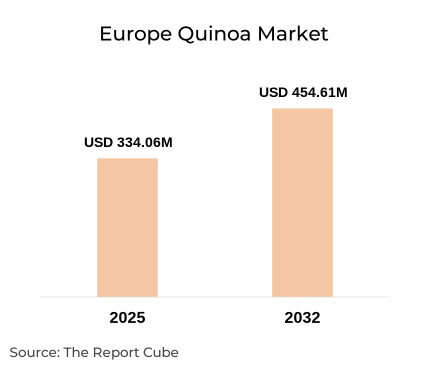
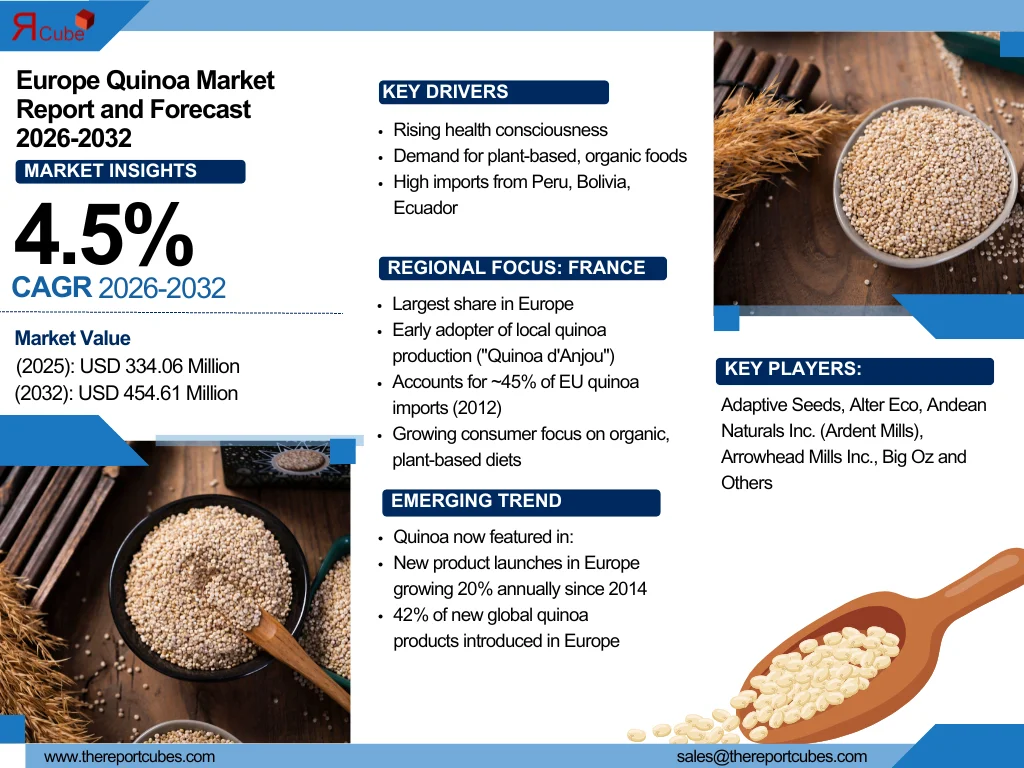
The Europe Quinoa Market size is valued at around USD 334.06 million in 2025 and is projected to reach USD 454.61million by 2030. Along with this, the market is estimated to grow at a CAGR of around 4.5% during the forecast period, i.e., 2026-32. The market growth is driven by the high imports of quinoa in the region, which accounts for one-third of total imports from main quinoa-producing countries such as Peru, Bolivia, and Ecuador. For instance, despite the fluctuation in the supply and trade prices, the import of quinoa increased from less than 6 thousand tonnes in 2012 to 28 thousand tonnes in 2019. Therefore, this is driving stable demand for quinoa and strong prospects for its future growth in the region.
Moreover, quinoa is adaptable to the adverse environmental conditions, which include nutrient-poor soil, drought, heavy metals, fluctuating temperatures, and UV-B light irradiance, thereby increasing its cultivation locally and appeal as a sustainable food source and also driving its role in food security in the region. For instance, France is the largest quinoa producer in Europe, with Anjou being its most important production region, as by now 375 farmers have planted a total of 7,500 acres in quinoa, yielding 4,000 tons in 2020.
Furthermore, due to the high versatility of quinoa in food applications and the diverse cuisine in the region, there are increasing avenues for incorporating quinoa into various food and beverage products such as bakery items, snacks, pasta, breakfast cereals, soup, and even beer. This is also increasing the competition between the key quinoa-producing countries in the Andes and Europe. Additionally, the demand for organic cultivation of quinoa is growing, which involves strict quality control and proper certification, thereby driving trust among consumers and the growth of the market in Europe.
What are the primary drivers behind the rise of Europe Quinoa Market?
Increasing Health Consciousness Among Consumers – The market growth is primarily driven by the increasing consumer inclination toward their health and wellness, where quinoa fits the bill as it is natural and gluten-free with a strong nutrient profile. This profile is a balance of rich dietary fiber, proteins, vitamins, unsaturated fats, and minerals. Also, quinoa has multiple functions which are associated with the reduction of chronic disease risk due to its antioxidant, anti-inflammatory, immunomodulatory, and anticarcinogenic properties, thereby surpassing traditional cereal grains in terms of biological value.
Moreover, this inclination towards health is driving the demand for quinoa originating from organic farming, which emphasizes the use of naturally occurring substances while prohibiting the use of synthetic fertilizers and pesticides. Additionally, this is pushing the consumers increasingly towards organic as well as fair trade certified quinoa in the region. Therefore, these align well with the increasing consciousness of consumers towards their health in the region, thereby leading to higher market size & volume.
What are the key growth opportunities in the Europe Quinoa market?
Increasing Support for Local Production of Quinoa – There are increasing disruptions in the global supply chain, which particularly spiked during the COVID pandemic, including high freight costs and geopolitical uncertainties, thereby increasing the push for locally and regionally produced and sourced quinoa in the region, away from its high reliance on imports from the leading producing countries. This is making way for agribusinesses in the region to actively develop the local cultivation of quinoa along with integrated supply chains that prioritize local procurement, traceability, quality control, and responsiveness to the demand of the consumer in the region.
Book your FREE 30-minute expert consultation today
Contact UsFor instance, quinoa producers in France have scaled up the domestic production to meet both the national and regional demand for quinoa. Additionally, the governments in the region are encouraging local partnerships with farmers, processing hubs, and transparency in certifications, thereby ensuring stable margins and positioning the region as a trusted producer in the global market.
What are the key challenges facing the Europe Quinoa industry?
Existence of Saponins in Quinoa Seeds – Saponins exist in the exterior coating of quinoa seeds as an antinutrient and are responsible for giving the seed its bitter taste. This is a challenge as this bitterness can lead to negative experiences in consumers and can hurt first impressions in new markets in the region. Therefore, this is increasing the need for its removal before consumption, thereby potentially impacting the entire value chain from processing to marketing of it. For instance, researchers have tried to develop methods for its removal in seeds without altering the composition of nutrients, such as washing the seeds in cold water.
Moreover, saponins drive away pests and birds in the field, thereby reducing the loss of crops. However, this is still a barrier for the market players due to the additional labor, water, and costs which is associated with their removal. This is increasing the expenses in the production of quinoa, which is being reflected in its retail price. Additionally, this high price when compared to other cereals is limiting their uptake by consumers, particularly in low-income households, thereby hindering the regional market growth & expansion.
Which emerging trends are shaping the Europe Quinoa industry?
Integration of Quinoa into Convenience Food – The market dynamics are changing due to the rapid integration of quinoa in diverse food and beverage products and items in the region, which is due to the versatility of quinoa. This integration property of quinoa is due to the overarching demand for new and accessible food options, thereby driving food manufacturers and brands to actively develop new product lines. For instance, 42% of new global products that feature quinoa launched in Europe have increased by an average of 20% annually since 2014. This has increased the presence of quinoa in bakery items, snacks, pasta, breakfast cereals, ready-made meals, soups, and even beer. Therefore, this ongoing product integration has increased its inclusion in many avenues and occasions, thereby leading to higher demand for Quinoa in this regional industry.
How is the Europe Quinoa Market Defined as per Segments?
The Europe Quinoa Market Research Reports underlines to the detailed market data & insights in accordance to the market segmentation. Some of the segments are:
Based on Farming Methods:
- Organic
- Conventional
Based on farming methods, organic farming holds the largest market share. The dominance of this segment is due to several factors, such as the European Green Deal and the commitment of the retailers to Environmental, Social, and Governance (ESG). Also, the demand for food and beverage products that are certified as organic is increasing among consumers, particularly in countries such as Germany and France, where organic farming and obtaining organic certification serve as an important signal for trust, thereby reassuring consumers about the absence of pesticides and synthetic ingredients. For instance, European supermarket chains such as Carrefour and Edeka have expanded their offerings of organic quinoa to meet the increasing demand, thereby exhibiting how organic certification in retail drives trust in consumers.
Moreover, due to this consumer preference, producers are facing increasing pressure to meet the European certification standards by adapting their cultivation methods to obtain organic certification and leverage fair trade initiatives such as Bolivia’s ‘Royal Quinoa.’ Therefore, these factors are driving the dominance of this segment in the regional Quinoa Industry.
Based on End-User:
- Food Industry
- Cosmetics
- Pharmaceuticals
- Industrial Uses
- Animal Feed
- Others
Based on end-user, the food industry segment holds the largest market share. The market lead is driven by the strong nutritional profile of quinoa, as it has protein of high quality, dietary fiber, nine essential amino acids, and is gluten-free, thereby making its applicability highly appealing in gluten-free products, plant-based protein alternatives, baby foods, and nutrient-dense snacks. This inclination of the consumers in the region towards a plant-based diet is driven by their increasing awareness of health, where quinoa fits well compared to other grains. Additionally, this is increasing the need for the food manufacturers to innovate and differentiate their offerings to meet the diverse palates while making sure that non-European suppliers supply pesticide-free organic quinoa in the region. Therefore, the diverse cuisines due to the region’s rich food and beverage culture are driving the dominance of this segment in the market.
How is the Europe quinoa market expected to expand across different regions during 2026–2030?
Geographically, the Europe Quinoa Market expands across:
- Germany
- France
- Netherlands
- United Kingdom
- Spain
- Italy
- Denmark
- Rest of Europe
Regionally, France holds the largest major share. The country has an essential role in both imports and the local production of quinoa, which is due to the strong consumer demand for healthy, plant-based, and organic food, thereby exhibiting dietary shifts in the country. For instance, France accounted for 45% of the European quinoa imports in 2012. While other countries started to adopt quinoa, the estimated consumption in the country grew to 10 thousand tonnes in 2019.
Moreover, the country was also one of the first European countries to cultivate quinoa with early initiatives such as Quinoa d’Anjou. This local production of quinoa, particularly from the "Quinoa d'Anjou" network, caters to the preference of the consumers for sustainable and locally sourced options, thereby leading to successful product launches, certification, supply partnerships, and increasing its overall market share in the regional Quinoa Industry.
Europe quinoa Market: Recent Developments (2025)
-
2024: Alnatura, a German retailer and producer of organic food, digitally transformed its space management capabilities by upgrading to SaaS with Blue Yonder Category Management solutions to meet the demands of modern commerce and evolving consumer needs. The project was implemented on time and under budget by Strategix, a Blue Yonder partner.
- 2024: The British Quinoa Company announced plans to expand its grower network for the upcoming spring season. They are looking to bring on a limited number of additional growers to meet surging demand. At that time, the company reported approximately 300 hectares under cultivation across 20 farms, with yield estimates of 1.5–1.75 t/ha and a current price of around USD1,008 per ton.
Top Companies in Europe Quinoa Market
Ask Our Lead Analyst a Question About This Report
Contact UsWhat Does Our Europe quinoa Market Research Study Entail?
- The Europe Quinoa Market Research Report highlights the forecast growth rate (CAGR) by anticipating the market size and share.
- The market analysis puts light upon the primary industry trends, driving aspects, potential opportunities, growth challenges, and other major factors.
- The Europe Quinoa Market Research Report entails details about the most critical shifts in market share in the prominent regions.
- Considering the statistics & the developments by the primary market competitors, our report also strives to demonstrate the most sought-after strategies of the key players.
Table of Contents
- Introduction
- Objective of the study
- Product Definition
- Market Segmentation
- Study Variables
- Research Methodology
- Secondary Data Points
- Companies Interviewed
- Primary Data Points
- Break Down of Primary Interviews
- Secondary Data Points
- Executive Summary
- Market Dynamics
- Drivers
- Challenges
- Opportunity Assessment
- Recent Trends and Developments
- Policy and Regulatory Landscape
- Europe Quinoa Market Overview (2020-2032)
- Market Size, By Value (in USD Millions)
- Market Share, By Farming Methods
- Organic
- Conventional
- Market Share, By End-User
- Food Industry
- Cosmetics
- Pharmaceuticals
- Industrial Uses
- Animal Feed
- Others
- Market Share, By Type
- Single
- Tricolor
- Market Share, By Product
- Seeds
- Flour
- Flakes
- Puffs
- Market Share, By Packaging Type
- Bags
- Pouches
- Box
- Jar
- Others
- Market Share, By Distribution Channel
- Offline
- Online
- Market Share, By Country
- Germany
- France
- Netherlands
- United Kingdom
- Spain
- Italy
- Denmark
- Rest of Europe
- Market Share, By Company
- Revenue Shares
- Competition Characteristics
- Germany Quinoa Market Overview, 2020-2032F
- Market Size, By Value (in USD Billions)
- By Farming Methods
- By End-User
- By Type
- By Product
- By Packaging Type
- By Distribution Channel
- France Quinoa Market Overview, 2020-2032F
- Market Size, By Value (in USD Billions)
- By Farming Methods
- By End-User
- By Type
- By Product
- By Packaging Type
- By Distribution Channel
- Netherlands Quinoa Market Overview, 2020-2032F
- Market Size, By Value (in USD Billions)
- By Farming Methods
- By End-User
- By Type
- By Product
- By Packaging Type
- By Distribution Channel
- United Kingdom Quinoa Market Overview, 2020-2032F
- Market Size, By Value (in USD Billions)
- By Farming Methods
- By End-User
- By Type
- By Product
- By Packaging Type
- By Distribution Channel
- Spain Quinoa Market Overview, 2020-2032F
- Market Size, By Value (in USD Billions)
- By Farming Methods
- By End-User
- By Type
- By Product
- By Packaging Type
- By Distribution Channel
- Italy Quinoa Market Overview, 2020-2032F
- Market Size, By Value (in USD Billions)
- By Farming Methods
- By End-User
- By Type
- By Product
- By Packaging Type
- By Distribution Channel
- Denmark Quinoa Market Overview, 2020-2032F
- Market Size, By Value (in USD Billions)
- By Farming Methods
- By End-User
- By Type
- By Product
- By Packaging Type
- By Distribution Channel
- Competitive Outlook (Company Profile - Partila List)
- Adaptive Seeds
- Company Overview
- Business Segments
- Strategic Alliances/Partnerships
- Recent Developments
- Alter Eco
- Company Overview
- Business Segments
- Strategic Alliances/Partnerships
- Recent Developments
- Andean Naturals Inc. (Ardent Mills)
- Company Overview
- Business Segments
- Strategic Alliances/Partnerships
- Recent Developments
- Arrowhead Mills Inc.
- Company Overview
- Business Segments
- Strategic Alliances/Partnerships
- Recent Developments
- Big Oz
- Company Overview
- Business Segments
- Strategic Alliances/Partnerships
- Recent Developments
- Hancock
- Company Overview
- Business Segments
- Strategic Alliances/Partnerships
- Recent Developments
- Heritage Harvest Seed
- Company Overview
- Business Segments
- Strategic Alliances/Partnerships
- Recent Developments
- Highland Farm
- Company Overview
- Business Segments
- Strategic Alliances/Partnerships
- Recent Developments
- Irupana Andean Organic Food S.A.
- Company Overview
- Business Segments
- Strategic Alliances/Partnerships
- Recent Developments
- Northern Quinoa
- Company Overview
- Business Segments
- Strategic Alliances/Partnerships
- Recent Developments
- Adaptive Seeds
- Contact Us & Disclaimer
Top Key Players & Market Share Outlook
- Adaptive Seeds
- Alter Eco
- Andean Naturals Inc. (Ardent Mills)
- Arrowhead Mills Inc.
- Big Oz
- Hancock
- Heritage Harvest Seed
- Highland Farm
- Irupana Andean Organic Food S.A.
- Northern Quinoa
- Quinoa Corporation
- Quinoa Foods Company SRL
- Quinoabol SRL
Frequently Asked Questions






