



Build Your Custom Market Intelligence Report
Customize Your ReportBrazil Renewable Energy Storage Market Key Highlights
By Technology:
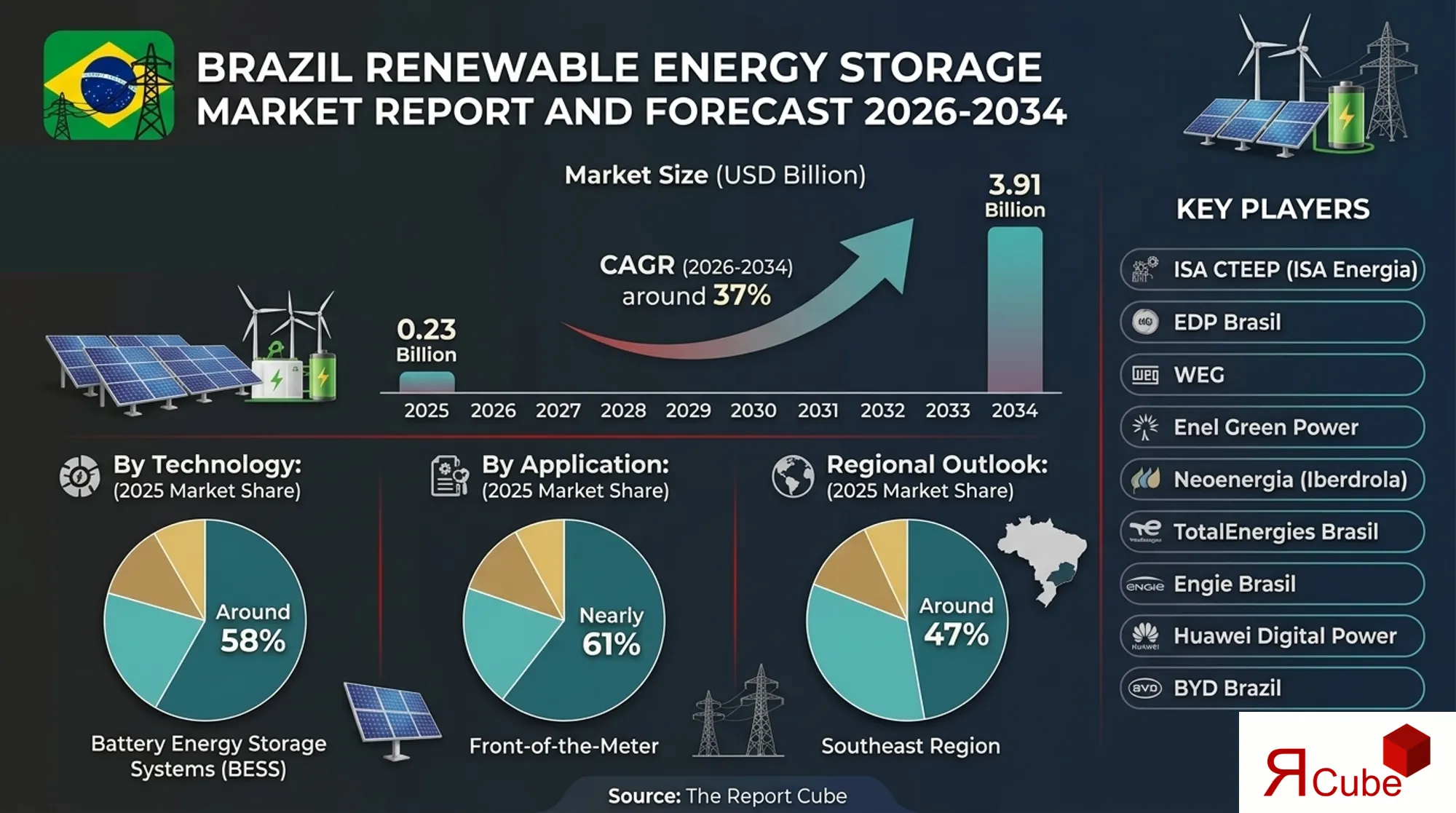
Battery Energy Storage Systems (BESS) segment leads the market, with around 58% market share.
By Application:
Front-of-the-Meter segment dominates the market, accounting for nearly 61% of total revenue.
Regional Outlook:
Southeast region dominates the market, with around 47% market share.
Brazil Renewable Energy Storage Market Insights & Analysis
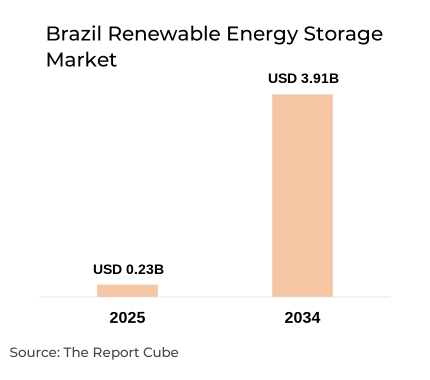
The Brazil Renewable Energy Storage Market is anticipated to register a CAGR of around 37% during the forecast period 2026-2034. the market size was valued at USD 0.23 billion in 2025 and is projected to reach USD 3.91 billion by 2034. The market is entering a rapid expansion phase, fueled by Brazil’s heavy reliance on hydropower and the growing integration of intermittent renewable sources such as solar and wind. As solar installations in Brazil surpassed 38 GW in 2025, the need for flexible storage solutions has intensified, positioning energy storage as a critical infrastructure layer rather than a complementary technology.
Investment momentum is clearly visible across utility-scale and distributed segments. In 2025, Brazil recorded over USD 1.2 billion in announced storage-linked renewable investments, with hybrid solar-plus-storage projects gaining traction in regions like Pernambuco and Bahia. Public policies are also shaping the market direction, with regulatory clarity from ANEEL enabling hybrid project approvals and grid interconnection. Meanwhile, technology providers are localizing manufacturing and services, reducing system costs by nearly 18% year-over-year. This blend of policy push, capital inflow, and technology maturity is transforming energy storage from pilot projects into scalable, revenue-generating assets across Brazil’s energy ecosystem.
Brazil Renewable Energy Storage Market Dynamics
Key Driver: Rapid Renewable Energy Expansion Creating Immediate Need for Grid Stability Solutions
Brazil’s aggressive renewable expansion is directly driving demand for energy storage systems, particularly as solar and wind generation become more prominent in the energy mix. By 2025, solar energy alone contributed over 18% of Brazil’s electricity capacity, yet its intermittency created operational challenges for grid operators. This has made storage systems essential for stabilizing supply fluctuations and ensuring consistent energy delivery. Utilities are increasingly investing in storage to avoid grid congestion and reduce curtailment losses, which reached nearly 7% in high-renewable regions. Additionally, industrial consumers are adopting storage to manage peak tariffs and improve energy reliability. As energy demand grows steadily across urban and industrial hubs, storage systems are evolving into a necessity rather than an optional upgrade, supporting Brazil’s long-term energy transition goals.
Book your FREE 30-minute expert consultation today
Contact UsIndustry Trends: Hybrid Renewable Projects and AI-Driven Energy Management Reshaping Market Landscape
The market is witnessing a strong shift toward hybrid renewable-plus-storage projects, where solar or wind installations are integrated with battery systems for optimized performance. In 2025, more than 42% of newly approved solar projects in Brazil included storage components, reflecting a structural change in project design. At the same time, digital technologies are enhancing storage efficiency. AI-driven energy management platforms are enabling predictive load balancing and real-time optimization, increasing system efficiency by up to 25%. Another emerging trend is the rise of commercial and industrial storage adoption, where businesses are installing behind-the-meter systems to control energy costs and ensure uninterrupted operations. These trends collectively indicate a transition toward intelligent, decentralized energy ecosystems.
Major Challenge: High Initial Capital Investment and Limited Financing Structures
The Brazil renewable energy storage market faces challenges related to high upfront costs and evolving financing mechanisms. Battery storage systems, particularly lithium-ion technologies, require significant capital investment, with project costs ranging between USD 350 to USD 600 per kWh in 2025. While costs are gradually declining, financing large-scale storage projects remains complex due to limited long-term revenue certainty. Unlike traditional generation assets, storage systems often depend on multiple revenue streams such as frequency regulation, peak shaving, and capacity markets, which are still developing in Brazil. Financial institutions remain cautious, leading to higher borrowing costs and extended payback periods. This financial uncertainty slows down project approvals and limits participation from smaller developers, creating a barrier to widespread adoption.
Opportunity: Expansion of Distributed Energy Storage Across Commercial and Industrial Sectors
One of the most promising opportunities lies in the rapid expansion of distributed energy storage across commercial and industrial sectors. Brazil’s industrial electricity tariffs remain among the highest in Latin America, encouraging businesses to invest in storage solutions to manage peak demand charges. By 2025, nearly 28% of large industrial facilities in São Paulo had initiated pilot storage installations. Additionally, microgrid development in remote and off-grid regions is gaining momentum, where storage systems ensure reliable power supply and reduce dependence on diesel generators. Government incentives and declining battery costs are expected to further accelerate adoption. This shift toward decentralized energy systems is opening new revenue streams for technology providers and creating a more resilient energy infrastructure across Brazil.
Brazil Renewable Energy Storage Market Segment-wise Analysis
By Technology:
- Battery Energy Storage Systems (BESS)
- Pumped Hydro Storage
- Thermal Energy Storage
- Hydrogen Energy Storage
- Others
Battery Energy Storage Systems (BESS) dominate the Brazil renewable energy storage market, holding approximately 58% market share in 2025. This dominance is driven by the scalability, rapid deployment capability, and declining cost curve of lithium-ion batteries, which account for nearly 72% of BESS installations. Utility-scale projects are increasingly favoring BESS due to their ability to provide multiple grid services, including frequency regulation and peak shaving. In addition, advancements in battery lifecycle management and recycling technologies are improving long-term cost efficiency. Brazil’s growing solar sector further reinforces BESS adoption, as batteries enable time-shifting of solar energy and enhance grid reliability. The flexibility of BESS systems makes them suitable for both large-scale and distributed applications, strengthening their leading position in the market.
By Application:
- Front-of-the-Meter
- Behind-the-Meter
The front-of-the-meter segment leads with around 61% market share, driven by utility-scale deployments aimed at grid stabilization and renewable integration. Large-scale storage systems are being deployed alongside solar and wind farms to manage variability and ensure consistent energy output. In 2025, over 65% of new storage capacity additions were linked to utility-scale renewable projects. These systems are also supporting transmission and distribution deferral, reducing the need for costly infrastructure upgrades. Moreover, frequency regulation services provided by front-of-the-meter storage are becoming a key revenue stream, enhancing project viability. As Brazil continues to expand its renewable capacity, this segment is expected to maintain strong growth momentum.
Regional Projection of Brazil Renewable Energy Storage Industry
- North
- Northeast
- Centerwest
- Southeast
- South
The Southeast region dominates the Brazil renewable energy storage market, accounting for nearly 47% of total market share in 2025. This dominance is largely due to the region’s high energy demand, industrial concentration, and advanced grid infrastructure. States such as São Paulo and Minas Gerais are leading adopters of both utility-scale and distributed storage systems. The presence of major industrial consumers drives demand for behind-the-meter storage solutions to manage energy costs and ensure reliability. Additionally, strong investment inflows and favorable regulatory frameworks have accelerated project development in the region. As renewable energy penetration increases, the Southeast continues to serve as a hub for innovation and large-scale deployment of energy storage technologies.
Brazil Renewable Energy Storage Market Recent Developments
- 2025: Neoenergia (Iberdrola) initiated construction of a 22 MWp solar project integrated with a 49 MWh battery storage system in Pernambuco, supporting hybrid renewable deployment and improving grid flexibility.
- 2025: Sungrow Brasil signed a major agreement to deploy 400 MWh of energy storage systems across Brazil, focusing on commercial and industrial applications and accelerating large-scale BESS adoption.
- 2025: TotalEnergies Brasil announced plans to explore investments in battery storage and hydropower projects, aligning with its broader renewable strategy and strengthening its presence in Brazil’s energy market.
- 2025: Huawei Digital Power aligned with Brazil’s government initiative for a dedicated battery storage auction, aiming to localize advanced BESS technologies and expand market penetration.
Need insights for a specific region within this market?
Request Regional DataWhy Choose This Report?
- Provides a comprehensive overview of the overall market analysis, encompassing key trends, consumer behavior analysis, and risk assessment to support strategic decision-making.
- Provides accurate, up-to-date insights into market size, segmentation, and emerging opportunities, helping to minimize risk & capitalizing on growth.
- Gives deep understanding of target audience preferences, investment habits, and communication channels for enhanced product development & marketing effectiveness.
- Delivers competitive analysis & benchmarking, uncovering the strengths & weaknesses of market competitors to guide strategies.
- Consolidate comprehensive market intelligence, reducing reasoning & streamlining research efforts.
- Facilitates customized market segmentation & risk mitigation strategies, fine-tuned to the business objectives.
- Aids in identifying both market challenges & untapped opportunities within the industry to drive long-term business growth.
- Provides valuable information based on actual customer data & search trends.
Table of Contents
- Introduction
- Objective of the Study
- Product and Category Definition
- Market Segmentation
- Study Variables
- Research Methodology
- Secondary Data Points
- Breakdown of Secondary Sources
- Primary Data Points
- Breakdown of Primary Interviews
- Secondary Data Points
- Executive Summary
- Market Dynamics
- Drivers
- Challenges
- Opportunity Assessment
- Recent Trends and Developments
- Regulatory and Policy Landscape
- Brazil Renewable Energy Storage Market Overview (2021-2034)
- Market Size, By Value (USD Billion)
- Market Share, By Technology
- Battery Energy Storage Systems (BESS)
- Lithium-ion Batteries
- Lead-acid Batteries
- Flow Batteries
- Other Battery Technologies
- Pumped Hydro Storage
- Thermal Energy Storage
- Hydrogen Energy Storage
- Others
- Battery Energy Storage Systems (BESS)
- Market Share, By Application
- Front-of-the-Meter
- Renewable Firming
- Transmission & Distribution Deferral
- Frequency Regulation & Ancillary Services
- Capacity & Peak Shaving
- Behind-the-Meter
- Commercial & Industrial
- Residential
- Microgrids & Off-grid Systems
- Front-of-the-Meter
- Market Share, By Connection
- On-grid
- Off-grid
- Hybrid Systems
- Market Share, By End User
- Utilities & IPPs
- Commercial & Industrial
- Residential
- Public Sector & Community Projects
- Market Share, By Region
- North
- Northeast
- Centerwest
- Southeast
- South
- Market Share, By Company
- Revenue Shares & Analysis
- Competitive Landscape
- North Brazil Renewable Energy Storage Market
- Market Size, By Value (USD Billion/Million)
- Market Share, By Technology
- Market Share, By Application
- Market Share, By Connection
- Market Share, By End User
- Northeast Brazil Renewable Energy Storage Market
- Market Size, By Value (USD Billion/Million)
- Market Share, By Technology
- Market Share, By Application
- Market Share, By Connection
- Market Share, By End User
- Centerwest Brazil Renewable Energy Storage Market
- Market Size, By Value (USD Billion/Million)
- Market Share, By Technology
- Market Share, By Application
- Market Share, By Connection
- Market Share, By End User
- Southeast Brazil Renewable Energy Storage Market
- Market Size, By Value (USD Billion/Million)
- Market Share, By Technology
- Market Share, By Application
- Market Share, By Connection
- Market Share, By End User
- South Brazil Renewable Energy Storage Market
- Market Size, By Value (USD Billion/Million)
- Market Share, By Technology
- Market Share, By Application
- Market Share, By Connection
- Market Share, By End User
- Competitive Outlook and Company Profiles
- ISA CTEEP (ISA Energia)
- Company Overview
- Product Portfolio
- Strategic Alliances/Partnerships
- Recent Developments
- EDP Brasil
- Company Overview
- Product Portfolio
- Strategic Alliances/Partnerships
- Recent Developments
- WEG
- Company Overview
- Product Portfolio
- Strategic Alliances/Partnerships
- Recent Developments
- Enel Green Power
- Company Overview
- Product Portfolio
- Strategic Alliances/Partnerships
- Recent Developments
- Neoenergia (Iberdrola)
- Company Overview
- Product Portfolio
- Strategic Alliances/Partnerships
- Recent Developments
- TotalEnergies Brasil
- Company Overview
- Product Portfolio
- Strategic Alliances/Partnerships
- Recent Developments
- Engie Brasil
- Company Overview
- Product Portfolio
- Strategic Alliances/Partnerships
- Recent Developments
- Huawei Digital Power
- Company Overview
- Product Portfolio
- Strategic Alliances/Partnerships
- Recent Developments
- BYD Brazil
- Company Overview
- Product Portfolio
- Strategic Alliances/Partnerships
- Recent Developments
- AES Brasil
- Company Overview
- Product Portfolio
- Strategic Alliances/Partnerships
- Recent Developments
- Hytron (Neuman & Esser)
- Company Overview
- Product Portfolio
- Strategic Alliances/Partnerships
- Recent Developments
- Cazen
- Company Overview
- Product Portfolio
- Strategic Alliances/Partnerships
- Recent Developments
- Elera Renováveis
- Company Overview
- Product Portfolio
- Strategic Alliances/Partnerships
- Recent Developments
- Statkraft Brasil
- Company Overview
- Product Portfolio
- Strategic Alliances/Partnerships
- Recent Developments
- RES Group Brasil
- Company Overview
- Product Portfolio
- Strategic Alliances/Partnerships
- Recent Developments
- Sungrow Brasil
- Company Overview
- Product Portfolio
- Strategic Alliances/Partnerships
- Recent Developments
- Shell Energy Brasil
- Company Overview
- Product Portfolio
- Strategic Alliances/Partnerships
- Recent Developments
- Others
- ISA CTEEP (ISA Energia)
- Contact Us and Disclaimer
Top Key Players & Market Share Outlook
- ISA CTEEP (ISA Energia)
- EDP Brasil
- WEG
- Enel Green Power
- Neoenergia (Iberdrola)
- TotalEnergies Brasil
- Engie Brasil
- Huawei Digital Power
- BYD Brazil
- AES Brasil
- Hytron (Neuman & Esser)
- Cazen
- Elera Renováveis
- Statkraft Brasil
- RES Group Brasil
- Sungrow Brasil
- Shell Energy Brasil
Frequently Asked Questions






