



Build Your Custom Market Intelligence Report
Customize Your ReportAustralia Robotaxi Market Key Takeaways
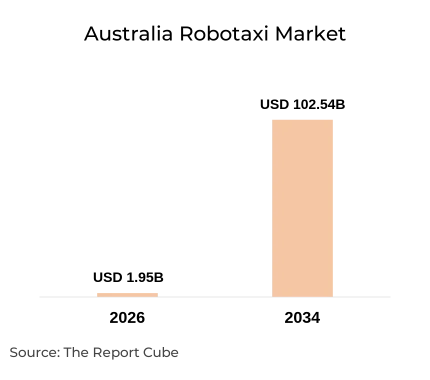
- Australia Robotaxi Market was valued at USD 1.95 billion in 2026.
- Market is projected to reach USD 102.54 billion by 2034 at 64.10% CAGR.
- Station-based service type holds the dominant revenue share in Australia.
- Passenger transport remains the leading application driving autonomous mobility demand.
- New South Wales leads regional adoption, powered by progressive AV trial frameworks.
- Queensland targets rapid expansion through the 2032 Brisbane Olympics infrastructure push.
- Leading players include Tesla, Waymo, Baidu Inc., and Zoox operating in Australia.
- AI-driven fleet management and Level 4 autonomy are defining the industry's future trajectory.
Australia Robotaxi Market Insights & Analysis
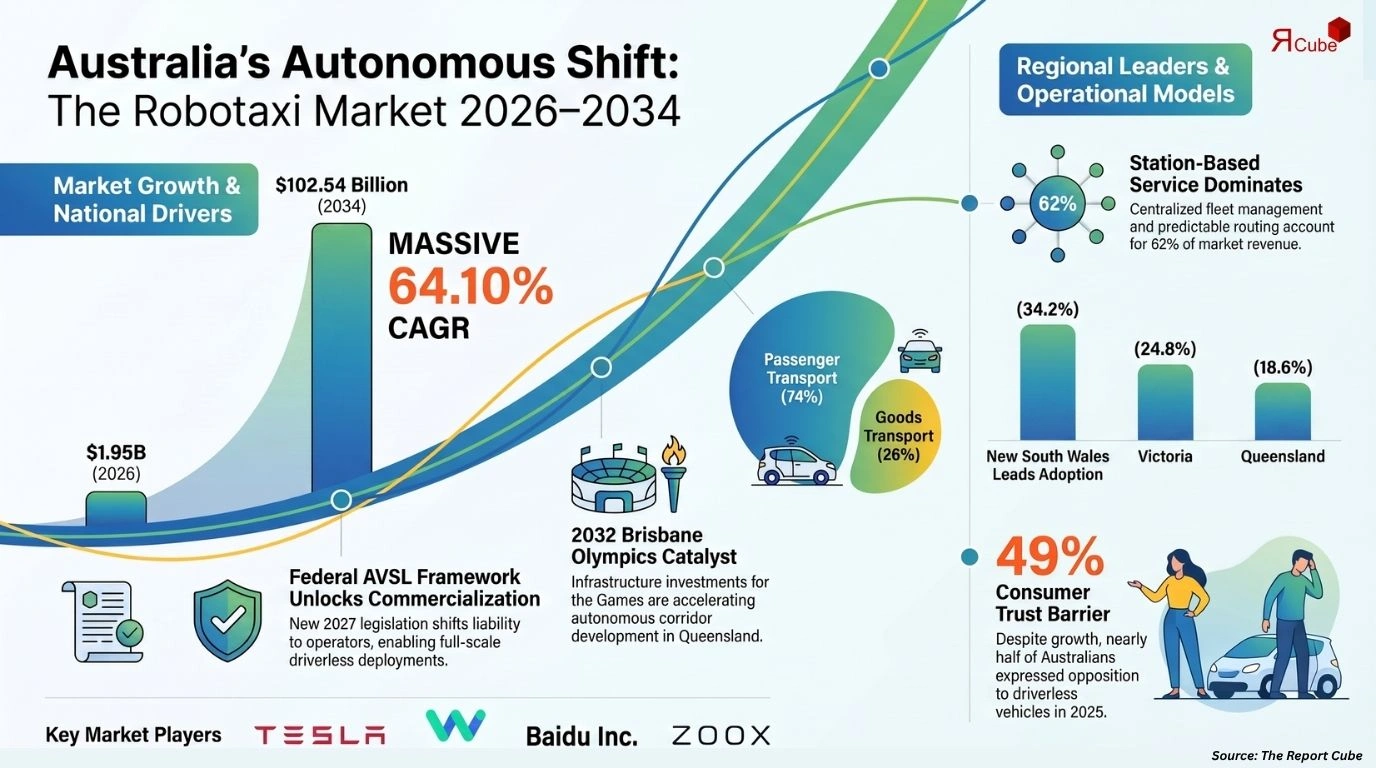
The Australia Robotaxi Market is anticipated to register a 64.10% CAGR during 2026–2034. The market size was valued at USD 1.95 billion in 2026 and is projected to reach USD 102.54 billion by 2034. The industry is benefiting from accelerating autonomous vehicle trials across New South Wales and Victoria, rising urban mobility demand, and a regulatory environment transitioning toward the federal Automated Vehicle Safety Law (AVSL) framework expected to enable commercial driverless deployments. Australia's dense metropolitan corridors and government-backed smart city investments are unlocking substantial commercial opportunities for autonomous ride-hailing operators across state boundaries.
Urban congestion costs in Australian cities including Sydney and Melbourne have long served as structural catalysts for mobility innovation. Transport for NSW's collaborative AV trial history, including its engagement with Level 4 autonomous platforms, signals institutional readiness for broader commercial rollouts. Private investment from global robotaxi operators has intensified, with Waymo actively lobbying Australian regulators and negotiating with vehicle manufacturers including Geely to support local fleet operations. Goldman Sachs Research projects the global robotaxi industry will reach approximately USD 415 billion by 2035, underscoring the transformative capital flows entering markets at Australia's stage of development.
Australia Robotaxi Market Dynamics
Australia's autonomous mobility sector is entering a critical inflection point as global AV operators accelerate entry strategies and domestic regulators build the legislative infrastructure needed for commercial deployment. Urbanization, rising rideshare adoption, and federal government commitments to reduce road trauma - with the National Transport Commission projecting AUD 320 billion in congestion savings through automation - are reinforcing the investment case for station-based robotaxi fleet deployment across eastern seaboard cities.
|
Factor |
Type |
Specific Impact on Market |
Magnitude |
|---|---|---|---|
|
Federal AVSL regulatory framework |
Driver |
Unlocks commercial driverless deployments from 2027 |
Very High |
|
Urban congestion and road trauma costs |
Driver |
Accelerates municipal and state support for AV pilots |
High |
|
Level 4 autonomous technology maturity |
Trend |
Enables geo-fenced commercial robotaxi operations |
Very High |
|
Consumer trust and technology acceptance |
Challenge |
Slows public uptake; 49% Australians opposed in 2025 survey |
High |
|
Brisbane 2032 Olympics infrastructure investment |
Opportunity |
Accelerates Queensland AV corridor development |
High |
Key Market Driver: Federal AVSL Framework Enabling Commercial Deployments
Australia's National Transport Commission is advancing the Automated Vehicle Safety Law to replace the current fragmented state-by-state trial permit system. The proposed framework fundamentally shifts liability from drivers to manufacturers and fleet operators, removing a critical regulatory barrier that has delayed large-scale commercial robotaxi launches. The NTC has quantified 8,000 lives saved and AUD 152 billion in crash cost avoidance through AV adoption. This legislative clarity is expected to unlock significant capital commitments from Waymo, Tesla, and other global operators targeting Australian metropolitan corridors for early deployment.
Major Industry Challenge: Fragmented State Regulations and Consumer Skepticism
Australia currently maintains inconsistent AV trial requirements across states, with Western Australia mandating both hands on the wheel while Queensland requires only one, and Victoria demanding VicRoads-issued Automated Driving System permits for modified vehicles. This regulatory fragmentation increases market entry complexity for global operators. In parallel, an iSelect survey published in September 2025 found nearly half of 500 Australian respondents opposed fully driverless vehicles operating locally, highlighting that consumer trust remains a significant adoption barrier requiring sustained public communication and safety data disclosure strategies.
Emerging Trend Shaping Outlook: AI-Powered Perception and Fleet Intelligence Systems
Robotaxi operators are increasingly deploying advanced AI architectures combining LiDAR, radar, cameras, and machine learning to generate real-time 3D environment mapping suited to Australian road conditions. Neural networks are eliminating the need to retrain vehicles for each new city, significantly reducing market entry costs for operators targeting Sydney and Melbourne. Waymo's simulation collaboration with Australian city planners, confirmed in March 2026, exemplifies how AI-driven autonomous fleet intelligence platforms for urban environments are replacing conventional rule-based programming to handle edge cases specific to Australia's infrastructure.
Need Specific Data, Let’s Customize the Report for You
Request CustomizationAustralia Robotaxi Market Segment-wise Analysis
Australia's robotaxi sector is evolving across two primary dimensions - service delivery model and application use case - each reflecting distinct commercial maturity levels and investment priorities across the country's major urban markets.
By Service Type
- Car Rental
- Station Based
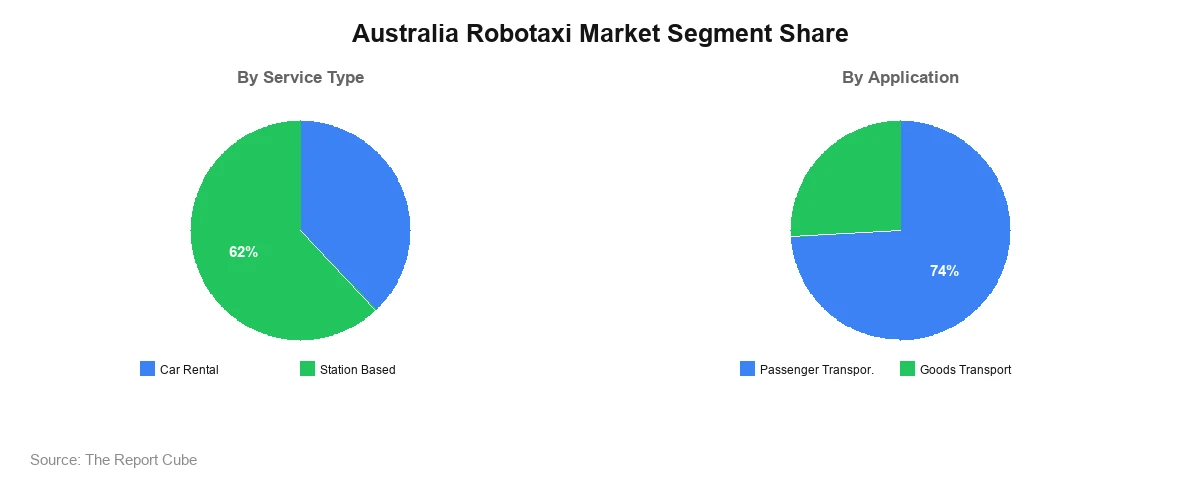
Station-based service accounts for an estimated 62% of the Australia Robotaxi Market by service type, driven by the operational efficiency advantages of centralized fleet management, predictable vehicle routing, and structured maintenance protocols suited to early-stage regulatory environments. State governments in NSW and Victoria have prioritized geo-fenced pilot zones where station-based dispatch models can be closely monitored, making this format the preferred deployment structure for international operators seeking regulatory approval. Waymo's discussions with NSW authorities have consistently centered on controlled zone operations, further reinforcing the dominance of station-based services in the near-term landscape.
Car rental-based robotaxi services represent approximately 38% market share and are gaining traction as consumer familiarity with autonomous platforms grows. This segment is expected to expand rapidly post-2027 as the AVSL framework removes barriers to point-to-point driverless service across broader urban zones. The flexibility of app-based autonomous rental aligns with existing rideshare infrastructure and positions operators like Tesla, with its Full Self-Driving subscription model, to capture growing demand from tech-forward urban commuters across Sydney and Melbourne.
By Application
- Passenger Transport
- Goods Transport
Passenger transport dominates the application segment with an estimated 74% market share, reflecting the primary commercial case for autonomous vehicles as urban mobility solutions. Sydney and Melbourne rank among the most navigable cities globally for AV deployment due to consistent road infrastructure and defined urban zones. NSW's Transport department has already approved multiple driverless shuttle pilots, with the CBD and airport corridors flagged as priority commercial zones. Rising demand from commuters, growing acceptance among younger demographics, and platform integration with ride-hailing services are sustaining investment into passenger-oriented autonomous mobility services across New South Wales.
Goods transport represents approximately 26% market share and is emerging as a strategically important application, particularly in Western Australia and NSW where autonomous freight vehicle trials on longer-range corridors are progressing. The segment benefits from regulatory flexibility - freight operations in industrial zones face fewer public safety objections than passenger transport - and from the operational economics of 24/7 driverless delivery cycles. Investment from logistics companies and AV operators in last-mile autonomous delivery is expected to accelerate this segment's growth substantially through 2034, particularly as the AVSL framework extends permissions beyond passenger applications.
Regional Projection of Australia Robotaxi Market
Australia's robotaxi market exhibits distinct regional variation driven by state-level regulatory maturity, urban density, infrastructure readiness, and government investment priorities. New South Wales and Victoria lead current activity, while Queensland's accelerating smart mobility agenda and Western Australia's favorable testing conditions are reshaping the long-term growth map.
|
Region |
Estimated Market Share |
Key Growth Factors |
Consumer Trends |
|---|---|---|---|
|
New South Wales |
34.2% |
Advanced AV trial frameworks, CBD corridor designations, TfNSW partnerships |
High early-adopter demand in Sydney metro |
|
Victoria |
24.8% |
VicRoads AV permits, state Future Transport Strategy, suburban corridor trials |
Growing demand for autonomous commuter services |
|
Queensland |
18.6% |
Brisbane 2032 Olympics investment, CAVI program, urban population growth |
Increasing tech infrastructure investment |
|
Australian Capital Territory |
10.1% |
Federal policy proximity, smart city mandates, compact urban geography |
High government procurement interest |
|
Western Australia |
7.9% |
Controlled test environment, autonomous freight corridors, mining-sector AV crossover |
Early-stage passenger AV interest |
|
Others |
4.4% |
Progressive rural AV trials, infrastructure modernization programs |
Emerging consumer awareness |
- New South Wales: NSW leads the market with approximately 34.2% share, anchored by Transport for NSW's progressive AV pilot program, Waymo's active Sydney lobbying, and the state's relatively accessible trial permit system compared to other jurisdictions.
- Victoria: Victoria maintains a 24.8% share driven by its Future Transport Strategy designating autonomous vehicles as a policy priority, alongside VicRoads-managed AV testing permits on suburban corridors.
- Queensland: Queensland holds approximately 18.6% and is positioned as the fastest-growing state market, with the 2032 Brisbane Olympics creating a compelling infrastructure investment timeline for autonomous mobility corridors.
- Australian Capital Territory: ACT captures around 10.1% share through its compact geography, federal government procurement pipelines, and proximity to national transport policy institutions, making it a strategic early deployment zone.
- Western Australia: WA accounts for approximately 7.9%, with its controlled environment, long freight corridors, and mining-sector autonomous vehicle crossover experience creating a favorable foundation for early commercial passenger operations.
- Others: Remaining states and territories collectively represent 4.4%, with incremental AV trial activity in South Australia and the Northern Territory contributing to long-term market development.
Australia Robotaxi Market: Recent Development (2025)
- Waymo accelerated Sydney trial planning, engaging NSW regulators and lobbying the Federal Infrastructure Minister in 2025.
- Tesla expanded its Full Self-Driving supervised capabilities to Australian vehicles, signaling local autonomous mobility readiness in 2025.
- Baidu's Apollo Go surpassed 250,000 weekly driverless rides globally, strengthening its case for Australia market entry in 2025.
- Zoox debuted public autonomous rides in the US, advancing its international expansion roadmap toward Australian deployments in 2025.
Australia Robotaxi Market Future Outlook (2034)
The Australia Robotaxi Market is projected to expand at a 64.10% CAGR, reaching approximately USD 102.54 billion by 2034. Federal AVSL enactment anticipated in 2027 will serve as the pivotal commercial trigger, enabling operators including Waymo, Tesla, and Zoox to transition from trial-phase engagements to full commercial fleet deployments across Sydney, Melbourne, and Brisbane. The 2032 Brisbane Olympics is expected to accelerate Queensland's infrastructure readiness, creating a nationally coordinated autonomous mobility corridor spanning Australia's eastern seaboard and reinforcing the country's position as a leading Asia-Pacific AV deployment destination.
Technology advancement will drive increasing cost efficiency across robotaxi fleets as AI-powered perception systems mature and vehicle hardware standardizes. End-of-lifecycle fleet renewal cycles will favor fully electric autonomous platforms, aligning with Australia's net-zero transport commitments. Operators will increasingly integrate robotaxi services with multimodal public transport networks, enabling seamless passenger journeys across train, bus, and autonomous vehicle connections. Long-term market expansion will be further supported by growing consumer acceptance, rising urban populations, and continued government investment in smart city infrastructure that positions autonomous mobility as a cornerstone of Australia's future transport ecosystem
Australia Robotaxi Market Report Coverage
|
Report Attribute |
Details |
|---|---|
|
Market Name |
Australia Robotaxi Market |
|
Market Size (2026) |
USD 1.95 Billion |
|
Market Size (2034) |
USD 102.54 Billion |
|
Forecast Period |
2026–2034 |
|
CAGR |
64.10% |
|
Base Year |
2026 |
|
Historical Years |
2021–2025 |
|
Forecast Years |
2026–2034 |
|
Segments Covered |
By Service Type, By Application, By Vehicle Type, By Propulsion Type |
|
Regions Covered |
New South Wales, Victoria, Queensland, Australian Capital Territory, Western Australia, Others |
|
Key Companies |
Tesla, Waymo, Baidu Inc., Zoox, Others |
|
Report Format |
PDF, Excel, PPT |
|
Customization |
Available as per client requirements |
Why Choose This Report?
- Comprehensive analysis of Australia's evolving autonomous vehicle regulatory landscape.
- Accurate market sizing with a reliable 64.10% CAGR forecast through 2034.
- Granular state-level regional breakdown covering all major Australian jurisdictions.
- Detailed segmentation across service type and application dimensions.
- Competitive intelligence on Tesla, Waymo, Baidu, and Zoox Australia strategies.
- Insights into federal AVSL legislation and its commercial deployment implications.
- Analysis of AI-driven fleet management and Level 4 autonomy trends.
- Data-driven research supporting investment, partnership, and market entry decisions.
Table of Contents
- Introduction
- Objective of the Study
- Product Definition
- Market Segmentation
- Study Variables
- Research Methodology
- Secondary Data Points
- Companies Interviewed
- Primary Data Points
- Breakdown of Primary Interviews
- Secondary Data Points
- Executive Summary
- Market Dynamics
- Drivers
- Challenges
- Opportunity Assessment
- Recent Trends and Developments
- Policy and Regulatory Landscape
- Australia Robotaxi Market Overview and Forecast Analysis (2021-2034)
- Market Size, By Value, By Growth Rate (CAGR/USD Billions)
- Demand – Supply Trends
- Market Share, By Propulsion Type
- Electric Vehicle
- Hybrid
- Market Share, By Vehicle Type
- Cars
- Shuttle/ Vans
- Market Share, By Service Type
- Car Rental
- Station Based
- Market Share, By Application
- Passenger Transport
- Goods Transport
- Market Share, By Region
- New South Wales
- Victoria
- Queensland
- Australian Capital Territory
- Western Australia
- Others
- Market Share, By Competitors
- Competition Characteristics
- Revenue Shares
- Electric Vehicle Australia Robotaxi Market Overview, 2021-2034F
- By Value (USD Million)
- By Vehicle Type – Market Size & Forecast 2021-2034, USD Million
- Cars
- Shuttle/ Vans
- Hybrid Australia Robotaxi Market Overview, 2021-2034F
- By Value (USD Million)
- By Vehicle Type – Market Size & Forecast 2021-2034, USD Million
- Cars
- Shuttle/ Vans
- Competitive Outlook (Company Profile – Partial List)
- Tesla
- Company Overview
- Business Segments
- Strategic Alliances/Partnerships
- Recent Developments
- Waymo
- Company Overview
- Business Segments
- Strategic Alliances/Partnerships
- Recent Developments
- Baidu Inc.
- Company Overview
- Business Segments
- Strategic Alliances/Partnerships
- Recent Developments
- Zoox
- Company Overview
- Business Segments
- Strategic Alliances/Partnerships
- Recent Developments
- Others
- Tesla
- Contact Us & Disclaimer
Top Key Players & Market Share Outlook
- Tesla
- Waymo
- Baidu Inc.
- Zoox
- Others
Frequently Asked Questions