


Build Your Custom Market Intelligence Report
Customize Your ReportKey Takeaways
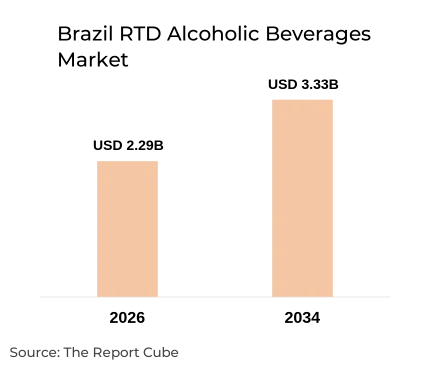
- Brazil RTD Alcoholic Beverages Market is valued at USD 2.29 billion in 2026.
- The market is projected to reach USD 3.33 billion by 2034 at a CAGR of 4.80%.
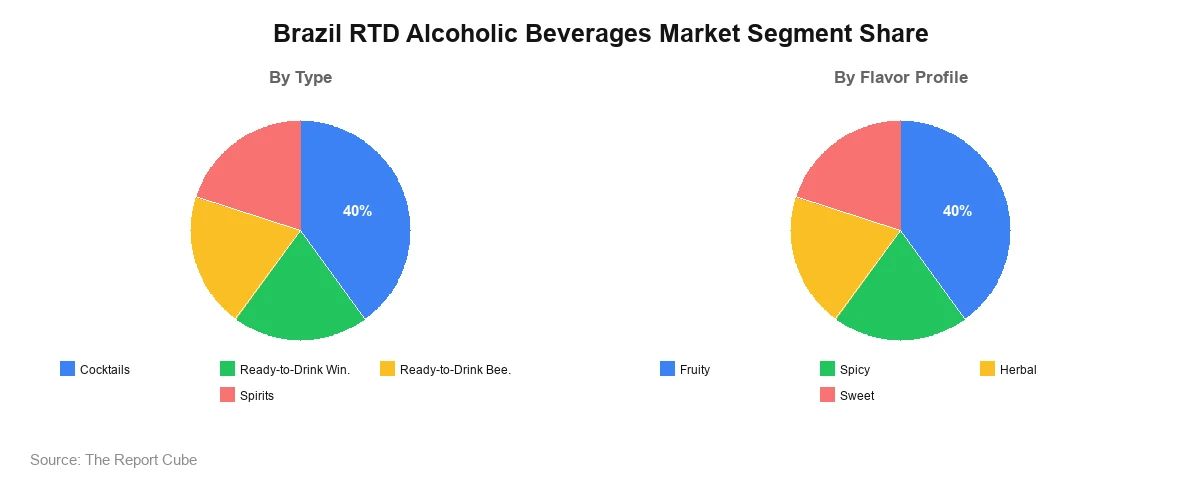
- Cocktails lead the type segment with an estimated 40% share in 2026.
- Fruity leads the flavor profile segment with an estimated 40% share in 2026.
- South is the leading region with an estimated 42% share in 2026.
- Anheuser-Busch InBev, Diageo, Heineken, Constellation Brands, Pernod Ricard, Molson Coors, Brown-Forman and Asahi are the supplied key players.
- Brewers and spirits companies are extending RTD ranges through seasonal flavors, premium launches and new packaging formats.
Market Overview
Ready-to-drink alcoholic beverages are pre-mixed, packaged drinks combining spirits, wine, or malt bases with juices, flavors, or carbonated mixers. They are sold in cans, bottles, and pouches, and range from low to high alcohol content. Cocktails, ready-to-drink wine, beer-based drinks, and spirit mixes serve consumption at social gatherings, events, and home settings.
The Brazil RTD Alcoholic Beverages Market Analysis points to a category still small within alcohol: Diageo estimates RTDs account for about 1.8% of Brazil’s alcoholic beverage market, against roughly 10.7% in North America. Weaker beer volumes, including a 4.5% decline reported by Ambev for 2025, are prompting brewers to broaden portfolios.
Market participants are expanding RTD portfolios through seasonal flavors, premium spirit brands, and carton packaging, with Carnival serving as a launch window for Ambev’s Beats and Heineken’s Amstel Vibes. Brazil’s market is valued at USD 2.29 billion in 2026 and is projected to grow at a CAGR of 4.80% during 2026–2034.
Brazil RTD Alcoholic Beverages Market Dynamics
Brazil’s RTD alcoholic beverages sector is shaped by product registration rules, uneven beer volumes, brewer and spirits-company portfolio expansion, and packaging innovation. Brazil RTD Alcoholic Beverages Market Growth depends on regulatory compliance and category-specific demand, while government sources do not directly confirm RTD revenue growth or the supplied 4.80% CAGR.
|
Factor |
Type |
Specific Impact on Market |
Magnitude |
|---|---|---|---|
|
Defined registration framework for mixed alcoholic beverages and cocktails |
Driver |
Gives compliant manufacturers a clear pathway to develop RTD cocktails; does not quantify demand |
Medium (qualitative) |
|
Brewer and spirits-company portfolio expansion |
Driver |
Increases brand investment, flavor launches and distribution effort in RTDs |
Medium–High (qualitative) |
|
Compliant cocktail and premium product development |
Opportunity |
Supports new mixed-beverage products, documented sourcing and traceability |
Medium (qualitative) |
|
Product classification and registration requirements |
Challenge |
Requires confirmation of classification, composition and registration before distribution |
Medium (qualitative) |
|
Weaker beverage production and alcohol volumes |
Challenge |
Creates uneven demand conditions; figures do not isolate RTD sales |
Medium (qualitative) |
|
Seasonal flavors and new packaging formats |
Trend |
Encourages limited editions, premium RTDs and carton packaging |
Medium–High (qualitative) |
Brazil RTD Alcoholic Beverages Market Growth Drivers
According to Brazil’s Ministry of Agriculture and Livestock (MAPA), mixed alcoholic beverages and alcoholic cocktails fall under defined product and establishment registration requirements. This gives compliant manufacturers a clear pathway to develop RTD cocktails, although the framework does not quantify demand. Cocktails are the largest supplied type segment, which makes regulatory clarity relevant to the category’s core products.
Beer weakness is pushing brewers toward adjacent categories. Ambev reported a 4.5% decline in beer sales volume in 2025 and continues to treat Beats as its principal RTD brand, supported by a dedicated Beyond Beer unit. Diageo also describes RTDs as its largest growth source in Brazil, where the category remains small relative to the wider alcohol market.
Brazil RTD Alcoholic Beverages Market Opportunities
Producers can develop compliant RTD cocktails and other mixed alcoholic beverages that meet MAPA’s registration and product requirements. The framework supports product development but does not guarantee commercial success or establish a growth rate. Higher-quality formulations also respond to premium demand that Diageo’s innovation team has identified in Brazil, particularly for whisky-based serves.
Documented ingredient sourcing, batch records, and compliance procedures can strengthen quality management and regulatory readiness, which MAPA emphasizes through product identity, safety, and traceability. New packaging formats, including carton packs used by brands such as Pitu and Skal, may also widen consumption occasions for younger consumers, although commercial results remain unverified.
Brazil RTD Alcoholic Beverages Industry Challenges
MAPA’s guidance requires manufacturers to confirm product classification, composition, and registration before commercial distribution. Alcoholic mixed beverages and cocktails must meet applicable product standards, which can lengthen launch timelines for new formulations. Smaller producers may face greater administrative effort, while current requirements for individual products still require confirmation with the authority.
Banco do Nordeste’s 2026 beverage industry analysis reports that Brazil’s beverage production declined by 2.6% in 2025 and that alcoholic beverage sales volumes generally weakened in 2024, with wine as an exception. RTD producers therefore operate in uneven demand conditions, although these figures do not isolate RTD sales. Competition from established brands and entrants such as Xeque Mate adds further pressure.
Need Specific Data, Let’s Customize the Report for You
Request CustomizationBrazil RTD Alcoholic Beverages Market Trends
Brazil RTD Alcoholic Beverages Market Trends reflect brand extensions from beer and spirits companies. Ambev refreshes Beats with new versions for Carnival, Heineken retained Amstel Vibes with two flavors, and Grupo Petrópolis introduced a limited-edition Spritz under Fest Drinks by Itaipava, indicating seasonal launches as a recurring commercial approach in the category.
Premiumization and packaging are the second direction. Diageo launched Johnnie Walker’s first RTD in Brazil as a permanent portfolio addition and expanded Smirnoff Ice production capacity in Ceará, while Tetra Pak is promoting carton packaging for alcoholic RTDs. These developments indicate wider formats, though they do not quantify category sales.
Brazil RTD Alcoholic Beverages Market Segment Analysis
Brazil RTD Alcoholic Beverages Market Share is distributed across type, flavor profile, packaging, and alcohol content categories. Estimated 2026 shares were supplied for the leading type and flavor segments only; other shares require validation.
By Type
- Cocktails
- Ready-to-Drink Wine
- Ready-to-Drink Beer
- Spirits
Cocktails lead the type category with an estimated 40% share in 2026, supported by demand for convenient mixed serves and by brands such as Diageo’s Smirnoff Ice and Johnnie Walker Blonde & Citrus, alongside Ambev’s Beats. MAPA’s registration framework for mixed alcoholic beverages and cocktails also provides a defined pathway for compliant product development. Ready-to-drink wine follows as a smaller segment; Banco do Nordeste identifies wine as an exception to weaker alcoholic beverage sales in 2024, although this does not isolate RTD wine. Ready-to-drink beer reflects brewers’ efforts to extend beer brands into new occasions, including Ambev’s Flying Fish, which combines light-beer attributes with ready-to-drink appeal. Spirits-based RTDs rely on established spirit brands and premium positioning, with Diageo identifying growing demand for premium products that combine convenience with quality. Growth rankings among these segments cannot be established from the supplied data.
By Flavor Profile
- Fruity
- Spicy
- Herbal
- Sweet
Fruity leads the flavor category with an estimated 40% share in 2026, reflecting the prominence of citrus and fruit-led profiles in recent launches such as Johnnie Walker Blonde & Citrus and Xeque Mate, which blends rum, lemon, guaraná, and yerba mate. Sweet flavors are associated with Smirnoff Ice, described as a carbonated vodka cocktail popular among sweet-drink consumers. Herbal profiles are illustrated by the yerba mate component in Xeque Mate, which positions the brand as an alternative to beer at Carnival events. Spicy flavors serve narrower taste preferences, and no verified Brazil-specific evidence was available to separate their performance. Flavor rotation for seasonal events continues to shape launch planning across domestic and international producers.
Regional Analysis
|
Region |
Estimated Market Share |
Key Growth Factors |
Industry Trends |
|---|---|---|---|
|
South |
42% |
Supplied leading region; state-level demand evidence requires validation |
Seasonal and premium RTD launches by national brands |
|
Central-West |
- |
RTD-specific evidence not verified |
Requires validation |
|
Northeast |
- |
Diageo’s Itaitinga plant in Ceará adds RTD production capacity |
Capacity expansion for Smirnoff Ice |
|
North |
- |
RTD-specific evidence not verified |
Requires validation |
South is modeled as the leading region with an estimated 42% share in 2026, according to the supplied market framework. Region-specific demand evidence was not supplied, so the leadership position should be validated against state-level consumption, distribution, and retail data before publication. The remaining 58% is spread across Central-West, Northeast, and North, with individual shares not supplied.
Northeast has verified supply-side activity, as Diageo expanded its Itaitinga plant in Ceará to produce 8 million litres of Smirnoff Ice by the end of 2027. Banco do Nordeste’s sector analysis also provides regional beverage industry context. Central-West and North currently lack verified RTD-specific evidence, so their positions are presented without share estimates.
Market Share & Competitive Landscape
The Brazil RTD Alcoholic Beverages Market includes global brewers, spirits producers, and domestic entrants. The table summarizes the supplied key players by capability and relevant segment. It does not represent numerical market share, and Brazil-specific RTD activity should be validated where noted.
|
Company |
Competitive Strength |
Primary Segment Served |
|---|---|---|
|
Anheuser-Busch InBev |
Operates in Brazil through Ambev; Beats, Rex Mix, Flying Fish and a Beyond Beer unit |
Canned RTDs and beer-adjacent drinks |
|
Diageo |
Smirnoff Ice, Johnnie Walker RTD and expanded Itaitinga production capacity |
Spirit-based cocktails and premium RTDs |
|
Heineken |
Amstel Vibes and a Beyond Beer marketing focus |
Beer-adjacent and flavored RTDs |
|
Constellation Brands |
Beer, wine and spirits portfolio; Brazil RTD activity not verified |
RTD wine and beer-based drinks |
|
Pernod Ricard |
Global spirits portfolio; Brazil RTD activity not verified |
Spirit-based RTDs |
|
Molson Coors Beverage Company |
Global brewer; Brazil RTD activity not verified |
RTD beer |
|
Brown-Forman |
Global whiskey and spirits brands; Brazil RTD activity not verified |
Spirit-based RTDs |
|
Asahi Group Holdings |
Global beverage and brewing group; Brazil RTD activity not verified |
Beer-adjacent and alcoholic beverages |
Key Companies in the Brazil RTD Alcoholic Beverages Market
Anheuser-Busch InBev: Anheuser-Busch InBev is headquartered in Leuven, Belgium, and operates in Brazil through Ambev. In February 2025, Ambev presented Rex Mix, a new Beats version for Carnival, and its Beyond Beer unit develops drinks beyond beer. Ambev also began distributing Flying Fish, which combines light-beer attributes with ready-to-drink appeal.
Diageo: Diageo is headquartered in London, United Kingdom. In October 2024, it launched Johnnie Walker’s first RTD in Brazil, and it later expanded its Itaitinga plant in Ceará for 8 million litres of Smirnoff Ice by 2027, strengthening its RTD capacity.
Recent Developments
|
Year / Month |
Company |
Development |
|---|---|---|
|
February 2025 |
Ambev |
Presented Rex Mix, a new version of Beats, for Carnival 2025. |
|
February 2025 |
Heineken |
Maintained Amstel Vibes with two flavors for Carnival 2025. |
|
2025 |
Tetra Pak |
Increased investment in carton packaging for alcoholic RTDs in Brazil, adopted by brands including Pitu and Skal. |
Brazil RTD Alcoholic Beverages Market Future Outlook
The Brazil RTD Alcoholic Beverages Market Forecast indicates growth from USD 2.29 billion in 2026 to USD 3.33 billion by 2034 at a CAGR of 4.80%, based on supplied estimates. Expansion is expected to depend on product innovation, distribution reach, regulatory compliance, and the ability of brewers and spirits companies to convert Carnival-led trial into repeat consumption throughout the year.
Diageo’s capacity expansion in Ceará and carton packaging adoption suggest continued investment in production and formats, while premium launches may support higher-value consumption. Risks include uneven beer and wider alcohol demand, registration requirements, and competition from domestic entrants such as Xeque Mate. The projections remain conditional scenarios, and RTD-specific historical data should be verified before the values are treated as outcomes.
Brazil RTD Alcoholic Beverages Market Report Coverage
This Brazil RTD Alcoholic Beverages Market Report summarizes the supplied valuation, forecast assumptions, segmentation, regional framework, and competitive ecosystem.
|
Parameter |
Details |
|---|---|
|
Market Name |
Brazil RTD Alcoholic Beverages Market |
|
Market Size 2026 |
USD 2.29 billion |
|
Market Size 2034 |
USD 3.33 billion |
|
Forecast Period |
2026–2034 |
|
CAGR |
4.80% |
|
Base Year |
2026 |
|
Historical Years |
2021–2025 |
|
Forecast Years |
2026–2034 |
|
Segments Covered |
By Type; By Flavor Profile; By Packaging Type; By Content |
|
Regions Covered |
South, Central-West, Northeast, North |
|
Key Companies |
Anheuser-Busch InBev, Diageo, Heineken, Constellation Brands, Pernod Ricard, Molson Coors Beverage Company, Brown-Forman, Asahi Group Holdings |
|
Customization |
Available as per client requirements |
Why Choose This Brazil RTD Alcoholic Beverages Market Report?
- Market coverage of RTD cocktails, wine, beer and spirits-based drinks sold in Brazil.
- Clear presentation of the supplied 2026 valuation, 2034 forecast and 4.80% CAGR.
- Segmentation across type, flavor profile, packaging type and alcohol content.
- Regional framework covering South, Central-West, Northeast and North.
- Competitive profiling of supplied global brewers and spirits companies with Brazil activity noted where verified.
- Trend and forecast insights to support portfolio planning, packaging decisions and market-entry evaluation.
- Context on MAPA registration requirements relevant to RTD product development.
Table of Contents
- Introduction
- Objective of the Study
- Product Definition
- Market Segmentation
- Study Variables
- Research Methodology
- Secondary Data Points
- Companies Interviewed
- Primary Data Points
- Breakdown of Primary Interviews
- Secondary Data Points
- Executive Summary
- Market Dynamics
- Drivers
- Challenges
- Opportunity Assessment
- Recent Trends and Developments
- Policy and Regulatory Landscape
- Brazil RTD Alcoholic Beverages Market Overview and Forecast Analysis (2021-2034)
- Market Size, By Value, By Growth Rate (CAGR/USD Billions)
- Demand – Supply Trends
- Market Share, By Type
- Cocktails
- Ready-to-Drink Wine
- Ready-to-Drink Beer
- Spirits
- Market Share, By Flavor Profile
- Fruity
- Spicy
- Herbal
- Sweet
- Market Share, By Packaging Type
- Cans
- Bottles
- Pouches
- Market Share, By Content
- Low Alcohol
- Regular Alcohol
- High Alcohol
- Market Share, By Region
- South
- Central-West
- Northeast
- North
- Market Share, By Competitors
- Competition Characteristics
- Revenue Shares
- Cocktails Brazil RTD Alcoholic Beverages Market Overview, 2021-2034F
- By Value (USD Million)
- By Flavor Profile – Market Size & Forecast 2021-2034, USD Million
- Fruity
- Spicy
- Herbal
- Sweet
- Ready-to-Drink Wine Brazil RTD Alcoholic Beverages Market Overview, 2021-2034F
- By Value (USD Million)
- By Flavor Profile – Market Size & Forecast 2021-2034, USD Million
- Fruity
- Spicy
- Herbal
- Sweet
- Ready-to-Drink Beer Brazil RTD Alcoholic Beverages Market Overview, 2021-2034F
- By Value (USD Million)
- By Flavor Profile – Market Size & Forecast 2021-2034, USD Million
- Fruity
- Spicy
- Herbal
- Sweet
- Spirits Brazil RTD Alcoholic Beverages Market Overview, 2021-2034F
- By Value (USD Million)
- By Flavor Profile – Market Size & Forecast 2021-2034, USD Million
- Fruity
- Spicy
- Herbal
- Sweet
- Competitive Outlook (Company Profile – Partial List)
- Anheuser-Busch InBev
- Company Overview
- Business Segments
- Strategic Alliances/Partnerships
- Recent Developments
- Diageo
- Company Overview
- Business Segments
- Strategic Alliances/Partnerships
- Recent Developments
- Heineken
- Company Overview
- Business Segments
- Strategic Alliances/Partnerships
- Recent Developments
- Constellation Brands
- Company Overview
- Business Segments
- Strategic Alliances/Partnerships
- Recent Developments
- Pernod Ricard
- Company Overview
- Business Segments
- Strategic Alliances/Partnerships
- Recent Developments
- Molson Coors Beverage Company
- Company Overview
- Business Segments
- Strategic Alliances/Partnerships
- Recent Developments
- Brown-Forman
- Company Overview
- Business Segments
- Strategic Alliances/Partnerships
- Recent Developments
- Asahi Group Holdings
- Company Overview
- Business Segments
- Strategic Alliances/Partnerships
- Recent Developments
- Anheuser-Busch InBev
- Contact Us & Disclaimer
Top Key Players & Market Share Outlook
- Anheuser-Busch InBev
- Diageo
- Heineken
- Constellation Brands
- Pernod Ricard
- Molson Coors Beverage Company
- Brown-Forman
- Asahi Group Holdings
Frequently Asked Questions