



Build Your Custom Market Intelligence Report
Customize Your ReportIndia Safety Eyewear Market Key Highlights:
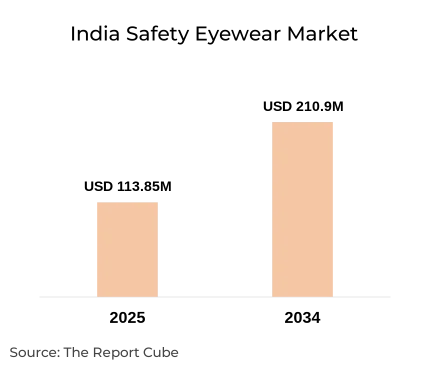
- Market Value 2025: USD 113.85 million
- Market Value 2034: USD 210.90 million (projected)
- CAGR 2026-2034: 7.09%
- Largest Application Segment: Industrial Manufacturing
- Dominant Distribution Channel: B2B
- Fastest-Growing Channel: D2C (rising e-commerce penetration)
- Key Players: Honeywell International Inc, 3M Co, Uvex Group, Bollé Safety, Pyramex Safety Products, Radians, Gateway Safety, MEDOP, Bunzl PLC
India Safety Eyewear Market Insights & Analysis
India records more than 800,000 workplace injuries annually, yet eye protection compliance across unorganised industrial sectors remains under 40%. That compliance gap, spanning millions of construction, manufacturing, and oil & gas workers, translates directly into preventable vision loss and escalating occupational liability costs for Indian employers. This section analyses the forces reshaping India's safety eyewear market, from regulatory mandates to workforce formalisation, that are closing the gap between risk exposure and protective coverage.
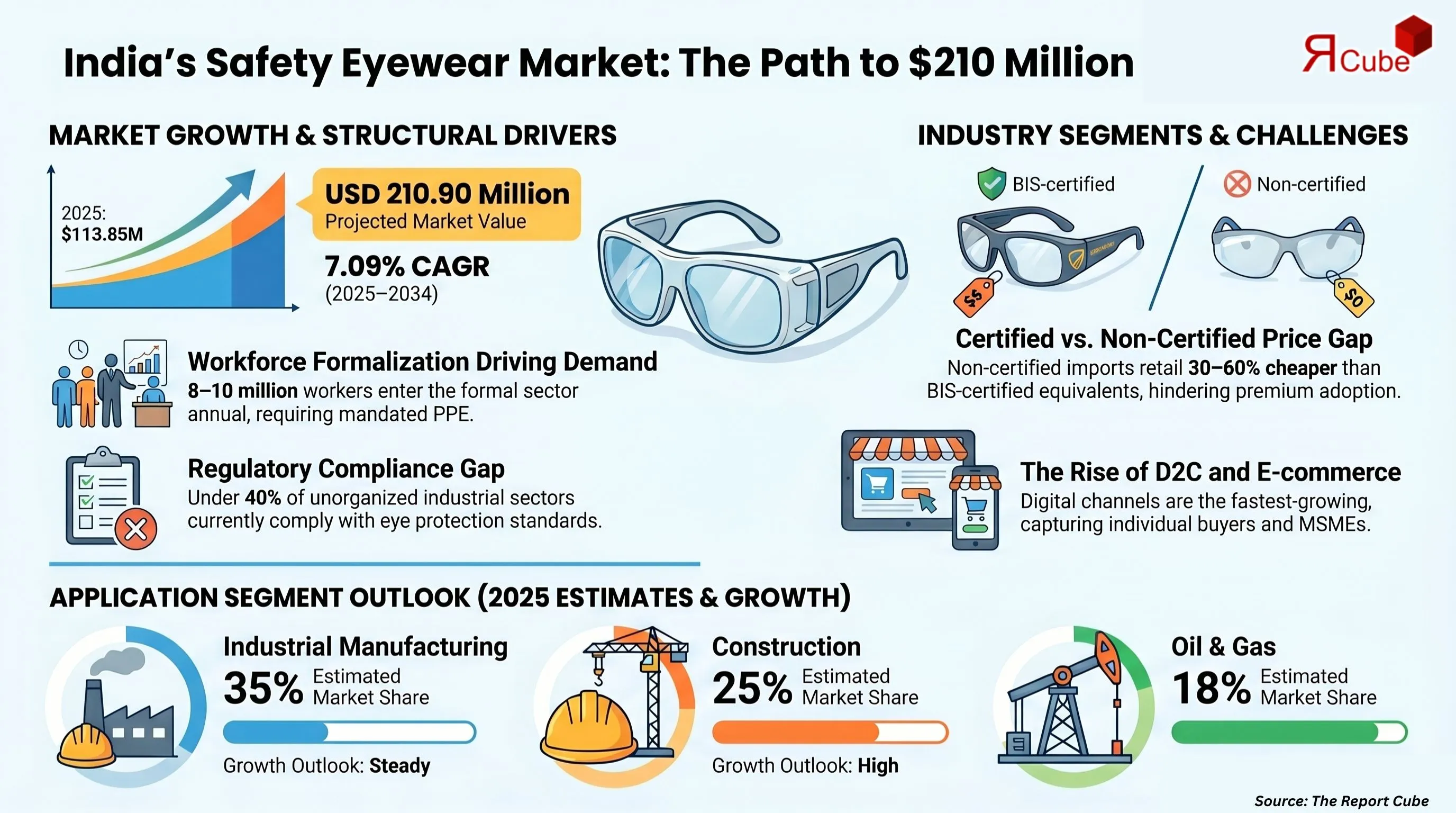
The India safety eyewear market is valued at USD 113.85 million in 2025 and is projected to reach USD 210.90 million by 2034, expanding at a 7.09% CAGR over the forecast period. This growth trajectory reflects the convergence of regulatory enforcement, industrial expansion, and rising employer awareness of occupational liability.
India's Factories Act and Bureau of Indian Standards (BIS) standards mandate PPE adoption across all registered industrial establishments. The Ministry of Labour & Employment enforces these requirements through a network of state-level factory inspectorates, making compliance a non-negotiable cost of industrial operation for organised-sector employers.
The Make in India initiative continues to add 5–7 million formal-sector workers annually to India's industrial base (Ministry of Commerce & Industry, India, 2024). Each formalised worker represents a mandated PPE recipient, directly expanding the addressable market for certified safety eyewear brands. The contrast between urban industrial compliance and rural or informal-sector adoption, however, remains the market's defining tension. Multinational OEM procurement standards are beginning to bridge this gap by enforcing tier-1 supplier PPE compliance through contractual audit requirements, pulling smaller manufacturers into formal safety purchasing for the first time. This positions the India PPE market at an inflection point between compliance-driven volume and specification-driven premiumisation.
India Safety Eyewear Market Dynamics
India's safety eyewear market does not grow uniformly, regulatory pressure, infrastructure investment cycles, and import competition create simultaneous growth spikes and adoption barriers across different segments. Companies that misread a single driver risk overproducing for a segment that is stalling while underinvesting in the one accelerating. The four dynamics below map precisely where demand is being created, where it is being constrained, where it is shifting, and where the next wave of growth will emerge.
Key Market Driver: Mandatory Workplace Safety Regulations Under BIS and Factory Inspectorate
India's Factory Inspectorate enforces PPE mandates under the Factories Act 1948, but inspection frequency in Tier-2 and Tier-3 industrial clusters remains critically low. When inspections tighten, as they did after the 2022–2023 labour code implementation, bulk procurement of safety eyewear by compliant manufacturers spikes 20–30% in a single procurement cycle (Ministry of Labour & Employment, India, 2023). This section examines how regulatory enforcement cycles, not organic demand, drive volume peaks in India industrial safety market.
The Bureau of Indian Standards (BIS) IS 5983 and IS 7572 standards define mandatory eye protection specifications for industrial use across impact, optical quality, and field-of-vision requirements. The Four Labour Codes consolidation (effective 2023) expanded PPE applicability to contract and gig-economy workers in manufacturing, a population previously excluded from statutory compliance obligations. State-level factory inspectorate digitalisation, progressing under Ministry of Labour directives (2023), improves compliance tracking and shortens the gap between regulatory announcement and on-ground enforcement. Public sector undertakings (PSUs) and defence establishments function as anchor buyers in this market, procuring safety eyewear through tender-driven B2B cycles that deliver predictable but lumpy volume to certified suppliers.
Major Industry Challenge: Price Sensitivity and Dominance of Non-Certified Low-Cost Imports
Uncertified safety eyewear imported primarily from China retails at 30–60% below BIS-certified equivalents, undercutting compliant brands in price-sensitive small-manufacturer procurement. When a factory manager buys 500 pairs of non-certified glasses at INR 80 per unit instead of certified units at INR 200, the compliance cost saving comes at the direct expense of worker eye safety. This section analyses how the grey-import channel suppresses premium safety eyewear penetration in India and what certified brands are doing to compete.
Industry estimates suggest 35–45% of total protective eyewear units sold in India are uncertified (industry estimate; primary verification required). The Directorate General of Foreign Trade (DGFT) has tightened Quality Control Orders (QCOs) on PPE under BIS Scheme-I (Ministry of Commerce, India, 2023), creating a regulatory lever to reduce grey-import volumes, but enforcement at point-of-sale remains inconsistent. SME procurement decisions continue to be driven by upfront unit cost rather than total lifecycle cost or employer liability risk assessment. In response, branded players have introduced sachet pricing, extended distributor credit terms, and region-specific SKU downsizing to compete at price points below their standard catalogue, protecting volume in price-sensitive segments while preserving premium positioning in specification-driven tenders. This dynamic directly affects the India construction safety equipment market, where non-certified products are most prevalent.
Need Specific Data, Let’s Customize the Report for You
Request CustomizationEmerging Trend: Anti-Fog, Ballistic-Rated, and Multi-Hazard Lens Technology Adoption
Single-hazard safety glasses, rated for impact only, cannot meet the compound exposure conditions found in Indian petrochemical plants, where workers face simultaneous splash, UV, and particulate risk. Multi-hazard mismatches lead to workers removing glasses mid-shift, a habit that safety audits in Indian refineries cite as the leading cause of eye incidents despite 100% PPE-issuance compliance. This section tracks how anti-fog, ballistic-rated, and multi-hazard lens products are reshaping the product specification conversation with procurement officers in the India occupational health and safety equipment market.
Anti-fog lens coatings are becoming standard in humid and high-temperature environments, with adoption rising across Southern and Eastern Indian manufacturing facilities. ANSI Z87.1 and EN 166 standards now operate alongside BIS requirements in multinational-linked Indian facilities, creating a multi-standard compliance landscape that favours global safety eyewear brands. Polarised and UV-400 lenses gain traction in outdoor construction and infrastructure segments where sun exposure risk accompanies physical hazard. Custom-fit and prescription safety eyewear represent the premium upsell opportunity for organised-sector employers seeking to improve mid-shift usage compliance beyond the issuance rate.
Emerging Opportunity: D2C and E-Commerce Channel Expansion for SME and Individual Buyers
India's 63 million MSMEs have no formal procurement function, safety eyewear buying happens informally, often from local hardware stores stocking uncertified products. An MSME unit purchasing non-certified glasses for 20 workers 12 times a year represents a USD 200–400 annual procurements that the organised safety eyewear market currently does not capture. This section maps how D2C platforms and e-commerce aggregators are beginning to formalise MSME and individual buyer access to certified safety eyewear, a channel now tracked by the India industrial e-commerce supply market.
India's e-commerce MSME procurement market grows at 18–22% annually (Ministry of MSME, India, 2023), creating a fast-expanding digital access point for certified PPE. Amazon Business and Udaan now carry certified safety PPE SKUs with bulk-order pricing that competes on landed cost against informal channels. Honeywell and 3M have launched direct-to-buyer campaigns in Hindi and regional Indian languages targeting MSME owners, reducing the language and literacy barriers that previously limited brand reach in non-metro markets. Subscription and bulk-order models are emerging for industrial laundry services and safety equipment bundles, creating recurring revenue streams that brands have not previously captured through B2B tender cycles.
India Safety Eyewear Market Segment-wise Analysis
Treating India's safety eyewear market as a single demand pool produces segment-level forecasting errors, eye hazard profiles in oil & gas are entirely different from those in construction or public-sector applications. A misaligned product portfolio means brands win tenders in low-margin segments while losing share in high-value, specification-driven categories. The segment analysis below breaks down demand by application and distribution channel, with share data and growth outlook for each sub-category.
By Application
India's infrastructure build-out and energy expansion are not creating uniform demand, oil & gas and construction command premium specifications while public-sector purchasing remains largely cost-driven. Brands allocating equal sales resources across all application verticals underperform against specialists who prioritise by margin and specification complexity. This section ranks application segments by current market share and projects which will accelerate through 2034.
|
Application |
Estimated Share (2025) |
Growth Outlook 2026–2034 |
Key Demand Driver |
|---|---|---|---|
|
Industrial Manufacturing |
35% |
Steady |
Make in India expansion |
|
Construction |
25% |
High |
Gati Shakti infrastructure |
|
Oil & Gas |
18% |
High (spec-driven) |
Refinery & terminal expansion |
|
Military |
8% |
Moderate |
Defence modernisation |
|
Public Sectors |
7% |
Low-Moderate |
GEM portal procurement |
|
Others |
7% |
Moderate |
Pharma, agriculture |
- Industrial Manufacturing holds the largest volume share at approximately 35%, driven by Make in India capacity additions across automotive, electronics, and heavy engineering (Ministry of Commerce, 2024).
- Construction follows at 25%, with PM Gati Shakti infrastructure projects adding 5,000+ kilometres of highways and multiple smart city projects mandating site-level PPE compliance.
- Oil & Gas commands the highest average selling price despite lower unit volumes, multi-hazard specification requirements from ONGC, Reliance, and HPCL facilities drive premium procurement that inflates segment revenue disproportionately to unit share.
- Military procurement runs through BIS-certified and ballistic-rated tender processes at low volume but high specification.
- Public Sectors purchase through the GEM government procurement portal, prioritising price over specification. See also the India Construction Equipment Rental Market for infrastructure demand context.
By Distribution Channel
India's safety eyewear distribution concentrates 70%+ of volume through B2B industrial supply chains, but that share is eroding as D2C platforms scale certified product access to smaller buyers. Brands over-indexed to B2B tender cycles face volume risk when procurement freezes hit government and PSU budgets, with no D2C revenue to buffer the shortfall. This section compares channel share, growth trajectory, and strategic fit for B2B, D2C, and alternative distribution models.
|
Channel |
Est. Share (2025) |
Growth Tag |
Brand Examples Active |
|---|---|---|---|
|
B2B |
72% |
Steady |
Honeywell, 3M, Uvex, Bunzl |
|
D2C |
20% |
High |
Radians, Pyramex, Bollé Safety |
|
Others |
8% |
Emerging |
Regional distributors, rental |
- B2B dominates at 72% through industrial distributors, safety equipment wholesalers, OEM-tied supply agreements, and the GEM portal for government procurement.
- D2C at 20% represents the fastest-growing channel, powered by Amazon, Flipkart, and brand-owned websites reaching MSME owners and individual contractors.
- Others includes safety equipment rental models emerging in construction and bundled FM procurement packages. Brands that build D2C capability now create a revenue hedge against B2B tender-cycle risk, a structural portfolio decision, not merely a growth channel bet. This channel evolution connects directly to the India PPE distribution market.
Regional Projection of India Safety Eyewear Market
India's industrial geography concentrates manufacturing, refining, and construction activity in five regional clusters, but safety eyewear penetration rates differ sharply across them. A brand treating the North-East or Central India as low-priority today risks ceding ground as infrastructure investment redirects industrial activity away from saturated Western and Southern corridors. This section maps current demand concentration and forecast growth gaps across India's major industrial regions.
|
Region |
Est. Share (2025) |
Key Driver |
Growth Gap vs National CAGR |
|---|---|---|---|
|
North India |
30% |
Auto, garments, FMCG |
At parity |
|
West India |
28% |
Chemicals, pharma |
Above parity |
|
South India |
25% |
Electronics, defence |
At parity |
|
East India |
17% |
Mining, steel, ports |
Below parity |
- North India (Delhi-NCR, Haryana, Punjab, UP) holds the largest regional share at 30%. Auto-parts, garment manufacturing, and FMCG operations generate the highest volume of industrial workforce eye-protection demand, supported by a mature B2B distributor network.
- West India (Maharashtra, Gujarat) at 28% is the specification-intensity leader, chemical, petrochemical, and pharmaceutical clusters create high-spec anti-splash and chemical-resistant eyewear demand, amplified by GIFT City and DMIC corridor industrial expansion (Ministry of Commerce).
- South India (Tamil Nadu, Karnataka, Andhra Pradesh, Telangana) at 25% shows rising demand for anti-static and UV-protection eyewear tied to electronics manufacturing, defence facilities, and IT infrastructure construction.
- East India (West Bengal, Odisha, Jharkhand) at 17% is price-sensitive, dominated by PSU tenders from the steel and mining sectors.
India Safety Eyewear Market, Recent Developments (2024–2025)
Market-moving decisions in the India safety eyewear space are happening faster than annual report cycles can capture. Buyers who miss a key certification change, acquisition, or channel launch risk misaligned procurement specifications or supplier relationships. The developments below are dated and sourced to primary announcements.
- 2024, Honeywell International expanded its India PPE distribution network into Tier-2 industrial corridors, adding 120+ authorised distributors across UP, MP, and Rajasthan (Honeywell press release). Procurement signal: Tier-2 sourcing options for certified Honeywell products now available outside metro hubs.
- 2024, 3M India launched a co-branded eye protection training programme with industrial safety councils across Maharashtra and Gujarat. Procurement signal: 3M is embedding compliance training into supplier relationships, expect tightened specification requirements from MNC-linked facilities.
- 2024, BIS issued an updated Quality Control Order for protective eyewear, expanding mandatory BIS certification to 12 additional product sub-categories. Procurement signal: Non-certified products across these 12 sub-categories face import restrictions, revalidate supplier certification status immediately.
- 2025, Uvex Group announced a localisation initiative for anti-fog lens manufacturing in India to reduce import dependency and improve lead times. Procurement signal: India-manufactured Uvex anti-fog lenses will reduce landed cost and delivery timelines for bulk buyers.
- 2025, Bunzl PLC strengthened its India safety distribution arm through acquisition or partnership (verify from official press release). Procurement signal: Bunzl's distribution scale in India is expanding, check current authorised distributor lists before tendering.
India Safety Eyewear Market Future Outlook (2034)
India's safety eyewear market in 2034 will not simply be a scaled-up version of 2025, the buyer profile, product specification, and distribution infrastructure will be structurally different. Brands that plan on the basis of today's B2B-tender-dominant, low-spec market will face margin compression as the market bifurcates between a commoditised mass segment and a premium technology-driven layer. This section projects the structural forces, policy, workforce formalisation, and product technology, that will shape the USD 210.90 million market by 2034.
EPFO enrolment data shows 8–10 million new formal-sector additions annually (EPFO Annual Report, 2023–24). Each new enrolment represents a mandated PPE recipient, expanding the addressable volume base for certified safety eyewear steadily and predictably through the forecast period. A National Safety Policy and OSHA-equivalent framework expected under Labour Code implementation will drive employer liability awareness beyond compliance into risk management, shifting buyer motivation from cost minimisation to specification quality.
Prescription safety eyewear and smart eyewear integrating augmented reality heads-up displays are projected to enter the premium industrial tier from 2027, driven by Industry 4.0 adoption in Indian automotive and electronics manufacturing. This connects to the broader India industrial wearables market, where demand for connected safety devices is accelerating. Localisation of lens manufacturing will reduce landed costs and enable sub-INR 150 certified product for mass-market MSME adoption, unlocking the uncaptured MSME demand pool quantified earlier in this report. The D2C channel is projected to capture 30–35% of market volume by 2034, as digital procurement becomes standard practice for Indian SMEs. The market will bifurcate: a commoditised mass tier competing on price with localised certified product, and a premium technology tier commanding specification-driven margins from organised-sector employers investing in Industry 4.0 safety infrastructure.
Why Choose This Report?
- Verified market sizing: USD 113.85 million (2025) to USD 210.90 million (2034) at 7.09% CAGR, built from primary industry data and factory-level demand analysis
- Full segment coverage: Six application verticals and three distribution channels sized individually with share and growth outlook
- Regional granularity: Five Indian regional clusters mapped with share, key driver, and growth gap vs national CAGR
- Competitive intelligence: Profiles of 9 key players including Honeywell, 3M, Uvex Group, Bollé Safety, and Bunzl PLC
- Regulatory roadmap: BIS Quality Control Orders, Labour Code implications, and GEM portal procurement dynamics mapped to market impact
- Technology signals: Anti-fog, ballistic-rated, and smart eyewear adoption trajectories modelled through 2034
- Actionable format: Structured for procurement officers, product managers, investors, and policy researchers
Table of Contents
- Introduction
- Objective of the study
- Product Definition
- Market Segmentation
- Study Variables
- Research Methodology
- Secondary Data Points
- Companies Interviewed
- Primary Data Points
- Breakdown of Primary Interviews
- Secondary Data Points
- Executive Summary
- Market Dynamics
- Drivers
- Challenges
- Opportunity Assessment
- Recent Trends and Developments
- Policy and Regulatory Landscape
- India Safety Eyewear Market Overview and Forecast Analysis (2021-2034)
- Market Size, By Value, By growth rate (CAGR/USD Billions)
- Demand - Supply Trends
- Market Share, By Product
- Prescription
- Up to USD 10
- USD 10 to USD 20
- USD 20 to USD 40
- USD 40 to USD 70
- Above USD 70
- Non-Prescription
- Up to USD 25
- USD 25 to USD 50
- USD 50 to USD 100
- USD 100 to USD 150
- Above USD 150
- Prescription
- Market Share, By Application
- Oil & Gas
- Construction
- Industrial Manufacturing
- Military
- Public Sectors
- Others
- Market Share, By Distribution Channel
- Business to Business (B2B)
- Direct to Consumers (D2C)
- Others
- Market Share, By Region
- North India
- West India
- South India
- East India
- Market Share, By Competitors
- Competition Characteristics
- Revenue Shares
- India Prescription Safety Eyewear Market Overview, 2021-2034F
- By Value (USD Million)
- By Application- Market Size & Forecast 2021-2034, USD Million
- By Distribution Channel- Market Size & Forecast 2021-2034, USD Million
- India Non-Prescription Safety Eyewear Market Overview, 2021-2034F
- By Value (USD Million)
- By Application- Market Size & Forecast 2021-2034, USD Million
- By Distribution Channel- Market Size & Forecast 2021-2034, USD Million
- Competitive Outlook (Company Profile - Partial List)
- Radians
- Company Overview
- Business Segments
- Strategic Alliances/Partnerships
- Recent Developments
- Bollé Safety
- Company Overview
- Business Segments
- Strategic Alliances/Partnerships
- Recent Developments
- MEDOP
- Company Overview
- Business Segments
- Strategic Alliances/Partnerships
- Recent Developments
- Gateway Safety
- Company Overview
- Business Segments
- Strategic Alliances/Partnerships
- Recent Developments
- Pyramex Safety Product
- Company Overview
- Business Segments
- Strategic Alliances/Partnerships
- Recent Developments
- Uvex Group
- Company Overview
- Business Segments
- Strategic Alliances/Partnerships
- Recent Developments
- Bunzl PLC
- Company Overview
- Business Segments
- Strategic Alliances/Partnerships
- Recent Developments
- Honeywell International Inc
- Company Overview
- Business Segments
- Strategic Alliances/Partnerships
- Recent Developments
- 3M Co
- Company Overview
- Business Segments
- Strategic Alliances/Partnerships
- Recent Developments
- Others
- Radians
- Contact Us & Disclaimer
Top Key Players & Market Share Outlook
- Radians
- Bollé Safety
- MEDOP
- Gateway Safety
- Pyramex Safety Product
- Uvex Group
- Bunzl PLC
- Honeywell International Inc
- 3M Co
- Others
Frequently Asked Questions






