



Build Your Custom Market Intelligence Report
Customize Your ReportSaudi Arabia Dairy Market Insights & Analysis
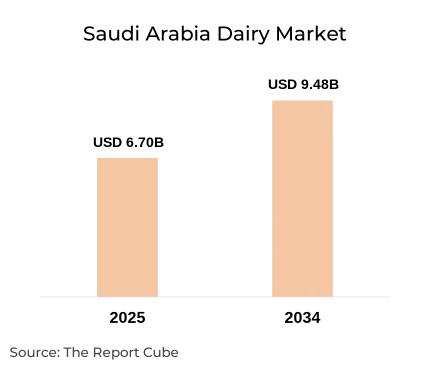
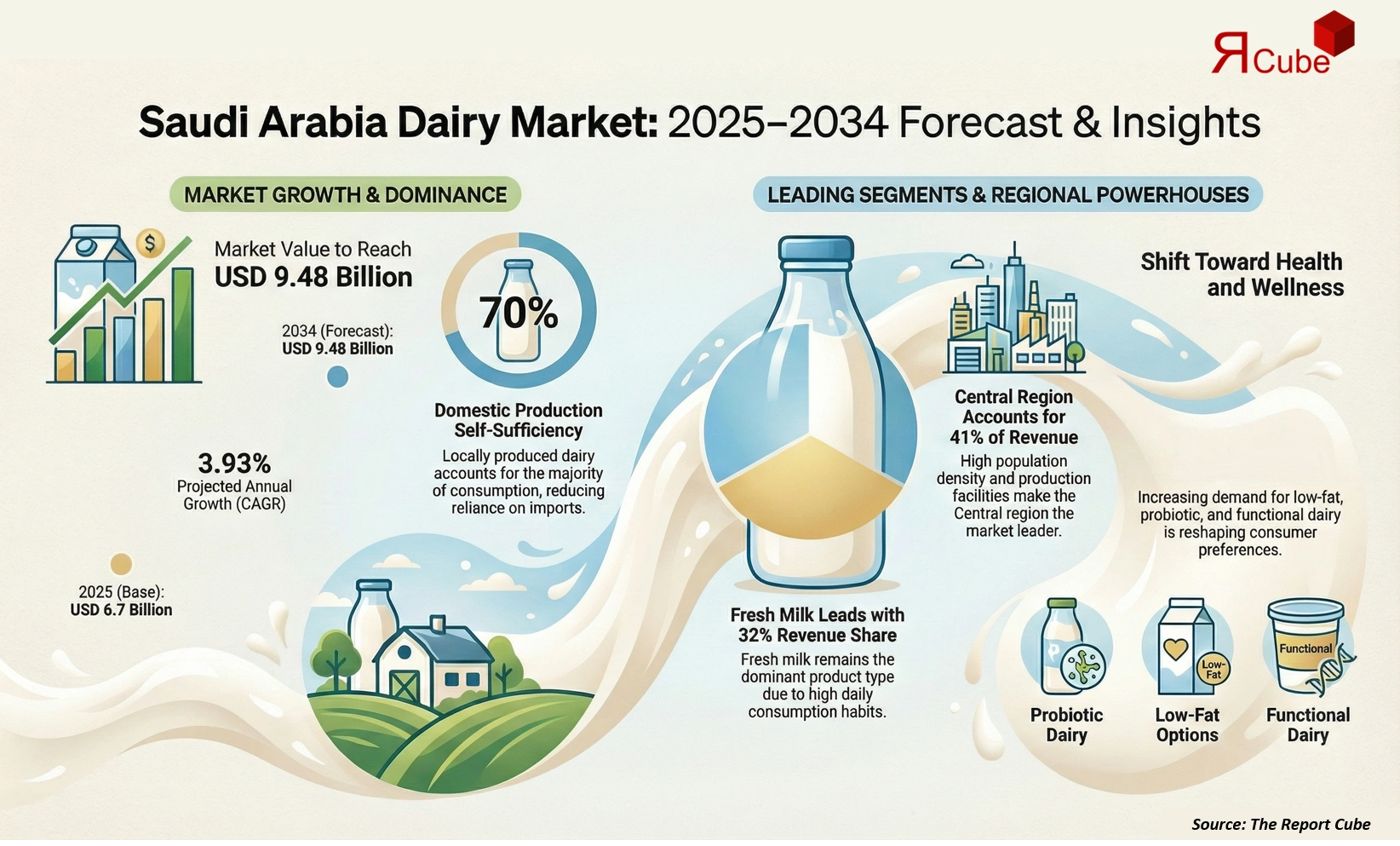
The Saudi Arabia Dairy Market is anticipated to register a CAGR of 3.93% during 2026-2034. The market size was valued at USD 6.7 billion in 2025 and is projected to reach USD 9.48 billion by 2034. The market plays a critical role in the Kingdom’s food security framework, supported by strong domestic production capabilities, advanced cold-chain infrastructure, and high per-capita dairy consumption compared to regional peers.
Demand for dairy products in Saudi Arabia remains resilient due to population growth, rising urbanization, and evolving dietary preferences. Fresh milk, yogurt, and cheese remain household staples, while value-added products such as flavored milk, probiotic yogurt, and dairy desserts are witnessing faster adoption among younger consumers. Additionally, increased awareness of nutrition and protein-rich diets has strengthened demand for dairy across both retail and foodservice channels.
The market also benefits from strong investments by leading domestic players in sustainable farming, digitalized supply chains, and product innovation. Government-backed food security initiatives and local sourcing mandates further enhance the market’s stability. As consumption patterns shift toward healthier and premium dairy offerings, the Saudi Arabia Dairy Market is expected to maintain steady growth momentum through 2034.
Saudi Arabia Dairy Market Recent Developments
- 2025: Almarai Company launched “Trofos” authentic Greek feta cheese brand for Saudi and wider GCC consumers.
- 2025: NADEC Fresh Milk was awarded “Product of the Year 2025 – KSA” in the dairy category.
Government Initiatives & Policies
- Saudi Vision 2030 - Food Security Program: Supports domestic dairy production and sustainable farming practices.
- National Agriculture Strategy: Promotes efficient water use and advanced agri-technologies in dairy farming.
Saudi Arabia Dairy Market Dynamics
Key Driver: Strong Domestic Production and High Dairy Consumption
The Saudi Arabia Dairy Market is primarily driven by strong domestic production capabilities combined with consistently high consumption levels. The Kingdom has invested heavily in large-scale dairy farms equipped with advanced automation, feed management, and animal health systems. As a result, locally produced dairy products account for more than 70% of total consumption, reducing dependence on imports. Additionally, dairy remains a core component of daily diets, with per-capita milk consumption exceeding regional averages. These factors ensure stable demand for fresh milk, yogurt, and cheese across income groups, reinforcing long-term market growth.
Book your FREE 30-minute expert consultation today
Contact UsIndustry Trends: Shift Toward Value-Added and Health-Focused Dairy Products
A key trend shaping the market is the growing shift toward value-added and health-oriented dairy products. Consumers are increasingly opting for low-fat, fortified, and probiotic dairy options to support digestive health and overall wellness. Flavored milk, drinkable yogurt, and functional dairy beverages are gaining traction among younger demographics. At the same time, premium cheese varieties and dairy desserts are expanding within urban retail outlets. This trend encourages manufacturers to invest in product differentiation, innovative packaging, and nutritional enhancement, strengthening competitive positioning.
Major Challenge: High Production Costs and Resource Constraints
Despite its strengths, the market faces challenges related to high production costs and resource limitations. Dairy farming in Saudi Arabia requires significant investment in water-efficient technologies and imported feed due to arid climatic conditions. Fluctuations in global feed prices directly impact operating margins for producers. Additionally, maintaining cold-chain logistics across vast regions adds to distribution costs. These factors create pricing pressures, particularly in price-sensitive consumer segments, potentially limiting faster market expansion.
Opportunity: Rising Demand for Low-Fat and Functional Dairy Products
The growing focus on health and wellness presents a strong opportunity for the Saudi Arabia Dairy Market. Demand for low-fat, skimmed, and functional dairy products is rising steadily as consumers seek balanced nutrition. Schools, hospitals, and fitness-focused consumers are increasingly incorporating such products into daily consumption. Manufacturers that invest in research, fortification, and targeted marketing can unlock new revenue streams. Additionally, expanding organized retail and e-commerce platforms enhance product accessibility, supporting future growth.
Saudi Arabia Dairy Market Segment-wise Analysis
By Product Type:
- Milk
- Curd & Yogurt
- Sour Milk Drinks
- Cheese
- Natural Cheese
- Processed Cheese
- Butter
- Cream
- Dairy Desserts
- Others
Among product types, Fresh Milk leads the Saudi Arabia Dairy Market, accounting for approximately 32% of total revenue in 2025. High daily consumption, strong local supply, and widespread retail availability support its dominance. UHT milk follows closely due to its longer shelf life and suitability for remote regions. Yogurt products are witnessing faster growth driven by health awareness, while cheese and dairy desserts continue to gain popularity within urban households.
By Fat Content:
- Regular Fat
- Low Fat
- Skimmed
The Regular Fat segment currently dominates with nearly 48% market share, supported by traditional consumption preferences. However, Low Fat dairy products are expanding rapidly, driven by health-conscious consumers and dietary recommendations. Skimmed dairy products, though smaller in share, are gaining visibility among fitness-focused and diabetic consumers, indicating gradual shifts in long-term consumption patterns.
Regional Projection of Saudi Arabia Dairy Industry
- Central
- Western
- Eastern
- Northern
- Southern
The Central region leads the Saudi Arabia Dairy Market, contributing approximately 41% of total revenue in 2025. This dominance is driven by high population density, strong retail penetration, and the presence of major dairy production facilities. The Western region follows due to strong demand from urban centers and hospitality sectors. Meanwhile, the Eastern region benefits from higher disposable incomes, while Northern and Southern regions present emerging growth opportunities supported by expanding distribution networks.
Need insights for a specific region within this market?
Request Regional DataWhy Choose This Report?
- Provides a comprehensive overview of the overall market analysis, encompassing key trends, consumer behavior analysis, and risk assessment to support strategic decision-making.
- Provides accurate, up-to-date insights into market size, segmentation, and emerging opportunities, helping to minimize risk & capitalizing on growth.
- Gives deep understanding of target audience preferences, investment habits, and communication channels for enhanced product development & marketing effectiveness.
- Delivers competitive analysis & benchmarking, uncovering the strengths & weaknesses of market competitors to guide strategies.
- Consolidate comprehensive market intelligence, reducing reasoning & streamlining research efforts.
- Facilitates customized market segmentation & risk mitigation strategies, fine-tuned to the business objectives.
- Aids in identifying both market challenges & untapped opportunities within the industry to drive long-term business growth.
- Provides valuable information based on actual customer data & search trends.
Table of Contents
- Introduction
- Objective of the Study
- Product and Category Definition
- Market Segmentation
- Study Variables
- Research Methodology
- Secondary Data Points
- Breakdown of Secondary Sources
- Primary Data Points
- Breakdown of Primary Interviews
- Secondary Data Points
- Executive Summary
- Market Dynamics
- Drivers
- Challenges
- Opportunity Assessment
- Recent Trends and Developments
- Regulatory and Policy Landscape
- Saudi Arabia Dairy Market Overview (2020-2034)
- Market Size, By Value (USD Billion)
- Market Share, By Product Type
- Milk
- Fresh Milk
- Flavored Milk
- Condensed Milk
- UHT Milk (Ultra-High Temperature Milk)
- Powdered Milk
- Curd & Yogurt
- Drinkable
- Spoonable
- Sour Milk Drinks
- Cheese
- Natural Cheese
- Cheddar
- Cottage
- Ricotta
- Parmesan
- Others
- Processed Cheese
- Butter
- Cream
- Fresh Cream
- Cooking Cream
- Whipping Cream
- Others
- Dairy Desserts
- Ice Cream
- Cheesecakes
- Frozen Desserts
- Others
- Others
- Milk
- Market Share, By Fat Content
- Regular Fat
- Low Fat
- Skimmed
- Market Share, By Category
- Fresh Dairy
- UHT Dairy
- Powdered Dairy
- Value Added Dairy
- Market Share, By Consumer Group
- Household
- Foodservice
- Institutional
- Market Share, By Distribution Channel
- On-Trade
- Off-Trade
- Supermarkets And Hypermarkets
- Convenience Stores
- Online Retail
- Specialist Retailers
- Others
- Market Share, By Region
- Central
- Western
- Eastern
- Northern
- Southern
- Market Share, By Company
- Competition Characteristics
- Revenue Shares & Analysis
- Central Region Dairy Market
- Market Size, By Value (USD Billion)
- Market Share, By Product Type
- Market Share, By Fat Content
- Market Share, By Category
- Market Share, By Consumer Group
- Market Share, By Distribution Channel
- Western Region Dairy Market
- Market Size, By Value (USD Billion)
- Market Share, By Product Type
- Market Share, By Fat Content
- Market Share, By Category
- Market Share, By Consumer Group
- Market Share, By Distribution Channel
- Eastern Region Dairy Market
- Market Size, By Value (USD Billion)
- Market Share, By Product Type
- Market Share, By Fat Content
- Market Share, By Category
- Market Share, By Consumer Group
- Market Share, By Distribution Channel
- Northern Region Dairy Market
- Market Size, By Value (USD Billion)
- Market Share, By Product Type
- Market Share, By Fat Content
- Market Share, By Category
- Market Share, By Consumer Group
- Market Share, By Distribution Channel
- Southern Region Dairy Market
- Market Size, By Value (USD Billion)
- Market Share, By Product Type
- Market Share, By Fat Content
- Market Share, By Category
- Market Share, By Consumer Group
- Market Share, By Distribution Channel
- Competitive Outlook and Company Profiles
- Almarai Company
- Company Overview
- Product Portfolio
- Strategic Alliances Partnerships
- Recent Developments
- NADEC
- Company Overview
- Product Portfolio
- Strategic Alliances Partnerships
- Recent Developments
- SADAFCO
- Company Overview
- Product Portfolio
- Strategic Alliances Partnerships
- Recent Developments
- Al Safi Danone
- Company Overview
- Product Portfolio
- Strategic Alliances Partnerships
- Recent Developments
- NADA Dairy
- Company Overview
- Product Portfolio
- Strategic Alliances Partnerships
- Recent Developments
- Al Othman Holding
- Company Overview
- Product Portfolio
- Strategic Alliances Partnerships
- Recent Developments
- Arla Foods
- Company Overview
- Product Portfolio
- Strategic Alliances Partnerships
- Recent Developments
- Fonterra
- Company Overview
- Product Portfolio
- Strategic Alliances Partnerships
- Recent Developments
- Nestle Saudi
- Company Overview
- Product Portfolio
- Strategic Alliances Partnerships
- Recent Developments
- Groupe Lactalis
- Company Overview
- Product Portfolio
- Strategic Alliances Partnerships
- Recent Developments
- Others
- Almarai Company
- Contact Us and Disclaimer
Top Key Players & Market Share Outlook
- Almarai Company
- NADEC
- SADAFCO
- Al Safi Danone
- NADA Dairy
- Al Othman Holding
- Arla Foods
- Fonterra
- Nestle Saudi
- Groupe Lactalis
- Others
Frequently Asked Questions






