



Build Your Custom Market Intelligence Report
Customize Your ReportKey Highlights
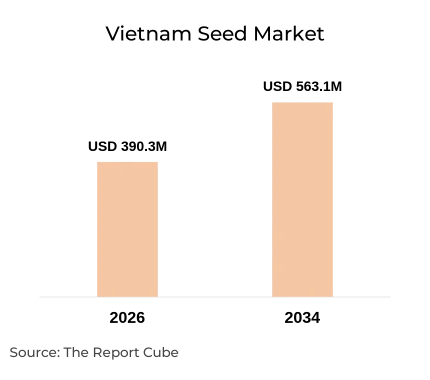
- The Vietnam Seed Market was valued at USD 390.3 million in 2026, the base year of this report.
- The market is projected to reach USD 563.1 million by 2034.
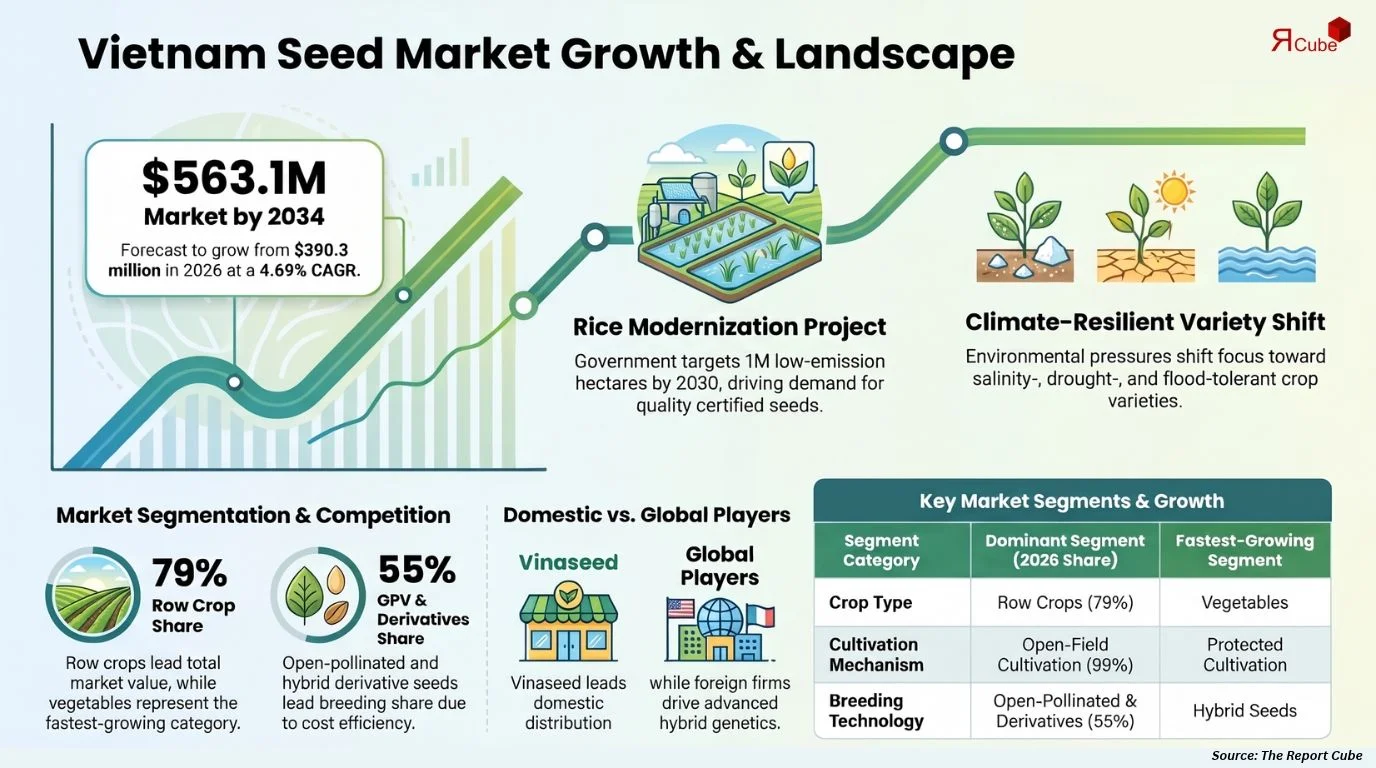
- The market is forecast to expand at a CAGR of 4.69% during 2026-2034.
- Row crops lead the crop-type segment with an estimated 79% share in 2026, while vegetables are the fastest-growing crop category.
- Open-field cultivation leads the cultivation-mechanism segment with an estimated 99.7% share in 2026, while protected cultivation is expected to grow fastest.
- Modernization of rice cultivation under the government’s One Million Hectares low-emission rice programme is a major growth driver.
- Domestic player Vinaseed competes with international suppliers including East-West Seed, Syngenta, Bayer and Corteva.
Market Outlook
The Vietnam Seed Market covers the commercial production, processing, distribution and sale of seeds for rice, maize, vegetables, oilseeds and other crops. Seeds are a primary agricultural input, and varietal quality directly affects yield, disease resistance and crop consistency. Domestic producers, multinational breeders, distributors and cooperatives supply farmers across the country’s major growing regions.
Demand is anchored in Vietnam’s large production base. According to the National Statistics Office, rice output reached approximately 43.5 million tonnes in 2025 and vegetable output approximately 19.6 million tonnes. Rice remains the core seed category, while hybrid maize and vegetable seeds are gaining importance as producers prioritize productivity, quality and climate resilience over conventional, farm-retained planting material.
The Vietnam Seed Market is estimated at USD 390.3 million in 2026 and is forecast to reach USD 563.1 million by 2034, a CAGR of 4.69%. Growth is expected to come from higher-value hybrid and improved varieties and from commercial horticulture. Competition is split between domestic suppliers with local distribution strength and international companies with breeding technology. Growth is expected to stay moderate and led by product-mix improvement rather than land expansion.
Government Regulations
The Vietnam Seed Market operates under Law on Crop Production No. 31/2018/QH14, issued on 19 November 2018 and effective from 1 January 2020. The law governs plant variety recognition, testing, circulation, seed production and trading, imports, quality inspection, and the protection of plant genetic resources. Commercial varieties must meet recognition and quality requirements before reaching farmers, which raises entry barriers for new suppliers. The Ministry of Agriculture and Environment oversees agricultural policy and implementation. Decision No. 1490/QD-TTg, approved on 27 November 2023, launched the One Million Hectares of High-Quality, Low-Emission Rice Development Project in the Mekong Delta, targeting completion by 2030. It promotes lower seed sowing rates, sustainable practices and better traceability. For market participants, these measures favour certified, high-quality and climate-adapted varieties, while seed-efficiency targets shift commercial value toward varietal quality rather than sowing volume. Genetically modified seeds remain subject to regulatory approval and permitted crop applications.
Vietnam Seed Market Dynamics
Demand in the Vietnam Seed Market is shaped by agricultural modernization, the shift toward improved and hybrid varieties, and government-backed rice programmes. Commodity price swings and climate exposure influence farmer purchasing power and varietal choice, while commercial horticulture is widening opportunities for specialized vegetable seeds. Together these factors support moderate, steady Vietnam Seed Market growth.
|
Factor |
Type |
Specific Impact on Market |
Magnitude |
|---|---|---|---|
|
Modernization of rice cultivation |
Driver |
Government low-emission rice programme supports demand for quality, adapted rice varieties |
High |
|
Adoption of improved and hybrid seeds |
Driver |
Raises value per seed purchase and favours technology-led suppliers |
Medium-High |
|
Protected cultivation and vegetable seeds |
Opportunity |
Greenhouse and horticulture production support specialized hybrid vegetable seeds |
Medium |
|
Agricultural price volatility |
Challenge |
Lower commodity prices can reduce farmer spending on premium seed |
Medium-High |
|
Climate-resilient varieties |
Trend |
Salinity, flood and drought pressures raise demand for adapted varieties |
Medium-High |
Growth Drivers: Modernization of Rice Cultivation
Vietnam’s One Million Hectares of High-Quality, Low-Emission Rice Project aims to transform Mekong Delta production by 2030. By the end of 2025, more than 354,000 hectares had been enrolled, according to the Ministry of Agriculture and Environment. The programme targets lower sowing rates and better traceability, which shifts demand toward higher-quality, certified and efficient rice varieties. Seed revenue gains are therefore expected to come from varietal value and replacement rather than larger seed volumes.
Market Opportunities: Protected Cultivation and Specialized Vegetable Seeds
Commercial horticulture, greenhouse farming and protected cultivation are expanding from a very small base, creating room for specialized vegetable genetics. Suppliers can develop greenhouse-compatible varieties, disease-resistant hybrids and technical support services for commercial growers. Vegetables are the fastest-growing crop category in this report, and protected cultivation is expected to be the fastest-growing cultivation mechanism. Companies with vegetable breeding capability and grower relationships are positioned to capture higher-value sales as production standards rise.
Industry Challenges: Agricultural Price Volatility
Rice and other commodity prices influence farmer incomes and seed purchasing decisions. Higher agricultural output does not automatically lift seed revenue. Vinaseed reported seeds and rice segment revenue of approximately VND 2,299 billion in 2025, down 6.1% from 2024, partly reflecting weaker commodity prices. Lower farm-gate prices can reduce spending on premium varieties and pressure supplier margins, making revenue growth in the Vietnam Seed Market more sensitive to price cycles than production volumes suggest.
Need Specific Data, Let’s Customize the Report for You
Request CustomizationMarket Trends: Growing Emphasis on Climate-Resilient Varieties
Flooding, storms, salinity intrusion and changing rainfall patterns affect Vietnamese agriculture, and the National Statistics Office has reported weather-related impacts on 2025 production. Seed developers are therefore prioritizing rice varieties with better tolerance to salinity, drought, flooding and disease. Government sustainability programmes reinforce this direction. Climate-adapted breeding is becoming a competitive differentiator, rewarding suppliers able to combine local adaptation with consistent yield and quality performance.
Vietnam Seed Market Segment Analysis
The Vietnam Seed Market is segmented by crop type, breeding technology, cultivation mechanism, seed characteristics and distribution channel. The categories are analytical and overlap across dimensions; for example, certified seeds may also be hybrid rice seeds. Leading-segment shares shown are supplied 2026 estimates.
By Breeding Technology
- Hybrid Seeds
- Open-Pollinated Varieties (OPV)
- Hybrid Derivatives
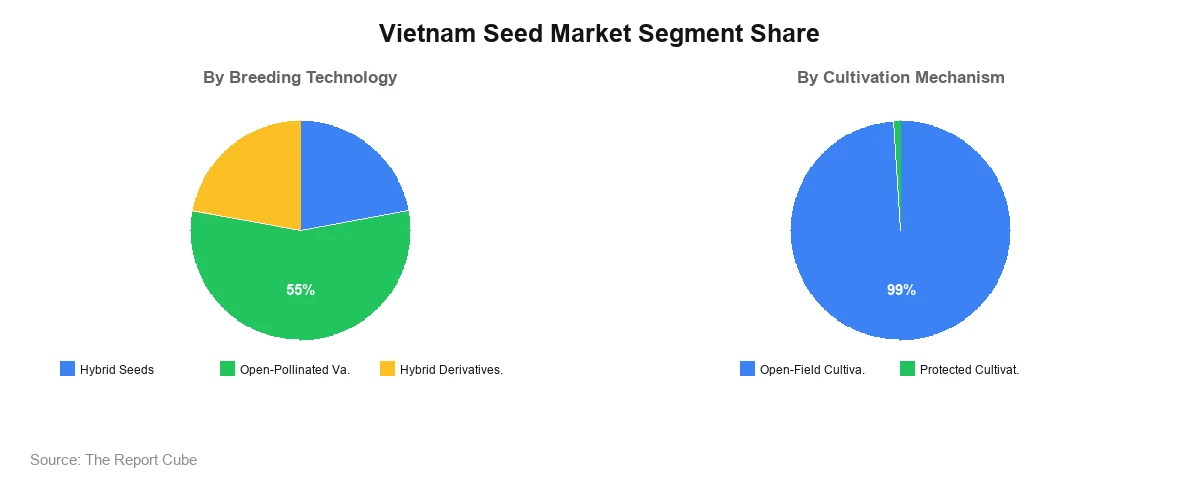
Open-pollinated varieties and hybrid derivatives together form the leading breeding-technology category, with an estimated 55% share in 2026. Their position reflects lower seed cost, farmers’ ability to reuse some planting material and strong use in rice and field crops. Hybrid seeds are the second-leading category and are expected to grow faster, supported by higher yield potential, uniform performance and rising commercial adoption in maize and vegetables. Hybrid seeds command higher prices per unit, making them important to supplier margins and to international breeders competing on technology.
By Cultivation Mechanism
- Open-Field Cultivation
- Protected Cultivation
Open-field cultivation leads with an estimated 99% share in 2026, because rice, maize and most conventional vegetables are grown in open fields. Protected cultivation, including greenhouse and controlled-environment production, is the other category and starts from a very small base. It is expected to be the fastest-growing mechanism as investment rises in high-value vegetable production. Seed demand in protected systems is concentrated in hybrid, disease-resistant vegetable varieties, giving the category commercial importance beyond its current size.
Competitive Landscape
The Vietnam Seed Market includes domestic seed manufacturers, multinational agricultural companies, specialized vegetable seed suppliers and regional distributors. Domestic companies are strong in locally adapted rice varieties and distribution, while international companies compete through breeding technology, hybrids and research capability. The table lists relevant participants and is not a verified ranking by market share.
|
Company |
Competitive Strength |
Primary Segment Served |
|---|---|---|
|
Vinaseed |
Domestic scale, production and distribution |
Rice, maize and vegetable seeds |
|
East-West Seed |
Tropical vegetable genetics |
Vegetables |
|
Syngenta Group |
International breeding and research capabilities |
Hybrid and vegetable seeds |
|
Bayer Crop Science |
Seed technologies and agricultural research |
Hybrid maize and field crops |
|
Corteva Agriscience |
Advanced plant genetics and seed technologies |
Hybrid field crops |
|
ThaiBinh Seed |
Locally adapted rice varieties |
Rice |
|
Southern Seed Corporation |
Domestic seed production and agricultural relationships |
Rice and other crops |
Vinaseed Corporation: Vinaseed is a Vietnamese seed manufacturer supplying rice, maize and vegetable seeds through domestic production and distribution networks. For 2024 it reported revenue of VND 2,448.7 billion and about 121,000 tonnes of seed production and trading, equal to around 22.5% of the food-crop seed market by its own measure. Its seeds and rice business reported approximately VND 2,299 billion in 2025. Its strength lies in domestic scale and farmer reach.
East-West Seed: East-West Seed is an international breeder and distributor of tropical vegetable seeds, operating in the Vietnamese market through vegetable breeding and seed distribution. Its portfolio is focused on tropical growing environments and is relevant to smallholder and commercial vegetable farmers. Its competitive positioning rests on tropical vegetable genetics, which aligns with vegetables being the fastest-growing crop category. Company-specific revenue and market share for Vietnam were not available from verified sources.
Recent Developments and Updates
- January 2026: Vietnam’s National Statistics Office published 2025 agricultural output data showing rice production of about 43.5 million tonnes and vegetables of about 19.6 million tonnes, confirming the production base supporting seed demand.
- March 2026: The Ministry of Agriculture and Environment reported that more than 354,000 hectares had been enrolled in the low-emission rice programme by end-2025, strengthening demand for adapted, quality rice varieties.
- April 2026: Vinaseed published its 2025 annual results, reporting seeds and rice segment revenue of about VND 2,299 billion, down 6.1% from 2024, illustrating commodity-price pressure on seed revenue.
Vietnam Seed Market Future Outlook
The Vietnam Seed Market is forecast to grow from USD 390.3 million in 2026 to USD 563.1 million by 2034, a CAGR of 4.69%. Growth is expected to strengthen in the middle of the forecast period as hybrid penetration and commercial horticulture expand, then moderate as adoption matures. Opportunities centre on climate-adapted rice, hybrid maize, specialized vegetable seeds and protected cultivation, with demand driven more by product mix than land area.
Competition is expected to reward companies that can deliver higher yields, disease resistance, climate adaptation and consistent quality. Domestic suppliers will rely on distribution and local adaptation, while international companies will invest in breeding technology and hybrid portfolios. Risks include commodity price volatility, weather-related production shocks and regulatory approval timelines. Forecast values are modelled projections, not observed outcomes, and depend on agricultural conditions and policy implementation.
Vietnam Seed Market Report Coverage
This report summarizes the supplied valuation, forecast, segmentation, competitive landscape and policy context for the Vietnam Seed Market.
|
Parameter |
Details |
|---|---|
|
Market Name |
Vietnam Seed Market |
|
Market Size (Base Year) |
USD 390.3 million (2026) |
|
Market Size (Forecast Year) |
USD 563.1 million (2034) |
|
CAGR |
4.69% |
|
Base Year |
2026 |
|
Historical Period |
2021-2025 |
|
Forecast Period |
2026-2034 |
|
Geographic Scope |
Vietnam |
|
Segmentation |
By Crop Type; By Breeding Technology; By Cultivation Mechanism; By Seed Characteristics; By Distribution Channel |
|
Key Companies |
Vinaseed; East-West Seed; Syngenta Group; Bayer Crop Science; Corteva Agriscience; ThaiBinh Seed; Southern Seed Corporation |
|
Customization |
Available as per requirement |
Why Choose This Vietnam Seed Market Report?
- Presents the 2026 valuation, 2034 forecast and 4.69% CAGR with stated assumptions.
- Segments the market by crop type, breeding technology, cultivation mechanism, seed characteristics and distribution channel.
- Reviews drivers, opportunities, challenges and trends supported by government policy and official production data.
- Identifies regional data gaps rather than estimating unsupported shares.
- Profiles domestic and international seed suppliers by capability and primary segment.
- Highlights emerging opportunities in climate-resilient varieties, hybrids and protected cultivation.
- Supports strategic planning, product positioning and investment decisions for seed companies and agribusiness stakeholders.
Table of Contents
- Introduction
- Objective of the Study
- Product Definition
- Market Segmentation
- Study Variables
- Research Methodology
- Secondary Data Points
- Companies Interviewed
- Primary Data Points
- Breakdown of Primary Interviews
- Secondary Data Points
- Executive Summary
- Market Dynamics
- Drivers
- Challenges
- Opportunity Assessment
- Recent Trends and Developments
- Policy and Regulatory Landscape
- Vietnam Seed Market Overview and Forecast Analysis (2021-2034)
- Market Size, By Value, By Growth Rate (CAGR/USD Millions)
- Demand – Supply Trends
- Market Share, By Crop Type
- Row Crops
- Rice
- Maize
- Soybean
- Other Grains and Cereals
- Oilseeds
- Vegetables
- Tomato
- Cucumber
- Pepper and Chilli
- Cabbage
- Other Vegetables
- Row Crops
- Market Share, By Breeding Technology
- Hybrid Seeds
- Open-Pollinated Varieties (OPV)
- Hybrid Derivatives
- Market Share, By Cultivation Mechanism
- Open-Field Cultivation
- Protected Cultivation
- Market Share, By Seed Characteristics
- Conventional Seeds
- Improved Seeds
- Genetically Modified Seeds
- Certified Seeds
- Market Share, By Distribution Channel
- Direct Sales
- Agricultural Input Dealers and Distributors
- Agricultural Cooperatives
- Online and Digital Distribution
- Market Share, By Region
- Northern Vietnam
- Central Vietnam
- Southern Vietnam
- Market Share, By Competitors
- Competition Characteristics
- Revenue Shares
- Row Crops Vietnam Seed Market Overview, 2021-2034F
- By Value (USD Million)
- By Breeding Technology – Market Size & Forecast 2021-2034, USD Million
- Hybrid Seeds
- Open-Pollinated Varieties (OPV)
- Hybrid Derivatives
- Vegetables Vietnam Seed Market Overview, 2021-2034F
- By Value (USD Million)
- By Breeding Technology – Market Size & Forecast 2021-2034, USD Million
- Hybrid Seeds
- Open-Pollinated Varieties (OPV)
- Hybrid Derivatives
- Competitive Outlook (Company Profile – Partial List)
- Vinaseed Corporation
- Company Overview
- Business Segments
- Strategic Alliances/Partnerships
- Recent Developments
- East-West Seed
- Company Overview
- Business Segments
- Strategic Alliances/Partnerships
- Recent Developments
- Syngenta Group
- Company Overview
- Business Segments
- Strategic Alliances/Partnerships
- Recent Developments
- Bayer Crop Science
- Company Overview
- Business Segments
- Strategic Alliances/Partnerships
- Recent Developments
- ThaiBinh Seed
- Company Overview
- Business Segments
- Strategic Alliances/Partnerships
- Recent Developments
- Southern Seed Corporation (SSC)
- Company Overview
- Business Segments
- Strategic Alliances/Partnerships
- Recent Developments
- Vinaseed Corporation
- Contact Us & Disclaimer
Top Key Players & Market Share Outlook
- Vinaseed Corporation
- East-West Seed
- Syngenta Group
- Bayer Crop Science
- ThaiBinh Seed
- Southern Seed Corporation (SSC)
Frequently Asked Questions