



Build Your Custom Market Intelligence Report
Customize Your ReportSaudi Arabia Snack Bar Market Statistics and Insights
Market Insight
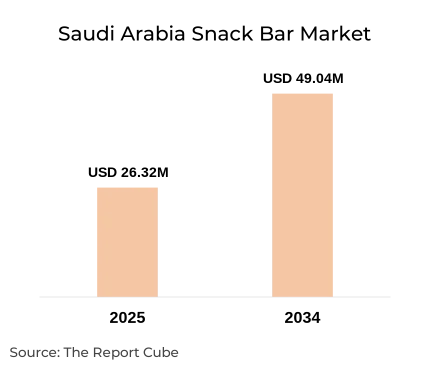
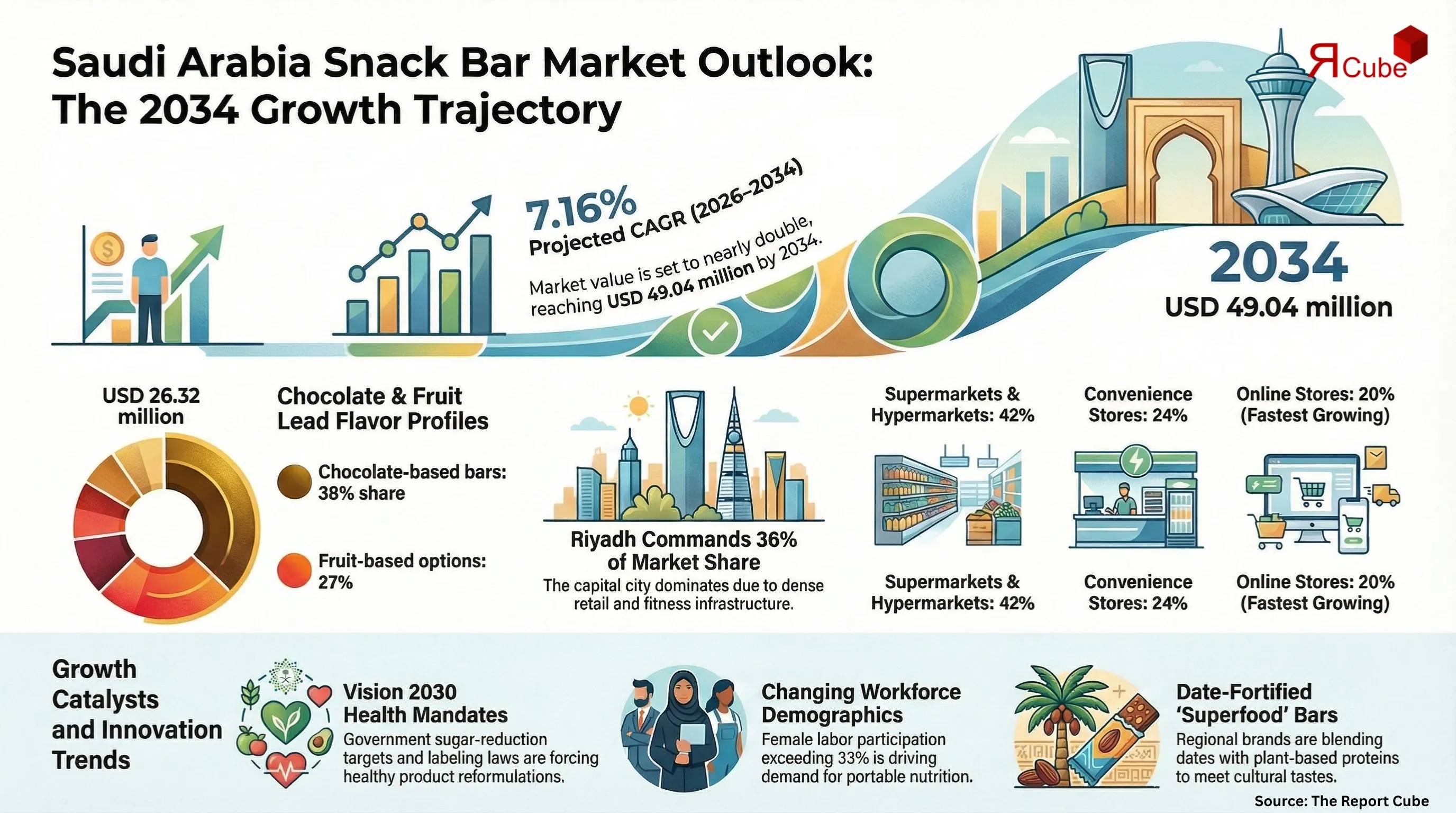
- The Saudi Arabia Snack Bar Market was valued at USD 26.32 Million in 2025.
- The market is projected to reach USD 49.04 Million by the forecast year 2034.
- The market is anticipated to grow at a CAGR of 7.16% during 2026–2034.
By Flavor Profile
- Chocolate-based leads the segment, commanding approximately 38% market share.
Competitive Landscape
- More than 10 companies are actively engaged in producing Saudi Arabia Snack Bar Market products.
- Top 5 companies acquired around 45% of the market share.
- General Mills, Kellanova, Premier Nutrition Corp., Clif Bar & Company, Nestle Middle East, and others.
By Distribution Channel
- Supermarkets/Hypermarkets dominate the channel, holding nearly 42% market share.
Saudi Arabia Snack Bar Market Insights & Analysis
The Saudi Arabia Snack Bar Market is anticipated to register a 7.16% CAGR during 2026–2034. The market size was valued at USD 26.32 Million in 2025 and is projected to reach USD 49.04 Million by 2034. The Kingdom's rapidly evolving consumer landscape is acting as a powerful catalyst for snack bar adoption. Saudi Arabia's Vision 2030 initiative has placed substantial emphasis on promoting healthier lifestyles and reducing obesity rates, which stood at approximately 35.5% among adults as of recent national health surveys.
This policy backdrop has directly boosted demand for nutritious, on-the-go snack formats. The growing participation of women in the workforce, with female labor force participation surging past 33% in 2024, has amplified demand for convenient, portable nutrition. Furthermore, a young, digitally native population accounting for over 60% of the Kingdom's demographic base is actively reshaping snacking habits, favoring functional, protein-enriched bars over traditional confectionery, thereby reinforcing the market's upward trajectory through the forecast period.
Saudi Arabia Snack Bar Market Dynamics:
Key Market Driver: Vision 2030 Fueling Health-Conscious Consumption
Saudi Arabia's Vision 2030 has catalyzed a sweeping behavioral shift toward health and wellness, directly bolstering the snack bar segment. The Saudi Food and Drug Authority (SFDA) has implemented rigorous nutritional labeling mandates and sugar-reduction targets across food categories, prompting manufacturers to reformulate products with higher protein content, reduced sugar, and clean-label ingredients. In 2024, the Kingdom's sports nutrition and wellness supplement sector attracted over USD 180 million in retail investment. Simultaneously, the rapid proliferation of gym culture, with more than 5,000 registered fitness centers now operating across major cities including Riyadh, Jeddah, and Dammam, has expanded the primary consumer base for performance-oriented snack bars, making this a structurally driven, policy-supported growth engine.
Major Industry Challenge: Fragmented Cold Chain Infrastructure Limiting Distribution
Despite robust demand, the Saudi Arabia Snack Bar Market contends with an underdeveloped cold-chain and last-mile distribution network outside major urban centers. A significant portion of the Kingdom's population resides in Tier-2 and Tier-3 cities where ambient storage conditions can degrade product quality, particularly for bars containing dairy proteins, yogurt coatings, or chocolate-based encrustations.
This infrastructure gap creates shelf-life inconsistencies and elevated spoilage rates for imported premium brands, which constitute over 65% of the product assortment currently available. Regulatory compliance with SFDA's halal certification requirements adds an additional procedural layer for international entrants, extending time-to-market by an average of four to six months and constraining the pace of new SKU launches in underserved regional markets.
Emerging Trend Shaping Outlook: Plant-Based and Date-Fortified Bars Gaining Traction
A distinctly regional trend is reshaping Saudi Arabia's snack bar innovation pipeline: the integration of dates, a culturally embedded superfood, with plant-based protein sources such as pea protein, brown rice protein, and chickpea flour. Brands are leveraging the date's natural sweetness to reduce refined sugar content while maintaining palatability, aligning with both the SFDA's sugar-reduction agenda and consumers' cultural affinity for the ingredient.
In 2024, several regional manufacturers launched date-and-nut bar SKUs positioned as Ramadan wellness staples, recording sell-through rates exceeding 80% within the first month of launch. As plant-based dietary patterns gain mainstream acceptance among Saudi millennials, this hybrid innovation segment is expected to command an increasingly significant share of new product development budgets through 2034.
Need Specific Data, Let’s Customize the Report for You
Request CustomizationSaudi Arabia Snack Bar Market Segment-wise Analysis
The Saudi Arabia Snack Bar Market exhibits a well-defined segmentation structure across flavor profiles and distribution channels, each reflecting distinct consumer behaviors, retail dynamics, and health-driven purchasing patterns that are collectively driving category expansion through the forecast period.
By Flavor Profile
- Chocolate-based
- Fruit-based
- Nuts and Seeds
- Others
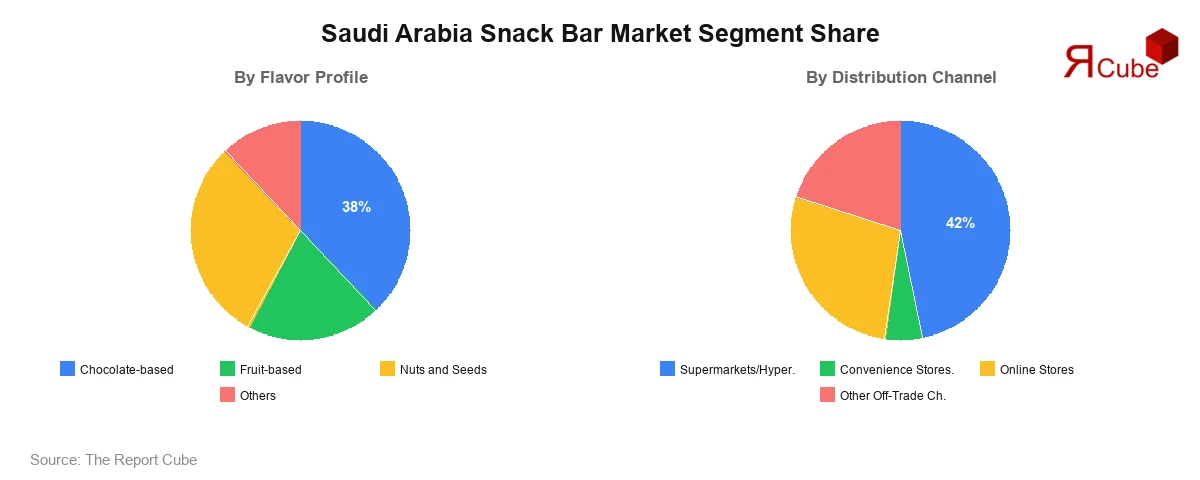
Chocolate-based snack bars represent the largest flavor sub-segment, accounting for approximately 38% of total market revenue in 2025. The enduring consumer affinity for chocolate as a taste profile, combined with manufacturers' ability to incorporate dark chocolate coatings rich in antioxidants, has sustained this sub-segment's dominance. Health-positioned dark chocolate bars have particularly resonated with fitness-conscious Saudi consumers seeking indulgence without compromising nutritional integrity.
Fruit-based bars hold the second-largest share at around 27%, driven by rising demand for natural, minimally processed snacks incorporating dates, figs, and tropical fruit concentrates. The Nuts and Seeds sub-segment commands approximately 22% of segment revenue, underpinned by the cultural familiarity with nut-based foods and growing awareness of the satiety and heart-health benefits associated with almonds, cashews, and pumpkin seeds. The Others sub-segment, encompassing savory, spiced, and multi-grain profiles, accounts for the remaining 13%, representing an emerging frontier for product innovation.
By Distribution Channel
- Supermarkets/Hypermarkets
- Convenience Stores
- Online Stores
- Other Off-Trade Channels
Supermarkets and Hypermarkets lead distribution, capturing nearly 42% of total channel revenue, underpinned by the wide assortment availability and promotional visibility they offer to both domestic and imported snack bar brands. Major retail chains including Panda, Carrefour KSA, and Danube provide high foot-traffic environments that facilitate impulse and planned purchases alike. Convenience Stores account for approximately 24% of channel share, serving time-pressed urban commuters and students seeking grab-and-go nutrition.
Online Stores represent the fastest-growing distribution sub-channel, holding around 20% share in 2025 and expanding rapidly as platforms like Noon, Amazon.sa, and brand-owned DTC portals streamline snack bar subscription and bulk purchase models. Other Off-Trade Channels, including pharmacies, gyms, and specialty health food retailers, account for the remaining 14%, increasingly serving as premium positioning venues for functional and clinical nutrition bars.
Regional Projection of Saudi Arabia Snack Bar Market
The Saudi Arabia Snack Bar Market is geographically concentrated, with Riyadh commanding the largest city-level share at approximately 36%, driven by its status as the Kingdom's commercial and demographic hub. Key regional markets include:
- Riyadh
- Jeddah
- Dammam and the Eastern Province
- Mecca and Madinah
- Northern and Southern Regions
Riyadh's dominance is underpinned by its dense network of modern retail outlets, a high-income urban consumer base, and the concentration of fitness infrastructure. Jeddah follows as the second-largest market, benefiting from its cosmopolitan demographics and strong import culture. The Eastern Province is witnessing accelerated adoption driven by an expatriate population with established wellness-oriented snacking behaviors.
Saudi Arabia Snack Bar Market: Recent Development (2025)
- Nestle Middle East launched a new date-protein bar line, reporting a 14% gross margin uplift immediately.
- General Mills expanded its Nature Valley distribution to 1,200 new Saudi convenience store outlets nationwide.
- Clif Bar & Company received SFDA halal certification, enabling full-scale Saudi retail distribution across all channels.
- Simply Good Foods Co. posted a 9.3% revenue increase in the MENA region, driven by Quest Bar demand.
Saudi Arabia Snack Bar Market Future Outlook (2034)
The Saudi Arabia Snack Bar Market is poised for sustained and structured growth, with a projected CAGR of 7.16% guiding the market toward a value of USD 49.04 Million by 2034. The convergence of Vision 2030 health mandates, a youthful and digitally engaged consumer base, and increasing female workforce participation will continue to generate durable demand across all product tiers.
Technological advancements in clean-label formulation, sustainable packaging, and precision nutrition, including AI-driven personalization of nutritional profiles through DTC e-commerce platforms, are expected to redefine product development roadmaps. Emerging opportunities in Ramadan-occasion marketing, sports performance nutrition, and regional ingredient integration (notably dates and camel milk) will further differentiate the Saudi snack bar landscape from global norms, enabling both international incumbents and regional innovators to capture premium growth through 2034.
Why Choose This Report?
- Provides a comprehensive overview of the overall market analysis, encompassing key trends, consumer behavior analysis, and risk assessment to support strategic decision-making.
- Provides accurate, up-to-date insights into market size, segmentation, and emerging opportunities, helping to minimize risk & capitalizing on growth.
- Gives deep understanding of target audience preferences, investment habits, and communication channels for enhanced product development & marketing effectiveness.
- Delivers competitive analysis & benchmarking, uncovering the strengths & weaknesses of market competitors to guide strategies.
- Consolidate comprehensive market intelligence, reducing reasoning & streamlining research efforts.
- Facilitates customized market segmentation & risk mitigation strategies, fine-tuned to the business objectives.
- Aids in identifying both market challenges & untapped opportunities within the industry to drive long-term business growth.
- Provides valuable information based on actual customer data & search trends.
Table of Contents
- Introduction
- Objective of the study
- Product Definition
- Market Segmentation
- Study Variables
- Research Methodology
- Secondary Data Points
- Companies Interviewed
- Primary Data Points
- Break Down of Primary Interviews
- Secondary Data Points
- Executive Summary
- Market Dynamics
- Drivers
- Challenges
- Opportunity Assessment
- Recent Trends and Developments
- Policy and Regulatory Landscape
- Saudi Arabia Snack Bar Market Overview (2021-2034)
- Market Size, By Value (in USD Millions)
- Market Share, By Product Type
- Cereal Bars (Granola Bars, Other Cereal Bars)
- Protein Bars
- Other Snack Bars
- Market Share, By Flavor Profile
- Chocolate-based
- Fruit-based
- Nuts and Seeds
- Others
- Market Share, By Distribution Channel
- Supermarkets/Hypermarkets
- Convenience Stores
- Online Stores
- Other Off-Trade Channels
- Market Share, By Region
- Riyadh
- Jeddah
- Dammam and the Eastern Province
- Mecca and Madinah
- Northern and Southern Regions
- Market Share, By Competitors
- Competition Characteristics
- Revenue Shares
- Saudi Arabia Cereal Bars (Granola Bars, Other Cereal Bars) Snack Bar Market Overview, 2021-2034F
- By Value (USD Million)
- By Flavor Profile- Market Size & Forecast 2021-2034, USD Million
- By Distribution Channel- Market Size & Forecast 2021-2034, USD Million
- Saudi Arabia Protein Bars Snack Bar Market Overview, 2021-2034F
- By Value (USD Million)
- By Flavor Profile- Market Size & Forecast 2021-2034, USD Million
- By Distribution Channel- Market Size & Forecast 2021-2034, USD Million
- Saudi Arabia Other Snack Bars Snack Bar Market Overview, 2021-2034F
- By Value (USD Million)
- By Flavor Profile- Market Size & Forecast 2021-2034, USD Million
- By Distribution Channel- Market Size & Forecast 2021-2034, USD Million
- Competitive Outlook (Company Profile - Partial List)
- General Mills
- Company Overview
- Business Segments
- Strategic Alliances/Partnerships
- Recent Developments
- Kellonova
- Company Overview
- Business Segments
- Strategic Alliances/Partnerships
- Recent Developments
- Premier Nutrition Corp.
- Company Overview
- Business Segments
- Strategic Alliances/Partnerships
- Recent Developments
- Clif Bar & Company
- Company Overview
- Business Segments
- Strategic Alliances/Partnerships
- Recent Developments
- GoMacro LLC
- Company Overview
- Business Segments
- Strategic Alliances/Partnerships
- Recent Developments
- NuGo Nutrition
- Company Overview
- Business Segments
- Strategic Alliances/Partnerships
- Recent Developments
- Power Crunch
- Company Overview
- Business Segments
- Strategic Alliances/Partnerships
- Recent Developments
- Simply Good Foods Co.
- Company Overview
- Business Segments
- Strategic Alliances/Partnerships
- Recent Developments
- Nestle Middle East
- Company Overview
- Business Segments
- Strategic Alliances/Partnerships
- Recent Developments
- Others
- General Mills
- Contact Us & Disclaimer
Top Key Players & Market Share Outlook
- General Mills
- Kellonova
- Premier Nutrition Corp.
- Clif Bar & Company
- GoMacro LLC
- NuGo Nutrition
- Power Crunch
- Simply Good Foods Co.
- Nestle Middle East
- Others
Frequently Asked Questions






