




Build Your Custom Market Intelligence Report
Customize Your ReportWhat Is the South Africa Logistics and Warehousing Market Size & Value?
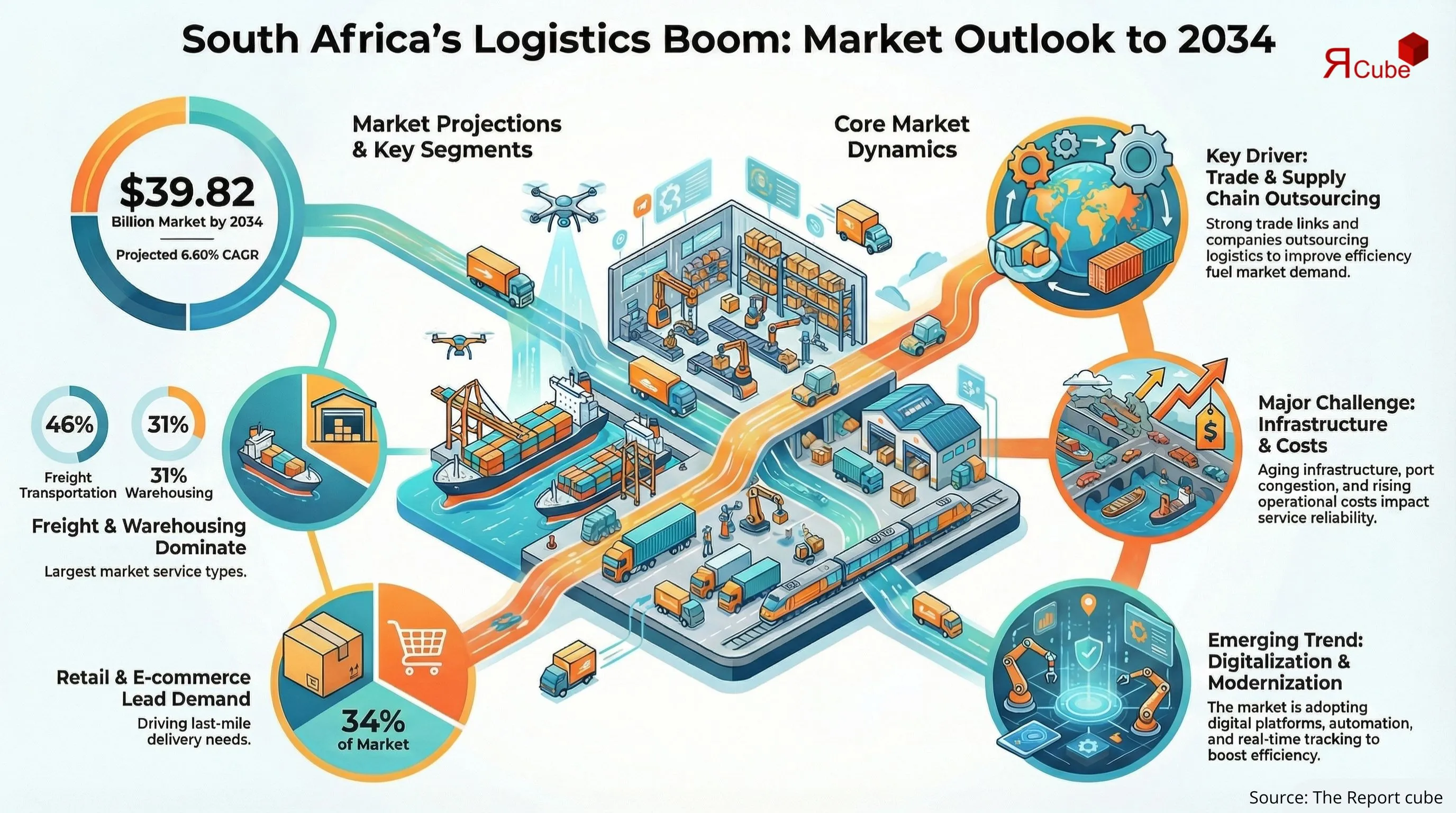
The South Africa Logistics and Warehousing Market is anticipated to register a 6.60% CAGR during 2026–2034. The market size was valued at USD 22.4 Billion in 2025 and is projected to reach USD 39.82 Billion by 2034. Growth is supported by expanding trade activity, rising e-commerce penetration, and the country’s role as a logistics gateway for Southern Africa. Increasing demand for efficient storage, freight movement, and integrated supply chain services across retail, manufacturing, mining, and agriculture is strengthening long-term market expansion.
South Africa Logistics and Warehousing Market Key Highlights
-
Strategic geographic position supports regional and cross-border logistics operations
-
E-commerce growth accelerates demand for modern warehousing and fulfillment services
-
Opportunity emerges from cold storage, automation, and value-added logistics services
-
Leading segments include freight transport, contract logistics, and warehousing solutions
-
Gauteng, KwaZulu-Natal, and Western Cape dominate logistics and storage activity
-
Government of South Africa supports transport infrastructure and trade facilitation initiatives
South Africa Logistics and Warehousing Market Dynamics
Key Market Driver – Trade Activity and Supply Chain Outsourcing
South Africa’s diversified economy and strong trade links drive sustained demand for logistics and warehousing services. Companies increasingly outsource logistics operations to improve efficiency, reduce costs, and focus on core competencies. Growth in retail distribution, industrial manufacturing, and agricultural exports is boosting demand for transportation, storage, and integrated supply chain management services across domestic and regional markets.
Major Industry Challenge – Infrastructure Constraints and Operational Costs
Aging transport infrastructure, port congestion, and rail capacity limitations pose challenges for logistics efficiency. Rising fuel prices, labor costs, and energy supply disruptions further increase operational expenses. These factors impact service reliability and profitability, particularly for time-sensitive and high-volume freight operations.
Emerging Trend Shaping Outlook – Digitalization and Warehouse Modernization
The market is increasingly adopting digital logistics platforms, real-time tracking, and warehouse management systems to improve visibility and efficiency. Automation, robotics, and data-driven inventory management are gaining traction in large distribution centers. Demand for cold chain logistics and sector-specific warehousing solutions is also rising, driven by pharmaceuticals, food, and e-commerce sectors.
Need insights for a specific region within this market?
Request Regional DataSouth Africa Logistics and Warehousing Industry Analysis 2026–2034
The South Africa logistics and warehousing industry includes road, rail, air, and sea freight services, along with public and contract warehousing. Growth is driven by domestic consumption, export-oriented industries, and regional distribution needs. Profitability is strongest for providers offering integrated logistics solutions, multimodal transport, and technology-enabled services. The industry is closely linked to retail, manufacturing, mining, agriculture, and international trade. Sales channels include long-term contracts, third-party logistics agreements, and on-demand freight services. During 2024–2025, companies focused on fleet optimization, warehouse expansion, and digital transformation to enhance service resilience.
How Are the South Africa Logistics and Warehousing Market Segments Defined?
Market segmentation highlights service types and end-use industries, enabling stakeholders to assess demand patterns and growth opportunities.
By Service Type
-
Freight Transportation
-
Warehousing and Storage
-
Contract Logistics
-
Value-Added Logistics Services
Freight transportation accounts for approximately 46 percent of total market value due to high dependence on road freight for domestic distribution. Warehousing and storage represent nearly 31 percent, supported by retail and e-commerce demand.
By End-Use Industry
-
Retail and E-commerce
-
Manufacturing and Industrial
-
Mining and Energy
-
Agriculture and Food
Retail and e-commerce dominate with around 34 percent share, driven by omnichannel distribution and last-mile delivery requirements.
South Africa Logistics and Warehousing Industry: Country Insights
South Africa is the largest logistics market in Sub-Saharan Africa, with Gauteng accounting for nearly 45 percent of warehousing capacity due to its role as the country’s primary economic hub. KwaZulu-Natal benefits from major port infrastructure, while the Western Cape supports export-oriented logistics for agriculture and consumer goods.
South Africa Logistics and Warehousing Market: Recent Innovations (2025)
-
Major logistics providers expanded automated warehousing and digital freight management platforms
-
International players strengthened cold chain and e-commerce fulfillment capabilities
Government Initiatives and Programs (2025)
-
Government of South Africa advanced transport infrastructure upgrades and port efficiency programs
-
Public initiatives supported trade facilitation and regional logistics corridor development
South Africa Logistics and Warehousing Market Future Outlook (2034)
By 2034, the South Africa Logistics and Warehousing Market is expected to reach USD 39.82 Billion, growing at a 6.60% CAGR. Market expansion will be driven by e-commerce growth, regional trade integration, and supply chain modernization. Technology advancement in automation, digital tracking, and data analytics will improve efficiency and reliability. Future growth will favor providers offering scalable, technology-driven, and integrated South Africa logistics and warehousing solutions aligned with evolving trade and distribution requirements.
Why Choose This Report?
-
Provides a comprehensive overview of the overall market analysis, encompassing key trends, consumer behavior analysis, and risk assessment
-
Provides accurate, up-to-date insights into market size, segmentation, and emerging opportunities
-
Gives deep understanding of target audience preferences and communication channels
-
Delivers competitive analysis and benchmarking to guide strategy development
-
Consolidates comprehensive market intelligence, reducing research effort
-
Facilitates customized market segmentation and risk mitigation strategies
-
Identifies market challenges and untapped opportunities
-
Provides insights based on actual customer data and search trends
Table of Contents
- Introduction
- Objective of the Study
- Scope of the South Africa Logistics and Warehousing Market
- Market Definition and Taxonomy
- Market Segmentation Overview
- Study Variables
- Base Year and Forecast Period
- Research Methodology
- Research Framework
- Secondary Research
- Secondary Data Sources
- Key Secondary Data Points
- Primary Research
- Companies Interviewed
- Breakdown of Primary Interviews
- Data Triangulation and Validation
- Assumptions and Limitations
- Executive Summary
- South Africa Logistics and Warehousing Market Snapshot
- Key Market Trends and Insights
- Market Size and Forecast Highlights (2020–2034, USD Billion)
- Competitive Landscape Summary
- Market Dynamics
- Market Drivers
- Market Restraints
- Market Opportunities
- Market Challenges
- Recent Trends and Developments
- Expansion of E-commerce and Retail Logistics
- Multimodal Transport and Infrastructure Developments
- Digitalization, Automation, and Cold Chain Expansion
- Policy and Regulatory Landscape
- Transport, Trade, and Logistics Regulations in South Africa
- Customs, Trade Facilitation, and Border Compliance
- Impact of Regulations on Market Growth
- South Africa Logistics and Warehousing Market Overview (2020–2034)
- Market Size and Forecast, By Value (USD Billion)
- Market Share Analysis, By Service Type
- Freight Transportation
- Warehousing and Storage
- Contract Logistics
- Value-Added Logistics Services
- Market Share Analysis, By End-Use Industry
- Retail and E-commerce
- Manufacturing and Industrial
- Mining and Energy
- Agriculture and Food
- Market Share Analysis, By Mode of Transport
- Road
- Rail
- Air
- Sea
- Inland Waterway
- Market Share Analysis, By Ownership Type
- Third-Party Logistics (3PL)
- Fourth-Party Logistics (4PL)
- In-House Logistics
- Market Share Analysis, By Company Size
- Large Enterprises
- Medium Enterprises
- Small and Medium Enterprises (SMEs)
- Market Share Analysis, By Company
- Revenue Share Analysis
- Competition Characteristics
- Competitive Landscape
- Market Share Analysis, By Company
- Competitive Positioning Matrix
- Strategic Initiatives, Mergers, Acquisitions, and Partnerships
- Company Profiles
- Imperial Logistics
- Company Overview
- Business Segments
- Strategic Alliances and Partnerships
- Recent Developments
- Bidvest Logistics
- Company Overview
- Business Segments
- Strategic Alliances and Partnerships
- Recent Developments
- Barloworld Logistics
- Company Overview
- Business Segments
- Strategic Alliances and Partnerships
- Recent Developments
- Grindrod Limited
- Company Overview
- Business Segments
- Strategic Alliances and Partnerships
- Recent Developments
- Super Group
- Company Overview
- Business Segments
- Strategic Alliances and Partnerships
- Recent Developments
- Transnet Freight Rail
- Company Overview
- Business Segments
- Strategic Alliances and Partnerships
- Recent Developments
- DHL Supply Chain
- Company Overview
- Business Segments
- Strategic Alliances and Partnerships
- Recent Developments
- Kuehne + Nagel
- Company Overview
- Business Segments
- Strategic Alliances and Partnerships
- Recent Developments
- DB Schenker
- Company Overview
- Business Segments
- Strategic Alliances and Partnerships
- Recent Developments
- DSV South Africa
- Company Overview
- Business Segments
- Strategic Alliances and Partnerships
- Recent Developments
- CEVA Logistics
- Company Overview
- Business Segments
- Strategic Alliances and Partnerships
- Recent Developments
- Maersk Logistics
- Company Overview
- Business Segments
- Strategic Alliances and Partnerships
- Recent Developments
- FedEx Express South Africa
- Company Overview
- Business Segments
- Strategic Alliances and Partnerships
- Recent Developments
- UPS South Africa
- Company Overview
- Business Segments
- Strategic Alliances and Partnerships
- Recent Developments
- Others
- Imperial Logistics
- Disclaimer
Top Key Players & Market Share Outlook
- Imperial Logistics
- Bidvest Logistics
- Barloworld Logistics
- Grindrod Limited
- Super Group
- Transnet Freight Rail
- DHL Supply Chain
- Kuehne + Nagel
- DB Schenker
- DSV South Africa
- CEVA Logistics
- Maersk Logistics
- FedEx Express South Africa
- UPS South Africa
- Others
Frequently Asked Questions






