


Build Your Custom Market Intelligence Report
Customize Your ReportKey Highlights
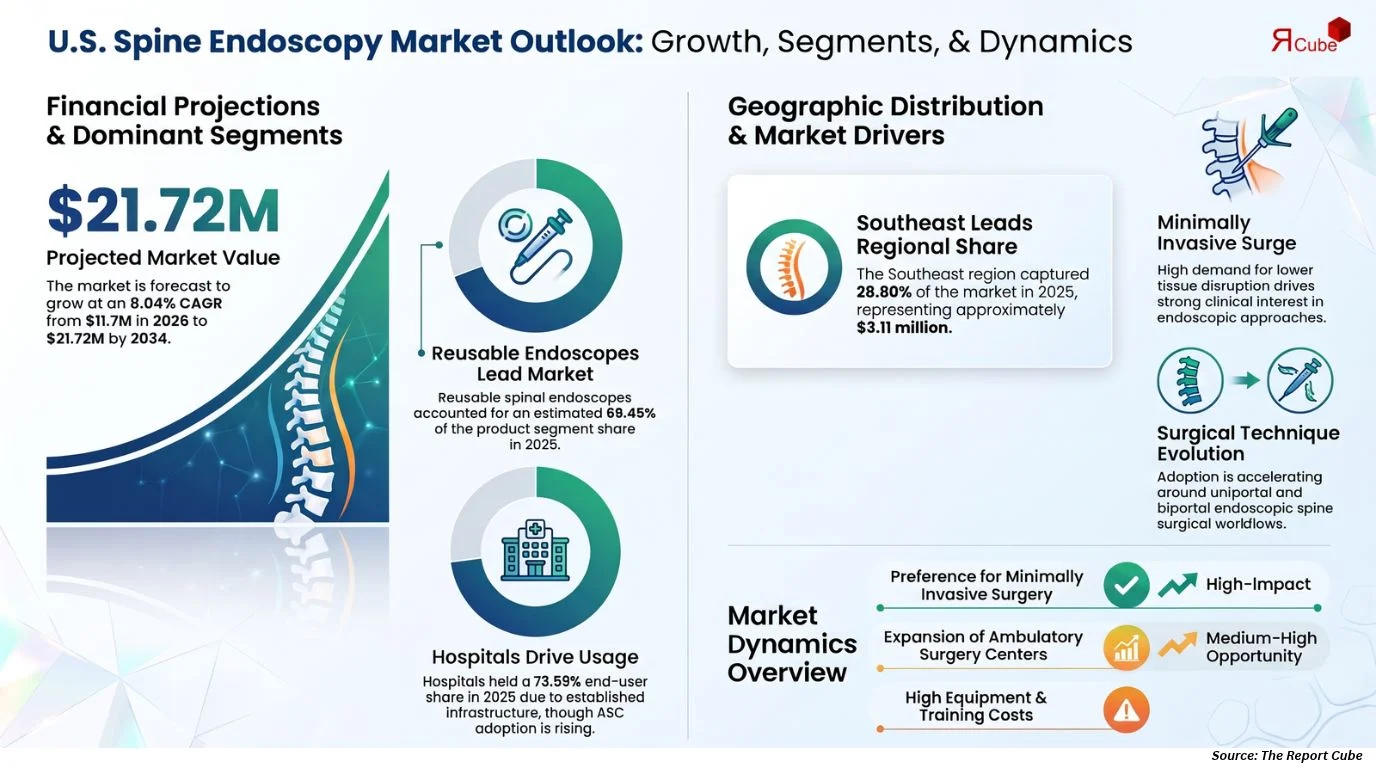
- The U.S. Spine Endoscopy Market was valued at USD 10.8 million in 2025 and is estimated at USD 11.7 million in 2026.
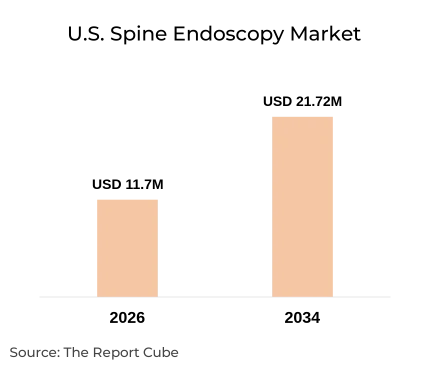
- Market size is forecast to reach USD 21.72 million by 2034, a CAGR of 8.04% during 2026–2034.
- By product type, reusable spinal endoscopes led with an estimated 69.45% share in 2025.
- By end user, hospitals led with an estimated 73.59% share in 2025.
- The Southeast was the leading region with an estimated 28.80% share in 2025.
- Growing preference for minimally invasive spine procedures is the major growth driver.
- Specialized endoscopic spine manufacturers compete with large medical technology companies, and the FDA cleared the Arthrex Spine Endoscope in May 2025.
Market Outlook
The U.S. Spine Endoscopy Market covers endoscopic visualization systems, spinal endoscopes and related instruments used in minimally invasive spinal procedures. These technologies let surgeons reach targeted spinal structures through small incisions while viewing the operative field on a camera system, which supports reduced tissue disruption in appropriately selected patients.
Demand comes from hospitals and ambulatory surgery centers (ASCs) treating conditions such as herniated discs, spinal stenosis and nerve compression. Clinical suitability depends on patient anatomy, diagnosis and surgeon experience. According to the CDC, 24.3% of U.S. adults experienced chronic pain in 2023, a general measure of pain burden rather than of spine endoscopy demand.
The U.S. Spine Endoscopy Market is estimated at USD 11.7 million in 2026 and is projected to reach USD 21.72 million by 2034, a CAGR of 8.04%. Growth factors include improved endoscopic instrumentation, wider surgeon training, and the expansion of outpatient spine surgery. These are supplied estimates, not officially published statistics.
Competition spans specialist endoscopic spine technology firms and larger surgical technology companies. Opportunities lie in advanced visualization, ergonomic instruments and ASC-focused product portfolios. Future direction depends on surgeon training, reimbursement conditions and clinical evidence supporting wider adoption of uniportal and biportal techniques.
Government Regulations
The U.S. Spine Endoscopy Market operates in a regulated medical-device environment overseen by the U.S. Food and Drug Administration (FDA). The regulatory pathway depends on device classification, intended use and technological characteristics. The 510(k) route requires demonstration of substantial equivalence to a legally marketed predicate device. The FDA 510(k) database records clearance of the Arthrex Spine Endoscope (K243602) with a decision date of May 16, 2025. Reimbursement is shaped by the Centers for Medicare & Medicaid Services (CMS), and coverage varies by procedure, payer, coding, care setting and medical necessity. CMS’s Transforming Episode Accountability Model (TEAM), scheduled for 2026–2030, includes selected surgical episodes such as spinal fusion, but it is not a dedicated reimbursement program for endoscopic spine procedures. Manufacturers must meet FDA clearance and quality requirements, while hospitals and ASCs must align equipment investment with payer policy. Regulatory and reimbursement clarity therefore influences market entry, adoption pace and product development.
U.S. Spine Endoscopy Market Dynamics
Demand is shaped by clinical interest in less invasive spinal procedures, advances in surgical visualization and shifts in hospital and ASC utilization. Adoption depends on procedural training, capital investment, reimbursement and clinical suitability. Together these factors determine how quickly endoscopic spine techniques become established across U.S. surgical facilities.
|
Factor |
Type |
Specific Impact on Market |
Magnitude |
|---|---|---|---|
|
Preference for minimally invasive spine procedures |
Driver |
Supports demand for endoscopes and visualization systems |
High |
|
Expansion of ASC utilization |
Opportunity |
Opens outpatient settings for selected procedures |
Medium–High |
|
High equipment and training costs |
Challenge |
Limits adoption in smaller facilities |
Medium–High |
|
Reimbursement and payment uncertainty |
Challenge |
Affects procedure economics for providers |
Medium |
|
Uniportal and biportal techniques |
Trend |
Broadens procedural options and instrument demand |
Medium–High |
Growth Drivers: Preference for Minimally Invasive Spine Procedures
Demand for minimally invasive spinal procedures supports interest in endoscopic surgical technologies. Compared with open approaches, selected endoscopic procedures may reduce surgical exposure and soft-tissue disruption, which makes them attractive for suitable patients and indications. Improvements in visualization and instrumentation, together with rising surgeon and patient awareness, support the adoption of spine endoscopy across hospitals and surgical facilities in the United States.
Market Opportunities: Expansion of Ambulatory Surgery Centers
The growth of outpatient surgical services creates an opportunity for spine endoscopy. Selected procedures may suit ASCs when patient selection, clinical protocols and reimbursement conditions permit. Facilities seeking to expand minimally invasive spine services can use endoscopic systems to manage procedural costs. Manufacturers with compact, workflow-efficient systems and strong training support may be best placed to serve this setting.
Industry Challenges: High Equipment Costs and Reimbursement Uncertainty
Endoscopic spine surgery requires specialized endoscopes, cameras, monitors, light sources, irrigation systems and dedicated instruments, and acquiring them can burden smaller facilities. Staff training and operating-room preparation add further costs. Reimbursement policies, payer coverage and coding requirements also vary, which creates uncertainty about whether clinical benefits justify investment. These factors can make adoption uneven across U.S. healthcare facilities.
Need Specific Data, Let’s Customize the Report for You
Request CustomizationMarket Trends: Uniportal and Biportal Endoscopic Techniques
Uniportal and biportal approaches are key areas of development in endoscopic spine surgery. Uniportal systems use a single working access route, whereas biportal techniques use separate viewing and working portals, each with different workflows and instrument configurations. Adoption depends on surgeon preference, training and the intended clinical application. Manufacturers are expanding portfolios to support both approaches, which broadens the range of compatible instruments.
U.S. Spine Endoscopy Market Segment Analysis
The market is segmented by product type, procedure type, application and end user. All supplied segments are listed below. Segment shares are supplied 2025 estimates where available, and no share is assigned where evidence was not supplied.
By Product Type
- Reusable Spinal Endoscopes
- Disposable / Single-Use Spinal Endoscopes
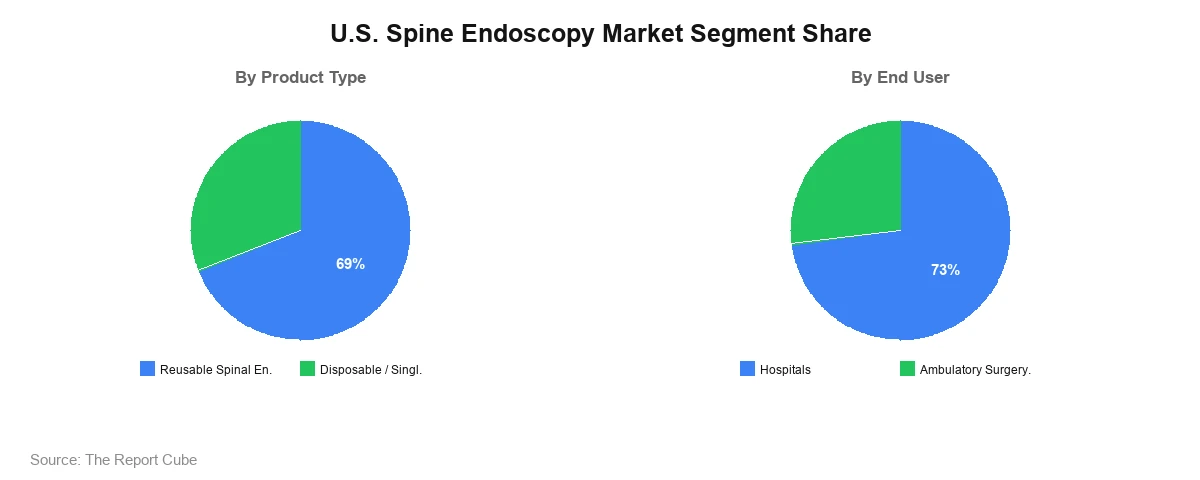
Reusable spinal endoscopes led the product-type segment with an estimated 69% share in 2025. Their position reflects established use in surgical facilities, repeated utilization and compatibility with existing endoscopic workflows, which supports commercial importance for facilities with high procedure volumes. Disposable and single-use endoscopes form the second segment, supported by interest in infection-control processes and simplified reprocessing, and they are relevant to facilities seeking to reduce instrument-handling requirements.
By End User
- Hospitals
- Ambulatory Surgery Centers (ASCs)
Hospitals led the end-user segment with an estimated 73% share in 2025. They benefit from established surgical infrastructure, specialist teams and the capacity to manage complex cases, which sustains equipment demand. ASCs are the second segment and are gaining relevance for selected procedures because of outpatient care models and interest in operational efficiency. Their role depends on patient selection, facility capability and reimbursement.
U.S. Spine Endoscopy Market Regional Analysis
Regional demand is influenced by hospital infrastructure, specialist availability, healthcare spending and the concentration of spine surgery centers. Adoption also depends on access to advanced surgical technologies and the presence of surgeons trained in endoscopic techniques. Shares below are supplied 2025 estimates, and none are assigned to regions without supplied data.
|
Region |
Estimated Market Share |
Key Growth Factors |
Industry Trends |
|---|---|---|---|
|
Southeast |
28% |
Hospital infrastructure and specialist availability |
Expanding minimally invasive spine services |
|
Northeast |
- |
Established academic and hospital networks |
Hospital-centered adoption |
|
Midwest |
- |
Regional hospital systems and ASC capacity |
Gradual adoption of endoscopic techniques |
|
West |
- |
Growing ASC utilization |
Outpatient-oriented spine surgery |
The Southeast accounted for an estimated 28% of the market in 2025, equivalent to about USD 3.11 million. Its position reflects the regional concentration of surgical facilities, specialist availability and spending on spine procedures. A consistently sourced share split for the Northeast, Midwest and West was not available, so none is estimated here.
Competitive Landscape
The market includes specialized endoscopic spine technology manufacturers and larger medical technology companies with broader surgical portfolios. Competition is shaped by visualization quality, instrument design, procedural compatibility, surgeon training, clinical support and distribution relationships. The table is not a ranking, and no market shares are assigned.
|
Company |
Competitive Strength |
Primary Segment Served |
|---|---|---|
|
Endoscopic spine systems including TESSYS, iLESSYS and CESSYS |
Spinal endoscopes and procedural systems |
|
|
RIWOspine GmbH |
Endoscopic spine surgery systems and instruments |
Spinal endoscopes and instruments |
|
Arthrex |
FDA-cleared spine endoscope; broad surgical portfolio |
Hospitals and ASCs |
|
elliquence |
Endoscopic spine surgery technology |
Endoscopic spine procedures |
|
KARL STORZ |
Endoscopic visualization technologies and instruments |
Visualization systems |
|
MAXMORESPINE |
Minimally invasive and endoscopic spinal products |
Spine procedures |
|
Johnson & Johnson MedTech |
Broad spine and surgical technology portfolio |
Hospitals and surgical facilities |
|
Armed Inc. |
Spine endoscopy products; details require verification |
Endoscopic spine procedures |
|
Nexon Medical |
Endoscopic spine technology; details require verification |
Endoscopic spine procedures |
|
Unintech GmbH |
Specialized spinal surgical instrumentation |
Surgical instruments |
joimax GmbH: joimax is a German medical technology company specializing in endoscopic spine surgery. Its portfolio includes the TESSYS, iLESSYS and CESSYS systems, which support different spinal regions and procedural approaches. Its competitive strength lies in a focused endoscopic product line and surgeon training programs. Its U.S. market presence and share should be validated against official company disclosures.
Arthrex: Arthrex is a medical technology company headquartered in Naples, Florida, with a broad surgical product range. Its Spine Endoscope received FDA 510(k) clearance (K243602) on May 16, 2025, extending its portfolio into endoscopic spine surgery. Its competitive strength lies in regulatory clearance, an established surgical customer base and distribution reach.
Recent Developments and Updates
- May 2025: The FDA’s 510(k) database recorded clearance of the Arthrex Spine Endoscope (K243602) with a decision date of May 16, 2025. The clearance shows continued regulatory activity and product development in the U.S. endoscopic spine segment.
- 2026: CMS’s Transforming Episode Accountability Model (TEAM) is scheduled to run from 2026 to 2030 and includes selected surgical episodes such as spinal fusion. It is not a dedicated program for endoscopic spine procedures, but it may influence hospital cost and procedure-selection decisions. The start date and scope should be verified against CMS publications before publication.
U.S. Spine Endoscopy Market Future Outlook
The U.S. Spine Endoscopy Market is expected to expand over 2026–2034 as interest in minimally invasive surgery, improved endoscopic systems and outpatient surgical services continue. The supplied estimates project growth from USD 11.7 million in 2026 to USD 21.72 million by 2034. Opportunities include advanced visualization, ergonomic instruments and systems suited to ASC workflows, particularly if procedural efficiency improves.
Competitive activity is likely to center on product portfolios supporting uniportal and biportal techniques, surgeon education and hospital and ASC partnerships. Challenges include equipment cost, training requirements, reimbursement uncertainty and uneven clinical suitability. The 2034 figure is a projection, not a verified outcome, and actual performance depends on adoption, pricing, product launches, reimbursement policy and clinical evidence.
U.S. Spine Endoscopy Market Report Coverage
This report summarizes the supplied valuation, forecast assumptions, segmentation, regional framework and competitive ecosystem of the U.S. Spine Endoscopy Market for 2026–2034.
|
Parameter |
Details |
|---|---|
|
Market Name |
U.S. Spine Endoscopy Market |
|
Market Size (Base Year) |
USD 10.8 million (2025) |
|
Market Size (Forecast Year) |
USD 21.72 million (2034) |
|
CAGR |
8.04% (2026–2034) |
|
Base Year |
2025 |
|
Historical Period |
2021–2025 |
|
Forecast Period |
2026–2034 |
|
Geographic Scope |
United States |
|
Segmentation |
By Product Type; By Procedure Type; By Application; By End User |
|
Regions Covered |
Southeast, Northeast, Midwest, West |
|
Key Companies |
joimax GmbH; RIWOspine GmbH; Arthrex; elliquence; KARL STORZ; MAXMORESPINE; Johnson & Johnson MedTech; Armed Inc.; Nexon Medical; Unintech GmbH |
|
Customization |
Available as per requirement |
Why Choose This U.S. Spine Endoscopy Market Report?
- Presents the supplied 2025 base value, 2026 estimate, 2034 forecast and 8.04% CAGR with stated assumptions.
- Segments the market by product type, procedure type, application and end user.
- Reviews drivers, opportunities, challenges and trends with a magnitude assessment.
- Provides regional context, with unsupplied shares identified rather than estimated.
- Profiles key manufacturers by capability and primary segment served.
- Highlights uniportal and biportal techniques and ASC expansion as emerging opportunities.
- Summarizes FDA and CMS policy context to support product, investment and planning decisions.
Table of Contents
- Introduction
- Objective of the Study
- Product Definition
- Market Segmentation
- Study Variables
- Research Methodology
- Secondary Data Points
- Companies Interviewed
- Primary Data Points
- Breakdown of Primary Interviews
- Secondary Data Points
- Executive Summary
- Market Dynamics
- Drivers
- Challenges
- Opportunity Assessment
- Recent Trends and Developments
- Policy and Regulatory Landscape
- U.S. Spine Endoscopy Market Overview and Forecast Analysis (2021-2034)
- Market Size, By Value, By Growth Rate (CAGR/USD Millions)
- Demand – Supply Trends
- Market Share, By Product Type
- Reusable Spinal Endoscopes
- Disposable / Single-Use Spinal Endoscopes
- Market Share, By Procedure Type
- Uniportal Endoscopic Spine Surgery
- Biportal Endoscopic Spine Surgery
- Market Share, By Application
- Lumbar Spine
- Cervical Spine
- Thoracic Spine
- Market Share, By End User
- Hospitals
- Ambulatory Surgery Centers (ASCs)
- Market Share, By Region
- Northeast
- Midwest
- South
- West
- Market Share, By Competitors
- Competition Characteristics
- Revenue Shares
- Reusable Spinal Endoscopes U.S. Spine Endoscopy Market Overview, 2021-2034F
- By Value (USD Million)
- By Procedure Type – Market Size & Forecast 2021-2034, USD Million
- Uniportal Endoscopic Spine Surgery
- Biportal Endoscopic Spine Surgery
- Disposable / Single-Use Spinal Endoscopes U.S. Spine Endoscopy Market Overview, 2021-2034F
- By Value (USD Million)
- By Procedure Type – Market Size & Forecast 2021-2034, USD Million
- Uniportal Endoscopic Spine Surgery
- Biportal Endoscopic Spine Surgery
- Competitive Outlook (Company Profile – Partial List)
- joimax GmbH
- Company Overview
- Business Segments
- Strategic Alliances/Partnerships
- Recent Developments
- RIWOspine GmbH
- Company Overview
- Business Segments
- Strategic Alliances/Partnerships
- Recent Developments
- Arthrex
- Company Overview
- Business Segments
- Strategic Alliances/Partnerships
- Recent Developments
- elliquence
- Company Overview
- Business Segments
- Strategic Alliances/Partnerships
- Recent Developments
- KARL STORZ
- Company Overview
- Business Segments
- Strategic Alliances/Partnerships
- Recent Developments
- MAXMORESPINE
- Company Overview
- Business Segments
- Strategic Alliances/Partnerships
- Recent Developments
- Johnson & Johnson MedTech
- Company Overview
- Business Segments
- Strategic Alliances/Partnerships
- Recent Developments
- Armed Inc.
- Company Overview
- Business Segments
- Strategic Alliances/Partnerships
- Recent Developments
- Nexon Medical
- Company Overview
- Business Segments
- Strategic Alliances/Partnerships
- Recent Developments
- Unintech GmbH
- Company Overview
- Business Segments
- Strategic Alliances/Partnerships
- Recent Developments
- joimax GmbH
- Contact Us & Disclaimer
Top Key Players & Market Share Outlook
- joimax GmbH
- RIWOspine GmbH
- Arthrex
- elliquence
- KARL STORZ
- MAXMORESPINE
- Johnson & Johnson MedTech
- Armed Inc.
- Nexon Medical
- Unintech GmbH
Frequently Asked Questions