




Build Your Custom Market Intelligence Report
Customize Your ReportGlobal Spirulina Market Insights & Analysis
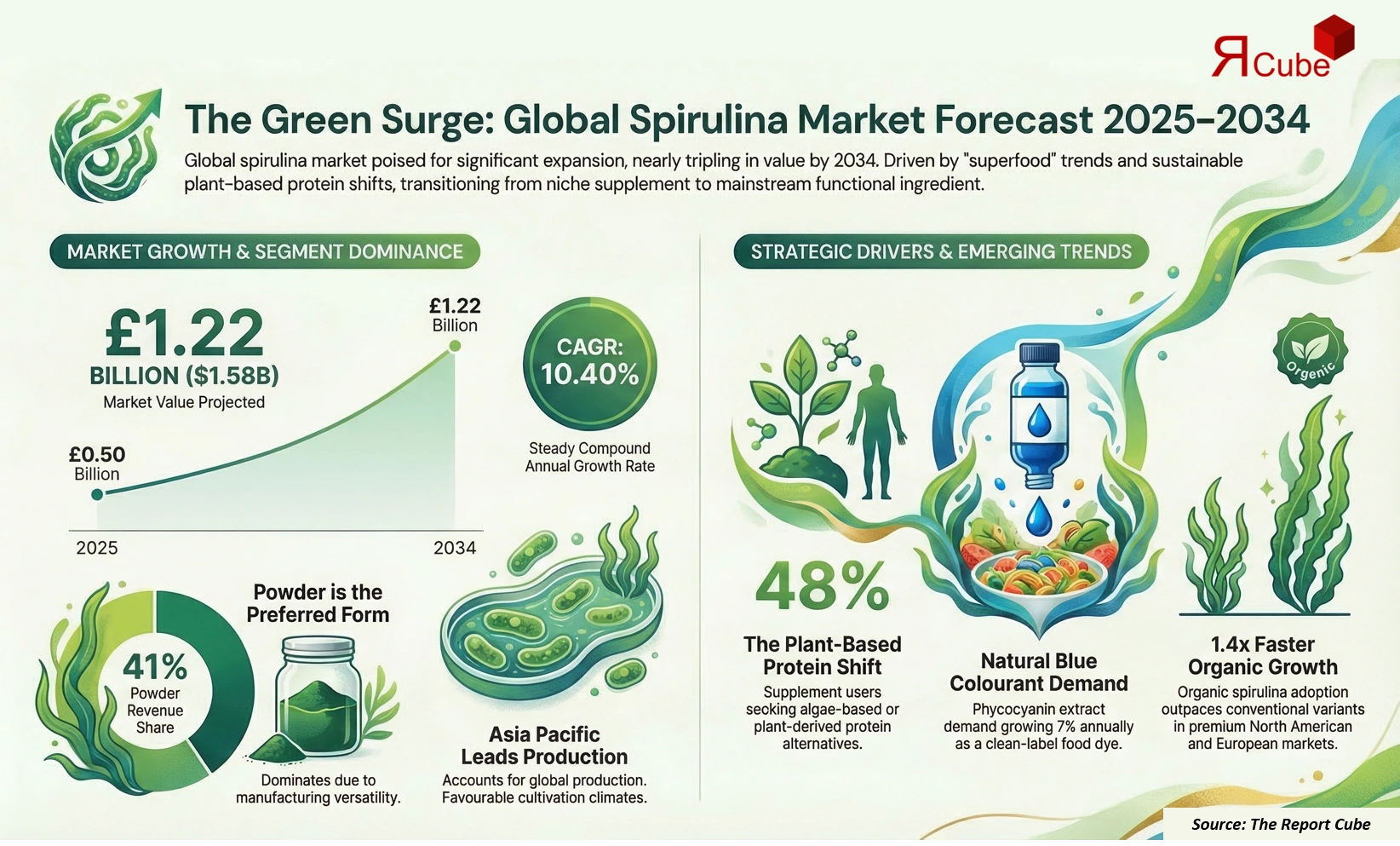
The Global Spirulina Market is anticipated to register a CAGR of 10.40% during the forecast period 2026-2034. The market size was valued at USD 0.65 billion in 2025 and is projected to reach USD 1.58 billion by 2034. This robust growth trajectory reflects the rising global demand for nutrient-dense superfoods and plant-based dietary supplements. Spirulina, a blue-green microalgae rich in protein, vitamins, antioxidants, and essential minerals, has gained strong acceptance across nutraceuticals, functional foods, cosmetics, and animal feed applications. Increasing awareness around preventive healthcare, immunity enhancement, and natural nutrition continues to strengthen market fundamentals.
Beyond basic supplementation, spirulina consumption is expanding into wellness nutrition, sports nutrition, clean-label food formulations, and vegan protein alternatives. Market adoption is further supported by growing consumer preference for algae-based protein sources due to their low environmental footprint compared to animal-based proteins. Industry data suggests that over 62% of global spirulina demand is now driven by dietary supplement and functional food applications, while cosmetics and aquaculture feed represent fast-emerging consumption areas. Asia Pacific remains a dominant production hub due to favorable climatic conditions and cost-efficient cultivation, while North America and Europe drive premium product demand, organic spirulina adoption, and value-added extract formulations.
Global Spirulina Market Recent Developments
- 2025: DIC Corporation expanded high-purity phycocyanin production to meet rising demand from functional beverages.
- 2025: Cyanotech Corporation introduced organic-certified spirulina tablets targeting premium nutraceutical brands.
Government Initiatives & Policies
- U.S. National Algae Initiative: Supports algae-based nutrition and sustainable biomass development.
- European Green Deal - Sustainable Food Systems: Promotes alternative proteins and eco-friendly food ingredients.
Global Spirulina Market Dynamics
Key Driver: Rising Demand for Natural Superfoods and Plant-Based Nutrition
The primary driver accelerating the spirulina market is the increasing global demand for natural superfoods and plant-based nutrition solutions. Spirulina is widely recognized for containing over 60% protein by dry weight, along with iron, beta-carotene, and phycocyanin, making it highly attractive to health-conscious consumers. Industry surveys indicate that nearly 48% of supplement users actively seek algae-based or plant-derived protein alternatives. Additionally, spirulina’s role in immunity support, detoxification, and energy enhancement has strengthened its presence in daily wellness regimens, protein blends, green powders, and functional beverages. These factors collectively sustain strong volume growth across both developed and emerging markets.
Major Challenge: Quality Standardization and Contamination Risks
Despite strong growth prospects, the market faces challenges related to quality consistency and contamination risks during cultivation. Spirulina production is highly sensitive to water quality, temperature, and harvesting conditions, which can impact nutrient composition. Contamination with heavy metals or microcystins remains a concern, particularly in unregulated production environments. Regulatory agencies in North America and Europe have tightened quality benchmarks, increasing compliance costs for manufacturers. According to industry estimates, quality testing and certification expenses can account for nearly 12-15% of total production costs. Smaller producers often struggle to meet these standards, limiting their access to premium markets.
Industry Trends: Expansion of Phycocyanin and Functional Ingredient Applications
A notable trend reshaping the spirulina market is the rapid expansion of phycocyanin and spirulina extract applications. Phycocyanin, a natural blue pigment with antioxidant and anti-inflammatory properties, is increasingly used in clean-label beverages, confectionery, and cosmetics. Global demand for natural food colorants has grown by over 7% annually, directly benefiting spirulina extract producers. Additionally, spirulina-based functional ingredients are being incorporated into energy bars, immunity shots, and sports nutrition products. This shift toward high-margin, value-added derivatives is improving overall profitability and encouraging investment in advanced extraction technologies.
Opportunity Ahead: Growth in Organic and Sustainable Spirulina Products
The growing preference for organic and sustainably sourced nutrition products presents a significant opportunity for market expansion. Organic spirulina is witnessing adoption rates nearly 1.4 times faster than conventional variants in North America and Europe. Consumers increasingly associate organic certification with purity, safety, and higher nutritional value. Sustainable cultivation methods, including closed-loop photobioreactors and renewable energy integration, are gaining traction. Companies investing in traceability, eco-certifications, and transparent sourcing are better positioned to capture premium pricing and long-term brand loyalty in both retail and B2B segments.
Global Spirulina Market Segment-wise Analysis
By Product Form:
- Powder
- Tablets
- Capsules
- Flakes
- Liquid and Paste
- Phycocyanin or Extracts
The powder segment dominates the market, accounting for approximately 41% of total revenue in 2025. Spirulina powder is widely used in smoothies, functional foods, dietary supplements, and animal feed due to its versatility and cost efficiency. Its ease of formulation allows manufacturers to incorporate it into a wide range of applications without complex processing. While tablets and capsules offer convenience, powder remains the preferred choice for bulk buyers and food manufacturers, ensuring its continued leadership throughout the forecast period.
By Nature:
- Conventional Spirulina
- Organic Spirulina
Conventional spirulina currently holds nearly 63% of the overall market share, driven by its lower production cost and widespread availability. However, organic spirulina is gaining momentum, particularly in premium supplement and functional food segments. Organic variants are increasingly favored by health-conscious consumers and regulatory-compliant markets, supporting higher price realization. The gradual shift toward organic cultivation is expected to narrow the share gap by 2034 as certification infrastructure expands globally.
Regional Projection of Global Spirulina Industry
- North America
- Europe
- Asia Pacific
- Latin America
- Middle East and Africa
Asia Pacific leads the global spirulina market, accounting for approximately 38% of total production and consumption in 2025. Favorable climatic conditions, lower cultivation costs, and strong domestic demand in countries such as China and India support regional dominance. North America follows as the largest revenue-generating region, driven by premium nutraceutical consumption and organic product demand. Europe demonstrates steady growth supported by sustainability regulations and natural food colorant adoption, while Latin America and the Middle East & Africa offer long-term growth potential through expanding health supplement markets.
Why Choose This Report?
- Provides a comprehensive overview of the overall market analysis, encompassing key trends, consumer behavior analysis, and risk assessment to support strategic decision-making.
- Provides accurate, up-to-date insights into market size, segmentation, and emerging opportunities, helping to minimize risk & capitalizing on growth.
- Gives deep understanding of target audience preferences, investment habits, and communication channels for enhanced product development & marketing effectiveness.
- Delivers competitive analysis & benchmarking, uncovering the strengths & weaknesses of market competitors to guide strategies.
- Consolidate comprehensive market intelligence, reducing reasoning & streamlining research efforts.
- Facilitates customized market segmentation & risk mitigation strategies, fine-tuned to the business objectives.
- Aids in identifying both market challenges & untapped opportunities within the industry to drive long-term business growth.
- Provides valuable information based on actual customer data & search trends.
Table of Contents
- Introduction
- Objective of the Study
- Product and Category Definition
- Market Segmentation
- Study Variables
- Research Methodology
- Secondary Data Points
- Breakdown of Secondary Sources
- Primary Data Points
- Breakdown of Primary Interviews
- Secondary Data Points
- Executive Summary
- Market Dynamics
- Drivers
- Challenges
- Opportunity Assessment
- Recent Trends and Developments
- Regulatory and Policy Landscape
- Global Spirulina Market Overview (2020-2034)
- Market Size, By Value (USD Billion)
- Market Share, By Product Form
- Powder
- Tablets
- Capsules
- Flakes
- Liquid and Paste
- Phycocyanin or Extracts
- Market Share, By Nature
- Conventional Spirulina
- Organic Spirulina
- Market Share, By Application
- Nutraceuticals or Dietary Supplements
- Food and Beverages
- Bakery and Confectionery
- Dairy and Frozen Desserts
- Beverages
- Snacks and Others
- Cosmetics and Personal Care
- Animal Feed and Aquafeed
- Agriculture and Fertilizers
- Others
- Market Share, By Distribution Channel
- Business-to-Business (B2B)
- Business-to-Consumer (B2C)
- Health Food Stores
- Pharmacies
- Supermarkets and Hypermarkets
- Online Retail
- E‑commerce
- Market Share, By End User
- Individuals and Households
- Food and Beverage Manufacturers
- Nutraceutical and Supplement Brands
- Cosmetics Manufacturers
- Feed Manufacturers
- Market Share, By Region
- North America
- Europe
- Asia Pacific
- Latin America
- Middle East and Africa
- Market Share, By Company
- Revenue Shares
- Competitive Landscape
- North America Spirulina Market
- Market Size, By Value (USD Billion)
- Market Share, By Product Form
- Market Share, By Nature
- Market Share, By Application
- Market Share, By Distribution Channel
- Market Share, By End User
- Market Share, By Region/Country Group
- Market Share, By Country
- United States
- Canada
- Mexico
- Europe Spirulina Market
- Market Size, By Value (USD Billion)
- Market Share, By Product Form
- Market Share, By Nature
- Market Share, By Application
- Market Share, By Distribution Channel
- Market Share, By End User
- Market Share, By Region/Country Group
- Market Share, By Country
- Germany
- France
- United Kingdom
- Italy
- Spain
- Northern and Nordic Countries
- Rest of Europe
- Asia Pacific Spirulina Market
- Market Size, By Value (USD Billion)
- Market Share, By Product Form
- Market Share, By Nature
- Market Share, By Application
- Market Share, By Distribution Channel
- Market Share, By End User
- Market Share, By Region/Country Group
- Market Share, By Country
- China
- India
- Japan
- South Korea
- Australia
- Rest of Asia Pacific
- Latin America Spirulina Market
- Market Size, By Value (USD Billion)
- Market Share, By Product Form
- Market Share, By Nature
- Market Share, By Application
- Market Share, By Distribution Channel
- Market Share, By End User
- Market Share, By Region/Country Group
- Market Share, By Country
- Brazil
- Mexico
- Rest of Latin America
- Middle East and Africa Spirulina Market
- Market Size, By Value (USD Billion)
- Market Share, By Product Form
- Market Share, By Nature
- Market Share, By Application
- Market Share, By Distribution Channel
- Market Share, By End User
- Market Share, By Region/Country Group
- Market Share, By Country
- Turkey
- Saudi Arabia
- United Arab Emirates
- South Africa
- Rest of Middle East and Africa
- Competitive Outlook and Company Profiles
- DIC Corporation
- Company Overview
- Product Portfolio
- Strategic Alliances/Partnerships
- Recent Developments
- Cyanotech Corporation
- Company Overview
- Product Portfolio
- Strategic Alliances/Partnerships
- Recent Developments
- Parry Nutraceuticals
- Company Overview
- Product Portfolio
- Strategic Alliances/Partnerships
- Recent Developments
- NOW Foods
- Company Overview
- Product Portfolio
- Strategic Alliances/Partnerships
- Recent Developments
- Far East Microalgae Industries
- Company Overview
- Product Portfolio
- Strategic Alliances/Partnerships
- Recent Developments
- Fuqing King Dnarmsa Spirulina
- Company Overview
- Product Portfolio
- Strategic Alliances/Partnerships
- Recent Developments
- TAAU Australia
- Company Overview
- Product Portfolio
- Strategic Alliances/Partnerships
- Recent Developments
- Prolgae Spirulina Supplies
- Company Overview
- Product Portfolio
- Strategic Alliances/Partnerships
- Recent Developments
- Yunnan Green A Biological Project
- Company Overview
- Product Portfolio
- Strategic Alliances/Partnerships
- Recent Developments
- Roquette Klötze
- Company Overview
- Product Portfolio
- Strategic Alliances/Partnerships
- Recent Developments
- DIC Corporation
- Contact Us and Disclaimer
Top Key Players & Market Share Outlook
- DIC Corporation
- Cyanotech Corporation
- Parry Nutraceuticals
- NOW Foods
- Far East Microalgae Industries
- Fuqing King Dnarmsa Spirulina
- TAAU Australia
- Prolgae Spirulina Supplies
- Yunnan Green A Biological Project
- Roquette Klötze
Frequently Asked Questions






