



Build Your Custom Market Intelligence Report
Customize Your ReportUAE Sustainable Building Materials Market Insights & Analysis
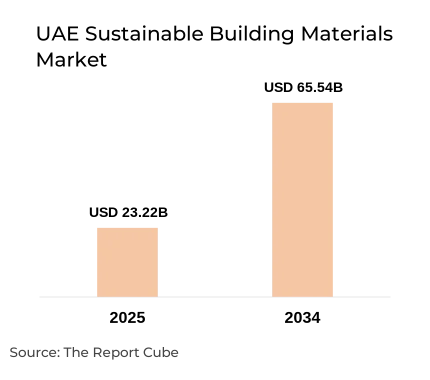
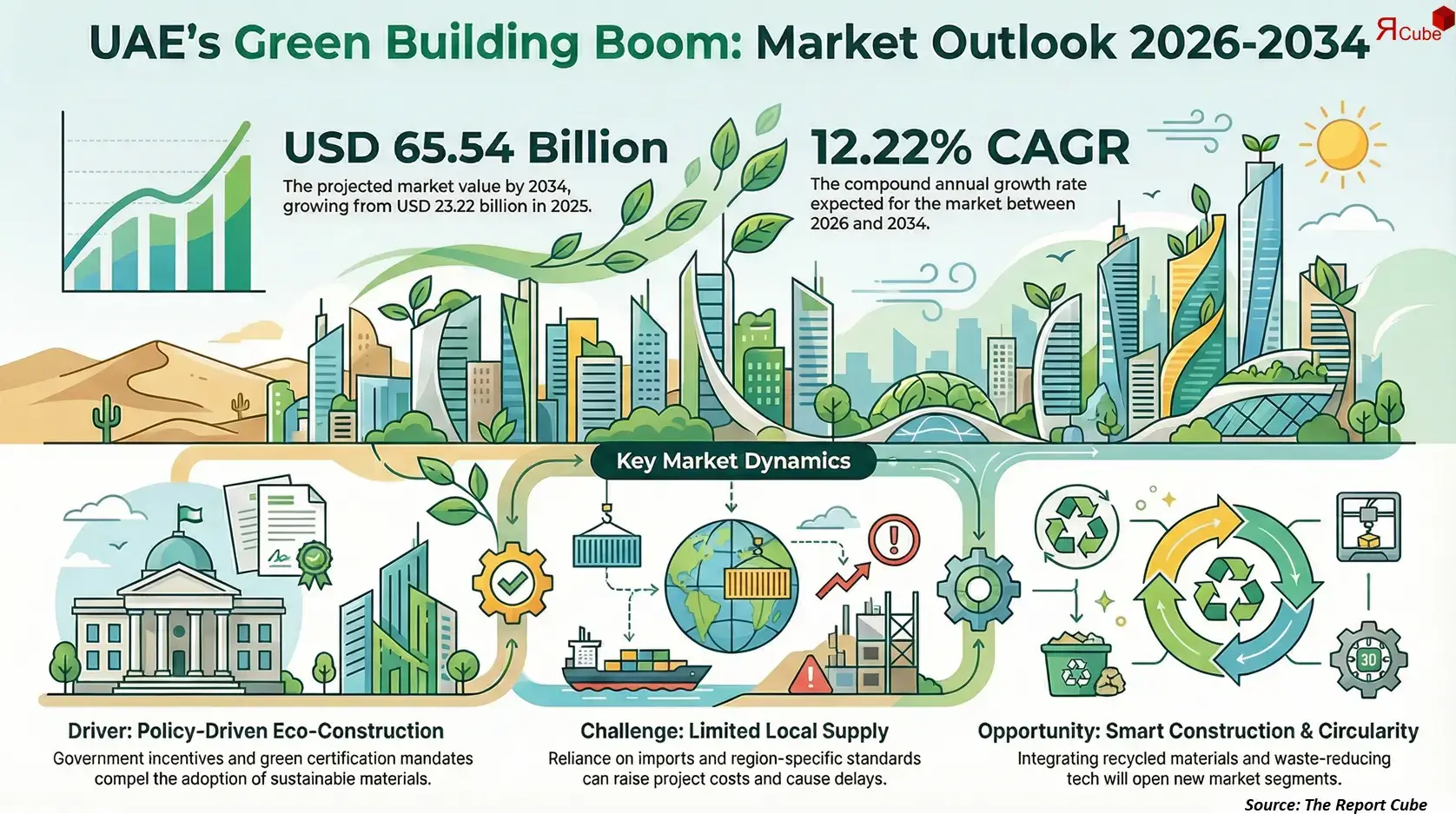
The UAE Sustainable Building Materials Market is anticipated to register a CAGR of 12.22% during 2026-2034. The market size was valued at USD 23.22 billion in 2025 and is projected to reach USD 65.54 billion by 2034. The rapid expansion of sustainable construction across the UAE is closely aligned with national sustainability visions, net-zero targets, and long-term urban development strategies. Increasing adoption of environmentally responsible materials in residential, commercial, and infrastructure projects is reshaping procurement decisions across the construction value chain.
Rising awareness of carbon footprints, energy efficiency, and lifecycle costs has encouraged developers to integrate recycled, bio-based, and low-carbon materials into new projects. Developers are increasingly prioritizing green certifications such as Estidama Pearl Rating and LEED, which mandate the use of sustainable inputs. This shift is supported by favorable regulatory frameworks, growing investor preference for ESG-compliant assets, and the UAE’s ambition to position itself as a global leader in sustainable urban development.
Furthermore, technological innovation in material science and manufacturing is improving the performance and cost competitiveness of sustainable alternatives. From advanced insulation systems to low-carbon concrete and recycled metals, product innovation is enabling broader adoption without compromising durability or design flexibility. Collectively, these factors are driving strong and consistent growth across the UAE Sustainable Building Materials Market through 2034.
UAE Sustainable Building Materials Market Recent Developments
- 2025: Saint-Gobain UAE expanded its low-carbon insulation production capacity to support large-scale green construction projects.
- 2025: RAK Ceramics introduced a recycled-content tile range aligned with green building certification requirements.
Government Initiatives & Policies
- UAE Net Zero 2050 Strategic Initiative: National roadmap accelerating low-carbon construction and sustainable material adoption.
- Dubai Clean Energy Strategy 2050: Policy framework promoting sustainable buildings and energy-efficient materials.
UAE Sustainable Building Materials Market Dynamics
Key Driver: Strong Government Mandates Supporting Green Construction
Government-driven sustainability mandates remain the primary driver of the UAE Sustainable Building Materials Market. Federal and emirate-level regulations increasingly require energy-efficient designs, reduced embodied carbon, and responsible sourcing of construction materials. Public infrastructure projects, including transportation hubs, government buildings, and utilities, are now required to comply with stringent sustainability benchmarks. This regulatory push creates consistent demand for recycled materials, low-carbon concrete, and high-performance insulation. Additionally, developers benefit from long-term operational cost savings through reduced energy consumption, reinforcing the economic rationale for sustainable material adoption.
Book your FREE 30-minute expert consultation today
Contact UsIndustry Trends: Rising Adoption of Low-Carbon and Recycled Materials
A significant trend shaping the market is the accelerating adoption of low-carbon concrete, recycled metals, and bio-based materials. Construction firms are increasingly replacing traditional cement with blended and alternative binders, reducing carbon emissions by up to 40% per project. Recycled steel and aluminum are gaining traction due to lower embodied energy and strong structural performance. Simultaneously, insulation materials and low-VOC coatings are being integrated to improve indoor air quality and thermal efficiency. These trends reflect a broader shift toward lifecycle-based material selection rather than upfront cost considerations.
Major Challenge: Higher Initial Costs and Supply Chain Constraints
Despite long-term benefits, higher upfront costs associated with sustainable building materials present a notable challenge. Advanced manufacturing processes, limited local sourcing for certain bio-based inputs, and fluctuating raw material prices contribute to cost premiums. Additionally, inconsistent availability of certified sustainable materials can delay project timelines. Small and mid-sized contractors may face difficulties absorbing these costs, particularly in price-sensitive segments. Addressing supply chain localization and economies of scale remains critical to overcoming this barrier.
Opportunity: Rapid Growth of Green Real Estate and Infrastructure Projects
The expansion of green real estate developments and sustainable infrastructure presents a substantial growth opportunity. Mega projects, smart cities, and mixed-use developments across Abu Dhabi and Dubai increasingly prioritize sustainability as a core value proposition. Demand for green roofs, advanced insulation, and sustainable wood alternatives is rising steadily. Furthermore, international investors favor assets aligned with ESG principles, driving developers to integrate sustainable materials as a competitive differentiator. This trend is expected to unlock long-term growth potential across multiple material categories.
UAE Sustainable Building Materials Market Segment-wise Analysis
By Product Category:
- Recycled Materials
- Bio-based Materials
- Low-carbon Concrete
- Insulation Materials
Low-carbon concrete leads the product category segment, accounting for approximately 29% of total market share in 2025. Its dominance is driven by widespread application across residential, commercial, and infrastructure projects. Developers increasingly favor low-carbon concrete to meet emission reduction targets without compromising structural integrity. Recycled materials follow closely, supported by government incentives and rising landfill diversion goals. Insulation materials also demonstrate strong growth due to energy efficiency mandates and increasing cooling demand in the UAE climate.
By Application:
- Residential Buildings
- Commercial Buildings
- Industrial Facilities
- Public Infrastructure
Commercial buildings represent the leading application segment, holding nearly 37% market share in 2025. Offices, retail complexes, and hospitality developments are early adopters of sustainable materials due to branding advantages and regulatory compliance. Residential buildings are rapidly closing the gap as developers respond to buyer demand for energy-efficient homes. Public infrastructure projects provide stable long-term demand, driven by government-funded sustainability initiatives and urban expansion plans.
Regional Projection of UAE Sustainable Building Materials Industry
- Abu Dhabi
- Dubai
- Sharjah
- Ras Al Khaimah
Dubai leads the UAE Sustainable Building Materials Market, contributing approximately 41% of total revenue in 2025. The emirate’s leadership is supported by aggressive sustainability regulations, large-scale real estate developments, and strong private-sector participation. Abu Dhabi follows closely, driven by government-backed infrastructure projects and industrial diversification initiatives. Northern emirates such as Ras Al Khaimah are emerging as manufacturing hubs for sustainable materials, strengthening regional supply chains and supporting balanced market growth.
Need insights for a specific region within this market?
Request Regional DataWhy Choose This Report?
- Provides a comprehensive overview of the overall market analysis, encompassing key trends, consumer behavior analysis, and risk assessment to support strategic decision-making.
- Provides accurate, up-to-date insights into market size, segmentation, and emerging opportunities, helping to minimize risk & capitalizing on growth.
- Gives deep understanding of target audience preferences, investment habits, and communication channels for enhanced product development & marketing effectiveness.
- Delivers competitive analysis & benchmarking, uncovering the strengths & weaknesses of market competitors to guide strategies.
- Consolidate comprehensive market intelligence, reducing reasoning & streamlining research efforts.
- Facilitates customized market segmentation & risk mitigation strategies, fine-tuned to the business objectives.
- Aids in identifying both market challenges & untapped opportunities within the industry to drive long-term business growth.
- Provides valuable information based on actual customer data & search trends.
Table of Contents
- Introduction
- Objective of the Study
- Product and Category Definition
- Market Segmentation
- Study Variables
- Research Methodology
- Secondary Data Points
- Breakdown of Secondary Sources
- Primary Data Points
- Breakdown of Primary Interviews
- Secondary Data Points
- Executive Summary
- Market Dynamics
- Drivers
- Challenges
- Opportunity Assessment
- Recent Trends and Developments
- Regulatory and Policy Landscape
- UAE Sustainable Building Materials Market Overview (2020-2034)
- Market Size, By Value (USD Billion)
- Market Share, By Product Category
- Recycled Materials
- Bio-based Materials
- Low-carbon Concrete
- Insulation Materials
- Green Roof Systems
- Sustainable Wood
- Bamboo & Timber
- Low-VOC Coatings
- Recycled Metals
- Other Products
- Market Share, By Application
- Residential Buildings
- Commercial Buildings
- Industrial Facilities
- Public Infrastructure
- Market Share, By Function
- Structural Use
- Thermal Insulation
- Roofing Systems
- Interior Finishes
- Market Share, By Region
- Abu Dhabi
- Dubai
- Sharjah
- Ras Al Khaimah
- Ajman
- Umm Al Quwain
- Fujairah
- Market Share, By Company
- Competition Characteristics
- Revenue Shares & Analysis
- Abu Dhabi Sustainable Building Materials Market
- Market Size, By Value (USD Billion)
- Market Share, By Product Category
- Market Share, By Application
- Market Share, By Function
- Market Share, By Company
- Dubai Sustainable Building Materials Market
- Market Size, By Value (USD Billion)
- Market Share, By Product Category
- Market Share, By Application
- Market Share, By Function
- Market Share, By Company
- Other Emirates Sustainable Building Materials Market
- Sharjah Market Overview
- Ras Al Khaimah Market Overview
- Ajman Market Overview
- Umm Al Quwain Market Overview
- Fujairah Market Overview
- Competitive Outlook and Company Profiles
- Saint-Gobain UAE
- Company Overview
- Product Portfolio
- Strategic Alliances/Partnerships
- Recent Developments
- BASF UAE
- Company Overview
- Product Portfolio
- Strategic Alliances/Partnerships
- Recent Developments
- Kingspan Insulation LLC
- Company Overview
- Product Portfolio
- Strategic Alliances/Partnerships
- Recent Developments
- Sika UAE
- Company Overview
- Product Portfolio
- Strategic Alliances/Partnerships
- Recent Developments
- Lafarge Emirates Cement
- Company Overview
- Product Portfolio
- Strategic Alliances/Partnerships
- Recent Developments
- CEMEX UAE
- Company Overview
- Product Portfolio
- Strategic Alliances/Partnerships
- Recent Developments
- RAK Ceramics
- Company Overview
- Product Portfolio
- Strategic Alliances/Partnerships
- Recent Developments
- Gulf Cement Company
- Company Overview
- Product Portfolio
- Strategic Alliances/Partnerships
- Recent Developments
- National Cement Company
- Company Overview
- Product Portfolio
- Strategic Alliances/Partnerships
- Recent Developments
- Knauf Insulation UAE
- Company Overview
- Product Portfolio
- Strategic Alliances/Partnerships
- Recent Developments
- Others
- Saint-Gobain UAE
- Contact Us and Disclaimer
Top Key Players & Market Share Outlook
- Saint-Gobain UAE
- BASF UAE
- Kingspan Insulation LLC
- Sika UAE
- Lafarge Emirates Cement
- CEMEX UAE
- RAK Ceramics
- Gulf Cement Company
- National Cement Company
- Knauf Insulation UAE
- Others
Frequently Asked Questions






