



Build Your Custom Market Intelligence Report
Customize Your ReportIndia Taxi Market Key Takeaways
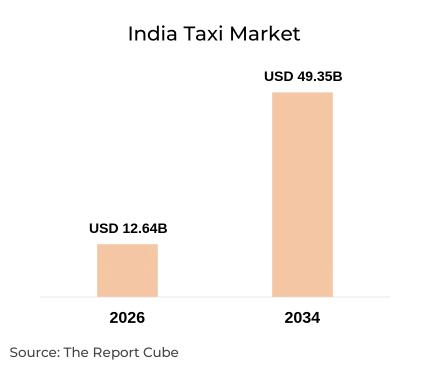
- India Taxi Market valued at USD 12.64 billion in 2026, signaling robust mobility demand.
- Industry projected to reach USD 49.35 billion by 2034, expanding at 18.56% CAGR.
- ICE-powered vehicles dominate propulsion, though electric taxi adoption accelerates rapidly.
- Intra-city point-to-point rides remain the most revenue-generating trip purpose segment.
- North India leads regional revenue contribution driven by Delhi-NCR aggregator density.
- South India is the fastest-growing region owing to Bengaluru's IT-driven ride demand.
- Key players include Ola Cabs, Uber, Rapido, BluSmart, inDrive, and Savaari Car Rentals.
- EV fleet expansion, corporate mobility contracts, and FAME III subsidies accelerate growth.
India Taxi Market Insights & Analysis
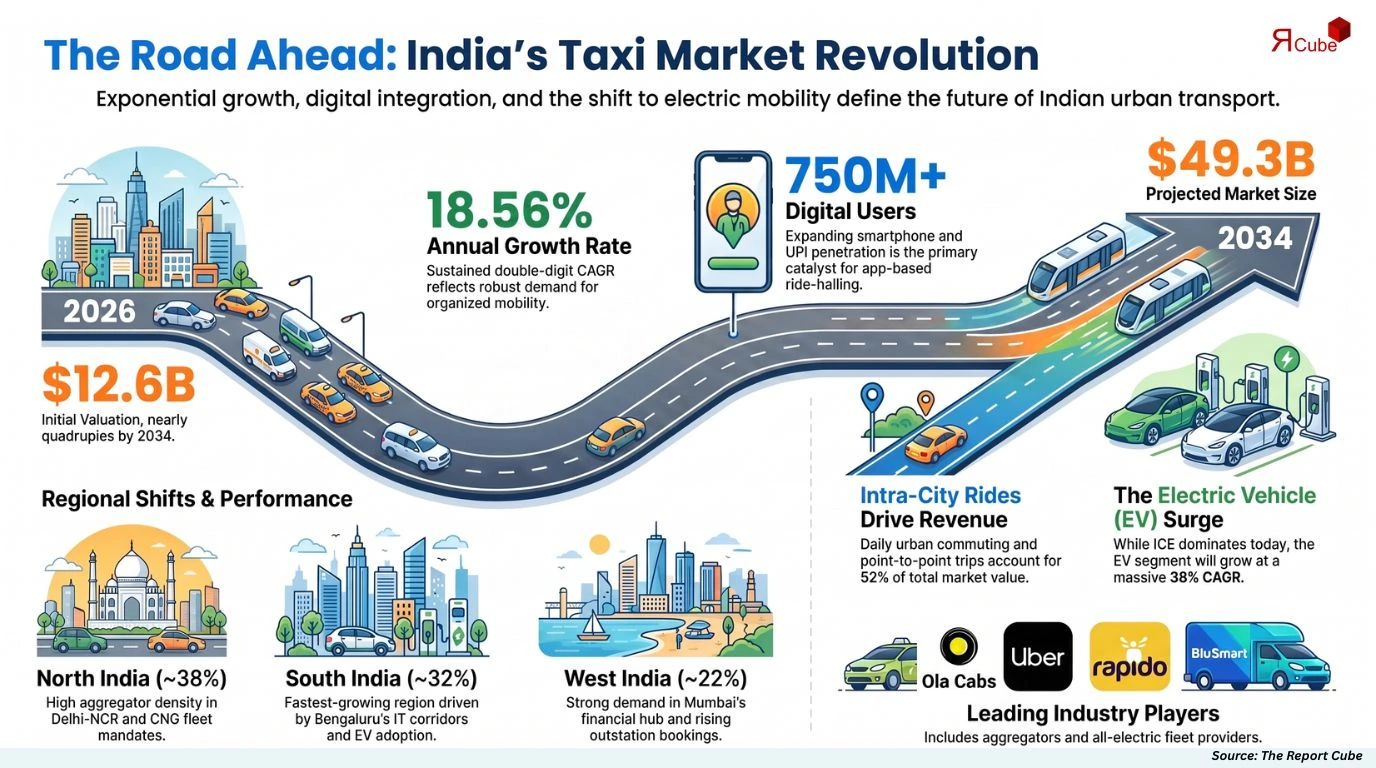
The India Taxi Market is anticipated to register a 18.56% CAGR during 2026–2034. The market size was valued at USD 12.64 billion in 2026 and is projected to reach USD 49.35 billion by 2034. The market is benefiting from accelerating smartphone penetration now exceeding 750 million active users, deepening UPI-led digital payment adoption, and rapid expansion of aggregator platforms into Tier 2 and Tier 3 cities. Government-led urban mobility investments under AMRUT 2.0 and Smart Cities Mission are creating supporting infrastructure for organized ride-hailing ecosystems across India's rapidly urbanizing corridors.
India's formal taxi ecosystem is undergoing a structural shift as corporate mobility outsourcing, airport connectivity demand, and intercity travel modernization reshape the revenue mix beyond traditional urban commuting. BluSmart Mobility's all-electric fleet expansion, supported by FAME II disbursements of over INR 1,500 crore, alongside Ola's fleet electrification commitments and Uber's Green initiative targeting 25,000 EVs by 2025, are collectively positioning the India Taxi Market for long-term sustainable growth. Rising per-capita incomes and shifting preferences toward mobility-as-a-service platforms further underpin forecast momentum.
India Taxi Market Dynamics
The India Taxi Market continues expanding as urbanization, digital infrastructure, and evolving consumer mobility behaviors converge. Aggregator platforms are rapidly scaling into untapped corridors, while regulatory frameworks around EV adoption and driver welfare are reshaping competitive dynamics. Sustained government investments in public transportation interfaces and airport connectivity further reinforce the organized segment's expansion trajectory across both metropolitan and emerging city clusters.
|
Factor |
Type |
Specific Impact on Market |
Magnitude |
|---|---|---|---|
|
Rising smartphone and internet penetration |
Driver |
Accelerates app-based cab-hailing adoption in Tier 2/3 cities |
Very High |
|
Government EV push (FAME III policy) |
Opportunity |
Expands electric taxi fleet deployment and EV subsidies |
High |
|
Shift from vehicle ownership to mobility-as-a-service |
Trend |
Increases ride-hailing frequency across urban demographics |
High |
|
Surge pricing regulation pressure |
Challenge |
Limits revenue optimization during peak demand windows |
Moderate |
|
Corporate mobility outsourcing growth |
Driver |
Boosts demand for aggregator-led employee transportation contracts |
High |
Key Market Driver: Rapid Urbanization Fueling Aggregator Demand
India's urban population is projected to reach 600 million by 2031, with over 50 new cities expected to cross the one-million population threshold by 2030. This demographic expansion is directly translating into demand for app-based ride-hailing services as organized taxi infrastructure remains underdeveloped relative to population density. Aggregator platforms such as Ola, Uber, and Rapido are aggressively onboarding driver-partners in Tier 2 markets including Jaipur, Coimbatore, Surat, and Bhopal, extending organized cab services across emerging Indian cities and capitalizing on rising middle-class mobility spending.
Major Industry Challenge: Driver Attrition and Earnings Volatility
High driver churn rates - estimated between 30% and 40% annually across major aggregator platforms - create persistent fleet availability challenges that suppress service quality and limit geographic expansion reliability. Earnings volatility driven by dynamic commission structures, fuel price fluctuations, and inconsistent incentive frameworks compels drivers to switch between platforms or exit the formal ecosystem. Regulatory interventions from state transport authorities in Karnataka, Maharashtra, and Tamil Nadu mandating minimum fare floors and driver income protections are adding compliance complexity that affects platform economics in densely competitive urban markets.
Emerging Trend Shaping Outlook: Electric Fleet Integration at Scale
The convergence of FAME III policy incentives, declining lithium-ion battery costs now approaching USD 110 per kWh, and corporate sustainability mandates is accelerating electric vehicle integration across India's formal taxi segment. BluSmart's 8,000-strong all-electric fleet in Delhi-NCR and Bengaluru demonstrates operational viability, while Ola Electric's B2B mobility arm is targeting fleet-level EV deployments for corporate and airport runs. Broader electric vehicle adoption in the India taxi ecosystem is expected to reshape propulsion economics, reduce per-kilometer operating costs, and attract ESG-aligned institutional investors into the mobility platform sector.
Need Specific Data, Let’s Customize the Report for You
Request CustomizationIndia Taxi Market Segment-wise Analysis
The India Taxi Market demonstrates distinct revenue concentration across propulsion technologies and trip purpose categories, with organized aggregators capturing an increasingly larger share from previously unstructured segments. Shift in consumer behavior toward digitally booked, metered, and GPS-tracked rides continues reshaping both fleet composition and operator strategy across the forecast period.
By Propulsion Type
- ICE (Petrol/Diesel/CNG)
- Electric
- Hybrid
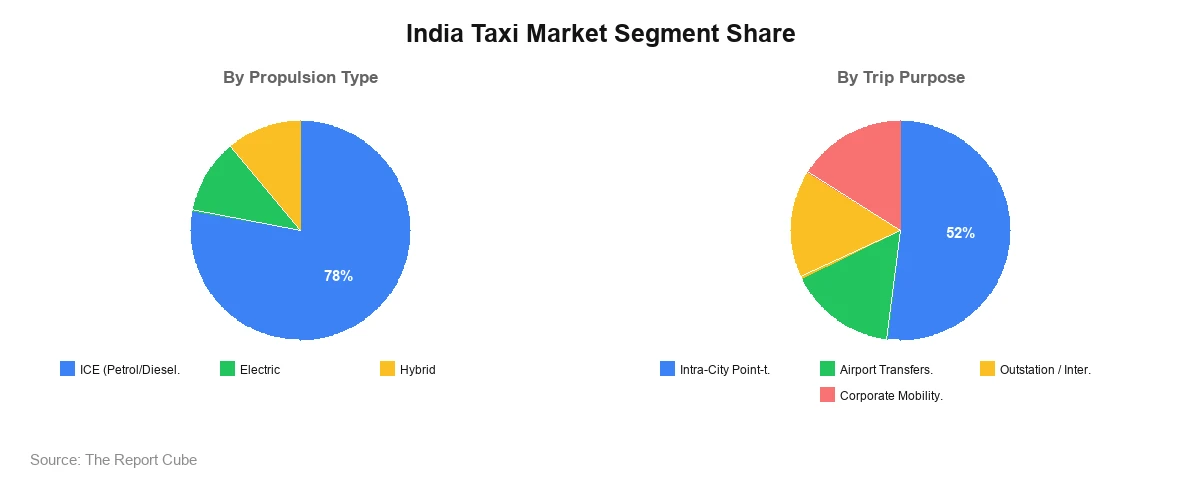
ICE-powered vehicles - spanning petrol, diesel, and CNG variants - dominate the India Taxi Market with an estimated 78% revenue share in 2026, driven by their widespread availability, lower upfront procurement costs, and an existing network of fuel infrastructure across urban and semi-urban corridors. CNG taxis in particular hold strong footing in Delhi-NCR, Mumbai, and Pune where mandated CNG fleet policies under pollution control norms have incentivized large-scale CNG taxi onboarding by aggregators and radio taxi operators alike. Meru Mobility and Carzonrent continue deploying predominantly CNG fleets for corporate and airport runs, reinforcing ICE dominance in revenue-generating premium segments.
The electric propulsion segment, currently estimated at approximately 14% market share, is the fastest-growing sub-segment and is expected to register a CAGR exceeding 38% through 2034 as FAME III subsidies, falling battery prices, and corporate EV mandates take effect. Hybrid vehicles represent the remaining share, finding niche adoption in premium and long-distance intercity applications. The electric taxi fleet expansion across Indian metro corridors is fundamentally altering total cost of ownership calculations for fleet operators, with BluSmart reporting per-kilometer savings of 40% compared to equivalent CNG models in Delhi operations.
By Trip Purpose
- Intra-City Point-to-Point
- Airport Transfers
- Outstation / Inter-city
- Corporate Mobility
Intra-city point-to-point rides account for approximately 52% of total India Taxi Market revenue, reflecting the dominant role of daily urban commuting and discretionary ride-hailing in market economics. The segment's strength is anchored in high-frequency, low-ticket rides aggregated at scale by Ola, Uber, and Rapido across metro and Tier 2 cities. Rapido's auto and bike-taxi expansion has further deepened intra-city penetration in cost-sensitive markets, with the platform reporting over 35 million monthly active users across more than 100 cities as of late 2024. Digital payment integration and ride-sharing pooling options continue supporting intra-city volume growth.
Airport transfers represent the highest revenue-per-ride segment at an estimated 18% share, with premium and pre-booked ride categories growing rapidly alongside airport passenger traffic, which crossed 370 million domestic passengers in FY2024. Outstation and intercity rides account for approximately 17% of market revenue and are expanding on the back of intercity cab services and highway mobility growth, supported by platforms like Savaari, inDrive, and Ola Outstation. Corporate mobility, contributing roughly 13%, is gaining share as enterprises increasingly outsource employee transportation to managed fleet operators, creating stable recurring revenue streams for organized cab aggregators.
Regional Projection of India Taxi Market
The India Taxi Market exhibits pronounced regional variation shaped by urban density, IT and commercial activity corridors, airport traffic volumes, regulatory environments, and the depth of aggregator platform penetration. North India leads total revenue contribution while South India is emerging as the fastest-growing region backed by Bengaluru's technology sector and expanding EV infrastructure.
|
Region |
Estimated Market Share |
Key Growth Factors |
Consumer Trends |
|---|---|---|---|
|
North India |
~38% |
Metro expansion in Delhi-NCR, Lucknow, Chandigarh; CNG fleet mandates |
High adoption of app-based rides and corporate mobility |
|
South India |
~32% |
Bengaluru-Chennai IT corridor demand; airport taxi infrastructure upgrades |
Strong EV taxi adoption and tech-savvy user base |
|
West India |
~22% |
Mumbai financial hub demand, Pune-Ahmedabad corridor growth |
Rising outstation trip bookings and premium cab segment |
|
East India |
~8% |
Kolkata smart city projects and expanding aggregator presence |
Increasing Tier 2 city onboarding by ride-hailing platforms |
- North India: North India commands approximately 38% of the India Taxi Market driven by the Delhi-NCR megapolis, which alone accounts for over 1.2 million organized cab rides daily across Ola, Uber, and BluSmart platforms. Lucknow, Jaipur, and Chandigarh are emerging as secondary growth corridors.
- South India: South India holds approximately 32% market share with Bengaluru representing the single largest city market due to IT corridor commuter demand, high app literacy, and strong EV taxi adoption led by BluSmart's Bengaluru operations and Namma Yatri's community-owned driver platform.
- West India: West India accounts for approximately 22% of revenue, underpinned by Mumbai's dense taxi ecosystem transitioning from Kaali-Peeli cabs toward app-based services, and Pune's rapid aggregator expansion serving its growing IT and manufacturing workforce population.
- East India: East India contributes approximately 8% of total market revenue with Kolkata as the primary hub. Smart city investments and aggregator expansion into Bhubaneswar, Guwahati, and Patna are creating incremental growth opportunities for organized taxi operators.
India Taxi Market: Recent Development (2025)
- Ola Cabs launched its AI-powered driver safety platform across 50 major Indian cities in 2025.
- BluSmart Mobility expanded its all-electric fleet to Hyderabad market, adding 2,000 new EVs.
- Uber India partnered with NITI Aayog to deploy 10,000 CNG-converted taxis in Tier 2 cities.
- inDrive introduced transparent peer-negotiated fare model across 30 new Indian cities in 2025.
India Taxi Market Future Outlook (2034)
The India Taxi Market is projected to expand at a 18.56% CAGR, reaching approximately USD 49.35 billion by 2034. This growth trajectory will be driven by the convergence of electric fleet maturation, AI-powered ride optimization, deeper aggregator penetration into India's 400-plus Tier 2 and Tier 3 cities, and the institutionalization of corporate mobility outsourcing. Autonomous vehicle pilots by leading technology firms and India's National Electric Mobility Mission targets will create new investment layers within the organized taxi ecosystem, attracting domestic and global capital into mobility platforms and fleet operators.
AI-driven dynamic pricing, predictive fleet deployment, and personalized rider experience platforms will become standard competitive capabilities among aggregators by 2030. The long-term market expansion will also be shaped by sustainable urban mobility investments across Indian smart cities, ONDC-led open network taxi commerce, and government-backed multimodal mobility integration connecting taxis with metro, bus, and last-mile transport services. Operators who establish EV fleet dominance, driver retention programs, and platform loyalty ecosystems in the 2026–2030 window will secure decisive long-term market positions through the forecast horizon.
India Taxi Market Report Coverage
|
Report Attribute |
Details |
|---|---|
|
Market Name |
India Taxi Market |
|
Market Size (2026) |
USD 12.64 Billion |
|
Market Size (2034) |
USD 49.35 Billion |
|
Forecast Period |
2026–2034 |
|
CAGR |
18.56% |
|
Base Year |
2026 |
|
Historical Years |
2021–2025 |
|
Forecast Years |
2026–2034 |
|
Segments Covered |
By Booking Type, By Service Type, By Vehicle Type, By Vehicle Type, By Trip Purpose, By Customer Segment |
|
Regions Covered |
North India, South India, West India, East India |
|
Key Companies |
ANI Technologies Pvt Ltd (Ola Cabs), Uber Technologies Inc., Rapido, Meru Mobility Tech Pvt Ltd, BluSmart Mobility Pvt Ltd, Carzonrent India Pvt Ltd, NTL FastTrack Taxi, Savaari Car Rentals, inDrive, Others |
|
Report Format |
PDF, Excel, PPT |
|
Customization |
Available as per client requirements |
Why Choose This Report?
- Comprehensive analysis covering propulsion, trip purpose, and regional market segmentation.
- Accurate market sizing with reliable 18.56% CAGR forecast through 2034.
- Detailed segmentation highlighting dominant and fastest-growing revenue opportunities.
- Regional insights covering North, South, West, and East India growth dynamics.
- Competitive profiling of Ola, Uber, BluSmart, Rapido, inDrive, and Savaari platforms.
- Analysis of EV fleet trends, FAME III impact, and corporate mobility outsourcing growth.
- 2025 recent development tracking across key aggregators and fleet operators.
- Data-driven research supporting investment, partnership, and market-entry decisions.
Table of Contents
- Introduction
- Objective of the Study
- Product Definition
- Market Segmentation
- Study Variables
- Research Methodology
- Secondary Data Points
- Companies Interviewed
- Primary Data Points
- Breakdown of Primary Interviews
- Secondary Data Points
- Executive Summary
- Market Dynamics
- Drivers
- Challenges
- Opportunity Assessment
- Recent Trends and Developments
- Policy and Regulatory Landscape
- India Taxi Market Overview and Forecast Analysis (2021-2034)
- Market Size, By Value, By Growth Rate (CAGR/USD Billions)
- Demand – Supply Trends
- Market Share, By Booking Type
- Online Booking
- Offline Booking
- Market Share, By Service Type
- Ride-Hailing
- Ride-Sharing / Car-Pooling
- Subscription & Corporate Leasing
- Market Share, By Vehicle Type
- Passenger Cars
- Two-Wheelers
- Three-Wheeler Auto-Rickshaws
- Vans & MPVs
- Market Share, By Propulsion Type
- ICE (Petrol/Diesel/CNG)
- Electric
- Hybrid
- Market Share, By Trip Purpose
- Intra-City Point-to-Point
- Airport Transfers
- Outstation / Inter-city
- Corporate Mobility
- Market Share, By Customer Segment
- Individual Consumers
- Corporate / Institutional
- Market Share, By Region
- North India
- South India
- West India
- Market Share, By Competitors
- Competition Characteristics
- Revenue Shares
- Online Booking India Taxi Market Overview, 2021-2034F
- By Value (USD Million)
- By Service Type – Market Size & Forecast 2021-2034, USD Million
- Ride-Hailing
- Ride-Sharing / Car-Pooling
- Subscription & Corporate Leasing
- Offline Booking India Taxi Market Overview, 2021-2034F
- By Value (USD Million)
- By Service Type – Market Size & Forecast 2021-2034, USD Million
- Ride-Hailing
- Ride-Sharing / Car-Pooling
- Subscription & Corporate Leasing
- Competitive Outlook (Company Profile – Partial List)
- ANI Technologies Pvt Ltd (Ola Cabs)
- Company Overview
- Business Segments
- Strategic Alliances/Partnerships
- Recent Developments
- Uber Technologies Inc.
- Company Overview
- Business Segments
- Strategic Alliances/Partnerships
- Recent Developments
- Rapido
- Company Overview
- Business Segments
- Strategic Alliances/Partnerships
- Recent Developments
- Meru Mobility Tech Pvt Ltd
- Company Overview
- Business Segments
- Strategic Alliances/Partnerships
- Recent Developments
- BluSmart Mobility Pvt Ltd
- Company Overview
- Business Segments
- Strategic Alliances/Partnerships
- Recent Developments
- Carzonrent India Pvt Ltd
- Company Overview
- Business Segments
- Strategic Alliances/Partnerships
- Recent Developments
- NTL FastTrack Taxi
- Company Overview
- Business Segments
- Strategic Alliances/Partnerships
- Recent Developments
- Savaari Car Rentals
- Company Overview
- Business Segments
- Strategic Alliances/Partnerships
- Recent Developments
- inDrive
- Company Overview
- Business Segments
- Strategic Alliances/Partnerships
- Recent Developments
- Others
- ANI Technologies Pvt Ltd (Ola Cabs)
- Contact Us & Disclaimer
Top Key Players & Market Share Outlook
- ANI Technologies Pvt Ltd (Ola Cabs)
- Uber Technologies Inc.
- Rapido
- Meru Mobility Tech Pvt Ltd
- BluSmart Mobility Pvt Ltd
- Carzonrent India Pvt Ltd
- NTL FastTrack Taxi
- Savaari Car Rentals
- inDrive
- Others
Frequently Asked Questions






