




Build Your Custom Market Intelligence Report
Customize Your ReportCanada Tire Market Key Highlights
By Type of Vehicle:
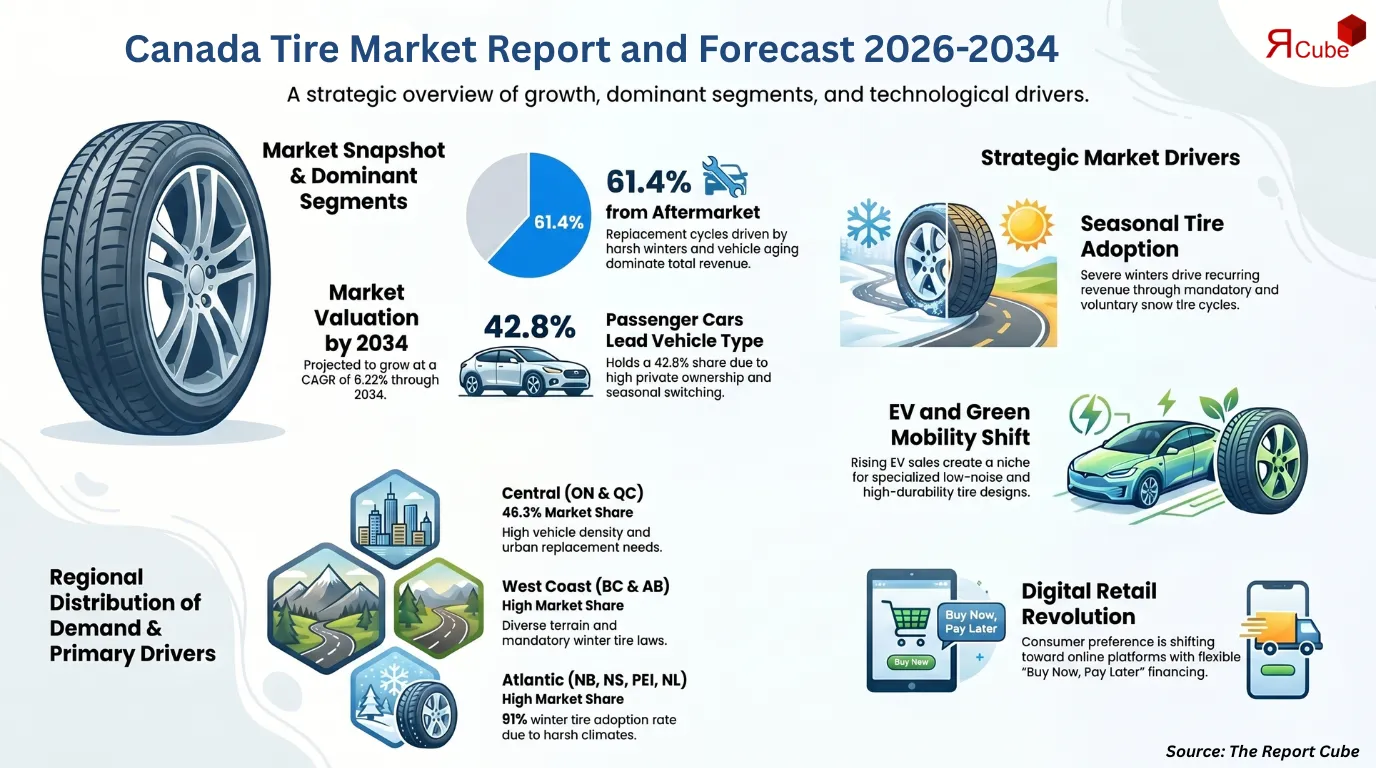
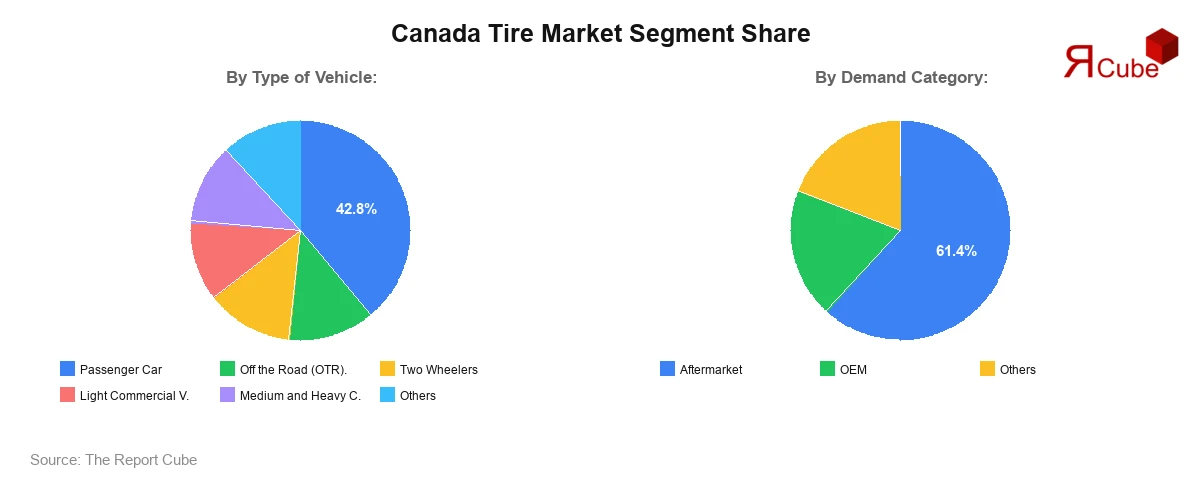
Passenger Car segment leads the market with nearly 42.8% share.
By Demand Category:
Aftermarket segment dominates the market with around 61.4% of revenue.
Regional Outlook:
Central Canada region dominates the Canada Tire market with approximately 46.3% share.
Canada Tire Market Insights & Analysis
The Canada Tire Market is anticipated to register a CAGR of around 6.22% during the forecast period 2026-2034. The market size is valued at USD 7.25 billion in 2026 and is projected to reach USD 11.75 billion by 2034. The tire market in Canada is benefiting from rising vehicle ownership, increasing average vehicle age, and strong seasonal tire replacement demand across provinces with prolonged winter conditions. Passenger vehicles continue to generate substantial tire consumption, while pickup trucks and SUVs are creating higher demand for durable all-terrain and winter-compatible radial tires. Growing electric vehicle adoption across Ontario, Quebec, and British Columbia is also encouraging tire manufacturers to develop low-noise and energy-efficient tire solutions designed specifically for EV performance requirements.
Canada’s automotive aftermarket ecosystem is evolving rapidly as consumers increasingly prefer digital tire purchasing platforms supported by flexible financing options and fast nationwide delivery. Tire manufacturers and distributors are strengthening regional supply chains and warehouse networks to improve inventory availability during peak winter seasons. In addition, transportation companies and commercial fleet operators are investing in premium tire solutions that improve fuel efficiency, road safety, and operational durability. Rising infrastructure activity, expanding freight movement, and long-distance logistics operations are further supporting demand for commercial vehicle tires throughout Canada. The market is also witnessing increased investments in sustainable tire technologies, recycled raw materials, and advanced tread compounds to align with changing environmental and mobility standards.
Canada Tire Market Impact Analysis
| Factor | Type | Specific Impact on Market | Magnitude | Business Implication |
|---|---|---|---|---|
| Growth in Vehicle Parc & Sales | Market | Expanding light and commercial vehicle base lifts tire demand | High | Supports steady OEM supply and large replacement volumes |
| Severe Winters & Seasonal Tire Use | Environmental | Mandatory and voluntary winter tire adoption boosts purchases | High | Drives recurring winter tire cycles and premium snow lines |
| Logistics and E commerce Expansion | Market | Rising freight movement increases wear on truck and bus tires | High | Creates strong multi axle replacement and fleet service demand |
| Shift Toward EV and Green Mobility | Regulatory | Emission targets accelerate EV sales needing low rolling tires | Medium | Opens niche for EV specific, durable and quiet tire designs |
| Advances in Smart and Fuel Saving Tires | Technological | Innovations improve safety, life and fuel economy for users | Medium | Allows premium pricing and upsell of technology rich products |
| Volatile Rubber and Crude Oil Prices | Environmental | Input cost swings pressure margins and retail price levels | Medium | Requires hedging, cost control and mix shift to value lines |
| Environmental Rules on Waste and Emissions | Regulatory | Rules on disposal and emissions raise compliance spending | Medium | Encourages investment in recycling and sustainable materials |
Canada Tire Market Dynamics
Key Driver: Expanding Seasonal Tire Adoption Across Canadian Provinces
Seasonal weather conditions remain one of the strongest growth drivers for the Canada tire market share. Provinces such as Quebec, Ontario, Alberta, and Manitoba experience extended snow and icy road conditions, increasing the need for winter tire replacement and seasonal tire switching. Canadian consumers are prioritizing vehicle safety, traction performance, and road stability, particularly during heavy snowfall periods. This trend continues to strengthen demand for winter tires, all-season tires, and premium radial tire products across passenger and commercial vehicle categories.
Insurance incentives and regional safety recommendations have also contributed to higher winter tire penetration rates in Canada. At the same time, rising ownership of SUVs, crossover vehicles, and pickup trucks is increasing demand for all-terrain and heavy-duty tire solutions capable of handling both urban and off-road driving conditions. Commercial transportation companies are further supporting market expansion by adopting high-durability tires that improve mileage efficiency and reduce long-term fleet operating costs.
Industry Trends: Growing Preference for EV-Compatible and All-Terrain Tires
The tire market in Canada is witnessing a clear shift toward specialized tire technologies designed for electric vehicles and larger utility vehicles. EV-compatible tires are gaining strong traction due to increasing electric passenger car adoption across metropolitan regions. Tire manufacturers are focusing on lower rolling resistance, reduced cabin noise, and improved tread durability to support EV battery efficiency and heavier vehicle loads. Premium tire brands are also investing in advanced silica compounds and intelligent tread designs to improve wet-weather and winter-road performance.
Alongside EV tire innovation, the popularity of all-terrain tires continues to rise among SUV and light truck owners across Canada. Consumers increasingly seek versatile tires capable of supporting highway driving, rough terrain mobility, and winter conditions within a single product category. This trend has encouraged major tire manufacturers to expand all-terrain tire portfolios featuring enhanced traction, durability, and fuel-efficient performance characteristics.
Book your FREE 30-minute expert consultation today
Contact UsMajor Challenge: Increasing Tire Manufacturing and Import Costs
Rising raw material costs continue to create pricing pressure within the Canada tire industry. Tire production heavily depends on natural rubber, synthetic rubber, carbon black, steel, and petroleum-based materials, all of which have experienced cost fluctuations over recent years. Canadian tire distributors and retailers are also managing higher logistics and warehousing expenses due to transportation inflation and supply chain disruptions affecting global trade routes.
Import dependency for several premium and commercial tire categories further exposes the market to currency exchange volatility and shipping delays. These factors have increased retail tire prices across both OEM and aftermarket sales channels. Budget-conscious consumers are increasingly comparing lower-cost alternatives, creating margin pressure for premium tire manufacturers. Seasonal inventory management also remains challenging because demand can change rapidly depending on weather intensity and regional driving conditions throughout Canada.
Opportunity: Expansion of Digital Tire Retail Platforms and Flexible Financing
Online tire retailing is creating significant growth opportunities for companies operating in the Canada tire market. Consumers increasingly prefer digital purchasing platforms that provide transparent pricing, broad product availability, installation partnerships, and home delivery convenience. Financing solutions such as Buy Now, Pay Later programs are improving affordability for consumers replacing winter tires, all-season tires, and premium tire sets during high-expense seasonal periods.
The growing adoption of electric vehicles and connected mobility solutions is also opening opportunities for advanced tire technologies. Tire manufacturers are investing in EV-specific tires with longer lifespan, lower noise generation, and improved energy efficiency to support changing mobility requirements. In addition, rural and underserved Canadian regions present untapped expansion potential for online tire distributors seeking broader market penetration through bilingual customer support and integrated logistics networks.
Canada Tire Market Segment-wise Analysis
By Type of Vehicle:
- Passenger Car
- Off the Road (OTR)
- Two Wheelers
- Light Commercial Vehicle
- Medium and Heavy Commercial Vehicles
- Others
The Passenger Car segment continues to dominate the Canada tire market with nearly 42.8% share due to the country’s large base of privately owned vehicles and high seasonal tire replacement frequency. Passenger cars across Canada commonly require separate winter and summer tire sets because of fluctuating climate conditions, particularly in snow-prone provinces. This replacement pattern significantly supports aftermarket tire demand throughout the year. Growth in crossover utility vehicles and compact SUVs is also strengthening demand for larger radial tires with improved traction and road handling capabilities.
Electric passenger vehicles are adding another layer of demand for specialized tires designed to manage instant torque, battery weight, and reduced rolling resistance. Tire manufacturers are increasingly introducing products focused on lower road noise and longer tread life to address EV performance requirements. Premium passenger tire demand remains strong in urban centers where consumers prioritize safety, ride comfort, and fuel efficiency.
By Demand Category:
- Aftermarket
- OEM
- Others
The Aftermarket segment accounts for the largest revenue contribution within the tire market in Canada, representing approximately 61.4% of total market share. Continuous tire replacement cycles, harsh winter weather, and growing road travel activity are major contributors supporting aftermarket expansion. Consumers frequently replace tires due to tread wear, seasonal changes, and long-distance commuting requirements, especially in metropolitan and suburban regions.
Digital retail channels are transforming the Canadian aftermarket tire industry by improving product accessibility and pricing transparency. Independent garages, automotive retailers, and e-commerce platforms are increasingly offering bundled services that include tire installation, balancing, storage, and financing. Commercial fleet operators also contribute heavily to aftermarket tire sales as transportation companies focus on minimizing downtime and improving fleet safety through regular tire replacement schedules.
Regional Projection of Canada Tire Industry
- Central
- West Coast
- Atlantic
- North
- Others
Central Canada remains the leading regional market, accounting for nearly 46.3% of the Canada tire market share. Ontario and Quebec generate substantial tire demand due to dense population concentration, high passenger vehicle ownership, and strong commercial transportation activity. Seasonal tire replacement demand remains particularly high in these provinces because of prolonged winter conditions and changing road temperatures throughout the year.
Major urban centers including Toronto, Montreal, Ottawa, and Hamilton support strong aftermarket tire sales through extensive dealership networks, service centers, and automotive retail chains. The region also benefits from rising electric vehicle registrations and expanding logistics infrastructure linked to e-commerce growth. Commercial freight movement between manufacturing hubs and urban distribution corridors further strengthens demand for medium and heavy commercial vehicle tires. Increasing investments in sustainable transportation infrastructure and EV charging networks are expected to support future demand for premium and energy-efficient tire technologies across Central Canada.
Need insights for a specific region within this market?
Request Regional DataCanada Tire Market Regional Analysis
The Canada tire market varies significantly across regions due to diverse climatic conditions, urban concentration, and economic activity.
| Region | Demand Level | Key Areas | System Dominance | Core Demand Logic | Growth Nature |
|---|---|---|---|---|---|
| Central (Ontario & Quebec) | Extremely High | Toronto, Montreal, Ottawa | All-season & Winter tires | 48% market share, high vehicle density | Urban replacement-driven |
| West Coast (BC & Alberta) | Very High | Vancouver, Calgary, Edmonton | Winter & All-terrain tires | Diverse terrain & mandatory winter laws | Oil & construction growth |
| Atlantic (NB, NS, PEI, NL) | High | Halifax, St. John's, Moncton | Winter & Studded tires | 91% winter tire adoption, harsh winters | Seasonal replacement |
| North (Yukon, NWT, Nunavut) | Medium | Yellowknife, Whitehorse, Iqaluit | Heavy-duty & OTR tires | Extreme weather & mining activities | Resource sector expansion |
| Others (MB & SK) | High | Winnipeg, Regina, Saskatoon | Winter & Agricultural tires | 60% winter adoption & farming demand | Agriculture-driven growth |
Government Initiatives & Policies
- Transport Canada Zero-Emission Vehicle Infrastructure Program (2025): The Canadian government expanded investments supporting EV charging infrastructure development nationwide, indirectly increasing demand for EV-compatible tire technologies and sustainable automotive components.
- Environment and Climate Change Canada Clean Transportation Initiative (2026): Canada strengthened policies promoting fuel-efficient transportation systems and low-emission mobility solutions, encouraging adoption of advanced radial tires and energy-efficient automotive technologies.
Canada Tire Industry Recent Developments
- 2025: TireSet.ca launched a nationwide online tire retail platform across Canada with Buy Now, Pay Later financing, bilingual customer support, and free nationwide shipping. The expansion reflects rising demand for digital tire retailing, flexible financing services, and direct-to-consumer aftermarket tire distribution models.
- 2025: Goodyear Tire & Rubber Company introduced Wrangler Outbound AT, Wrangler Workhorse AT 2, and Wrangler ElectricDrive AT tires targeting SUVs, work vans, light trucks, and EVs. The launch strengthens competition within the premium all-terrain and EV-compatible tire category across Canada.
Why Choose This Report?
- Provides a comprehensive overview of the overall market analysis, encompassing key trends, consumer behavior analysis, and risk assessment to support strategic decision-making.
- Provides accurate, up-to-date insights into market size, segmentation, and emerging opportunities, helping to minimize risk & capitalizing on growth.
- Gives deep understanding of target audience preferences, investment habits, and communication channels for enhanced product development & marketing effectiveness.
- Delivers competitive analysis & benchmarking, uncovering the strengths & weaknesses of market competitors to guide strategies.
- Consolidate comprehensive market intelligence, reducing reasoning & streamlining research efforts.
- Facilitates customized market segmentation & risk mitigation strategies, fine-tuned to the business objectives.
- Aids in identifying both market challenges & untapped opportunities within the industry to drive long-term business growth.
- Provides valuable information based on actual customer data & search trends.
Table of Contents
- Introduction
- Objective of the Study
- Product and Category Definition
- Market Segmentation
- Study Variables
- Research Methodology
- Secondary Data Points
- Breakdown of Secondary Sources
- Primary Data Points
- Breakdown of Primary Interviews
- Secondary Data Points
- Executive Summary
- Market Dynamics
- Emerging Opportunities
- Adoption Trends
- Demand Drivers
- Disruption Analysis (Challenges)
- Industry Analysis & Strategic Insights
- Supply/Value Chain Analysis
- Pricing Analysis
- Go-To-Market (GTM) Strategy
- BCG Matrix
- Recent Trends and Developments
- Import and Export Analysis
- Regulatory and Policy Landscape
- Region-wise policies
- Government Initiatives
- Canada Tire Market Overview and Forecast Analysis (2021-2034)
- Market Size, By Value, By Growth Rate (CAGR/USD Billion)
- Market Share, By Type of Vehicle
- Passenger Car
- Off the Road (OTR)
- Two Wheelers
- Light Commercial Vehicle
- Medium and Heavy Commercial Vehicles
- Others
- Market Share, By Demand Category
- Aftermarket
- OEM
- Others
- Market Share, By Type of Tire
- Bias
- Radial
- Others
- Market Share, By Sales Channel
- Online
- Direct Sales
- Exclusive Outlets & Multi-brand Stores
- Others
- Market Share, By Season
- Winter
- Summer
- All Season
- Others
- Market Share, By Price Category
- Premium
- Budget
- Economy
- Others
- Market Share, By Tire Size
- Tire Size 1
- Tire Size 2
- Tire Size 3
- Tire Size 4
- Tire Size 5
- Market Share, By Region
- Central
- West Coast
- Atlantic
- North
- Others
- Market Share, By Company
- Revenue Shares & Analysis
- Competitive Landscape
- Central Canada Tire Market Overview and Forecast Analysis (2021-2034)
- Market Size, By Value, By Growth Rate (CAGR/USD Billion/Million)
- Market Share, By Type of Vehicle
- Market Share, By Demand Category
- Market Share, By Type of Tire
- Market Share, By Sales Channel
- Market Share, By Season
- Market Share, By Price Category
- Market Share, By Tire Size
- West Coast Canada Tire Market Overview and Forecast Analysis (2021-2034)
- Market Size, By Value, By Growth Rate (CAGR/USD Billion/Million)
- Market Share, By Type of Vehicle
- Market Share, By Demand Category
- Market Share, By Type of Tire
- Market Share, By Sales Channel
- Market Share, By Season
- Market Share, By Price Category
- Market Share, By Tire Size
- Atlantic Canada Tire Market Overview and Forecast Analysis (2021-2034)
- Market Size, By Value, By Growth Rate (CAGR/USD Billion/Million)
- Market Share, By Type of Vehicle
- Market Share, By Demand Category
- Market Share, By Type of Tire
- Market Share, By Sales Channel
- Market Share, By Season
- Market Share, By Price Category
- Market Share, By Tire Size
- North Canada Tire Market Overview and Forecast Analysis (2021-2034)
- Market Size, By Value, By Growth Rate (CAGR/USD Billion/Million)
- Market Share, By Type of Vehicle
- Market Share, By Demand Category
- Market Share, By Type of Tire
- Market Share, By Sales Channel
- Market Share, By Season
- Market Share, By Price Category
- Market Share, By Tire Size
- Others Canada Tire Market Overview and Forecast Analysis (2021-2034)
- Market Size, By Value, By Growth Rate (CAGR/USD Billion/Million)
- Market Share, By Type of Vehicle
- Market Share, By Demand Category
- Market Share, By Type of Tire
- Market Share, By Sales Channel
- Market Share, By Season
- Market Share, By Price Category
- Market Share, By Tire Size
- Competitive Analysis, 2026
- Market Share of Key Players
- Competitive Mapping for Each Segment and Companies Operating Regionally
- Central Canada Tire Companies Share & Competitive Analysis, 2026
- West Coast Canada Tire Companies Share & Competitive Analysis, 2026
- Atlantic Canada Tire Companies Share & Competitive Analysis, 2026
- North Canada Tire Companies Share & Competitive Analysis, 2026
- Company Profile (Partial List)
- Goodyear Tire & Rubber Company
- Company Overview
- Product Portfolio
- Strategic Alliances/Partnerships
- Recent Developments
- Apollo Tires
- Company Overview
- Product Portfolio
- Strategic Alliances/Partnerships
- Recent Developments
- Pirelli & C. S.p.A.
- Company Overview
- Product Portfolio
- Strategic Alliances/Partnerships
- Recent Developments
- Yokohama Rubber Company Limited
- Company Overview
- Product Portfolio
- Strategic Alliances/Partnerships
- Recent Developments
- Michelin Group
- Company Overview
- Product Portfolio
- Strategic Alliances/Partnerships
- Recent Developments
- Toyo Tire and Rubber Company
- Company Overview
- Product Portfolio
- Strategic Alliances/Partnerships
- Recent Developments
- Bridgestone Corporation
- Company Overview
- Product Portfolio
- Strategic Alliances/Partnerships
- Recent Developments
- Hankook Tire Co., Ltd.
- Company Overview
- Product Portfolio
- Strategic Alliances/Partnerships
- Recent Developments
- Continental AG
- Company Overview
- Product Portfolio
- Strategic Alliances/Partnerships
- Recent Developments
- Sumitomo Rubber Industries Limited
- Company Overview
- Product Portfolio
- Strategic Alliances/Partnerships
- Recent Developments
- Others (Partial List)
- Goodyear Tire & Rubber Company
- Contact Us and Disclaimer
Top Key Players & Market Share Outlook
- Goodyear Tire & Rubber Company
- Apollo Tires
- Pirelli & C. S.p.A.
- Yokohama Rubber Company Limited
- Michelin Group
- Toyo Tire and Rubber Company
- Bridgestone Corporation
- Hankook Tire Co., Ltd.
- Continental AG
- Sumitomo Rubber Industries Limited
- Others
Frequently Asked Questions






