



Build Your Custom Market Intelligence Report
Customize Your ReportIndia Traditional Medicine Market Statistics and Insights
Market Insight
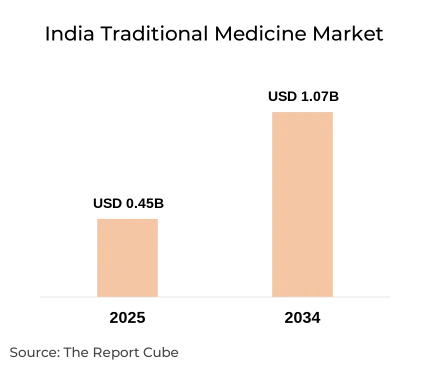
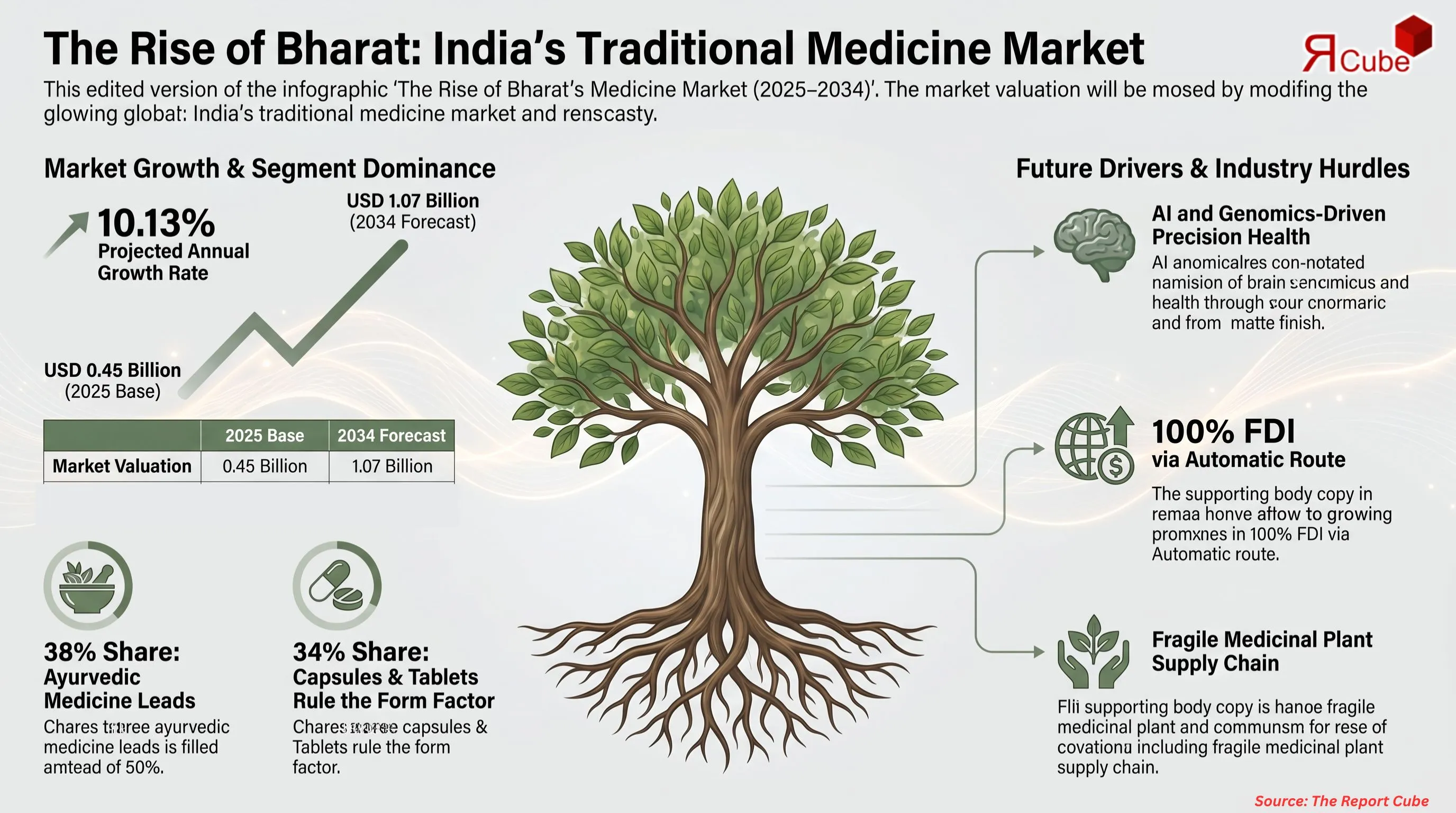
- India Traditional Medicine Market size valued at USD 0.45 billion in 2025.
- India Traditional Medicine Market projected to reach USD 1.07 billion by 2034.
- India Traditional Medicine Market anticipated to register a robust 10.13% CAGR.
By Product
- Ayurvedic Medicine dominates the segment, accounting for approximately 38% share.
Competitive Landscape
- More than 10 companies are actively engaged in producing India Traditional Medicine Market products.
- Top 5 companies acquired around 45% of the market share.
- Patanjali Ayurved Limited, Himalaya Global Holdings Ltd., Dabur Ltd, Baidyanath Group, Arogya Ayurveda Kendra, and others.
By Form
- Capsules and Tablets lead this segment, holding approximately 34% of total revenue share.
India Traditional Medicine Market Insights & Analysis
The India Traditional Medicine Market is anticipated to register a 10.13% CAGR during 2026–2034. The market size was valued at USD 0.45 billion in 2025 and is projected to reach USD 1.07 billion by 2034. India's traditional medicine sector is undergoing a structural transformation, driven by coordinated government investment and growing domestic and international recognition. The Union Budget for FY26 allocated Rs 3,992.9 crore to the Ministry of Ayush, a 14.2% year-on-year increase, reflecting the government's intent to institutionalize traditional medicine within India's broader healthcare economy.
In May 2025, the Ministry of Ayush and the World Health Organization signed a Memorandum of Understanding to embed a Traditional Medicine module within the International Classification of Health Interventions, formally recognizing Ayurveda, Yoga, Siddha, and Unani in global clinical documentation. Concurrently, the launch of the Ayush Nivesh Saarthi portal, developed in partnership with Invest India, established a single-window investment platform allowing 100% FDI through the automatic route, further signaling India's ambition to attract global capital into this sector. Exports of Ayush and herbal products reached Rs 5,907 crore in FY25, a 5.86% rise over FY24, with export volumes expanding by over 21%, underscoring deepening global demand.
India Traditional Medicine Market Dynamics
Key Market Driver Post-Pandemic Preventive Healthcare Demand Surge
The COVID-19 pandemic fundamentally realigned Indian consumer healthcare preferences toward immunity-building and preventive wellness, a shift that has proven durable well beyond the immediate crisis period. A 2022–2023 National Sample Survey Office (NSSO) study recorded Ayush system awareness at 94–96% nationally, with usage exceeding 50% across both urban (52.9%) and rural (46.3%) populations.
This widespread adoption reflects a structural preference for traditional formulations such as Chyawanprash, Ashwagandha-based supplements, and Tulsi-based extracts. Manufacturers have responded by expanding their SKU portfolios in nutraceutical and immunity segments, which now command premium price points. This demand-supply alignment is a primary revenue accelerant for market participants through 2034.
Major Industry Challenge Medicinal Plant Supply Chain Fragmentation
India's traditional medicine industry depends on a network of over 8,000 medicinal plant species, yet the cultivation and collection ecosystem remains highly fragmented, dominated by small-scale tribal and rural collectors who lack post-harvest infrastructure. This structural fragility creates batch-to-batch variability in raw material quality, directly undermining manufacturers' ability to meet Good Manufacturing Practice (GMP) compliance requirements set by the Ministry of Ayush.
Irregular monsoon patterns have further compressed yields of key botanicals such as Ashwagandha, Shatavari, and Giloy in major cultivation belts across Rajasthan and Madhya Pradesh. Companies must invest disproportionately in backward integration and contract farming arrangements to ensure consistent sourcing, which compresses margins and creates barriers for mid-tier manufacturers seeking to scale production.
Emerging Trend Shaping Outlook Genomics and AI-Driven Prakriti Diagnostics
India's traditional medicine sector is increasingly converging with genomic science and artificial intelligence to create precision-health applications rooted in Ayurvedic theory. The WHO's 2025 technical brief on AI in Traditional Medicine recognized India as a global benchmark, specifically citing the Ayurgenomics platform, Ayush Grid, and SAHI diagnostic tools. The 'Desh Ka Prakriti Parikshan Abhiyaan' campaign logged 1.29 crore Prakriti assessments, enabling personalized formulation recommendations based on individual constitutional profiles.
This data-driven personalization model is being adopted by major players including Himalaya and Dabur to develop targeted product lines. By 2034, genomics-enabled product development is expected to shift the traditional medicine market from mass-market generics toward high-value, evidence-based therapeutic products commanding significantly higher per-unit realizations.
Need Specific Data, Let’s Customize the Report for You
Request CustomizationIndia Traditional Medicine Market Segment-wise Analysis
India's traditional medicine landscape is characterized by a rich diversity of product forms and delivery mechanisms, reflecting centuries of practice alongside rapid contemporary innovation. Two dimensions, product type and dosage form, offer the most analytically significant segmentation lens for understanding where revenue pools are deepest and where growth trajectories are steepest through 2034.
By Product
- Herbal Medicine
- Ayurvedic Medicine
- Unani Medicine
- Alternative Medicine
- Homeopathy Medicine
- Others
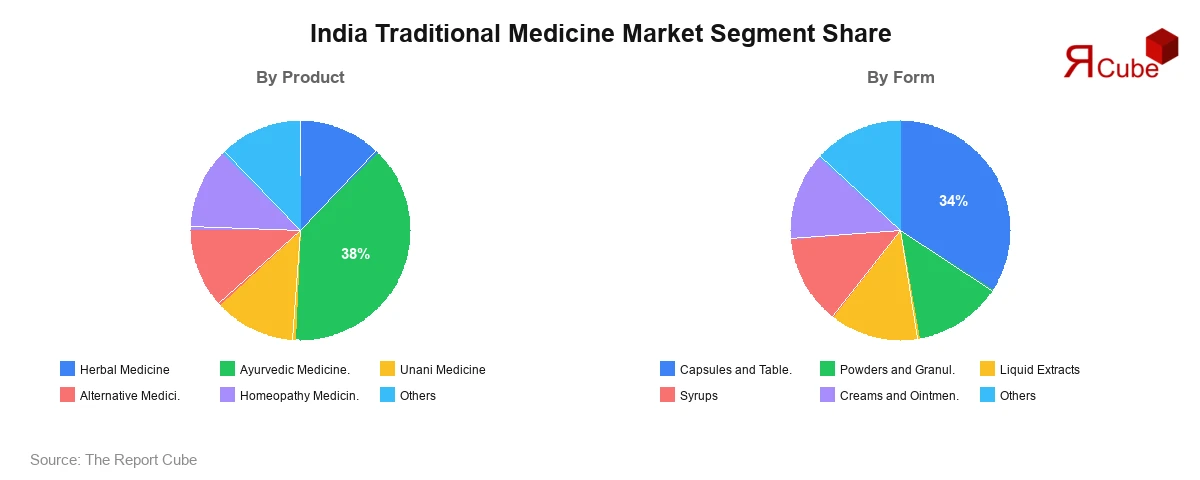
Ayurvedic Medicine commands the largest share at approximately 38% of total product-segment revenue, anchored by deep consumer familiarity, a robust regulatory framework under the Ministry of Ayush, and the commercial dominance of established brands such as Patanjali, Dabur, and Himalaya. Its growth is reinforced by WHO's ICD-11 integration of Ayurveda, which lends formal clinical credibility previously unavailable.
Herbal Medicine represents the second-largest segment at around 27%, buoyed by rising demand for non-synthetic immunity supplements, particularly among urban millennials. Homeopathy Medicine holds approximately 14% share, primarily driven by institutional prescriptions through government AYUSH hospitals and wellness centers. Unani Medicine accounts for roughly 11%, with strong geographic concentration in Uttar Pradesh, Bihar, and West Bengal. Alternative Medicine and other categories collectively represent the remaining share, growing steadily through integrative oncology and geriatric care adoption.
By Form
- Capsules and Tablets
- Powders and Granules
- Liquid Extracts
- Syrups
- Creams and Ointment
- Others
Capsules and Tablets lead the By Form segment at approximately 34% revenue share, driven primarily by consumer preference for standardized dosing, extended shelf life, and urban lifestyle compatibility, attributes that powder-based formats traditionally lacked. Pharmaceutical-grade encapsulation has enabled major manufacturers to bridge traditional formulations with modern quality benchmarks, accelerating institutional and OTC channel penetration.
Powders and Granules retain approximately 23% share, remaining preferred in rural and semi-urban markets where traditional practitioners and household use drive demand for products like Triphala churna and Ashwagandha powder. Syrups account for around 16%, particularly in pediatric and geriatric formulations, while Liquid Extracts hold approximately 12%, growing through clinical and professional wellness channels. Creams and Ointments represent a high-growth niche at around 10%, fueled by rising consumer demand for Ayurvedic dermatology products.
Regional Projection of India Traditional Medicine Market
India's traditional medicine market is distributed across four primary regions, each reflecting distinct demand drivers and infrastructure maturity:
- North India
- South India
- West India
- East India
North India leads with approximately 36% of total market revenue, anchored by its proximity to major Ayush manufacturing hubs in Uttarakhand, Himachal Pradesh, and Uttar Pradesh, where raw botanical sourcing, processing, and distribution infrastructure are most developed. This region benefits from dense practitioner networks, institutional government hospitals, and the direct influence of industry flagships such as Patanjali Ayurved, headquartered in Haridwar. South and West India follow with growing urban wellness and nutraceutical demand patterns.
India Traditional Medicine Market: Recent Development (2025)
- Patanjali Ayurved reported a 12% revenue increase in FY25, driven by expanded herbal supplement distribution.
- Himalaya Global Holdings launched fifteen new Ayurvedic skincare SKUs targeting urban dermatology segments in Q2 2025.
- Dabur Ltd recorded a 9.4% operating margin improvement in its healthcare division following Chyawanprash category expansion.
- Baidyanath Group entered a strategic partnership with three Ayush government hospitals to supply classical formulations.
India Traditional Medicine Market Future Outlook (2034)
The India Traditional Medicine Market is projected to reach USD 1.07 billion by 2034, expanding at a 10.13% CAGR over the forecast period. The convergence of genomics-enabled personalization, AI-driven diagnostics, and digital commerce infrastructure will unlock new revenue corridors beyond conventional OTC and institutional channels. Government-backed investment through initiatives such as Ayush Nivesh Saarthi and a 14.2% increase in the FY26 Ministry of Ayush budget underscore policy continuity that will sustain market confidence.
As export volumes continue to grow, up 21.46% in FY25, cross-border demand particularly from Southeast Asia, Europe, and the Middle East will become an increasingly material revenue contributor. The market is expected to attract significant private equity and FDI participation, propelling mid-tier players toward clinical validation and product premiumization strategies over the next decade.
Why Choose This Report?
- Provides a comprehensive overview of the overall market analysis, encompassing key trends, consumer behavior analysis, and risk assessment to support strategic decision-making.
- Provides accurate, up-to-date insights into market size, segmentation, and emerging opportunities, helping to minimize risk & capitalizing on growth.
- Gives deep understanding of target audience preferences, investment habits, and communication channels for enhanced product development & marketing effectiveness.
- Delivers competitive analysis & benchmarking, uncovering the strengths & weaknesses of market competitors to guide strategies.
- Consolidate comprehensive market intelligence, reducing reasoning & streamlining research efforts.
- Facilitates customized market segmentation & risk mitigation strategies, fine-tuned to the business objectives.
- Aids in identifying both market challenges & untapped opportunities within the industry to drive long-term business growth.
- Provides valuable information based on actual customer data & search trends.
Table of Contents
- Introduction
- Objective of the study
- Product Definition
- Market Segmentation
- Study Variables
- Research Methodology
- Secondary Data Points
- Companies Interviewed
- Primary Data Points
- Breakdown of Primary Interviews
- Secondary Data Points
- Executive Summary
- Market Dynamics
- Drivers
- Challenges
- Opportunity Assessment
- Recent Trends and Developments
- Policy and Regulatory Landscape
- India Traditional Medicine Market Overview (2021-2034)
- Market Size, By Value (in USD Billions)
- Market Share, By Product
- Herbal Medicine
- Ayurvedic Medicine
- Unani Medicine
- Alternative Medicine
- Homeopathy Medicine
- Others
- Market Share, By Form
- Capsules and Tablets
- Powders and Granules
- Liquid Extracts
- Syrups
- Creams and Ointment
- Others
- Market Share, By Disease Indication
- Cardiac Disorders
- Bone and Joint Disorders
- Gynecological Disorders
- Neurological and Mental Disorders
- Digestive Disorders
- Others
- Market Share, By Distribution Channel
- Hospitals
- Retail Pharmacies
- Online Pharmacies
- Market Share, By Region
- North India
- South India
- West India
- East India
- Market Share, By Competitors
- Competition Characteristics
- Revenue Shares
- India Herbal Medicine Traditional Medicine Market Overview, 2021-2034F
- By Value (USD Million)
- By Form- Market Size & Forecast 2021-2034, USD Million
- By Disease Indication- Market Size & Forecast 2021-2034, USD Million
- By Distribution Channel- Market Size & Forecast 2021-2034, USD Million
- India Ayurvedic Medicine Traditional Medicine Market Overview, 2021-2034F
- By Value (USD Million)
- By Form- Market Size & Forecast 2021-2034, USD Million
- By Disease Indication- Market Size & Forecast 2021-2034, USD Million
- By Distribution Channel- Market Size & Forecast 2021-2034, USD Million
- India Unani Medicine Traditional Medicine Market Overview, 2021-2034F
- By Value (USD Million)
- By Form- Market Size & Forecast 2021-2034, USD Million
- By Disease Indication- Market Size & Forecast 2021-2034, USD Million
- By Distribution Channel- Market Size & Forecast 2021-2034, USD Million
- India Alternative Medicine Traditional Medicine Market Overview, 2021-2034F
- By Value (USD Million)
- By Form- Market Size & Forecast 2021-2034, USD Million
- By Disease Indication- Market Size & Forecast 2021-2034, USD Million
- By Distribution Channel- Market Size & Forecast 2021-2034, USD Million
- India Homeopathy Medicine Traditional Medicine Market Overview, 2021-2034F
- By Value (USD Million)
- By Form- Market Size & Forecast 2021-2034, USD Million
- By Disease Indication- Market Size & Forecast 2021-2034, USD Million
- By Distribution Channel- Market Size & Forecast 2021-2034, USD Million
- India Others Traditional Medicine Market Overview, 2021-2034F
- By Value (USD Million)
- By Form- Market Size & Forecast 2021-2034, USD Million
- By Disease Indication- Market Size & Forecast 2021-2034, USD Million
- By Distribution Channel- Market Size & Forecast 2021-2034, USD Million
- Competitive Outlook (Company Profile - Partial List)
- Arogya Ayurveda Kendra
- Company Overview
- Business Segments
- Strategic Alliances/Partnerships
- Recent Developments
- Patanjali Ayurved Limited
- Company Overview
- Business Segments
- Strategic Alliances/Partnerships
- Recent Developments
- Himalaya Global Holdings Ltd.
- Company Overview
- Business Segments
- Strategic Alliances/Partnerships
- Recent Developments
- Baidyanath Group
- Company Overview
- Business Segments
- Strategic Alliances/Partnerships
- Recent Developments
- Dabur Ltd
- Company Overview
- Business Segments
- Strategic Alliances/Partnerships
- Recent Developments
- Swastik Ayurveda
- Company Overview
- Business Segments
- Strategic Alliances/Partnerships
- Recent Developments
- Navayur Herbals
- Company Overview
- Business Segments
- Strategic Alliances/Partnerships
- Recent Developments
- The Divine Ayurveda
- Company Overview
- Business Segments
- Strategic Alliances/Partnerships
- Recent Developments
- Arlak Ayurveda Pvt Ltd
- Company Overview
- Business Segments
- Strategic Alliances/Partnerships
- Recent Developments
- Others
- Arogya Ayurveda Kendra
- Contact Us & Disclaimer
Top Key Players & Market Share Outlook
- Arogya Ayurveda Kendra
- Patanjali Ayurved Limited
- Himalaya Global Holdings Ltd.
- Baidyanath Group
- Dabur Ltd
- Swastik Ayurveda
- Navayur Herbals
- The Divine Ayurveda
- Arlak Ayurveda Pvt Ltd
- Others
Frequently Asked Questions






