



Build Your Custom Market Intelligence Report
Customize Your ReportTurkey Activated Carbon Market Insights & Analysis
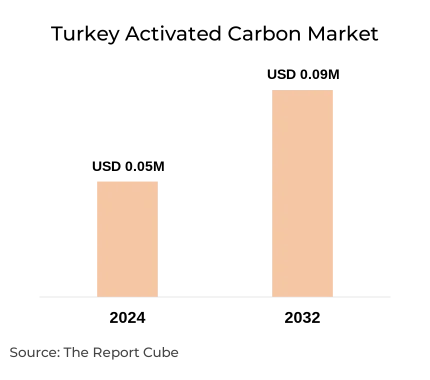
The Turkey Activated Carbon Market was valued at USD 8.2 Million in 2024 and is anticipated to register a CAGR of around 8% during the forecast period, i.e., 2025-32. Owing to the mounting demand in numerous industries, including F&B manufacturing, water treatment, and air purification, the market is envisioned to expand steadily. As activated carbon has a big surface area, it is commonly utilized in water filtration & purification. Activated carbon is typically manufactured from coal, wood, and others. They have a character for getting free of impurities like smells, pollution, and organic compounds. The requirement for effective filtration systems has matured due to the quick extension of sectors like manufacturing, chemical processing, and food & beverage industries. Also, the reduction of hazardous pollutants from industrial emissions & discharges is what is propelling the deployment of activated carbon.
The water supplies of Turkey are under more strain as a result of the nation’s expanding urban population. To safeguard clean & safe drinking water supplies, industries & municipal authorities are gradually employing activated carbon solutions for water filtration. Moreover, there is a larger requirement for activated carbon in air filtration systems due to mounting awareness of the health risks linked with air pollution. This is predominantly vital in heavily populated, high-pollution cities like Istanbul.
Additionally, throughout the last two years, there has been a noticeable surge in numerous healthcare facilities as the government has taken the necessary steps to fortify Turkey’s healthcare system. Patients from all across the country can now easily access healthcare services because of the several new hospitals that have developed throughout the years. Owing to this, there is an increased need for activated carbon in this industry, majorly because it is used extensively to treat gastrointestinal disorders & drug overdoses. Thus, adoption has increased throughout the whole healthcare industry.
Besides, in recent years, the F&B sector has expanded throughout Turkey. The consumer base is growing as more individuals, especially working women, which is driving the demand for processed food that is ready to eat. In addition, as the travel & tourism industry grew, so did the need for food & beverage items due to the growth of the hospitality, food service industries, and restaurants. As a result, Turkey’s F&B manufacturing industry would need to expand in the following years. The water treatment sector is predicted to expand as individuals become more conscious of the need to conserve & reuse water. Also, to prepare water for reuse in industrial & agricultural applications, activated carbon is essential. Hence, this would generate an opportunistic arena for the Turkey Carbon Market in the forthcoming years.

Turkey Activated Carbon Market Dynamics
- Surge in the Production Capacity of Cosmetics to Drive the Industry Expansion
There has been a prominent rise in the need for cosmetic products in diverse regions of Turkey in the past few years, especially due to the country’s increasing youth population. In recent years, the nation’s younger generation has aggressively shifted toward the usage of skincare, other self-care goods, and cosmetics. International enterprises are expressing interest in boosting their production capacity in Turkey to meet the predictable demand for beauty products due to a surge in the market.
Additionally, the country’s tourism industry has thrived, which has raised demand for cosmetics suitable for a range of skin tones. As a result of this market trend, activated carbon has become much more in demand over the past years owing to its active usage as a raw material in the manufacturing of various cosmetics. Moreover, activated carbon is not just employed for raw materials, it is also employed in the treatment of water & wastewater in several cosmetic manufacturing facilities, thus driving the Turkey Activated Carbon Market.
- Fluctuation in Raw Material Prices & Availability to Impede the Market Growth
The supply & volatility of essential raw materials, such as coal, coconut shells, and wood present a major challenge to the Turkey Activated Carbon Market. The supply of these raw materials, which are essential for the making of activated carbon, can alter because of things like seasonal availability, environmental restrictions, and geopolitical situations. Furthermore, price fluctuations for these materials on the global market may result in higher production costs, which may affect the firm’s profitability. Owing to this volatility, producers or manufacturers find it challenging to keep up consistent supply & pricing, which might retrain the Turkey Activated Carbon Market expansion.
- Adoption of Sustainable Production Techniques to Gain Traction in the Future Years
Adopting eco-friendly & sustainable activated carbon production techniques is becoming more & more popular as environmental awareness increases. Turkey’s manufacturers can benefit from this trend by creating energy-efficient production methods & developing activated carbon from renewable resources like agricultural waste (like fruit husks & nutshells). This aids in reducing reliance on conventional raw materials such as wood & coal, lowering supply chain risks, while also satisfying consumer demand for sustainable products, thus opening new doors for the Turkey Activated Carbon Market.
Turkey Activated Carbon Market Segment-wise Analysis
By Source:
- Coconut
- Wood
- Coal
- Others (Peat, Nutshell, etc.)
The use of Coal as a raw material for activated carbon synthesis has grown significantly & is accounted to capture the largest share of the Turkey Activated Carbon Market. As activated carbon made from coal is less expensive than that produced from other sources, its use in the country’s industrial sector has elevated significantly. Additionally, it has been noted that activated carbon derived from coal is effective in treating wastewater, thus the industry for these products has enhanced. Also, numerous manufacturing facilities have been established nationwide in recent years owing to government initiatives to encourage the expansion of the industrial sector.
By Application:
- Water Treatment
- Food & Beverage
- Healthcare
- Automotive
- Industrial Processing
- Others (Cosmetic, Mining, etc.)
The market for activated carbon in Turkey is dominated by the Water Treatment application sector. The dominant position is a result of strict environmental restrictions, urbanization, and population expansion driving the requirement for clean water in both the municipal & industrial sectors. The country is dealing with pollution & water scarcity, which has increased the amount of investment in water treatment & purification systems. In these systems, activated carbon is vital as it efficiently eliminates impurities & other contaminants like chlorine.
Moreover, a substantial amount of activated carbon must be utilized in the treatment of industrial wastewater to meet discharge requirements set by nature. Also, water treatment is the most substantial & essential use of activated carbon owing to the rising emphasis on sustainable water management techniques & regulatory restrictions to reduce water pollution.
Top Companies in Turkey Activated Carbon Market
Turkey Activated Carbon Market Companies Market Share (2026-2034)
Understand The Key Trends Shaping This Market
Download Free SampleWhat Does Our Turkey Activated Carbon Market Research Study Entail?
- Turkey Activated Carbon Market Research Report highlights the forecast growth rate or CAGR by anticipating the market size & share.
- The market analysis puts light upon the primary industry trends, driving aspects, potential opportunities, growth challenges, and other major factors.
- Turkey Activated Carbon Market Research Report entails details about the most critical shifts in market share in the prominent regions.
- Considering the statistics & the developments by the primary market competitors, our report also strives to demonstrate the most sought-after strategies of the key players.
Table of Contents
- Introduction
- Objective of the study
- Product Definition
- Market Segmentation
- Study Variables
- Research Methodology
- Secondary Data Points
- Companies Interviewed
- Primary Data Points
- Break Down of Primary Interviews
- Secondary Data Points
- Executive Summary
- Market Dynamics
- Drivers
- Challenges
- Opportunity Assessment
- Recent Trends and Developments
- Policies and Regulatory Landscape
- Import Export Analysis
- Supply Chain Analysis
- Turkey Activated Carbon Market Overview (2020-2032)
- Market Size, By Value (in USD Millions)
- Market Size, By Volume (Thousand Tons)
- Turkey Activated Carbon Market Share, By Product Type
- Powdered Activated Carbon
- Granular Activated Carbon
- Extruded & Pelletized Activated Carbon
- Impregnated Activated Carbon
- Turkey Activated Carbon Market Share, By Source
- Coconut
- Nutshell
- Coal
- Others (Peat, Wood Etc.)
- Turkey Activated Carbon Market Share, By Application
- Liquid Phase Application
- Gas Phase Application
- Turkey Activated Carbon Market Share, By End User Industry
- Water Treatment
- Food & beverages
- Pharmaceutical and Medical
- Automotive
- Industrial
- Others
- Turkey Activated Carbon Market Share, By Region
- North
- West
- Central
- South
- East
- Southeast
- Turkey Activated Carbon Market Share, By Company
- Market Share, By Top 3 Companies
- Competitive Outlook (Company Profiles – Partial List)
- Haycarb PLC.
- Company Overview
- Business Segments
- Strategic Alliance/Partnerships
- Recent Developments
- CarboTech
- Company Overview
- Business Segments
- Strategic Alliance/Partnerships
- Recent Developments
- Chemviron
- Company Overview
- Business Segments
- Strategic Alliance/Partnerships
- Recent Developments
- Donau Carbon
- Company Overview
- Business Segments
- Strategic Alliance/Partnerships
- Recent Developments
- Jacobi Carbons
- Company Overview
- Business Segments
- Strategic Alliance/Partnerships
- Recent Developments
- Carbon Activated Corporation
- Company Overview
- Business Segments
- Strategic Alliance/Partnerships
- Recent Developments
- Western Carbon & Chemicals
- Company Overview
- Business Segments
- Strategic Alliance/Partnerships
- Recent Developments
- Pame Carbon
- Company Overview
- Business Segments
- Strategic Alliance/Partnership
- Recent Developments
- Aktif Karbon Turkiye
- Company Overview
- Business Segments
- Strategic Alliance/Partnerships
- Recent Developments
- Financials
- Huamei Activated Carbon Co., Ltd
- Company Overview
- Business Segments
- Strategic Alliance/Partnerships
- Recent Developments
- Others
- Haycarb PLC.
- Contact Us & Disclaimer
List of Figure
Figure 1: Study framework and research scope
Figure 2: Study objectives and research questions
Figure 3: Product definition — activated carbon types and characteristics
Figure 4: Market segmentation structure for Turkey activated carbon market
Figure 5: Study variables and measurement indicators
Figure 6: Research methodology and data validation framework
Figure 7: Secondary data points and research references
Figure 8: Companies interviewed — respondent distribution
Figure 9: Primary data points captured
Figure 10: Breakdown of primary interviews by respondent type
Figure 11: Executive summary — key market indicators (2020–2032)
Figure 12: Market dynamics — drivers and restraints
Figure 13: Key market drivers for activated carbon demand in Turkey
Figure 14: Market challenges and risk factors
Figure 15: Opportunity assessment — high-growth applications
Figure 16: Recent trends and developments in activated carbon technologies
Figure 17: Policies and regulatory landscape affecting activated carbon in Turkey
Figure 18: Import–export analysis — activated carbon flows and trends
Figure 19: Supply chain analysis — sourcing, processing and distribution structure
Figure 20: Turkey activated carbon market overview (2020–2032) — value and volume trends
Figure 21: Market size, by value (USD millions) — historical & forecast
Figure 22: Market size, by volume (thousand tons) — historical & forecast
Figure 23: Market share, by product type — powdered, granular, extruded/pelletized, impregnated
Figure 24: Product type comparison — performance and application suitability
Figure 25: Market share, by source — coconut, nutshell, coal, others
Figure 26: Market share, by application — liquid phase vs gas phase
Figure 27: Market share, by end user industry — water treatment, food & beverages, pharmaceuticals, automotive, industrial, others
Figure 28: Market share, by region — North, West, Central, South, East, Southeast
Figure 29: Market share, by company — leading manufacturers in Turkey
Figure 30: Market share of top 3 companies — consolidated view
Figure 31: Competitive landscape overview — positioning matrix
Figure 32: Company profile snapshot — Haycarb PLC
Figure 33: Company profile snapshot — CarboTech
Figure 34: Company profile snapshot — Chemviron
Figure 35: Company profile snapshot — Donau Carbon
Figure 36: Company profile snapshot — Jacobi Carbons
Figure 37: Company profile snapshot — Carbon Activated Corporation
Figure 38: Company profile snapshot — Western Carbon & Chemicals
Figure 39: Company profile snapshot — Pame Carbon
Figure 40: Company profile snapshot — Aktif Karbon Turkiye
Figure 41: Company profile snapshot — Huamei Activated Carbon
Figure 42: Additional company profiles — other regional and global players
List of Table
Table 1: Study objectives and definitions
Table 2: Product definition and classification of activated carbon types
Table 3: Market segmentation taxonomy — product, source, application, end user, region
Table 4: Study variables — metrics, units, and analytical parameters
Table 5: Research methodology — sampling, primary and secondary data structure
Table 6: Secondary data points — sources and verification protocols
Table 7: List of companies interviewed — respondent categories
Table 8: Primary data points — key insights captured
Table 9: Breakdown of primary interviews — by function and region
Table 10: Executive summary — market metrics (2020, 2024, 2032)
Table 11: Market dynamics — drivers, restraints, opportunity matrix
Table 12: Import–export analysis — volumes, values, and major trade partners
Table 13: Supply chain analysis — value chain stages and key participants
Table 14: Turkey activated carbon market size — value (USD millions)
Table 15: Turkey activated carbon market size — volume (thousand tons)
Table 16: Market share, by product type — powdered, granular, extruded/pelletized, impregnated
Table 17: Market share, by source — coconut, nutshell, coal, others
Table 18: Market share, by application — liquid phase vs gas phase
Table 19: Market share, by end user — water treatment, food & beverage, pharmaceuticals, automotive, industrial, others
Table 20: Market share, by region — North, West, Central, South, East, Southeast
Table 21: Market share, by company — comparative table
Table 22: Market share of top 3 companies — consolidated metrics
Table 23: Competitive benchmarking — product portfolio, capabilities and strengths
Table 24: Company profiles summary — strategic alliances, partnerships and developments
Table 25: SWOT summary table for major market participants
Table 26: Pricing trends and influencing factors
Table 27: Forecasting assumptions and sensitivity analysis
Table 28: Contact information and disclaimer
Top Key Players & Market Share Outlook
- Haycarb Plc
- CarboTech
- Chemviron
- Donau Carbon
- Jacobi Carbons
- Carbon Activated Corporation
- Western Carbon & Chemicals
- Pame Carbon
- Aktif Karbon Turkiye
- Huamei Activated Carbon Co., Ltd
- Others
Frequently Asked Questions






