



Build Your Custom Market Intelligence Report
Customize Your ReportEthiopia Two Wheeler Tire Market Key Highlights
By Vehicle Type:
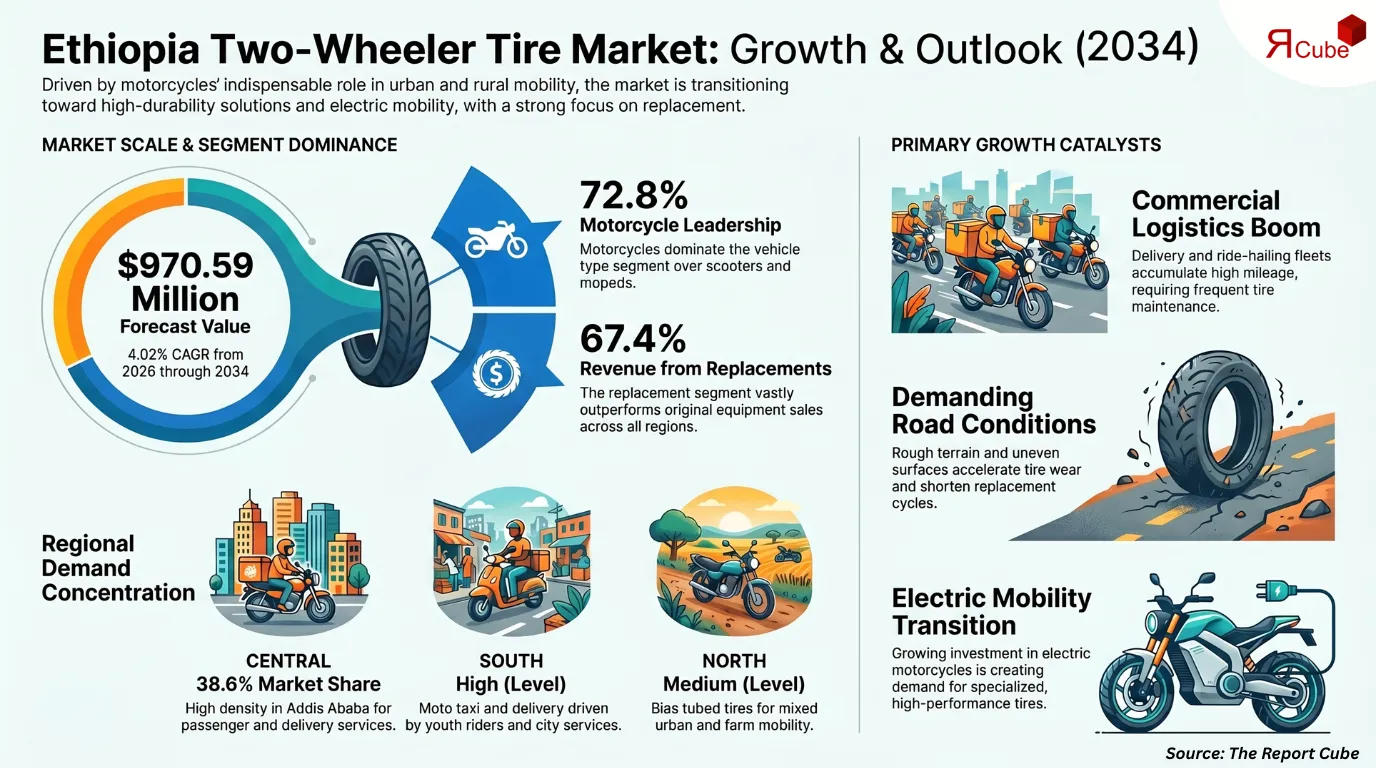
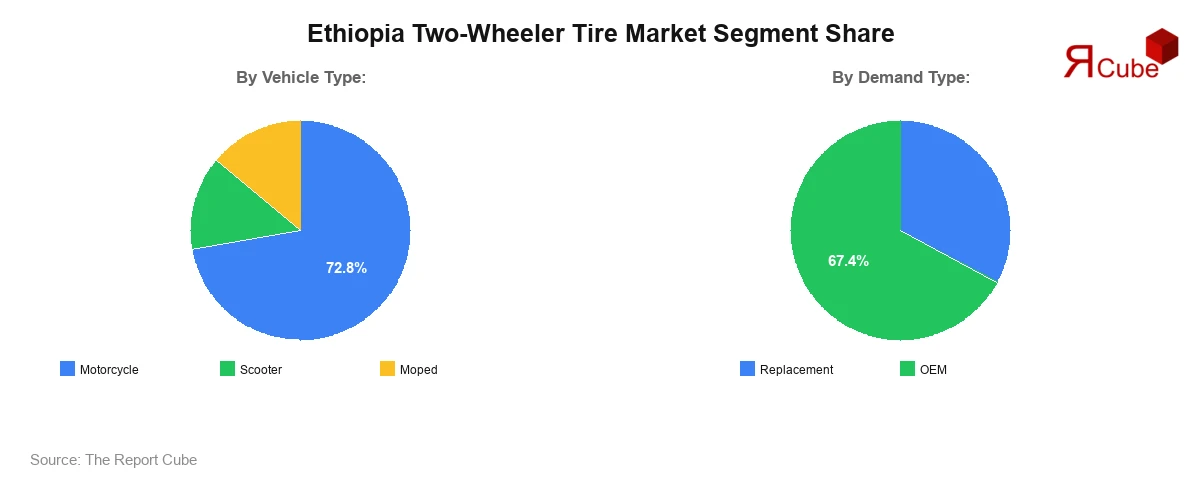
Motorcycle segment leads the market with approximately 72.8% share.
By Demand Type:
Replacement segment dominates the market with nearly 67.4% of revenue.
Regional Outlook:
Central region dominates the Ethiopia Two Wheeler Tire market with around 38.6% share.
Ethiopia Two Wheeler Tire Market Insights & Analysis
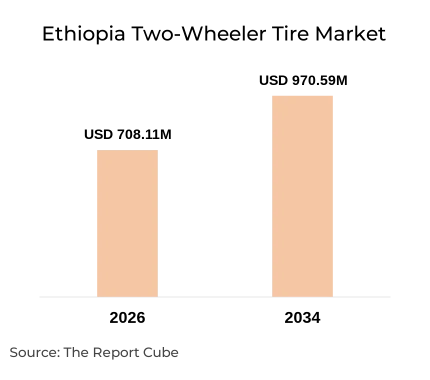
The Ethiopia Two Wheeler Tire Market is anticipated to register a CAGR of around 4.02% during the forecast period 2026-2034. The market size is valued at USD 708.11 million in 2026 and is projected to reach USD 970.59 million by 2034. Growth in the market is closely linked to the expanding role of two-wheelers in Ethiopia’s transportation ecosystem. Motorcycles remain a practical mobility solution for both urban commuters and rural populations due to their affordability, fuel efficiency, and ability to navigate areas with limited road infrastructure. Increasing reliance on motorcycles for passenger transport, small-scale trade, agricultural activities, and last-mile logistics continues to support steady tire consumption. Replacement demand remains particularly strong as vehicles frequently operate on uneven road surfaces, accelerating tire wear and replacement cycles.
Market expansion is also being supported by investment in sustainable transportation initiatives and the emergence of electric mobility projects. The increasing deployment of electric motorcycles in major cities such as Addis Ababa is creating additional demand for high-performance and durable tire products. International tire manufacturers are strengthening distribution networks and expanding product availability to address rising vehicle ownership levels. At the same time, growing awareness regarding vehicle safety, tire maintenance, and operational efficiency among commercial fleet operators is encouraging adoption of higher-quality tire solutions. These factors collectively reinforce the long-term growth outlook for the Ethiopia two-wheeler tire market.
Ethiopia Two-Wheeler Tire Market Impact Analysis
| Factor | Type | Specific Impact on Market | Magnitude | Business Implication |
|---|---|---|---|---|
| Urbanization and Mobility Demand | Market | Growing city populations increase need for low cost transport | High | Supports continuous growth in two wheeler and tire volumes |
| Dominance of Imported Tire Brands | Competitive | Imported products hold major share in local tire segment | High | Local players must differentiate on value and service support |
| Rising Motorcycle and Scooter Parc | Market | Expanding vehicle base drives recurring replacement demand | High | Aftermarket becomes key revenue and loyalty building channel |
| Fluctuating Rubber and Input Prices | Environmental | Cost swings pressure margins and retail pricing stability | Medium | Requires hedging, sourcing diversity, and lean cost control |
| Road Infrastructure and Terrain Conditions | Environmental | Rough roads raise tire wear and shorten replacement cycles | Medium | Creates demand for durable patterns tailored for local usage |
| Regulatory Moves on Safety Standards | Regulatory | Potential enforcement of quality norms filters low grade tires | Medium | Benefits compliant brands with robust testing and certification |
| Growth of Delivery and Ride Hailing Use | Consumer | High mileage fleets need frequent tire maintenance cycles | High | Enables fleet focused offerings and long term supply contracts |
Ethiopia Two Wheeler Tire Market Dynamics
Key Driver: Rising Motorcycle Adoption for Urban and Rural Transportation
Motorcycle ownership has increased significantly across Ethiopia as households, entrepreneurs, and transportation providers seek cost-effective mobility solutions. In many regions, motorcycles serve as an essential means of transportation where public transit coverage remains limited. Their versatility in navigating congested urban streets and reaching remote communities has contributed to a larger active vehicle fleet, directly increasing demand for replacement tires. Rising disposable incomes in urban centers and growing access to financing options have further supported motorcycle purchases among first-time buyers.
Commercial utilization of motorcycles has become an equally important growth catalyst. Delivery services, courier operators, ride-hailing businesses, and informal transport providers depend heavily on two-wheelers to maintain operational efficiency. Higher daily travel distances naturally increase tire wear, leading to more frequent replacement requirements. As commercial activity expands and mobility needs continue evolving, tire manufacturers are expected to benefit from a stable and recurring demand base across both urban and rural markets.
Industry Trends: Expansion of Electric Mobility and Tire Technology Advancements
Electric mobility is gradually emerging as an important trend within Ethiopia’s transportation sector. Public and private investments aimed at reducing fuel dependency and lowering transport emissions are encouraging the adoption of electric motorcycles. Companies entering the market are increasingly focusing on battery-swapping systems and locally assembled electric two-wheelers, creating new opportunities for specialized tire products designed to support different weight distributions and torque characteristics.
Alongside electrification, manufacturers are investing in tire technologies that improve durability, grip, and operational life under demanding road conditions. Product development efforts increasingly focus on puncture resistance, heat management, and enhanced tread performance to address the challenges associated with mixed urban and rural usage patterns. As fleet operators prioritize lower maintenance costs and improved vehicle uptime, advanced tire solutions are expected to gain greater acceptance throughout the forecast period.
Book your FREE 30-minute expert consultation today
Contact UsMajor Challenge: Price Sensitivity and Presence of Low-Cost Imports
Affordability remains one of the most influential purchasing factors in Ethiopia’s two-wheeler tire industry. Many vehicle owners operate within tight budget constraints and often prioritize lower upfront costs over long-term product performance. This purchasing behavior creates substantial competition among manufacturers and distributors, particularly within the economy and budget tire categories. As a result, premium tire brands frequently face challenges in expanding their market penetration despite offering superior durability and performance characteristics.
Competitive pressure is further intensified by the availability of low-cost imported products. While these products provide accessible options for price-conscious consumers, variations in quality standards can affect customer confidence and overall market consistency. Tire manufacturers must therefore balance affordability, durability, and brand reputation to remain competitive while maintaining profitability. Addressing these pricing dynamics will remain a critical strategic consideration throughout the forecast horizon.
Opportunity: Growing Commercial Delivery Networks and Fleet Expansion
Rapid urbanization and the expansion of commercial delivery networks are creating attractive growth opportunities for the Ethiopia two-wheeler tire market. Businesses increasingly depend on motorcycles to transport food, parcels, retail goods, and essential services within densely populated urban areas. This operational model allows companies to reduce transportation costs while improving delivery speed, leading to sustained growth in motorcycle fleet deployment.
Higher vehicle utilization among commercial operators generates substantial replacement tire demand due to increased mileage accumulation. Fleet managers are also becoming more focused on reducing downtime and improving operational efficiency, encouraging investments in reliable tire solutions with longer service life. The continued expansion of e-commerce activity, urban logistics operations, and electric motorcycle fleets is expected to create additional revenue opportunities for tire manufacturers and distributors serving the Ethiopian market.
Ethiopia Two Wheeler Tire Market Segment-wise Analysis
By Vehicle Type:
- Motorcycle
- Scooter
- Moped
The motorcycle segment accounts for the largest share of the Ethiopia two-wheeler tire market, representing approximately 72.8% of total revenue. Strong demand is supported by the widespread use of motorcycles for personal transportation, commercial deliveries, agricultural activities, and informal transport services. Their relatively low acquisition and operating costs make them a preferred transportation option across both urban and rural communities. The segment continues to benefit from increasing vehicle registrations and growing dependence on two-wheelers for daily mobility needs.
Replacement tire demand is particularly robust within the motorcycle category because these vehicles often operate under demanding conditions that accelerate tread wear. Commercial riders typically travel longer distances and carry heavier loads, resulting in more frequent tire replacements compared to scooters and mopeds. Ongoing investments in mobility infrastructure and expanding commercial transportation services are expected to reinforce the segment’s leading position throughout the forecast period.
By Demand Type:
- Replacement
- OEM
The replacement segment dominates the Ethiopia two-wheeler tire market with an estimated share of 67.4% of total revenue. A growing motorcycle population combined with challenging road conditions contributes to regular tire replacement requirements. Vehicle owners increasingly recognize the importance of maintaining tire quality to improve safety, fuel efficiency, and overall riding performance. This has supported consistent demand across both urban centers and rural regions.
Distribution networks comprising multi-brand retailers, independent dealers, and local service centers play a significant role in facilitating replacement tire sales. Commercial fleet operators represent a particularly important customer group due to their higher annual mileage and accelerated tire consumption rates. As two-wheeler ownership continues expanding across Ethiopia, the replacement segment is expected to maintain its dominant contribution to overall market revenues.
Regional Projection of Ethiopia Two Wheeler Tire Industry
- North
- Central
- West
- South
- Southwest
The Central region holds the largest share of the Ethiopia two-wheeler tire market, accounting for approximately 38.6% of total industry revenue. The region benefits from a high concentration of population, economic activity, and transportation infrastructure. Addis Ababa, as the country's primary commercial hub, generates substantial demand for motorcycles used in passenger mobility, delivery services, logistics operations, and business transportation. These factors contribute to higher vehicle utilization and stronger replacement tire demand compared to other regions.
Market growth in Central Ethiopia is further supported by increasing investments in electric mobility, fleet modernization initiatives, and transportation service expansion. The presence of established distribution networks and retail channels improves product accessibility and availability for end users. Continued urban development, rising commercial activity, and expanding mobility requirements are expected to sustain the region’s leadership position in the Ethiopia two-wheeler tire market over the forecast period.
Need insights for a specific region within this market?
Request Regional DataEthiopia Two-Wheeler Tire Market Regional Analysis
The Ethiopia two-wheeler tire market shows strong regional gaps led by urban density, trade routes, and road connectivity.
| Cluster | Demand Level | Key Areas | System Dominance | Core Demand Logic | Growth Nature |
|---|---|---|---|---|---|
| North | Medium | Bahir Dar, Gondar belt | Bias tubed commuter tires | Mixed urban and farm mobility | Steady fleet replacement |
| Central | Very High | Addis Ababa, Adama axis | Urban commuter and taxi tires | Dense daily passenger movement | Fastest aftermarket expansion |
| West | Medium | Nekemte, Assosa corridor | Rugged bias tires | Agri trade and feeder roads | Gradual volume-led growth |
| South | High | Hawassa, Shashamane belt | Moto taxi and delivery tires | Youth riders and city services | Usage driven repeat demand |
| Southwest | Low to Medium | Jimma, Gambela stretch | Basic bias on-road tires | Low base with rising access | Emerging network-driven growth |
Government Initiatives & Policies
- National Electric Mobility Strategy (2025): Ethiopia continues implementing policies supporting electric vehicle adoption, including electric motorcycles and charging infrastructure development. The initiative aims to reduce fuel imports, improve urban air quality, and accelerate sustainable transportation growth.
- Green Transport and Energy Transition Program (2026): Government authorities expanded support for clean mobility projects through incentives for electric vehicle deployment and local assembly activities. The program encourages private sector participation in sustainable transportation infrastructure and fleet modernization.
Ethiopia Two Wheeler Tire Industry Recent Developments
- May 2026: Dodai secured USD 13 million in Series A funding to expand its electric motorcycle and battery-swapping ecosystem across Addis Ababa. The investment supports growth of locally assembled electric motorcycles and additional battery-swapping stations, enhancing operational efficiency for delivery fleets and urban mobility users. The development is expected to increase two wheeler utilization rates, strengthen commercial transportation activity, and create sustained demand for replacement tires as fleet mileage expands across the country.
Why Choose This Report?
- Provides a comprehensive overview of the overall market analysis, encompassing key trends, consumer behavior analysis, and risk assessment to support strategic decision-making.
- Provides accurate, up-to-date insights into market size, segmentation, and emerging opportunities, helping to minimize risk & capitalizing on growth.
- Gives deep understanding of target audience preferences, investment habits, and communication channels for enhanced product development & marketing effectiveness.
- Delivers competitive analysis & benchmarking, uncovering the strengths & weaknesses of market competitors to guide strategies.
- Consolidate comprehensive market intelligence, reducing reasoning & streamlining research efforts.
- Facilitates customized market segmentation & risk mitigation strategies, fine-tuned to the business objectives.
- Aids in identifying both market challenges & untapped opportunities within the industry to drive long-term business growth.
- Provides valuable information based on actual customer data & search trends.
Table of Contents
- Introduction
- Objective of the Study
- Product and Category Definition
- Market Segmentation
- Study Variables
- Research Methodology
- Secondary Data Points
- Breakdown of Secondary Sources
- Primary Data Points
- Breakdown of Primary Interviews
- Secondary Data Points
- Executive Summary
- Market Dynamics
- Emerging Opportunities
- Adoption Trends
- Demand Drivers
- Disruption Analysis (Challenges)
- Industry Analysis and Strategic Insights
- Supply and Value Chain Analysis
- Pricing Analysis
- Go-To-Market Strategy
- BCG Matrix
- Recent Trends and Developments
- Import and Export Analysis
- Regulatory and Policy Landscape
- Region-wise Policies
- Government Initiatives
- Ethiopia Two-Wheeler Tire Market Overview and Forecast Analysis (2021-2034)
- Market Size, By Value, By Growth Rate (CAGR/USD Million)
- Market Share, By Vehicle Type
- Motorcycle
- Scooter and Moped
- Market Share, By Propulsion
- Electric
- ICE
- Market Share, By Demand Type
- Replacement
- OEM
- Market Share, By Sales Channel
- Online
- Multi Brand Stores
- Direct Sales
- Exclusive Outlets
- Market Share, By Tire Type
- Bias
- Radial
- Market Share, By Tire Size
- Tire Size 1
- Tire Size 2
- Tire Size 3
- Tire Size 4
- Tire Size 5
- Market Share, By Price Category
- Premium
- Budget
- Economy
- Market Share, By Company
- Revenue Shares and Analysis
- Competitive Landscape
- Amhara Two-Wheeler Tire Market Overview and Forecast Analysis (2021-2034)
- Market Size, By Value, By Growth Rate (CAGR/USD Million)
- Market Share, By Vehicle Type
- Market Share, By Propulsion
- Market Share, By Demand Type
- Market Share, By Sales Channel
- Market Share, By Tire Type
- Market Share, By Tire Size
- Market Share, By Price Category
- Sidama Two-Wheeler Tire Market Overview and Forecast Analysis (2021-2034)
- Market Size, By Value, By Growth Rate (CAGR/USD Million)
- Market Share, By Vehicle Type
- Market Share, By Propulsion
- Market Share, By Demand Type
- Market Share, By Sales Channel
- Market Share, By Tire Type
- Market Share, By Tire Size
- Market Share, By Price Category
- Oromia Two-Wheeler Tire Market Overview and Forecast Analysis (2021-2034)
- Market Size, By Value, By Growth Rate (CAGR/USD Million)
- Market Share, By Vehicle Type
- Market Share, By Propulsion
- Market Share, By Demand Type
- Market Share, By Sales Channel
- Market Share, By Tire Type
- Market Share, By Tire Size
- Market Share, By Price Category
- Somali Two-Wheeler Tire Market Overview and Forecast Analysis (2021-2034)
- Market Size, By Value, By Growth Rate (CAGR/USD Million)
- Market Share, By Vehicle Type
- Market Share, By Propulsion
- Market Share, By Demand Type
- Market Share, By Sales Channel
- Market Share, By Tire Type
- Market Share, By Tire Size
- Market Share, By Price Category
- Gambela Two-Wheeler Tire Market Overview and Forecast Analysis (2021-2034)
- Market Size, By Value, By Growth Rate (CAGR/USD Million)
- Market Share, By Vehicle Type
- Market Share, By Propulsion
- Market Share, By Demand Type
- Market Share, By Sales Channel
- Market Share, By Tire Type
- Market Share, By Tire Size
- Market Share, By Price Category
- Competitive Analysis, 2026
- Market Share of Key Players
- Competitive Mapping for Each Segment and Companies Operating Regionally
- Amhara Two-Wheeler Tire Companies Share and Competitive Analysis, 2026
- Sidama Two-Wheeler Tire Companies Share and Competitive Analysis, 2026
- Oromia Two-Wheeler Tire Companies Share and Competitive Analysis, 2026
- Somali Two-Wheeler Tire Companies Share and Competitive Analysis, 2026
- Gambela Two-Wheeler Tire Companies Share and Competitive Analysis, 2026
- Company Profile (Partial List)
- Apollo Tyres Ltd.
- Company Overview
- Product Portfolio
- Strategic Alliances and Partnerships
- Recent Developments
- Michelin
- Company Overview
- Product Portfolio
- Strategic Alliances and Partnerships
- Recent Developments
- Goodyear Tire and Rubber Company
- Company Overview
- Product Portfolio
- Strategic Alliances and Partnerships
- Recent Developments
- MRF
- Company Overview
- Product Portfolio
- Strategic Alliances and Partnerships
- Recent Developments
- Bridgestone Corporation
- Company Overview
- Product Portfolio
- Strategic Alliances and Partnerships
- Recent Developments
- Continental AG
- Company Overview
- Product Portfolio
- Strategic Alliances and Partnerships
- Recent Developments
- CEAT
- Company Overview
- Product Portfolio
- Strategic Alliances and Partnerships
- Recent Developments
- Pirelli Tyre S.p.A
- Company Overview
- Product Portfolio
- Strategic Alliances and Partnerships
- Recent Developments
- Maxxis International
- Company Overview
- Product Portfolio
- Strategic Alliances and Partnerships
- Recent Developments
- Sumitomo Rubber Industries Ltd.
- Company Overview
- Product Portfolio
- Strategic Alliances and Partnerships
- Recent Developments
- Others (Partial List)
- Apollo Tyres Ltd.
- Contact Us and Disclaimer
Top Key Players & Market Share Outlook
- Apollo Tyres Ltd.
- Michelin
- Goodyear Tire & Rubber Company
- MRF
- Bridgestone Corporation
- Continental AG
- CEAT
- Pirelli Tyre S.p.A
- Maxxis International
- Sumitomo Rubber Industries Ltd.
Frequently Asked Questions






