


Build Your Custom Market Intelligence Report
Customize Your ReportKey Takeaways
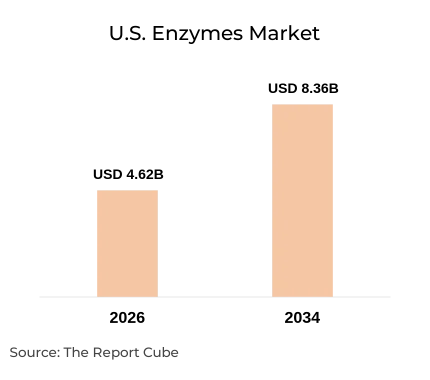
- U.S. Enzymes Market is valued at USD 4.62 billion in 2026.
- The market is projected to reach USD 8.36 billion by 2034, expanding at a CAGR of 7.70%.
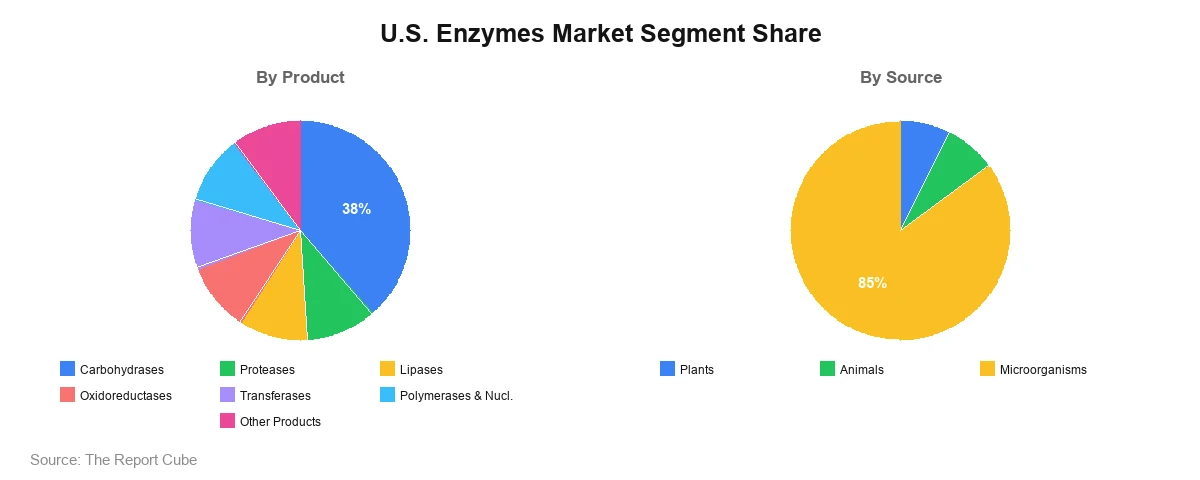
- Carbohydrases lead the product segment with an estimated 38% share in 2026.
- Microorganisms lead enzyme sourcing with an estimated 85% share in 2026.
- North is the leading region with an estimated 29% share in 2026.
- Industrial and specialty enzymes form the end-use base across food, fuel, feed and pharmaceutical applications.
- Novozymes, DuPont, AB Enzymes, BASF, DSM, Amano Enzyme and Kerry Group are among the key players.
- Renewable fuel requirements and domestic biomanufacturing investment are important market themes.
Market Overview
Enzymes are biological catalysts, mostly proteins, that accelerate chemical reactions in food processing, fuel production, animal nutrition, cleaning products, pharmaceuticals and research. Commercial enzymes are produced mainly through microbial fermentation and are classified by function, including carbohydrases, proteases and lipases, which allow manufacturers to improve process efficiency, product consistency and ingredient performance.
The U.S. Enzymes Market Analysis shows demand anchored in food processing, renewable fuel production, animal nutrition and industrial biotechnology. The market is valued at USD 4.62 billion in 2026, with microorganisms accounting for an estimated 85% of the source segment. Federal renewable fuel volumes of 26.81 billion RINs for 2026 add demand for starch- and biomass-processing enzymes.
Manufacturers adopt enzymes to replace harsher chemical processes, raise conversion yields and meet product specifications in food, fuel and feed applications. Domestic biomanufacturing investment and enzyme-specific food safety controls are shaping production practices. The market is projected to grow at a CAGR of 7.70% during 2026–2034, reaching USD 8.36 billion by 2034.
U.S. Enzymes Market Dynamics
The U.S. enzymes market is influenced by demand from food processing, renewable fuel production, animal nutrition, pharmaceuticals and industrial biotechnology. Government policies, food safety requirements, domestic biomanufacturing investment and fermentation advances shape operating conditions, while production costs, regulatory documentation and competition from global suppliers influence pricing, adoption and supplier strategies.
|
Factor |
Type |
Specific Impact on Market |
Magnitude |
|---|---|---|---|
|
Food and beverage processing applications |
Driver |
FDA-recognized enzyme preparations support starch conversion, cheese production and other food manufacturing uses |
High |
|
Renewable fuel requirements |
Driver |
EPA 2026–2027 volumes support enzymes used in starch hydrolysis and biomass conversion |
High |
|
Advanced and cellulosic biofuels |
Opportunity |
Cellulosic requirements create room for enzymes used in cellulose breakdown |
Medium–High |
|
Domestic biomanufacturing capacity |
Opportunity |
Federal initiatives support facilities for commercial-scale biotechnology production |
Medium |
|
Food enzyme regulatory compliance |
Challenge |
Approval, GRAS and safety documentation add testing and compliance responsibilities |
Medium–High |
|
Pilot-scale infrastructure gaps |
Challenge |
Limited scale-up infrastructure can slow commercialization |
Medium |
|
Controlled manufacturing and domestic investment |
Trend |
Source characterization, process controls and federal investment shape production practices |
Medium–High |
U.S. Enzymes Market Growth Drivers
According to the U.S. Food and Drug Administration, enzyme preparations are used in food manufacturing applications such as starch conversion, cheese production and general food processing. FDA regulations list multiple enzyme preparations for specified uses, showing established commercial integration. U.S. Enzymes Market Growth is also linked to food and beverage processing volumes.
Renewable Fuel Standard requirements set by the U.S. Environmental Protection Agency reach 26.81 billion RINs for 2026 and 27.02 billion RINs for 2027. EPA finalized these volumes on March 27, 2026. This regulatory framework supports renewable fuel production, creating demand for enzymes used in starch hydrolysis, biomass conversion and biofuel processing. EPA announced the final 2026 and 2027 volumes on March 27, 2026.
U.S. Enzymes Market Opportunities
The EPA’s 2026–2027 Renewable Fuel Standard includes cellulosic biofuel requirements of 1.36 billion RINs in 2026 and 1.43 billion RINs in 2027. These obligations create room for manufacturers developing enzymes for cellulose breakdown, biomass processing and advanced renewable fuel production, although actual commercial uptake depends on individual fuel producers’ project economics.
Federal initiatives described by the U.S. Government Accountability Office have supported biomanufacturing facility construction and commercial-scale production capabilities. Enzyme manufacturers and biotechnology suppliers may find opportunities to develop domestic fermentation, enzyme engineering and industrial biotechnology capacity, particularly where pilot-scale and commercial-scale infrastructure currently remains limited, although realization depends on capital availability and project timelines.
U.S. Enzymes Industry Challenges
FDA rules state that food ingredients must satisfy applicable food additive approval requirements or qualify for an exclusion, including Generally Recognized as Safe status. Enzyme preparations must meet relevant safety and use requirements, creating documentation, testing and compliance responsibilities that add time and cost for manufacturers introducing new commercial enzyme products.
The U.S. Government Accountability Office reports that the United States has insufficient infrastructure to advance some biotechnology projects from laboratory development to commercial production, particularly at pilot scale. This gap can constrain commercialization and domestic scaling of biotechnology-based manufacturing technologies, including enzyme production, and may extend development timelines for new enzyme products.
Need Specific Data, Let’s Customize the Report for You
Request CustomizationU.S. Enzymes Market Trends
Among the notable U.S. Enzymes Market Trends is rising institutional attention to domestic biomanufacturing. The U.S. Government Accountability Office reports that the Department of Defense has invested approximately USD 965.2 million since 2021 across initiatives supporting biotechnology development, domestic biomanufacturing facilities and commercial-scale production. Direct effects on enzyme production remain to be assessed.
FDA guidance addresses enzyme source organisms, production processes, enzyme preparations and manufacturing-related constituents. This emphasis reinforces controlled production, source characterization and safety documentation in commercial enzyme manufacturing. For suppliers, a focus on established quality systems and validated fermentation processes becomes an expected part of market participation, particularly for commercial food-grade enzyme preparations.
U.S. Enzymes Market Segment Analysis
U.S. Enzymes Market Share is distributed across product, source and end-use categories, each shaped by distinct processing requirements and regulatory pathways. Estimated 2026 shares reflect the supplied market framework, and percentages are stated only for leading segments.
By Product
- Carbohydrases
- Proteases
- Lipases
- Oxidoreductases
- Transferases
- Polymerases & Nucleases
- Other Products
Carbohydrases lead the By Product segment with an estimated 38% share in 2026, supported by their role in starch conversion, food and beverage processing, animal feed and biofuel production. Proteases follow, serving food processing, detergent and animal nutrition applications where protein breakdown improves product performance. Lipases are used in food, baking and detergent formulations, while oxidoreductases and transferases support specialized food, textile and biocatalysis applications. Polymerases and nucleases serve molecular biology, diagnostics and research workflows, and other products include niche enzymes with application-specific demand. Growth across the range is driven by renewable fuel requirements, food manufacturing activity, domestic biomanufacturing investment and pharmaceutical and research laboratory demand. Evidence identifying the fastest-growing product segment was not supplied and requires validation.
By Source
- Plants
- Animals
- Microorganisms
Microorganisms lead the By Source segment with an estimated 85% share in 2026, reflecting fermentation-based production that supports consistent quality, scalable output and reduced dependence on agricultural or animal inputs. Plants supply enzymes such as certain proteases and amylases for specific food and nutraceutical uses, while animals provide pancreatic and rennet-type preparations used in selected food and pharmaceutical applications. Demand across sources follows regulatory acceptance, production scalability, application suitability and source characterization requirements for food-grade enzyme preparations. FDA guidance on source organisms and production processes increases the importance of documented source characterization for every source category.
Regional Analysis
|
Region |
Estimated Market Share |
Key Growth Factors |
Industry Trends |
|---|---|---|---|
|
North |
29% |
Leading region in supplied data; regional drivers require validation |
Demand follows national food, biotechnology and research activity |
|
West |
- |
Food processing and biotechnology activity (qualitative) |
- |
|
Southwest |
- |
Food and fuel-related processing activity (qualitative) |
- |
|
Midwest |
- |
Agricultural processing base and enzyme manufacturing sites in Illinois and Iowa |
Proximity of production assets to agricultural and fuel processing |
North is the leading region with an estimated 29% share in 2026, based on supplied figures. Regional demand drivers for North were not specified in the supplied data and require validation before publication, so the analysis relies on the national factors affecting enzyme use: food processing, biotechnology activity and research laboratory demand.
The Midwest hosts enzyme production and agricultural processing assets, including Amano Enzyme USA’s manufacturing site in Elgin, Illinois, and IFF’s enzyme plant in Cedar Rapids, Iowa. West and Southwest shares were not supplied; these regions are expected to follow broader demand from food processing, biotechnology and fuel-related activity, subject to validation.
Market Share & Competitive Landscape
The U.S. enzymes market includes global enzyme producers, specialty manufacturers, ingredient companies and laboratory suppliers. The table summarizes the supplied companies by general capability and relevant segment. It does not represent numerical market share, and U.S.-specific sales and distribution should be validated.
|
Company |
Competitive Strength |
Primary Segment Served |
|---|---|---|
|
Novozymes (part of Novonesis) |
Broad enzyme and biosolutions portfolio with global production scale |
Food and beverage, household care and feed applications |
|
DuPont |
Legacy enzyme portfolio now associated with IFF, which operates an enzyme plant in Cedar Rapids, Iowa |
Food, personal care, animal nutrition and biofuels |
|
AB Enzymes |
Fermentation-based enzyme supply |
Food processing and industrial applications |
|
BASF SE |
Chemical manufacturing scale and feed enzyme expertise |
Animal nutrition and industrial applications |
|
DSM (Koninklijke DSM N.V.) |
Food and beverage enzyme expertise; feed enzyme alliance share sold to Novonesis |
Food and beverage enzymes |
|
Amano Enzymes Inc. / Amano Enzyme |
Specialty microbial enzymes, with an Elgin, Illinois manufacturing site |
Food, dietary supplement, industrial and diagnostic applications |
|
Kerry Group |
Enzyme and biotechnology solutions, including lactase |
Dairy, food and beverage |
|
Engrain LLC |
Supplied participant; U.S. product scope requires validation |
Requires validation |
|
AG Scientific |
Supplied participant; laboratory supply scope requires validation |
Research and laboratory applications |
|
Others |
Regional manufacturers, importers and distributors |
Local enzyme supply and service |
Key Companies in the U.S. Enzymes Market
Novozymes (Novonesis): Novozymes A/S, part of Novonesis Group, is headquartered in Bagsvaerd, Denmark. Novonesis reported EUR 1,119.3 million in first-quarter 2026 sales with 7% organic growth, and in February 2025 announced the acquisition of dsm-firmenich’s share of the Feed Enzyme Alliance. Its strength lies in broad enzyme portfolios and global production scale.
Amano Enzyme USA: Amano Enzyme USA Co. Ltd., based in Elgin, Illinois, is a U.S. subsidiary of Amano Enzyme, founded in 1899. The company began a 29,827-square-foot plant expansion in May 2024, completed in 2025, and showcased specialty microbial enzymes at SupplySide Global in October 2025. Its strength is specialty microbial enzymes.
Recent Developments
|
Year / Month |
Company |
Development |
|---|---|---|
|
October 2025 |
Amano Enzyme USA |
Presented its specialty microbial enzyme portfolio at SupplySide Global, Las Vegas, on 29–30 October. |
|
March 2026 |
Novonesis |
Issued EUR 1.7 billion in bonds on 16 March to refinance the bridge facility linked to the Feed Enzyme Alliance acquisition. |
|
March 2026 |
U.S. EPA |
Finalized Renewable Fuel Standard volumes for 2026 and 2027 on 27 March, a regulatory change relevant to biofuel enzyme demand. |
U.S. Enzymes Market Future Outlook
The U.S. Enzymes Market Forecast indicates expansion from USD 4.62 billion in 2026 to USD 8.36 billion by 2034 at a CAGR of 7.70%, based on supplied estimates. Growth is expected to depend on food and beverage processing activity, renewable fuel requirements, animal nutrition demand, pharmaceutical and research applications, and the pace of domestic biomanufacturing investment, while performance across individual segments will differ.
Technology investment is likely to focus on fermentation efficiency, enzyme engineering and commercial production scale-up, supported by federal attention to biomanufacturing capacity. Risks include food ingredient compliance requirements, limited pilot-scale and commercial-scale infrastructure, manufacturing and production costs, and competition among global suppliers. The projected values are supplied assumptions, and actual outcomes depend on regulation, supplier execution, investment timing and customer capital spending.
U.S. Enzymes Market Report Coverage
This U.S. Enzymes Market Report summarizes the supplied valuation, forecast assumptions, segmentation, regional framework and competitive ecosystem.
|
Parameter |
Details |
|---|---|
|
Market Name |
U.S. Enzymes Market |
|
Market Size 2026 |
USD 4.62 billion |
|
Market Size 2034 |
USD 8.36 billion |
|
Forecast Period |
2026–2034 |
|
CAGR |
7.70% |
|
Base Year |
2026 |
|
Historical Years |
2021–2025 |
|
Forecast Years |
2026–2034 |
|
Segments Covered |
By Product; By Source; By End Use |
|
Regions Covered |
West, Southwest, North, Midwest |
|
Key Companies |
Novozymes, DuPont, AB Enzymes, BASF SE, DSM (Koninklijke DSM N.V.), Amano Enzymes Inc., Kerry Group, Engrain LLC, Amano Enzyme, AG Scientific |
|
Customization |
Available as per client requirements |
Why Choose This U.S. Enzymes Market Report?
- Market coverage of enzymes across food, fuel, feed, pharmaceutical and research applications.
- Clear presentation of the supplied 2026 valuation, 2034 forecast and 7.70% CAGR.
- Segmentation across seven product types, three sources and two end-use categories.
- Regional framework covering West, Southwest, North and Midwest.
- Competitive profiling of global enzyme producers, specialty manufacturers and ingredient suppliers.
- Trend and forecast insights to support product planning, procurement strategy and market-entry evaluation.
- Context on FDA, EPA and federal biomanufacturing priorities relevant to enzyme investment decisions.
Table of Contents
- Introduction
- Objective of the Study
- Product Definition
- Market Segmentation
- Study Variables
- Research Methodology
- Secondary Data Points
- Companies Interviewed
- Primary Data Points
- Breakdown of Primary Interviews
- Secondary Data Points
- Executive Summary
- Market Dynamics
- Drivers
- Challenges
- Opportunity Assessment
- Recent Trends and Developments
- Policy and Regulatory Landscape
- U.S. Enzymes Market Overview and Forecast Analysis (2021-2034)
- Market Size, By Value, By Growth Rate (CAGR/USD Billions)
- Demand – Supply Trends
- Market Share, By Product
- Carbohydrases
- Proteases
- Lipases
- Oxidoreductases
- Transferases
- Polymerases & Nucleases
- Other Products
- Market Share, By Source
- Plants
- Animals
- Microorganisms
- Market Share, By End Use
- Industrial Enzymes
- Food & Beverages
- Detergents
- Animal Feed
- Biofuels
- Textiles
- Pulp & Paper
- Nutraceutical
- Personal Care & Cosmetics
- Wastewater
- Other End Use
- Specialty Enzymes
- Pharmaceutical
- Research & Biotechnology
- Diagnostics
- Biocatalysts
- Industrial Enzymes
- Market Share, By Region
- West
- Southwest
- North
- Midwest
- Market Share, By Competitors
- Competition Characteristics
- Revenue Shares
- Carbohydrases U.S. Enzymes Market Overview, 2021-2034F
- By Value (USD Million)
- By Source – Market Size & Forecast 2021-2034, USD Million
- Plants
- Animals
- Microorganisms
- Proteases U.S. Enzymes Market Overview, 2021-2034F
- By Value (USD Million)
- By Source – Market Size & Forecast 2021-2034, USD Million
- Plants
- Animals
- Microorganisms
- Lipases U.S. Enzymes Market Overview, 2021-2034F
- By Value (USD Million)
- By Source – Market Size & Forecast 2021-2034, USD Million
- Plants
- Animals
- Microorganisms
- Oxidoreductases U.S. Enzymes Market Overview, 2021-2034F
- By Value (USD Million)
- By Source – Market Size & Forecast 2021-2034, USD Million
- Plants
- Animals
- Microorganisms
- Transferases U.S. Enzymes Market Overview, 2021-2034F
- By Value (USD Million)
- By Source – Market Size & Forecast 2021-2034, USD Million
- Plants
- Animals
- Microorganisms
- Polymerases & Nucleases U.S. Enzymes Market Overview, 2021-2034F
- By Value (USD Million)
- By Source – Market Size & Forecast 2021-2034, USD Million
- Plants
- Animals
- Microorganisms
- Other Products U.S. Enzymes Market Overview, 2021-2034F
- By Value (USD Million)
- By Source – Market Size & Forecast 2021-2034, USD Million
- Plants
- Animals
- Microorganisms
- Competitive Outlook (Company Profile – Partial List)
- Novozymes
- Company Overview
- Business Segments
- Strategic Alliances/Partnerships
- Recent Developments
- DuPont
- Company Overview
- Business Segments
- Strategic Alliances/Partnerships
- Recent Developments
- AB Enzyme
- Company Overview
- Business Segments
- Strategic Alliances/Partnerships
- Recent Developments
- BASF SE
- Company Overview
- Business Segments
- Strategic Alliances/Partnerships
- Recent Developments
- DSM (Koninklijke DSM N.V.)
- Company Overview
- Business Segments
- Strategic Alliances/Partnerships
- Recent Developments
- Amano Enzymes Inc.
- Company Overview
- Business Segments
- Strategic Alliances/Partnerships
- Recent Developments
- Kerry Group
- Company Overview
- Business Segments
- Strategic Alliances/Partnerships
- Recent Developments
- Engrain LLC
- Company Overview
- Business Segments
- Strategic Alliances/Partnerships
- Recent Developments
- Amano Enzyme
- Company Overview
- Business Segments
- Strategic Alliances/Partnerships
- Recent Developments
- AG Scientific
- Company Overview
- Business Segments
- Strategic Alliances/Partnerships
- Recent Developments
- Novozymes
- Contact Us & Disclaimer
Top Key Players & Market Share Outlook
- Novozymes
- DuPont
- AB Enzyme
- BASF SE
- DSM (Koninklijke DSM N.V.)
- Amano Enzymes Inc.
- Kerry Group
- Engrain LLC
- Amano Enzyme
- AG Scientific
Frequently Asked Questions