




Build Your Custom Market Intelligence Report
Customize Your ReportGlobal Veterinary Pain Management Market Size, Share, Trends & Forecast 2026-2034
Key Takeaways
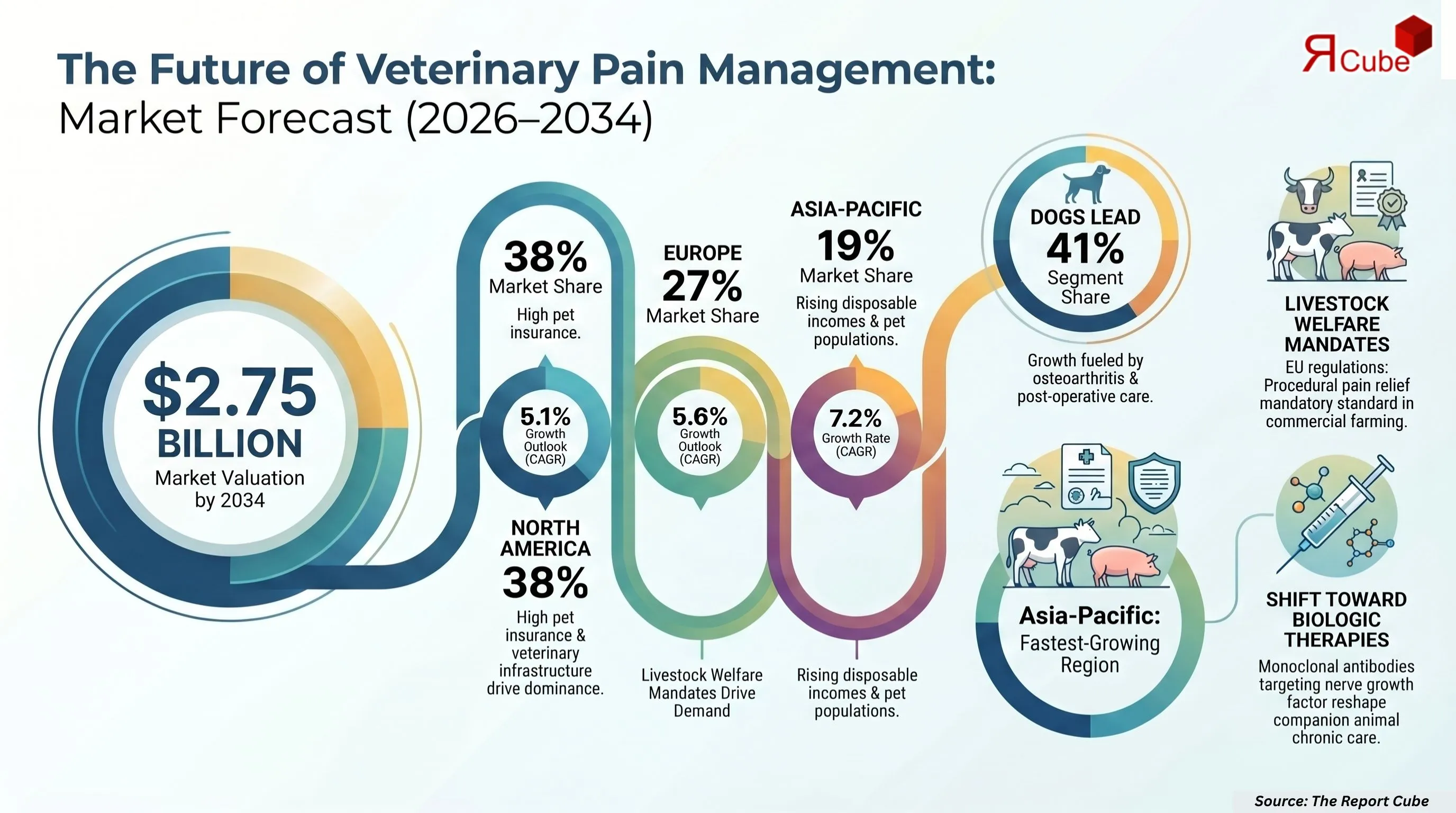
- The global veterinary pain management market is projected to grow from USD 1.8 billion in 2026 to USD 2.75 billion by 2034, at a CAGR of 5.45%.
- Veterinary hospitals hold the dominant end-user share, driven by higher surgical volumes and access to multimodal pain protocols.
- Dogs account for the largest animal-type segment, supported by high companion animal ownership rates and rising expenditures on pet healthcare.
- North America leads all regions, underpinned by established veterinary infrastructure, pet insurance penetration, and a high density of licensed practitioners.
- Asia-Pacific is the fastest-growing region, fuelled by expanding pet populations, rising disposable incomes, and increasing awareness of animal welfare standards.
Global Veterinary Pain Management Market Insights & Analysis
Pain in animals goes undetected longer than in humans, and by the time a pet owner notices, the condition has often progressed. Veterinary pain management remains under-resourced globally, with the American Veterinary Medical Association (AVMA) estimating that a majority of chronic pain cases in companion animals go undiagnosed or untreated until clinical severity forces intervention (AVMA, 2024). That gap between observable suffering and medical response is exactly where market growth concentrates.
The global veterinary pain management market is valued at USD 1.8 billion in 2026 and is forecast to reach USD 2.75 billion by 2034 at a CAGR of 5.45%. Growth is driven by three converging forces: the humanisation of pets in developed economies, expanded regulatory approvals for veterinary-specific analgesics, and a measurable shift in veterinary practice standards toward proactive pain assessment protocols. The market is not uniform, companion animal pain care, particularly for dogs and cats, far outpaces livestock pain management in both volume and per-treatment spend. However, livestock segments are gaining regulatory attention, particularly in the European Union, where mandatory pain relief for certain agricultural procedures has been progressively extended under EU Regulation 2016/429 (European Commission, 2016).
Key players operating across this market include Zoetis, Elanco, Boehringer Ingelheim, Merck & Co., Inc., Dechra Pharmaceuticals Plc (EQT), Vetoquinol, Ceva Animal Health, Norbrook, Chanelle Pharma (Exponent), and Assisi (Wind Point Partners). These companies compete on pipeline breadth, label extensions, and regional distribution strength. Zoetis and Elanco currently hold the largest combined share, supported by their broad species coverage and established relationships with veterinary hospital networks across North America and Europe.
Global Veterinary Pain Management Market Dynamics
Key Market Driver: Rising Pet Humanisation and Companion Animal Healthcare Spending
Pet ownership rates are climbing, and so is the average spend per animal. The American Pet Products Association (APPA) reported that U.S. pet industry expenditure reached USD 147 billion in 2023, with veterinary care and product spending representing the second-largest category (APPA, 2023). As owners treat pets as family members, tolerance for untreated pain has declined, directly expanding the addressable patient population for analgesic products. This driver is most pronounced in dogs and cats, where elective procedures, orthopaedic surgeries, and chronic disease management increasingly incorporate structured pain management protocols.
Major Industry Challenge: Regulatory Fragmentation Across Species and Geographies
Approving analgesics for veterinary use is not a single-market problem, it is a multi-species, multi-jurisdiction challenge. A compound approved for use in dogs in the United States may face a different regulatory pathway for equine or livestock applications in the EU, and an entirely separate review process in emerging markets. The U.S. Food and Drug Administration's Center for Veterinary Medicine (FDA-CVM) requires species-specific clinical data, meaning that a pain product approved for dogs cannot be automatically applied to cats without separate trials (FDA, 2023). This regulatory fragmentation increases time-to-market, raises R&D costs, and creates pricing asymmetries across geographies, constraining smaller players and slowing market penetration in non-companion animal segments.
Emerging Trend: Multimodal Pain Management Protocols in Veterinary Practice
Single-drug pain management is giving way to protocol-based, multimodal approaches. Veterinary anaesthesiologists increasingly combine NSAIDs, opioids, local anaesthetics, and adjunctive therapies such as gabapentin to manage perioperative and chronic pain more effectively while reducing individual drug doses and associated adverse effects. The International Veterinary Academy of Pain Management (IVAPM) has published guidelines supporting this approach across companion and equine species (IVAPM, 2022). The shift creates demand for a broader product portfolio per patient episode, supporting growth in both pharmaceutical sales volume and premium-priced combination protocols.
Need Specific Data, Let’s Customize the Report for You
Request CustomizationEmerging Opportunity: Veterinary Pain Management in Livestock Under Welfare Mandates
Livestock pain management has historically lagged companion animal care, but regulatory mandates are reshaping the economics. The EU's Farm to Fork Strategy and updated animal welfare legislation are driving mandatory analgesic use for procedures such as dehorning, castration, and tail docking in cattle and swine (European Commission, 2020). This creates a newly formalised demand category. Companies with existing livestock pharmaceutical portfolios, particularly Boehringer Ingelheim and Zoetis, are positioned to capture this segment as welfare-compliant protocols become standard in commercial farming operations across Europe and, increasingly, in markets adopting EU-equivalent standards.
Global Veterinary Pain Management Market Segment-wise Analysis
By End User
Veterinary hospitals concentrate the highest pain management spend per visit, combining surgical analgesic protocols, post-operative pain monitoring, and chronic disease management into a single care pathway. This segment leads the market and is projected to retain its dominance through 2034, driven by rising surgical volumes in companion animal care and the adoption of IVAPM-recommended pain scoring systems.
|
End User Segment |
Estimated Share (2026) |
Growth Outlook |
Key Driver |
|---|---|---|---|
|
Veterinary Hospitals |
52% |
High |
Surgical volume growth; multimodal protocol adoption |
|
Clinics |
34% |
Moderate |
Preventive care integration; chronic pain management |
|
Research Institutes |
14% |
Steady |
Drug development pipelines; species-specific trials |
Veterinary clinics, while smaller in per-visit analgesic spend, represent a high-volume entry point for chronic pain management in companion animals, particularly as NSAID therapy for osteoarthritis in ageing dog and cat populations becomes a standard long-term prescription. Research institutes drive a smaller but strategically important share, sustaining R&D activity for new analgesic compounds and species-specific formulations.
By Animal Type
Dogs account for the largest animal-type share of the veterinary pain management market, supported by the highest per-animal veterinary spend among companion species and a well-documented clinical evidence base for analgesic protocols. Osteoarthritis, post-surgical pain, and cancer-related pain are the three most common indications driving dog-directed prescriptions.
|
Animal Type |
Estimated Share (2026) |
Growth Outlook |
Primary Indication |
|---|---|---|---|
|
Dogs |
41% |
High |
Osteoarthritis; post-operative pain; oncology pain |
|
Cats |
22% |
High |
Chronic musculoskeletal pain; dental pain; surgery |
|
Horses |
18% |
Moderate |
Musculoskeletal injuries; colic; post-surgical pain |
|
Livestock |
19% |
Fast-growing |
Welfare-mandated procedural analgesia |
Cats represent the fastest-growing companion animal sub-segment, partly because feline pain has historically been under-recognised and under-treated. A growing body of peer-reviewed evidence has quantified the prevalence of degenerative joint disease in cats, with one study in the Journal of Feline Medicine and Surgery estimating that over 90% of cats over 12 years of age show radiographic evidence of joint degeneration (Journal of Feline Medicine and Surgery, 2022). This has prompted regulatory approvals for feline-specific analgesics, most notably the monoclonal antibody frunevetmab (Solensia, Zoetis), approved by the European Medicines Agency in 2021 and FDA-approved in 2023. Livestock is the fastest-growing segment by absolute trajectory, driven by welfare mandate enforcement.
Regional Projection of Global Veterinary Pain Management Market
|
Region |
Estimated Share (2026) |
CAGR |
Key Driver |
Notable Gap |
|---|---|---|---|---|
|
North America |
38% |
5.1% |
Pet insurance penetration; high veterinary spend |
Rural veterinary access limits livestock segment |
|
Europe |
27% |
5.6% |
Animal welfare regulation; livestock mandate rollout |
Regulatory divergence post-Brexit (UK vs. EU) |
|
Asia-Pacific |
19% |
7.2% |
Pet population growth; rising middle-class spend |
Under-developed veterinary infrastructure in rural markets |
|
Latin America |
9% |
4.8% |
Brazil and Mexico companion animal market expansion |
Pricing and affordability barriers |
|
Middle East & Africa |
7% |
4.3% |
Equine segment in GCC; growing veterinary networks |
Limited livestock regulation enforcement |
- North America leads with approximately 38% of the global market in 2026. The U.S. drives the bulk of this share, the country has the world's highest per-capita veterinary expenditure, with APPA data placing total U.S. vet care and product spending above USD 38 billion annually (APPA, 2023). Pet insurance adoption, now covering an estimated 4–5% of U.S. pets, removes cost barriers for higher-value pain management interventions and supports repeat prescription fills.
- Europe is the second-largest region and the most regulatory-active. The EU's progressive extension of mandatory procedural analgesia in livestock is reshaping the livestock segment, while companion animal pain management in markets like Germany, France, and the Netherlands mirrors North American patterns. The post-Brexit regulatory divergence between the UK's Veterinary Medicines Directorate and the EMA has introduced some delay in cross-market product approvals but has not significantly dampened UK demand.
- Asia-Pacific is the fastest-growing region at an estimated 7.2% CAGR through 2034. China and Japan account for the largest shares, with China showing the most rapid growth in companion animal ownership, the Chinese pet market exceeded USD 25 billion in 2022 (China Pet Industry White Paper, 2023). Veterinary infrastructure in urban centres is developing quickly, though rural regions lag significantly in trained practitioners and analgesic availability.
- Latin America is growing steadily, led by Brazil and Mexico. Brazil's pet market is the world's third-largest by animal population, though per-animal veterinary spend remains well below North American levels. Argentina and Colombia represent secondary growth markets.
- Middle East & Africa shows a bifurcated pattern, GCC equine care (particularly in the UAE and Saudi Arabia) sustains a premium analgesic segment, while sub-Saharan livestock markets remain largely outside the formal pain management market due to cost and access constraints.
Global Veterinary Pain Management Market, Recent Developments (2025)
- Zoetis (January 2025): Announced expanded label approval for Librela (bedinvetmab) in additional EU markets for the treatment of chronic osteoarthritis pain in dogs, following Phase III trial data confirming sustained efficacy across 14 months of dosing.
- Elanco (March 2025): Received FDA approval for a new extended-release formulation of meloxicam for post-operative pain management in dogs, reducing dosing frequency from daily to every 72 hours.
- Assisi Animal Health / Wind Point Partners (February 2025): Expanded distribution of its non-pharmaceutical pulsed electromagnetic field (PEMF) therapy devices into Australian and New Zealand veterinary hospital networks, marking the brand's first entry into Asia-Pacific markets.
Global Veterinary Pain Management Market Future Outlook (2034)
Veterinary pain management is entering a period of category maturation, where the question is no longer whether to treat animal pain, but how precisely, at what cost, and through which channel. By 2034, the market is projected to reach USD 2.75 billion, shaped by four structural forces. First, biologic therapies, specifically monoclonal antibodies targeting nerve growth factor (NGF) pathways, will capture a growing share of the companion animal segment. Zoetis's Librela and Solensia are early proofs of concept; pipeline candidates from Elanco, Boehringer Ingelheim, and Dechra are expected to enter market by 2028–2030, intensifying the premium segment. Second, digital pain monitoring tools integrated with veterinary practice management software will create a data layer supporting chronic pain prescription decisions, reducing the diagnostic gap that currently suppresses prescription rates.
Third, animal welfare regulation will continue to formalise livestock pain management as a mandatory cost of production in regulated markets, converting an optional expenditure into a recurring, compliance-driven demand category across Europe and, progressively, in markets adopting equivalent standards. Fourth, generic competition will pressure NSAID pricing in mature markets, compressing margins at the commodity end while premium biologics drive revenue growth at the top. Companies that invest now in species-specific pipeline expansion and regulatory relationship-building in Asia-Pacific will hold the strongest competitive positions by 2034.
Global Veterinary Pain Management Market Report Coverage
|
Report Features |
Details |
|---|---|
|
Market Size (Value) |
USD 1.8 Billion (2026) |
|
Forecast Period |
2026–2034 |
|
CAGR |
5.45% |
|
Base Year |
2026 |
|
Historical Data |
2021–2025 |
|
Customization |
Available |
|
Segments Covered |
By End User; By Animal Type; By Product Type; By Route of Administration |
|
Regions Covered |
North America; Europe; Asia-Pacific; Latin America; Middle East & Africa |
|
Key Companies |
Zoetis; Elanco; Boehringer Ingelheim; Merck & Co., Inc.; Dechra Pharmaceuticals Plc (EQT); Vetoquinol; Ceva Animal Health; Norbrook; Chanelle Pharma (Exponent); Assisi (Wind Point Partners) |
|
Report Format |
PPT, PDF & Excel |
Why Choose This Report?
- Covers all four primary animal-type segments, dogs, cats, horses, and livestock, with species-specific growth drivers and regulatory context, not a single blended figure.
- Includes recent developments from 2024–2025, covering Zoetis Librela label expansions, Elanco FDA approvals, and Boehringer Ingelheim acquisition activity.
- Regional analysis spans five geographies with sub-country breakdowns for North America, Europe, and Asia-Pacific, including China's fast-growing pet market.
- Addresses the livestock welfare mandate segment specifically, covering EU regulatory timelines and their commercial implications for key players.
- Competitive landscape maps ten named players, including private equity-backed entities Dechra/EQT, Chanelle/Exponent, and Assisi/Wind Point Partners, with portfolio and distribution analysis.
- Distinguishes between pharmaceutical analgesics, monoclonal antibody biologics, and non-pharmaceutical adjunctive therapies in the product landscape.
- Delivered in PPT, PDF, and Excel formats, with customisation available for additional species, geographies, or product sub-categories.
Table of Contents
- Introduction
- Objective of the study
- Product Definition
- Market Segmentation
- Study Variables
- Research Methodology
- Secondary Data Points
- Companies Interviewed
- Primary Data Points
- Breakdown of Primary Interviews
- Secondary Data Points
- Executive Summary
- Market Dynamics
- Drivers
- Challenges
- Opportunity Assessment
- Recent Trends and Developments
- Policy and Regulatory Landscape
- Global Veterinary Pain Management Market Overview and Forecast Analysis (2021-2034)
- Market Size, By Value, By growth rate (CAGR/USD Billions)
- Demand - Supply Trends
- Market Share, By End User
- Veterinary Hospitals
- Clinics
- Research Institutes
- Market Share, By Animal Type
- Dogs
- Cats
- Horses
- Livestock
- Market Share, By Product Type
- Non-Steroidal Anti-Inflammatory Drugs
- Opioids
- Analgesics
- Adjuvant Analgesics
- Market Share, By Route of Administration
- Oral
- Injections
- Transdermal
- Topical
- Market Share, By Region
- North America
- Europe
- Asia-Pacific
- Latin America
- Middle East & Africa
- Market Share, By Company
- Revenue Shares
- Competition Characteristics
- North America Veterinary Pain Management Market Overview (2021-2034)
- Market Size, By Value (in USD Billions)
- Market Share, By End User
- Market Share, By Animal Type
- Market Share, By Product Type
- Market Share, By Route of Administration
- By Country
- The US
- Canada
- Mexico
- The US Veterinary Pain Management Market Overview (2021-2034)
- Market Share, By End User
- Market Share, By Animal Type
- Market Share, By Product Type
- Market Share, By Route of Administration
- Canada Veterinary Pain Management Market Overview (2021-2034)
- Market Share, By End User
- Market Share, By Animal Type
- Market Share, By Product Type
- Market Share, By Route of Administration
- Mexico Veterinary Pain Management Market Overview (2021-2034)
- Market Share, By End User
- Market Share, By Animal Type
- Market Share, By Product Type
- Market Share, By Route of Administration
- South America Veterinary Pain Management Market Overview (2021-2034)
- Market Size, By Value (in USD Billions)
- Market Share, By End User
- Market Share, By Animal Type
- Market Share, By Product Type
- Market Share, By Route of Administration
- By Country
- Brazil
- Argentina
- Rest of South America
- Brazil Veterinary Pain Management Market Overview (2021-2034)
- Market Share, By End User
- Market Share, By Animal Type
- Market Share, By Product Type
- Market Share, By Route of Administration
- Argentina Veterinary Pain Management Market Overview (2021-2034)
- Market Share, By End User
- Market Share, By Animal Type
- Market Share, By Product Type
- Market Share, By Route of Administration
- Europe Veterinary Pain Management Market Overview (2021-2034)
- Market Size, By Value (in USD Billions)
- By End User
- By Animal Type
- By Product Type
- By Route of Administration
- By Country
- Germany
- The UK
- France
- Spain
- Italy
- Rest of Europe
- Germany Veterinary Pain Management Market Overview (2021-2034)
- Market Share, By End User
- Market Share, By Animal Type
- Market Share, By Product Type
- Market Share, By Route of Administration
- France Veterinary Pain Management Market Overview (2021-2034)
- Market Share, By End User
- Market Share, By Animal Type
- Market Share, By Product Type
- Market Share, By Route of Administration
- The UK Veterinary Pain Management Market Overview (2021-2034)
- Market Share, By End User
- Market Share, By Animal Type
- Market Share, By Product Type
- Market Share, By Route of Administration
- Spain Veterinary Pain Management Market Overview (2021-2034)
- Market Share, By End User
- Market Share, By Animal Type
- Market Share, By Product Type
- Market Share, By Route of Administration
- Italy Veterinary Pain Management Market Overview (2021-2034)
- Market Share, By End User
- Market Share, By Animal Type
- Market Share, By Product Type
- Market Share, By Route of Administration
- The Middle East & Africa Veterinary Pain Management Market Overview (2021-2034)
- Market Size, By Value (in USD Billions)
- By End User
- By Animal Type
- By Product Type
- By Route of Administration
- By Country
- The UAE
- Saudi Arabia
- South Africa
- Rest of the Middle East & Africa
- The UAE Veterinary Pain Management Market Overview (2021-2034)
- Market Share, By End User
- Market Share, By Animal Type
- Market Share, By Product Type
- Market Share, By Route of Administration
- Saudi Arabia Veterinary Pain Management Market Overview (2021-2034)
- Market Share, By End User
- Market Share, By Animal Type
- Market Share, By Product Type
- Market Share, By Route of Administration
- South Africa Veterinary Pain Management Market Overview (2021-2034)
- Market Share, By End User
- Market Share, By Animal Type
- Market Share, By Product Type
- Market Share, By Route of Administration
- Asia-Pacific Veterinary Pain Management Market Overview (2021-2034)
- Market Size, By Value (in USD Billions)
- By End User
- By Animal Type
- By Product Type
- By Route of Administration
- By Country
- China
- India
- Japan
- South Korea
- Australia
- Rest of Asia-Pacific
- China Veterinary Pain Management Market Overview (2021-2034)
- Market Share, By End User
- Market Share, By Animal Type
- Market Share, By Product Type
- Market Share, By Route of Administration
- India Veterinary Pain Management Market Overview (2021-2034)
- Market Share, By End User
- Market Share, By Animal Type
- Market Share, By Product Type
- Market Share, By Route of Administration
- Japan Veterinary Pain Management Market Overview (2021-2034)
- Market Share, By End User
- Market Share, By Animal Type
- Market Share, By Product Type
- Market Share, By Route of Administration
- South Korea Veterinary Pain Management Market Overview (2021-2034)
- Market Share, By End User
- Market Share, By Animal Type
- Market Share, By Product Type
- Market Share, By Route of Administration
- Austraila Veterinary Pain Management Market Overview (2021-2034)
- Market Share, By End User
- Market Share, By Animal Type
- Market Share, By Product Type
- Market Share, By Route of Administration
- Competitive Outlook (Company Profile - Partial List)
- Boehringer Ingelheim
- Company Overview
- Business Segments
- Strategic Alliances/Partnerships
- Recent Developments
- Vetoquinol
- Company Overview
- Business Segments
- Strategic Alliances/Partnerships
- Recent Developments
- Ceva Animal Health, Llc
- Company Overview
- Business Segments
- Strategic Alliances/Partnerships
- Recent Developments
- Chanelle Pharma (Exponent)
- Company Overview
- Business Segments
- Strategic Alliances/Partnerships
- Recent Developments
- Elanco
- Company Overview
- Business Segments
- Strategic Alliances/Partnerships
- Recent Developments
- Dechra Pharmaceuticals Plc (Eqt)
- Company Overview
- Business Segments
- Strategic Alliances/Partnerships
- Recent Developments
- Zoetis
- Company Overview
- Business Segments
- Strategic Alliances/Partnerships
- Recent Developments
- Merck & Co., Inc.
- Company Overview
- Business Segments
- Strategic Alliances/Partnerships
- Recent Developments
- Norbrook
- Company Overview
- Business Segments
- Strategic Alliances/Partnerships
- Recent Developments
- Assisi (Wind Point Partners)
- Company Overview
- Business Segments
- Strategic Alliances/Partnerships
- Recent Developments
- Others
- Boehringer Ingelheim
- Disclaimer
Top Key Players & Market Share Outlook
- Boehringer Ingelheim
- Vetoquinol
- Ceva Animal Health, Llc
- Chanelle Pharma (Exponent)
- Elanco
- Dechra Pharmaceuticals Plc (Eqt)
- Zoetis
- Merck & Co., Inc.
- Norbrook
- Assisi (Wind Point Partners)
- Others
Frequently Asked Questions






