




Build Your Custom Market Intelligence Report
Customize Your ReportGCC Warehousing and Distribution Logistics Market Size, Share, Trends & Forecast 2026-2034
Key Takeaways
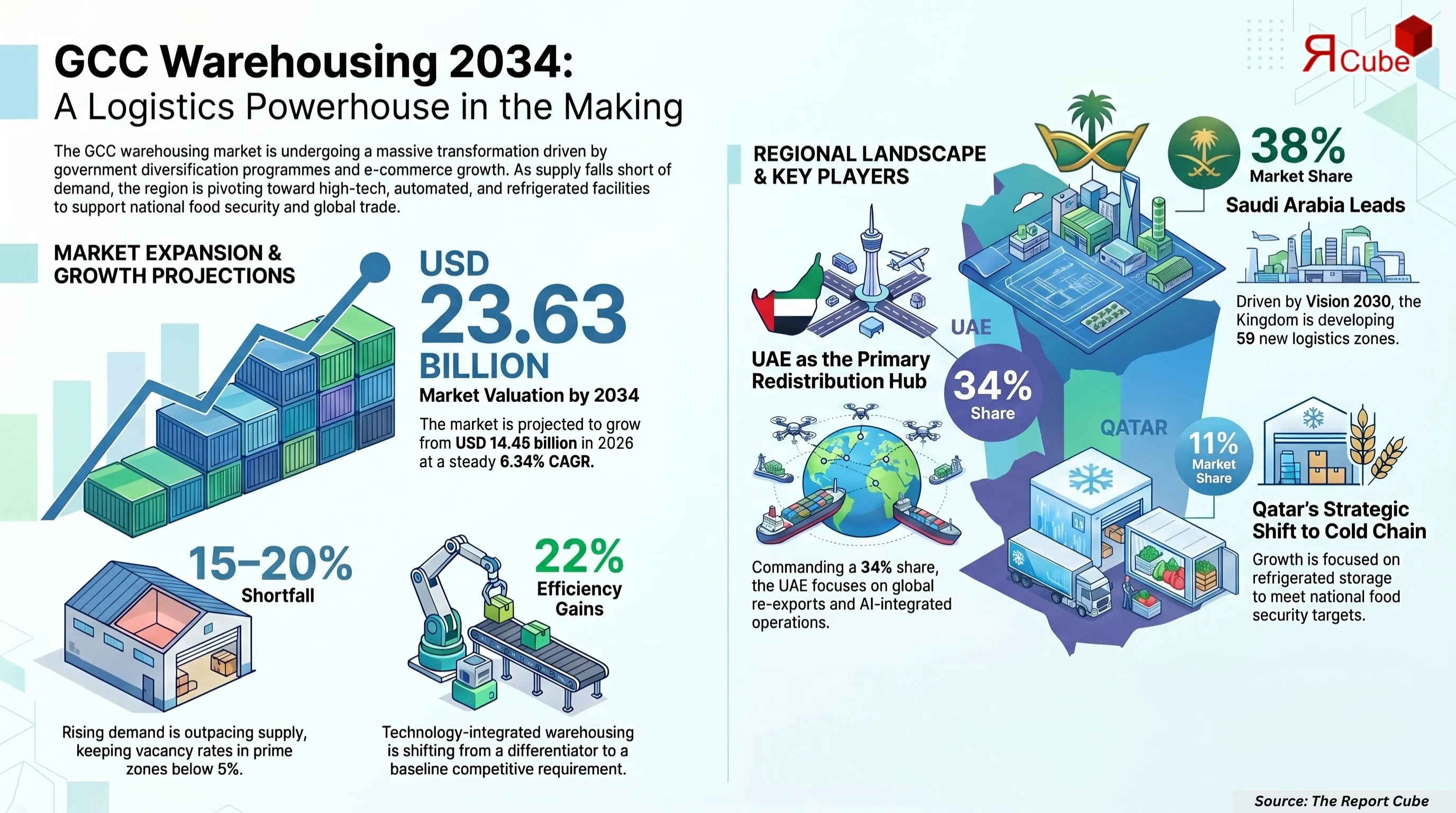
- The GCC warehousing and distribution logistics market is projected to grow from USD 14.45 billion in 2026 to USD 23.63 billion by 2034, at a CAGR of 6.34%.
- Saudi Arabia accounts for the largest share of GCC warehousing demand, driven by Vision 2030 logistics infrastructure investments (Saudi Vision 2030, 2024).
- Private warehouse adoption is accelerating as e-commerce operators and 3PL providers seek dedicated, temperature-controlled, and technology-integrated storage solutions.
- Cold chain logistics infrastructure is expanding across the UAE and Saudi Arabia, supported by food security mandates and pharmaceutical distribution requirements.
GCC Warehousing and Distribution Logistics Market Insights & Analysis
Warehousing costs in the GCC are rising faster than operators can absorb - average occupancy rates in prime UAE logistics zones exceeded 95% in 2023 (JLL MENA Real Estate, 2024), and available Grade A warehouse space remains undersupplied by an estimated 15–20% relative to demand. This imbalance is pushing lease rates upward and forcing logistics operators to weigh costly private builds against shrinking public storage inventories. The GCC warehousing and distribution logistics market offers a direct solution: a structured breakdown of where growth is occurring, which warehouse types carry the highest returns, and which ownership models are gaining operator preference through 2034.
The GCC's warehousing sector sits at the intersection of three structural shifts - government-mandated diversification programs, a post-pandemic reorganisation of regional supply chains, and surging cross-border e-commerce volumes. Saudi Arabia's Vision 2030 has earmarked over SAR 50 billion for logistics infrastructure upgrades (Saudi Vision 2030 Annual Report, 2023), while the UAE's National Agenda prioritises making Dubai a top-five global logistics hub by 2031 (UAE Government Portal, 2024). These state-backed commitments translate directly into demand for modern, scalable warehousing, both for domestic consumption and as regional redistribution nodes serving South Asia, East Africa, and the Levant.
Private warehousing is outpacing public options at a measured but sustained rate. Operators with high-value inventory - pharmaceutical companies, electronics distributors, and luxury retailers - prefer the control, customisation, and compliance certainty that private facilities provide. Meanwhile, general warehousing and storage continues to command the largest volume share, given its role in FMCG, construction materials, and automotive parts distribution. The GCC logistics real estate market is reshaping around these dual forces, and understanding segment-level trajectory is essential for operators making capital allocation decisions through 2034.
GCC Warehousing and Distribution Logistics Market Dynamics
Key Market Driver: Vision 2030 and National Logistics Infrastructure Programs
GCC governments are spending at a scale that private investment alone could not replicate - and warehousing is a direct beneficiary. Saudi Arabia's National Transport and Logistics Strategy targets positioning the Kingdom as a global logistics hub by 2030, with dedicated spending on dry ports, bonded zones, and last-mile distribution infrastructure (Saudi Ministry of Transport, 2023). This creates a pipeline of large-format warehouse developments attached to multi-modal logistics parks, generating sustained demand for both general and refrigerated storage capacity through the forecast period.
Major Industry Challenge: Land Scarcity and Grade A Space Undersupply
Available warehouse land in key GCC economic zones is constrained by competing urban development priorities. In Dubai's prime logistics corridors - Dubai Investments Park, Al Quoz, and Jebel Ali - vacancy rates for Grade A warehousing have fallen below 3% (CBRE MENA, 2024), making capacity expansion a multi-year project rather than an on-demand response. Developers face 18–36-month permitting and construction timelines, meaning demand surges - such as those triggered by e-commerce peaks or new pharmaceutical cold chain mandates - cannot be met quickly. This structural gap limits short-term market elasticity and increases the cost burden on operators locked into above-market lease renewals.
Emerging Trend: Automation and Warehouse Management System Adoption
GCC warehouse operators are deploying automated storage and retrieval systems (AS/RS), autonomous mobile robots (AMR), and AI-driven warehouse management systems (WMS) at a pace driven by labour cost pressures and e-commerce fulfilment speed requirements. Amazon's fulfilment centre expansion in Saudi Arabia and the UAE, alongside Aramex's investment in automated sorting infrastructure, signals that technology-integrated warehousing is shifting from a differentiator to a baseline expectation. Global WMS software spending in the Middle East is projected to grow at 9.1% CAGR through 2028 (Gartner, 2024), reflecting the acceleration of this adoption curve across tier-1 and tier-2 GCC logistics providers.
Need Specific Data, Let’s Customize the Report for You
Request CustomizationEmerging Opportunity: Refrigerated Warehousing for Pharmaceutical and Food Security Mandates
GCC governments are legislating cold chain requirements as part of national food security and pharmaceutical sovereignty strategies. Qatar's National Food Security Program and the UAE's AgriFood Strategy 2051 each mandate expanded cold storage capacity linked to local production and strategic buffer stocks (Qatar Planning and Statistics Authority, 2023; UAE Ministry of Climate Change, 2024). For warehousing operators, this creates a high-margin, government-backed demand channel for refrigerated storage that carries fewer vacancy risks than general-purpose facilities. The GCC cold chain logistics market is poised to grow disproportionately within the broader warehousing market through 2034, making refrigerated capacity a priority capital allocation for operators entering or expanding in the region.
GCC Warehousing and Distribution Logistics Market Segment-wise Analysis
By Warehouse Type
General warehousing and storage holds the dominant share of the GCC warehousing market, driven by the region's high import dependency - GCC states collectively import over 85% of their food supply and a comparable proportion of manufactured goods (FAO, 2023). General warehouses serve as the backbone of FMCG, electronics, automotive parts, and construction materials distribution, benefiting from established 3PL relationships and multi-client storage configurations that optimise cost per pallet.
|
Warehouse Type |
Estimated Market Share (2026) |
Growth Outlook (2026-2034) |
|---|---|---|
|
General Warehousing and Storage |
68% |
Steady; driven by FMCG and e-commerce volume |
|
Refrigerated Warehousing and Storage |
32% |
Accelerated; driven by food security and pharma mandates |
Refrigerated warehousing is the faster-growing sub-segment within the type dimension. The UAE's pharmaceutical exports reached USD 3.1 billion in 2023 (UAE Ministry of Economy, 2024), and maintaining cold chain integrity from manufacturer to end distributor requires expanding refrigerated storage capacity at each node. Saudi Arabia's domestic food production expansion under Vision 2030 likewise requires increased cold storage for perishable output. The unit economics of refrigerated storage - higher lease rates, longer contract tenures, and lower speculative vacancy risk - make this sub-segment attractive to institutional warehouse developers.
By Ownership
Private warehouses are gaining share within the GCC as operators prioritise operational control, compliance customisation, and integration with proprietary WMS platforms. Large-scale retailers, pharmaceutical distributors, and e-commerce fulfilment operators - including Amazon, Noon, and major healthcare distributors - increasingly commit capital to owned or long-term-leased dedicated facilities rather than competing for shrinking public warehouse space.
|
Ownership Type |
Estimated Market Share (2026) |
Growth Outlook (2026-2034) |
|---|---|---|
|
Private Warehouses |
55% |
Growing; driven by 3PL expansion and e-commerce |
|
Public Warehouses |
45% |
Stable; serving SMEs and seasonal demand overflow |
Public warehouses retain a critical role for SMEs, seasonal importers, and companies testing new GCC markets before committing to fixed-cost private facilities. Free zone operators in Jebel Ali (UAE) and King Abdullah Economic City (Saudi Arabia) provide public warehousing with added trade facilitation services - customs clearance, re-labelling, and bonded storage - that keep this segment relevant for cross-border distribution players. GCC free zone logistics market dynamics directly influence public warehouse demand as new free zone developments come online through the forecast period.
Regional Projection of GCC Warehousing and Distribution Logistics Market
|
Region |
Estimated Share (2026) |
Key Driver |
Supply Gap |
|---|---|---|---|
|
Saudi Arabia |
38% |
Vision 2030 logistics infrastructure |
Grade A shortage in Riyadh and Jeddah corridors |
|
UAE |
34% |
Dubai as a global redistribution hub |
Sub-3% vacancy in prime zones |
|
Qatar |
11% |
Post-FIFA 2022 infrastructure utilisation |
Cold chain undersupply relative to food security targets |
|
Kuwait |
8% |
Import-dependent economy; FMCG demand |
Limited bonded warehousing capacity |
|
Oman |
6% |
Duqm Special Economic Zone development |
Distance from primary demand centres |
|
Bahrain |
3% |
Financial services-linked logistics demand |
Smallest market; dependent on Saudi cross-border trade |
- Saudi Arabia leads the GCC market by volume and growth investment. The National Transport and Logistics Strategy is building 59 logistics zones linked to rail, road, and port infrastructure (Saudi Ministry of Transport, 2023), creating structured demand for warehousing at each node. Riyadh and Jeddah are the primary demand centres, with e-commerce fulfilment and FMCG distribution driving the most active leasing activity.
- UAE operates as the GCC's primary redistribution node, with Jebel Ali Port - the largest port in the Middle East - anchoring a logistics ecosystem that handles re-exports to over 100 countries (DP World, 2024). Dubai's ambition to rank among the top five global logistics hubs by 2031 is backed by continued free zone expansion and investment in AI-integrated port and warehouse operations.
- Qatar is converting post-World Cup infrastructure into logistics capacity, with refrigerated warehousing growth accelerating as the country pursues food self-sufficiency targets under its National Food Security Program (Qatar Planning and Statistics Authority, 2023).
- Oman is an emerging market within the GCC, with the Duqm Special Economic Zone positioning itself as a logistics gateway to South Asia and East Africa. Warehouse development in Duqm is at an early stage but benefits from 25-year tax exemption frameworks that attract long-term logistics investment.
GCC Warehousing and Distribution Logistics Market - Recent Developments (2025)
- DHL Supply Chain announced a USD 100 million investment in new automated warehousing facilities in Saudi Arabia and the UAE (January 2025), targeting pharmaceutical and e-commerce clients.
- Kuehne + Nagel opened a GCC regional distribution centre in King Abdullah Economic City, providing bonded warehousing and pharma-grade cold chain services (February 2025).
- FedEx announced expansion of its Saudi Arabia hub capacity by 30%, driven by B2C e-commerce growth and same-day delivery demand from Riyadh and Jeddah (April 2025).
GCC Warehousing and Distribution Logistics Market Future Outlook (2034)
Grade A warehouse vacancy across the GCC's primary logistics corridors is forecast to remain below 5% through 2028, sustaining above-average rental growth that compresses returns for operators without owned assets. The market will bifurcate between high-specification facilities - cold chain, automation-ready, ESG-compliant - and older, lower-grade stock that faces functional obsolescence as regulatory standards tighten. Operators who have not begun capital programs by 2026 face a 3–5-year lag before new capacity can enter service.
Three forces will define the GCC warehousing market by 2034. First, automation penetration will cross a threshold where manual-only operations become commercially unviable for tier-1 clients - the cost differential between automated and manual fulfilment at scale will exceed 18–22% per unit handled (Gartner, 2024), making WMS and robotics investment a competitive necessity rather than a premium option. Second, refrigerated warehousing will outgrow the broader market as GCC food security legislation moves from aspiration to mandate - Qatar, Saudi Arabia, and the UAE have each set 2030 targets for domestic food production that require expanded cold storage at every supply chain node. Third, cross-border e-commerce will continue growing at double the rate of domestic retail, sustaining demand for bonded warehousing and last-mile distribution infrastructure at UAE and Saudi Arabia gateway nodes. The GCC warehousing and distribution logistics market will reach USD 23.63 billion by 2034, with the operators who combine owned assets, automation investment, and cold chain capability positioned to capture disproportionate share.
GCC Warehousing and Distribution Logistics Market Report Coverage
|
Report Features |
Details |
|---|---|
|
Market Size (Value) |
USD 14.45 Billion (2026) |
|
Forecast Period |
2026-2034 |
|
CAGR |
6.34% |
|
Base Year |
2026 |
|
Historical Data |
2021-2025 |
|
Delivery |
PPT, PDF & Excel |
|
Segments Covered |
By Warehouse Type; By Ownership, By End-User Industry |
|
Regions Covered |
Saudi Arabia, UAE, Qatar, Kuwait, Oman, Bahrain |
|
Key Companies |
DHL Group, GWC, Aramex, Al-Futtaim Logistics, GAC, Al-Majdouie Logistics, CMA CGM (incl. CEVA Logistics), Kuehne + Nagel, FedEx |
|
Customisation |
Available |
Why Choose This Report?
- Covers all six GCC member states with country-level market sizing and growth projections through 2034.
- Provides segment-level revenue forecasts for both warehouse type and ownership dimensions - not just headline market totals.
- Maps recent capital investment by key players including DHL, CMA CGM, Aramex, and GWC against available capacity data.
- Includes cold chain and refrigerated warehousing analysis aligned to GCC national food security and pharmaceutical distribution mandates.
- Benchmarks public vs. private warehouse economics with occupancy rate, lease rate, and return-on-asset data by country.
- Tracks government logistics infrastructure programs - Saudi Vision 2030, UAE National Agenda, Qatar National Food Security Program - and their direct warehousing demand implications.
- Delivered in PPT, PDF, and Excel for immediate integration into investment memos, feasibility studies, and strategic planning decks.
Table of Contents
- Introduction
- Objective of the study
- Product Definition
- Market Segmentation
- Study Variables
- Research Methodology
- Secondary Data Points
- Companies Interviewed
- Primary Data Points
- Breakdown of Primary Interviews
- Secondary Data Points
- Executive Summary
- Market Dynamics
- Drivers
- Challenges
- Opportunity Assessment
- Recent Trends and Developments
- Policy and Regulatory Landscape
- GCC Warehousing and Distribution Logistics Market Overview and Forecast Analysis (2021-2034)
- Market Size, By Value, By growth rate (CAGR/USD Billions)
- Demand - Supply Trends
- Market Share, By Warehouse Type
- General Warehousing and Storage
- Refrigerated Warehousing and Storage
- Market Share, By Ownership
- Private Warehouses
- Public Warehouses
- Market Share, By End-User Industry
- E-commerce & Retail
- Food & Beverage
- Pharma & Healthcare
- Automotive
- Manufacturing & Engineering Goods
- Others
- Market Share, By Country
- Saudi Arabia
- UAE
- Qatar
- Kuwait
- Oman
- Bahrain
- Market Share, By Company
- Revenue Shares
- Competition Characteristics
- Saudi Arabia Warehousing and Distribution Logistics Market Overview, 2021-2034 F
- Market Size, By Value (in USD Billions)
- By Warehouse Type
- By Ownership
- By End-User Industry
- UAE Warehousing and Distribution Logistics Market Overview, 2021-2034 F
- Market Size, By Value (in USD Billions)
- By Warehouse Type
- By Ownership
- By End-User Industry
- Qatar Warehousing and Distribution Logistics Market Overview, 2021-2034 F
- Market Size, By Value (in USD Billions)
- By Warehouse Type
- By Ownership
- By End-User Industry
- Kuwait Warehousing and Distribution Logistics Market Overview, 2021-2034 F
- Market Size, By Value (in USD Billions)
- By Warehouse Type
- By Ownership
- By End-User Industry
- Oman Warehousing and Distribution Logistics Market Overview, 2021-2034 F
- Market Size, By Value (in USD Billions)
- By Warehouse Type
- By Ownership
- By End-User Industry
- Competitive Outlook (Company Profile - Partial List)
- DHL Group
- Company Overview
- Business Segments
- Strategic Alliances/Partnerships
- Recent Developments
- GWC
- Company Overview
- Business Segments
- Strategic Alliances/Partnerships
- Recent Developments
- Aramex
- Company Overview
- Business Segments
- Strategic Alliances/Partnerships
- Recent Developments
- Al-Futtaime Logistics
- Company Overview
- Business Segments
- Strategic Alliances/Partnerships
- Recent Developments
- GAC
- Company Overview
- Business Segments
- Strategic Alliances/Partnerships
- Recent Developments
- Al-Majdouie Logistics
- Company Overview
- Business Segments
- Strategic Alliances/Partnerships
- Recent Developments
- CMA CGM (incl. Ceva Logistics)
- Company Overview
- Business Segments
- Strategic Alliances/Partnerships
- Recent Developments
- Kuehne + Nagel
- Company Overview
- Business Segments
- Strategic Alliances/Partnerships
- Recent Developments
- FedEx
- Company Overview
- Business Segments
- Strategic Alliances/Partnerships
- Recent Developments
- Others
- DHL Group
- Contact Us & Disclaimer
Top Key Players & Market Share Outlook
- DHL Group
- GWC
- Aramex
- Al-Futtaime Logistics
- GAC
- Al-Majdouie Logistics
- CMA CGM (incl. Ceva Logistics)
- Kuehne + Nagel
- FedEx
- Others
Frequently Asked Questions






