



Build Your Custom Market Intelligence Report
Customize Your ReportGCC Wires and Cables Market Key Highlights
By Type:
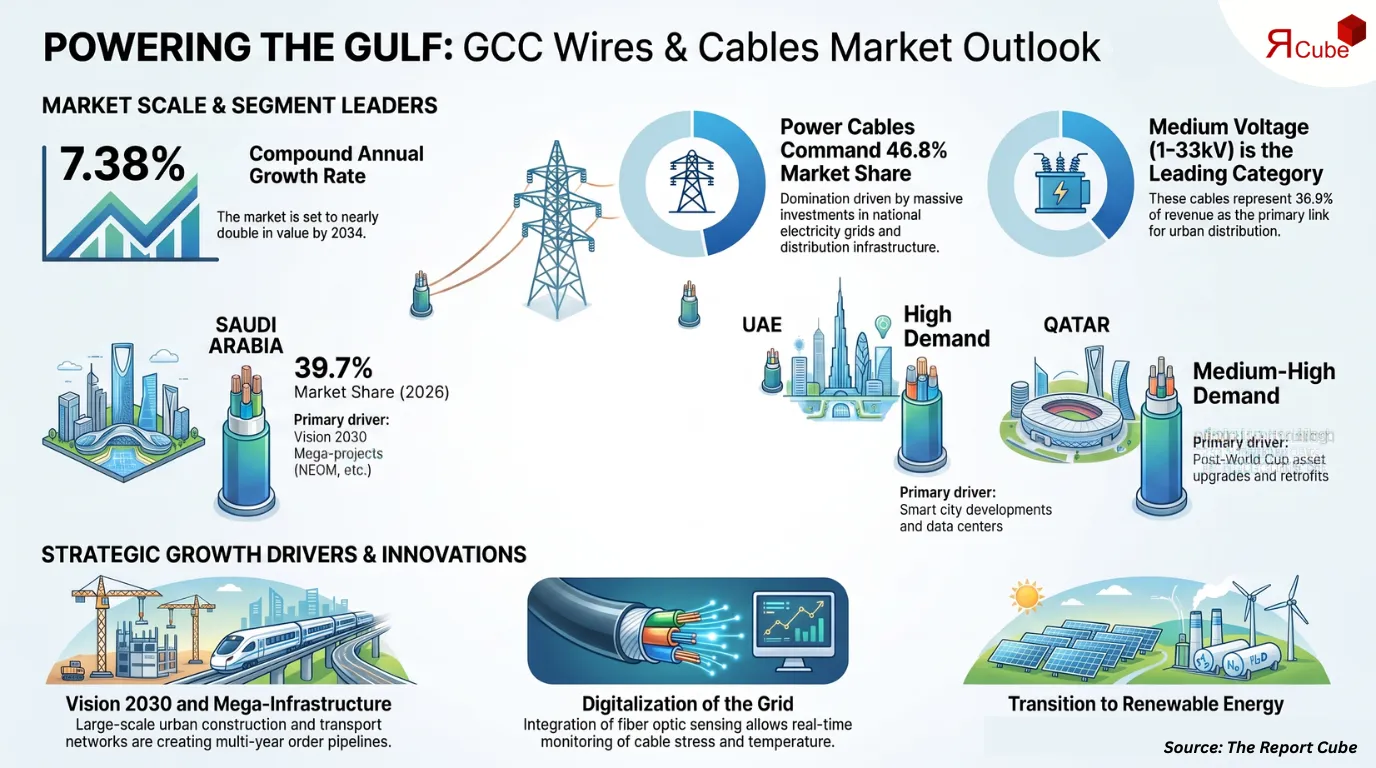
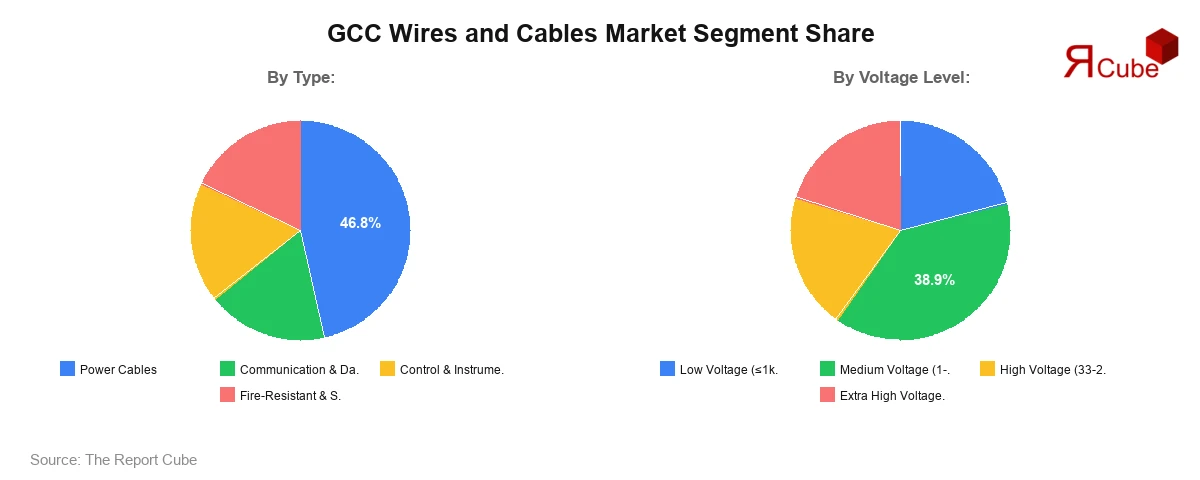
Power Cables segment leads the market with nearly 46.8% market share.
By Voltage Level:
Medium Voltage (1-33kV) segment dominates the market with around 38.9% of total revenue.
Countries Outlook:
Saudi Arabia dominates the GCC Wires and Cables Market with approximately 39.7% market share.
GCC Wires and Cables Market Insights & Analysis
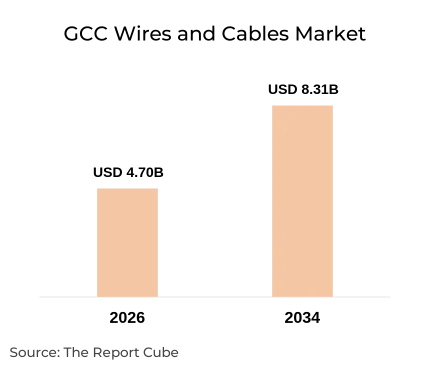
The GCC Wires and Cables Market is anticipated to register a CAGR of around 7.38% during the forecast period 2026-2034. The market size is valued at USD 4.70 billion in 2026 and is projected to reach USD 8.31 billion by 2034. Demand is being shaped by sustained investment in electricity infrastructure, industrial diversification, and large-scale urban construction across the Gulf Cooperation Council. Governments are allocating significant capital toward new substations, transmission corridors, industrial cities, airports, ports, rail networks, and mixed-use developments, all of which require reliable electrical distribution systems. Saudi Arabia continues to account for the largest share of regional cable consumption, supported by Vision 2030 projects, while the United Arab Emirates is strengthening demand through smart city developments, data center expansion, and next-generation utility networks. Growing electricity consumption across residential, commercial, and industrial sectors is encouraging utilities to expand and modernize transmission and distribution infrastructure, creating consistent demand for low-, medium-, high-, and extra-high-voltage cable systems.
Manufacturing capacity within the GCC has advanced considerably over the past few years as regional producers increase investments in automated production lines, advanced insulation technologies, and international product certification. Companies are expanding their portfolios with fire-resistant cables, low-smoke halogen-free products, fiber optic communication cables, and extra-high-voltage transmission solutions to address evolving infrastructure requirements. The region is also witnessing greater localization of cable manufacturing as governments encourage domestic industrial production to strengthen supply chain resilience and reduce reliance on imported electrical components. Rapid deployment of utility-scale solar projects, cross-border electricity interconnection programs, hydrogen production facilities, and digital infrastructure is expected to sustain long-term demand for high-performance cable solutions. These structural investments continue to strengthen the outlook for the GCC wires and cables industry while creating opportunities for manufacturers capable of supplying technically advanced and energy-efficient products.
GCC Wires and Cables Market Impact Analysis
| Factor | Type | Specific Impact on Market | Magnitude | Business Implication |
|---|---|---|---|---|
| Large Infrastructure Investments | Market | Construction and transport projects sharply lift cable demand | High | Supports multi year order pipelines across core segments |
| Power Grid and Renewables Expansion | Market | New transmission lines and solar farms need advanced cables | High | Drives sales of high voltage and renewable ready cable lines |
| Digitalization and Telecom Rollout | Technological | 5G and fiber rollouts boost demand for data grade cables | High | Enables premium pricing for high performance specialty cables |
| Raw Material Price Volatility | Environmental | Fluctuating copper and PVC costs pressure producer margins | Medium | Requires hedging and flexible pricing to protect profits |
| Escalating Geopolitical Tensions | Environmental | Regional tensions can disrupt trade flows and supply chains | Medium | Necessitates diversified sourcing and risk mapped inventory |
| Shift to Smart Energy Systems | Technological | Smart grids increase need for durable intelligent cabling | High | Promotes innovation in smart monitoring and grid cables |
| Regional Economic Diversification | Market | Non oil sectors expand, creating fresh wiring demand sources | Medium | Opens new verticals in industry, services, and logistics |
GCC Wires and Cables Market Dynamics
Key Driver: Rising Investments in Power Transmission and National Infrastructure Development
Electricity infrastructure remains one of the largest areas of public investment across GCC economies, creating a stable foundation for the wires and cables industry. Governments are expanding national transmission networks, constructing new substations, and upgrading aging distribution assets to improve grid reliability and accommodate rising electricity demand. Saudi Arabia, the United Arab Emirates, Qatar, and Oman continue to commission large residential communities, industrial zones, logistics hubs, and transportation projects that require extensive cable installations throughout every stage of development. These long-term infrastructure programs are generating sustained procurement of power, control, instrumentation, and communication cables across utility and construction sectors.
Growth in renewable energy capacity is adding another layer of demand for advanced cable systems. Utility-scale solar parks, battery energy storage projects, and regional transmission corridors require high-performance medium- and high-voltage cables capable of operating efficiently under extreme climatic conditions. Increasing electrification of industrial operations, expansion of metro networks, and deployment of electric vehicle charging infrastructure are further supporting investments in modern cable technologies that deliver improved operational reliability and lower transmission losses.
Industry Trends: Digital Grid Infrastructure and Advanced Cable Engineering
Utility operators across the GCC are moving beyond conventional power transmission by investing in intelligent grid infrastructure that combines electrical performance with digital monitoring capabilities. High-voltage cable systems equipped with fiber optic sensing technology are becoming increasingly important for monitoring temperature, mechanical stress, and network loading in real time. These technologies enable utilities to identify operational issues before failures occur, improving system reliability while reducing maintenance costs across large transmission networks.
Manufacturers are also increasing production of specialized cable products designed to meet higher safety and performance standards. Demand for fire-resistant, low-smoke, and environmentally compliant insulation materials continues to rise across commercial buildings, transportation infrastructure, healthcare facilities, and industrial plants. Automated production processes, precision quality testing, and internationally certified manufacturing facilities are helping regional suppliers compete for large infrastructure contracts while strengthening the GCC's position as an emerging manufacturing hub for advanced cable solutions.
Book your FREE 30-minute expert consultation today
Contact UsMajor Challenge: Commodity Price Volatility and Increasing Technical Requirements
Fluctuating prices of copper and aluminum remain a persistent challenge for cable manufacturers throughout the GCC. These raw materials account for a significant proportion of production costs, making profitability highly sensitive to changes in international commodity markets. Long-term infrastructure contracts often limit the ability of manufacturers to fully recover unexpected increases in material costs, creating pressure on operating margins. Global shipping costs and supply chain disruptions can further affect procurement schedules and project execution.
Technical requirements for utility and infrastructure projects are also becoming more demanding. Developers increasingly require compliance with international performance standards, advanced testing procedures, and extended product life cycles before awarding major contracts. Meeting these specifications requires continuous investment in research, laboratory testing, manufacturing technology, and workforce development. Smaller regional manufacturers may find it difficult to match these investment levels while maintaining competitive pricing in a market characterized by strong competition from established domestic and international suppliers.
Opportunity: Renewable Energy Expansion and Smart Infrastructure Investment
Energy diversification strategies adopted across GCC countries are creating substantial opportunities for manufacturers of advanced wires and cable systems. Large-scale solar power developments, green hydrogen projects, battery storage facilities, and regional electricity interconnection programs require reliable transmission infrastructure capable of supporting higher power loads over long distances. Extra-high-voltage cables, specialized renewable energy cables, and advanced grid connection systems are expected to experience sustained demand as countries continue expanding clean energy capacity throughout the forecast period.
Digital transformation initiatives are opening additional opportunities across communication and data cable applications. Expansion of hyperscale data centers, fifth-generation telecommunications infrastructure, cloud computing facilities, and smart city developments is increasing investment in fiber optic and intelligent cable systems across the Gulf region. Local manufacturing incentives, combined with continued infrastructure spending, are encouraging producers to introduce technologically advanced products that improve operational efficiency, reduce lifecycle costs, and support the long-term modernization of power and communication networks across GCC economies.
GCC Wires and Cables Market Segment-wise Analysis
By Type:
- Power Cables
- Communication & Data Cables
- Control & Instrumentation Cables
- Fire-Resistant & Safety Cables
Power Cables held the largest share of the GCC Wires and Cables Market, accounting for nearly 46.8% of total revenue in 2026. The segment's leadership is supported by sustained investment in electricity generation, transmission, and distribution infrastructure across Saudi Arabia, the United Arab Emirates, Qatar, and Oman. Utility companies are expanding grid capacity to accommodate rising electricity demand from residential communities, industrial complexes, commercial buildings, and transport infrastructure. Major developments, including smart cities, industrial zones, airports, ports, and metro rail projects, require extensive deployment of low-, medium-, and high-voltage power cables to ensure safe and uninterrupted electricity supply. Growing investments in renewable energy projects are further increasing the need for reliable power transmission networks throughout the GCC.
Manufacturers are strengthening this segment by introducing cables with enhanced thermal performance, corrosion resistance, and longer operational life to withstand high ambient temperatures and harsh desert conditions. Demand is also rising for underground power cable systems as governments prioritize resilient electricity infrastructure with lower maintenance requirements and improved urban aesthetics. Cross-border electricity interconnection projects and expansion of utility-scale solar facilities continue to generate procurement opportunities for high-capacity power cables, reinforcing the segment's dominant position throughout the forecast period.
By Voltage Level:
- Low Voltage (≤1kV)
- Medium Voltage (1-33kV)
- High Voltage (33-220kV)
- Extra High Voltage (>220kV)
Medium Voltage (1-33kV) emerged as the leading voltage category, contributing approximately 38.9% of the GCC Wires and Cables Market in 2026. These cables serve as the primary link between transmission networks and end-user distribution systems, making them indispensable for urban infrastructure, industrial facilities, commercial developments, and public utilities. Their widespread adoption is driven by ongoing investments in housing projects, healthcare facilities, educational institutions, manufacturing plants, and mixed-use developments across the region. Medium-voltage networks also play a critical role in integrating distributed renewable energy sources into national electricity grids while maintaining stable and efficient power distribution.
Electricity utilities across the GCC are replacing aging distribution infrastructure with advanced medium-voltage cable systems that offer higher operational efficiency, improved insulation performance, and reduced transmission losses. Rising deployment of electric vehicle charging stations, industrial automation facilities, and smart grid technologies is further accelerating demand for this voltage category. The segment continues to benefit from its versatility, cost-effectiveness, and ability to support both expanding urban centers and large-scale industrial projects, ensuring its leading revenue contribution during the forecast period.
Regional Projection of GCC Wires and Cables Industry
- Saudi Arabia
- United Arab Emirates
- Kuwait
- Oman
- Qatar
- Bahrain
Saudi Arabia accounted for the largest share of the GCC Wires and Cables Market, representing nearly 39.7% of regional revenue in 2026. The country's leading position is supported by continuous investment in electricity infrastructure, industrial diversification, and large-scale construction activities under Vision 2030. Mega developments, including NEOM, The Red Sea Project, Qiddiya, Diriyah Gate, and multiple industrial cities, require extensive installation of power, communication, and control cables across residential, commercial, transportation, and utility applications. Expansion of transmission networks and substations to accommodate increasing electricity demand has further strengthened cable consumption throughout the Kingdom.
Saudi Arabia also benefits from one of the GCC's most established cable manufacturing ecosystems, supported by leading domestic producers and growing investments in localized industrial production. Increasing deployment of renewable energy projects, including utility-scale solar installations and grid modernization initiatives, continues to create demand for medium-, high-, and extra-high-voltage cable systems. Ongoing investments in data centers, digital infrastructure, oil and gas facilities, and cross-border electricity interconnections are expected to reinforce the country's market leadership while supporting steady growth in cable production and consumption over the forecast period.
Need insights for a specific region within this market?
Request Regional DataGCC Wires and Cables Market - Countries Analysis
The GCC wires and cables market differs by country, driven by power grid upgrades, construction cycles and industrial diversification.
| Country | Demand Level | Key Demand Centers | Product Dominance | Core Demand Logic | Growth Nature |
|---|---|---|---|---|---|
| Saudi Arabia | Very High | NEOM, Riyadh, Jeddah zones | Power & MV cables | Vision 2030 mega grids & cities | Infrastructure‑led, long cycle |
| United Arab Emirates | High | Dubai, Abu Dhabi, free zones | Building & LV cables | Construction upcycle and FDI inflows | Project‑driven, cyclical |
| Kuwait | Medium | Kuwait City, oil clusters | Power & control cables | Utility upgrades and oil projects | Gradual, budget‑linked |
| Oman | Medium | Muscat, Sohar, Duqm | Transmission & HV cables | Industrial ports and grid expansion | Steady, export‑enabling |
| Qatar | Medium to High | Doha, industrial corridors | Building & specialty cables | Post‑World Cup asset buildup | Upgrade‑ and retrofit‑led |
| Bahrain | Low to Medium | Manama, industrial parks | LV & building wires | Compact grid and real estate | Niche, replacement‑heavy |
Government Initiatives & Policies
- Saudi Arabia National Renewable Energy Program (NREP): Saudi Arabia continued expanding utility-scale renewable energy projects during 2026 under the National Renewable Energy Program, increasing investments in transmission infrastructure and grid expansion. The initiative supports higher demand for high-voltage and extra-high-voltage cable systems used in renewable energy integration.
- UAE Energy Strategy 2050 and National Smart Grid Programs: The UAE accelerated smart grid deployment, renewable energy integration, and electricity network modernization during 2025-2026 under the UAE Energy Strategy 2050. The program promotes advanced transmission networks, fiber optic communication systems, and intelligent cable infrastructure for future-ready power distribution.
GCC Wires and Cables Industry Recent Developments
- 2026: Dubai Cable (Ducab) successfully completed Extended Pre-Qualification (EPQ) testing for its 400 kV Extra High Voltage cable system, developed in collaboration with Brugg Cables and independently certified by DEKRA. The qualified system supports long-distance transmission projects, regional grid interconnections, and high-capacity renewable power corridors operating under demanding GCC environmental conditions.
- 2026: Dubai Cable (Ducab) expanded its High-Voltage Fiber Optic (HVFO) cable portfolio by integrating optical fiber sensing technology into transmission cables. The solution enables continuous monitoring of temperature, mechanical stress, and network loading, helping utilities improve predictive maintenance, reduce outages, and strengthen smart grid infrastructure across the GCC.
Why Choose This Report?
- Provides a comprehensive overview of the overall market analysis, encompassing key trends, consumer behavior analysis, and risk assessment to support strategic decision-making.
- Provides accurate, up-to-date insights into market size, segmentation, and emerging opportunities, helping to minimize risk while capitalizing on growth prospects.
- Gives deep understanding of target audience preferences, investment patterns, and evolving infrastructure requirements for enhanced product development and business planning.
- Delivers competitive analysis and benchmarking, uncovering the strengths and weaknesses of major market participants to support informed strategic decisions.
- Consolidates comprehensive market intelligence, reducing research time while improving business planning efficiency.
- Facilitates customized market segmentation and risk mitigation strategies aligned with organizational objectives.
- Assists in identifying both market challenges and untapped growth opportunities across the GCC wires and cables industry.
- Provides valuable information supported by industry trends, infrastructure investments, and evolving customer demand patterns.
Table of Contents
- Introduction
- Objective of the Study
- Product and Category Definition
- Market Segmentation
- Study Variables
- Research Methodology
- Secondary Data Points
- Breakdown of Secondary Sources
- Primary Data Points
- Breakdown of Primary Interviews
- Secondary Data Points
- Executive Summary
- Market Dynamics
- Emerging Opportunities
- Adoption Trends
- Demand Drivers
- Disruption Analysis (Challenges)
- Industry Analysis & Strategic Insights
- Supply/Value Chain Analysis
- Pricing Analysis
- Go-To-Market (GTM) Strategy
- BCG Matrix
- Recent Trends and Developments
- Import and Export Analysis
- Regulatory and Policy Landscape
- Country-wise Policies
- Government Initiatives
- GCC Wires and Cables Market Overview and Forecast Analysis (2021-2034)
- Market Size, By Value, By Growth Rate (CAGR/USD Billion)
- Market Share, By Type
- Power Cables
- Communication & Data Cables
- Control & Instrumentation Cables
- Fire-Resistant & Safety Cables
- Market Share, By Voltage Level
- Low Voltage (≤1kV)
- Medium Voltage (1-33kV)
- High Voltage (33-220kV)
- Extra High Voltage (>220kV)
- Market Share, By Installation
- Overhead
- Underground
- Submarine
- Market Share, By Material
- Copper
- Aluminium
- Glass
- Market Share, By End User
- Aerospace & Defense
- Construction
- IT & Telecommunication
- Power Transmission & Distribution
- Oil & Gas
- Consumer Electronics
- Manufacturing
- Automotive
- Others
- Market Share, By Country
- Saudi Arabia
- United Arab Emirates
- Kuwait
- Oman
- Qatar
- Bahrain
- Market Share, By Company
- Revenue Shares & Analysis
- Competitive Landscape
- Saudi Arabia Wires and Cables Market Overview and Forecast Analysis (2021-2034)
- Market Size, By Value, By Growth Rate (CAGR/USD Billion/Million)
- Market Share, By Type
- Market Share, By Voltage Level
- Market Share, By Installation
- Market Share, By Material
- Market Share, By End User
- United Arab Emirates Wires and Cables Market Overview and Forecast Analysis (2021-2034)
- Market Size, By Value, By Growth Rate (CAGR/USD Billion/Million)
- Market Share, By Type
- Market Share, By Voltage Level
- Market Share, By Installation
- Market Share, By Material
- Market Share, By End User
- Kuwait Wires and Cables Market Overview and Forecast Analysis (2021-2034)
- Market Size, By Value, By Growth Rate (CAGR/USD Billion/Million)
- Market Share, By Type
- Market Share, By Voltage Level
- Market Share, By Installation
- Market Share, By Material
- Market Share, By End User
- Oman Wires and Cables Market Overview and Forecast Analysis (2021-2034)
- Market Size, By Value, By Growth Rate (CAGR/USD Billion/Million)
- Market Share, By Type
- Market Share, By Voltage Level
- Market Share, By Installation
- Market Share, By Material
- Market Share, By End User
- Qatar Wires and Cables Market Overview and Forecast Analysis (2021-2034)
- Market Size, By Value, By Growth Rate (CAGR/USD Billion/Million)
- Market Share, By Type
- Market Share, By Voltage Level
- Market Share, By Installation
- Market Share, By Material
- Market Share, By End User
- Bahrain Wires and Cables Market Overview and Forecast Analysis (2021-2034)
- Market Size, By Value, By Growth Rate (CAGR/USD Billion/Million)
- Market Share, By Type
- Market Share, By Voltage Level
- Market Share, By Installation
- Market Share, By Material
- Market Share, By End User
- Competitive Analysis, 2026
- Market Share of Key Players
- Competitive Mapping for Each Segment and Companies Operating Countryally
- Saudi Arabia Wires and Cables Companies Share & Competitive Analysis, 2026
- United Arab Emirates Wires and Cables Companies Share & Competitive Analysis, 2026
- Kuwait Wires and Cables Companies Share & Competitive Analysis, 2026
- Oman Wires and Cables Companies Share & Competitive Analysis, 2026
- Qatar Wires and Cables Companies Share & Competitive Analysis, 2026
- Bahrain Wires and Cables Companies Share & Competitive Analysis, 2026
- Company Profile (Partial List)
- Doha Cables
- Company Overview
- Product Portfolio
- Strategic Alliances/Partnerships
- Recent Developments
- Bahra Cable
- Company Overview
- Product Portfolio
- Strategic Alliances/Partnerships
- Recent Developments
- QICC Cables (Qatar International Cable Company)
- Company Overview
- Product Portfolio
- Strategic Alliances/Partnerships
- Recent Developments
- Power Plus Cables
- Company Overview
- Product Portfolio
- Strategic Alliances/Partnerships
- Recent Developments
- Al Fanar Electrical Systems
- Company Overview
- Product Portfolio
- Strategic Alliances/Partnerships
- Recent Developments
- National Cable Industry
- Company Overview
- Product Portfolio
- Strategic Alliances/Partnerships
- Recent Developments
- Dubai Cable (Ducab)
- Company Overview
- Product Portfolio
- Strategic Alliances/Partnerships
- Recent Developments
- Oman Cables Industry (OCI)
- Company Overview
- Product Portfolio
- Strategic Alliances/Partnerships
- Recent Developments
- Jeddah Cable
- Company Overview
- Product Portfolio
- Strategic Alliances/Partnerships
- Recent Developments
- Riyadh Cable
- Company Overview
- Product Portfolio
- Strategic Alliances/Partnerships
- Recent Developments
- Others (Partial List)
- Doha Cables
- Contact Us and Disclaimer
Top Key Players & Market Share Outlook
- Doha Cables
- Bahra Cable
- QICC Cables (Qatar International Cable Company)
- Power Plus Cables
- Al Fanar Electrical Systems
- National Cable Industry
- Dubai Cable (Ducab)
- Oman Cables Industry (OCI)
- Jeddah Cable
- Riyadh Cable
- Others
Frequently Asked Questions