Australia Air Conditioners Market Set to Reach USD 4.10 Billion by 2034, Driven by Climate Pressures and Urban Expansion
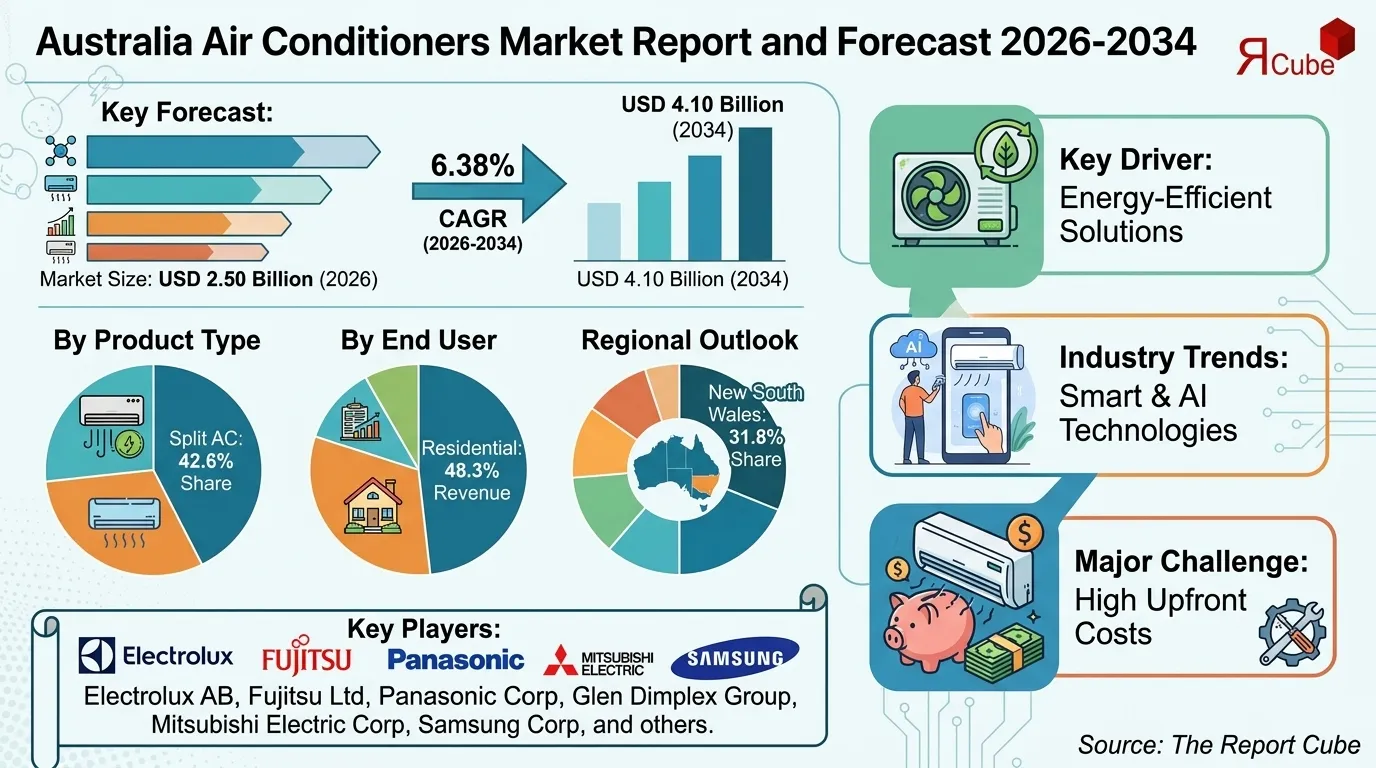
The Australia Air Conditioners Market is on a sustained growth trajectory, fueled by record heat events, accelerating urbanization, and tightening energy efficiency standards. According to the latest industry analysis, the Australia Air Conditioners Market is projected to grow at a CAGR of around 6.38% between 2026 and 2034, with market size increasing from USD 2.50 billion in 2026 to USD 4.10 billion by 2034.
Australia Air Conditioners Market Overview
Australia's air conditioning industry is no longer a seasonal afterthought - it has become essential infrastructure. Back-to-back summers breaking temperature records across Queensland, New South Wales, and Victoria have moved residential and commercial cooling from a luxury to a necessity. At the same time, rapid urban development in cities like Sydney, Melbourne, and Brisbane is adding millions of square metres of new residential, commercial, and mixed-use space that requires modern climate control solutions from day one.
The HVAC market in Australia is also benefiting from a policy push. Federal and state-level energy efficiency frameworks are pushing builders and facility managers toward inverter-based systems, smart thermostats, and low-GWP refrigerant technologies - changes that tend to lift average unit values even as they reduce long-run operating costs.
Key Growth Drivers
Three forces are reshaping air conditioning industry trends in Australia. First, climate change is extending the cooling season and raising peak-demand temperatures, particularly in inland and northern regions where legacy cooling capacity was never designed for current conditions. Second, the residential construction boom is generating first-install demand that new subdivisions and apartment towers across the eastern seaboard are driving. Third, energy regulations are pushing commercial and industrial buyers to replace ageing systems with high-efficiency alternatives earlier than a standard replacement cycle would otherwise require - effectively compressing the refresh timeline across the installed base.
Australia Air Conditioners Market Segmentation Insights
The Australia Air Conditioners Market spans a broad product range, and each category is responding to distinct demand signals.
Room air conditioners hold the largest share of the residential segment, with split and multi-split systems dominant in houses and medium-density apartments. Ducted split systems are gaining ground in higher-end residential builds, where whole-home conditioning is now a standard specification rather than an upgrade. Cassette air conditioners continue to find strong uptake in retail fit-outs, open-plan offices, and hospitality venues, where ceiling-mounted units deliver even air distribution without occupying wall or floor space.
Packaged air conditioners serve the light commercial and small industrial segments, offering a self-contained solution that reduces installation complexity. Chillers underpin large commercial buildings, data centres, and hospitals - sectors where cooling loads are continuous and system reliability is non-negotiable. Demand for energy-efficient chiller upgrades is particularly active as building owners respond to corporate net-zero commitments and green building rating requirements.
Competitive Landscape of Australia Air Conditioners Market
The Australia Air Conditioners Market is served by a mix of established Japanese and Korean multinationals, European conglomerates, and fast-growing Chinese manufacturers. Daikin Industries Ltd leads on brand recognition and service network depth, particularly in the commercial segment. Mitsubishi Electric Corp and Fujitsu Ltd hold strong positions in ducted and split-system residential markets. Panasonic Corp competes across residential and light commercial categories with a focus on inverter efficiency.
Samsung Corp and Hisense Group are expanding their Australian footprints on the strength of competitive pricing and improving product quality. Gree Electric Appliances Inc of Zhuhai is growing its presence through both direct channels and white-label arrangements. Electrolux AB and Glen Dimplex Group maintain market positions in specific residential and commercial niches, with the latter active in heating and cooling integration. A range of other regional and specialist players round out the competitive field.
Australia Air Conditioners Market Outlook
The trajectory of the Australia Air Conditioners Market through 2034 is clear: steady volume growth, rising average selling prices driven by efficiency mandates, and ongoing product mix shift toward smart, connected systems. Businesses and homeowners investing in HVAC upgrades today are navigating both climate risk and energy cost pressures - and the industry is responding with a broader, more sophisticated product portfolio than the market has seen before.