



Build Your Custom Market Intelligence Report
Customize Your ReportAustralia Air Conditioners Market Key Highlights
By Product Type:
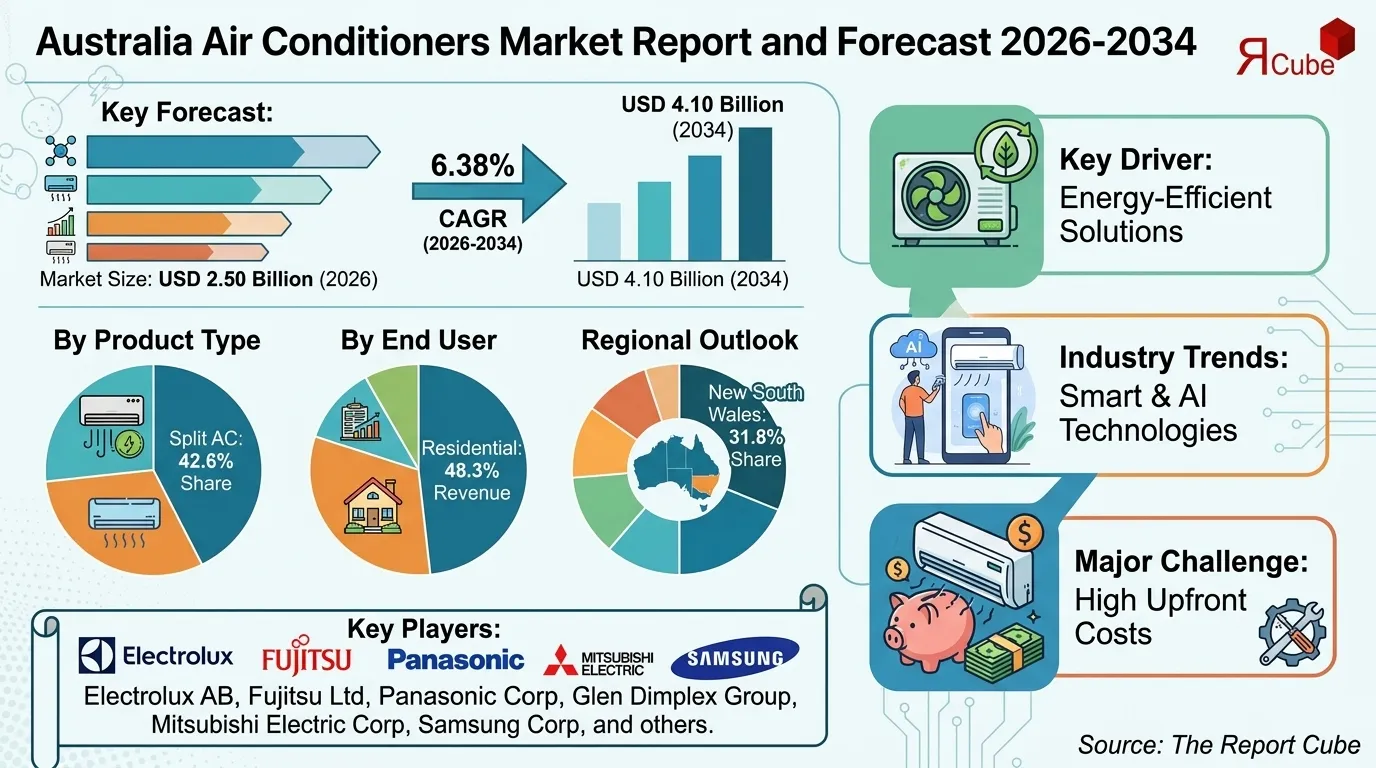
Split AC segment leads the market with 42.6% share.
By End User:
Residential segment dominates the market with 48.3% of revenue.
Regional Outlook:
New South Wales region dominates the Australia Air Conditioners market with 31.8% share.
Australia Air Conditioners Market Insights & Analysis
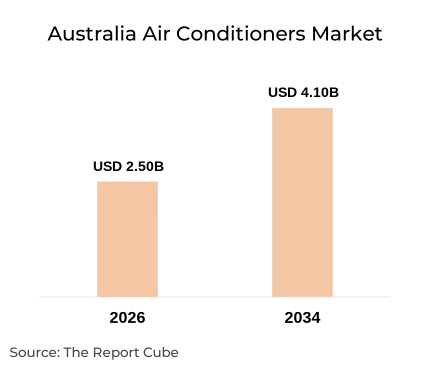
The Australia Air Conditioners Market is projected to grow at a CAGR of around 6.38% between 2026 and 2034, with market size increasing from USD 2.50 billion in 2026 to USD 4.10 billion by 2034. Demand is strongly concentrated in high-temperature and densely populated states such as New South Wales, Queensland, and Victoria, where prolonged summer heatwaves and urban density drive continuous cooling requirements. Cities including Sydney, Brisbane, and Melbourne account for a significant share of installations, supported by rising residential construction, with housing approvals exceeding 180,000 units in 2025, directly boosting demand for split and ducted air conditioning systems in new housing developments and suburban expansions.
Market growth is further reinforced by infrastructure expansion across Sydney and Melbourne, particularly in data centers, hospitals, and commercial office spaces, where thermal management requirements are critical. Australia’s data center capacity increased by over 12% in 2025, creating strong demand for precision and centralized cooling systems. The market is also shaped by strict energy efficiency standards under the National Construction Code (NCC) and state-level rebate programs in regions such as Victoria and New South Wales, which incentivize the adoption of high-efficiency inverter systems. Manufacturers are aligning with these requirements by introducing climate-adaptive air conditioning systems designed for extreme heat conditions, along with low-GWP refrigerants and smart, connected HVAC technologies, particularly in urban households where energy costs and sustainability considerations directly influence purchasing decisions.
Australia Air Conditioners Market Impact Analysis
| Factor | Type | Specific Impact | Magnitude | Strategic Implication |
|---|---|---|---|---|
| Climate Duality (Tropical North vs Temperate South) | Structural Driver | Creates two distinct demand models: cooling-dominant vs hybrid HVAC | High | Product strategy must be region-specific, not national |
| High Penetration of Split & Inverter Systems | Market Maturity | Limits first-time buyers; growth shifts to upgrades | High | Replacement cycle becomes key revenue driver |
| Electricity Price Sensitivity | Behavioral Constraint | Users optimize usage patterns rather than reduce purchases | High | Demand shifts toward ultra-efficient systems |
| Construction Boom in Urban Corridors | Demand Driver | High-rise residential and commercial HVAC integration | High | Growth in ducted, VRF, and centralized systems |
| Energy Efficiency Regulations (MEPS + NCC) | Regulatory Driver | Forces shift to compliant, high-efficiency systems | High | Accelerates obsolescence of legacy units |
| Smart HVAC & IoT Penetration | Technology Driver | Already mainstream in premium segment | Medium–High | Competition shifts from hardware → ecosystem control |
| Commercial HVAC Dominance in Value | Market Structure | Large buildings drive higher ticket installations | High | B2B channel becomes critical for revenue scaling |
| Import Dependency (Asia-led supply) | Market Structure | Pricing pressure and brand competition | Medium | Margins depend on distribution & service network |
Australia Air Conditioners Market Dynamics
Key Driver: Rising demand for energy-efficient and climate-responsive cooling solutions
Growing awareness around electricity consumption and carbon emissions is accelerating demand in the Australia air conditioners market growth landscape. Households and businesses are shifting toward inverter ACs and VRF systems that reduce power usage by nearly 25% compared to conventional units. Energy rating labels and stricter building efficiency standards are encouraging buyers to invest in advanced systems.
Another important factor is the increasing frequency of heatwaves across Australia, with average summer temperatures rising by 1.4°C over the past decade. This drives strong replacement demand for older systems and boosts installation in new buildings. Consumer preference trends show rising searches for “energy efficient air conditioners Australia” and “low power split AC systems,” reflecting demand for long-term cost savings and sustainable cooling solutions.
Book your FREE 30-minute expert consultation today
Contact UsIndustry Trends: Integration of smart and AI-enabled air conditioning technologies
Technology adoption is reshaping Australia air conditioners market trends, with AI-enabled and IoT-connected systems gaining strong traction. Smart ACs with app-based control, voice integration, and predictive maintenance features are becoming standard in urban households. Connected cooling solutions allow real-time energy monitoring, improving efficiency and user convenience.
Commercial sectors are also adopting intelligent HVAC systems that adjust cooling based on occupancy and external climate conditions. In 2025, over 35% of newly installed commercial AC systems included smart automation features. Keywords such as “smart air conditioners Australia” and “AI cooling systems” are seeing increased search visibility, highlighting evolving user intent toward automation and comfort optimization.
Major Challenge: High upfront costs and installation complexities
Initial investment remains a key barrier impacting Australia air conditioners market demand, particularly for advanced systems like VRF and ducted split units. Installation costs can account for up to 30% of total system expenditure, making affordability a concern for small businesses and homeowners. Complex installation requirements also limit adoption in older buildings.
Maintenance and servicing costs further add to long-term ownership expenses. Skilled technician shortages in certain regions can delay installations and repairs, impacting customer experience. Search trends indicate growing queries around “affordable air conditioners Australia” and “AC installation cost,” showing cost sensitivity among buyers and influencing purchase decisions.
Opportunity: Expansion of commercial infrastructure and green building projects
Rising investments in commercial real estate, healthcare, and data centers are creating new opportunities in the Australia air conditioners market share expansion. Green building certifications and sustainable construction practices are driving demand for energy-efficient HVAC systems with low environmental impact.
Government incentives for eco-friendly buildings and renewable integration are further supporting adoption. Developers are increasingly incorporating centralized cooling systems and smart HVAC technologies into new projects. Keywords like “green HVAC systems Australia” and “commercial air conditioning solutions” are gaining traction, indicating strong future demand driven by sustainability-focused infrastructure development.
The expansion of hyperscale data centers in Sydney and Melbourne is significantly increasing demand for precision cooling systems, particularly in high-density digital infrastructure clusters.
Australia Air Conditioners Market Segment-wise Analysis
By Product Type:
- Chillers
- Room Air Conditioners
- Cassette Air Conditioners
- Packaged Air Conditioners
- Ducted Split Systems
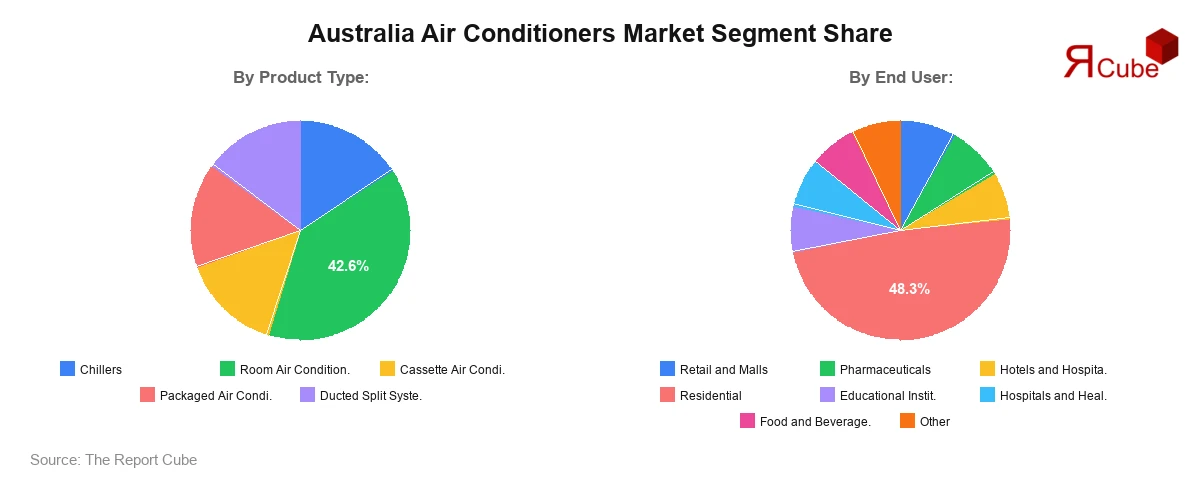
Split air conditioners dominate the Australia air conditioners market share, accounting for nearly 42.6% of total revenue in 2026. Their popularity is driven by flexibility, energy efficiency, and suitability for residential and small commercial applications. Units within the 1 to 1.5 ton capacity range hold the highest demand due to their compatibility with average room sizes in urban housing.
Demand is also supported by rising consumer preference for inverter-based split systems that reduce electricity consumption by up to 30%. Search analysis shows high engagement for “split AC price Australia” and “best inverter air conditioners,” highlighting strong consumer focus on performance and cost savings. Continuous product innovation, including Wi-Fi connectivity and eco-friendly refrigerants, is further strengthening segment growth.
By End User:
- Retail and Malls
- Pharmaceuticals
- Food and Beverage
- Hotels and Hospitality
- Data Centers
- Offices
- Manufacturing
- Residential
- Educational Institutions
- Hospitals and Healthcare
- Other
The residential segment leads the Australia air conditioners market demand with approximately 48.3% revenue share in 2026. Increasing home ownership, rising disposable income, and growing awareness of indoor comfort are key factors driving this segment. Over 70% of Australian households now use at least one air conditioning system, indicating strong penetration.
Urban expansion and apartment developments are further supporting installation demand for compact and energy-efficient units. Consumer search trends such as “home air conditioners Australia” and “energy efficient cooling for homes” reflect strong residential demand. Smart AC adoption is also rising, with homeowners prioritizing app-controlled and automated cooling systems for improved convenience and energy savings.
Regional Projection of Australia Air Conditioners Industry
- Queensland
- New South Wales
- Victoria
- South Australia
- Others
New South Wales leads the Australia air conditioners market with around 31.8% share, supported by high population density, urban infrastructure, and strong residential construction activity. Sydney alone contributes significantly to demand, with continuous development of apartments and commercial spaces driving installations.
Rising summer temperatures and humidity levels in the region increase dependence on cooling systems, particularly split and ducted AC units. Commercial expansion, including office spaces and retail centers, further boosts demand. Search trends such as “air conditioners Sydney” and “cooling systems NSW” indicate strong regional demand. Government focus on energy efficiency and sustainable housing also supports adoption of advanced air conditioning technologies.
Queensland represents one of the highest demand regions due to consistently high temperatures and humidity levels, while New South Wales leads in total installations due to population concentration and urban development.
Australia’s air conditioner demand is highly climate-dependent, with significantly higher installation intensity in Queensland and Western Australia, where prolonged heatwaves and high summer temperatures drive continuous cooling requirements. In contrast, states such as Victoria and New South Wales exhibit mixed HVAC demand, combining both heating and cooling needs due to seasonal variability.
Australia Air Conditioners Market Regional Analysis
The Australian air conditioning market is structurally divided by climate zones, leading to fundamentally different demand patterns across states.
| Region | Demand Type | Key Cities | System Dominance | Core Demand Logic | Growth Nature |
|---|---|---|---|---|---|
| Queensland | Cooling-Dominant | Brisbane, Gold Coast | Split & Ducted AC | High humidity + year-round cooling need | Volume-driven growth |
| New South Wales | Hybrid (Cooling + Heating) | Sydney | Split + Central HVAC | Urban density + commercial infrastructure | Mixed demand (new + retrofit) |
| Victoria | Heating-Dominant with Cooling Peaks | Melbourne | Reverse-cycle systems | Temperature variability | Replacement-driven growth |
| Western Australia | Extreme Cooling Demand | Perth | Ducted + Split AC | Hot dry climate | High-capacity system demand |
| South Australia | Seasonal Cooling | Adelaide | Split AC | Heatwaves + energy sensitivity | Efficiency-driven upgrades |
| Northern Territory | Continuous Cooling | Darwin | Commercial-grade AC | Tropical climate (constant demand) | High usage intensity market |
Need insights for a specific region within this market?
Request Regional DataGovernment Initiatives & Policies
- National Energy Performance Strategy: Introduced in 2025, this program promotes high-efficiency appliances, including air conditioners, with rebate incentives.
- Green Building Fund Expansion 2026: Supports adoption of energy-efficient HVAC systems in commercial buildings to reduce emissions.
Australia Air Conditioners Industry Recent Developments
- 2025: Samsung Corp introduced an AI-driven WindFree air conditioner under its AI-connected living portfolio, designed to optimize cooling and reduce energy consumption, with Australia launch scheduled for 2026, strengthening smart home integration.
- 2025: Daikin Industries Ltd launched the VRV H Series heat pump system in Australia, improving efficiency, reliability, and installation flexibility, targeting commercial infrastructure demand for advanced HVAC solutions.
- 2025: Mitsubishi Electric Corp enabled built-in Wi-Fi across key residential AC models in Australia, allowing remote operation and supporting growing demand for smart, connected cooling systems.
Why Choose This Report?
- Provides a comprehensive overview of the overall market analysis, encompassing key trends, consumer behavior analysis, and risk assessment to support strategic decision-making.
- Provides accurate, up-to-date insights into market size, segmentation, and emerging opportunities, helping to minimize risk & capitalizing on growth.
- Gives deep understanding of target audience preferences, investment habits, and communication channels for enhanced product development & marketing effectiveness.
- Delivers competitive analysis & benchmarking, uncovering the strengths & weaknesses of market competitors to guide strategies.
- Consolidate comprehensive market intelligence, reducing reasoning & streamlining research efforts.
- Facilitates customized market segmentation & risk mitigation strategies, fine-tuned to the business objectives.
- Aids in identifying both market challenges & untapped opportunities within the industry to drive long-term business growth.
- Provides valuable information based on actual customer data & search trends.
Table of Contents
- Introduction
- Objective of the Study
- Product and Category Definition
- Market Segmentation
- Study Variables
- Research Methodology
- Secondary Data Points
- Breakdown of Secondary Sources
- Primary Data Points
- Breakdown of Primary Interviews
- Secondary Data Points
- Executive Summary
- Market Dynamics
- Emerging Opportunities
- Adoption Trends
- Demand Drivers
- Disruption Analysis (Challenges)
- Industry Analysis and Strategic Insights
- Supply and Value Chain Analysis
- Pricing Analysis
- Go-To-Market (GTM) Strategy
- BCG Matrix
- Recent Trends and Developments
- Import and Export Analysis
- Regulatory and Policy Landscape
- Region-wise Policies
- Government Initiatives
- Australia Air Conditioners Market Overview and Forecast Analysis (2021-2034)
- Market Size, By Value, By Growth Rate (CAGR/USD Billion)
- Market Share, By Product Type
- Chillers
- Water-cooled Chillers
- Air-cooled Chillers
- Other Chillers
- Room Air Conditioners
- Split AC
- Up to 1 Ton
- 1 Ton to 1.5 Ton
- Above 1.6 to 2 Ton
- Above 2 Ton
- Window AC
- Up to 1 Ton
- 1 Ton to 2 Ton
- Above 2 Ton
- Split AC
- Cassette Air Conditioners
- Up to 2 Tons
- 2.1 to 4 Tons
- 4.1 to 5 Tons
- Above 5 Tons
- Packaged Air Conditioners
- Up to 5 Tons
- 6 to 10 Tons
- 11 to 20 Tons
- Above 20 Tons
- Ducted Split Systems
- VRF Systems
- Up to 5 Tons
- 6 to 10 Tons
- 11 to 20 Tons
- Above 20 Tons
- Others (Air Handling Units / Fan Coil Units, etc.)
- Chillers
- Market Share, By Refrigerant Type
- R290
- R410A
- R32
- R1234ze / R1234yf
- R134a
- Others
- Market Share, By Distribution Channel
- Multi-brand Stores
- Online
- Direct Sales
- Authorized Dealers and Distributors
- Market Share, By End User
- Retail and Malls
- Pharmaceuticals
- Food and Beverage
- Hotels and Hospitality
- Data Centers
- Offices
- Manufacturing
- Residential
- Educational Institutions
- Hospitals and Healthcare
- Other
- Market Share, By Region
- Queensland
- New South Wales
- Victoria
- South Australia
- Others
- Market Share, By Company
- Revenue Shares and Analysis
- Competitive Landscape
- Queensland Air Conditioners Market Overview and Forecast Analysis (2021-2034)
- Market Size, By Value, By Growth Rate (CAGR/USD Billion/Million)
- Market Share, By Product Type
- Market Share, By Refrigerant Type
- Market Share, By Distribution Channel
- Market Share, By End User
- New South Wales Air Conditioners Market Overview and Forecast Analysis (2021-2034)
- Market Size, By Value, By Growth Rate (CAGR/USD Billion/Million)
- Market Share, By Product Type
- Market Share, By Refrigerant Type
- Market Share, By Distribution Channel
- Market Share, By End User
- Victoria Air Conditioners Market Overview and Forecast Analysis (2021-2034)
- Market Size, By Value, By Growth Rate (CAGR/USD Billion/Million)
- Market Share, By Product Type
- Market Share, By Refrigerant Type
- Market Share, By Distribution Channel
- Market Share, By End User
- South Australia Air Conditioners Market Overview and Forecast Analysis (2021-2034)
- Market Size, By Value, By Growth Rate (CAGR/USD Billion/Million)
- Market Share, By Product Type
- Market Share, By Refrigerant Type
- Market Share, By Distribution Channel
- Market Share, By End User
- Competitive Analysis, 2026
- Market Share of Key Players
- Competitive Mapping for Each Segment and Companies Operating By Region
- Queensland Air Conditioners Companies Share and Competitive Analysis, 2026
- New South Wales Air Conditioners Companies Share and Competitive Analysis, 2026
- Victoria Air Conditioners Companies Share and Competitive Analysis, 2026
- South Australia Air Conditioners Companies Share and Competitive Analysis, 2026
- Company Profiles (Partial List)
- Electrolux AB
- Company Overview
- Product Portfolio
- Strategic Alliances/Partnerships
- Recent Developments
- Fujitsu Ltd
- Company Overview
- Product Portfolio
- Strategic Alliances/Partnerships
- Recent Developments
- Panasonic Corp
- Company Overview
- Product Portfolio
- Strategic Alliances/Partnerships
- Recent Developments
- Glen Dimplex Group
- Company Overview
- Product Portfolio
- Strategic Alliances/Partnerships
- Recent Developments
- Mitsubishi Electric Corp
- Company Overview
- Product Portfolio
- Strategic Alliances/Partnerships
- Recent Developments
- Samsung Corp
- Company Overview
- Product Portfolio
- Strategic Alliances/Partnerships
- Recent Developments
- Daikin Industries Ltd
- Company Overview
- Product Portfolio
- Strategic Alliances/Partnerships
- Recent Developments
- Hisense Group
- Company Overview
- Product Portfolio
- Strategic Alliances/Partnerships
- Recent Developments
- Gree Electric Appliances Inc of Zhuhai
- Company Overview
- Product Portfolio
- Strategic Alliances/Partnerships
- Recent Developments
- Others (Partial List)
- Electrolux AB
- Contact Us and Disclaimer
Top Key Players & Market Share Outlook
- Electrolux AB
- Fujitsu Ltd
- Panasonic Corp
- Glen Dimplex Group
- Mitsubishi Electric Corp
- Samsung Corp
- Daikin Industries Ltd
- Hisense Group
- Gree Electric Appliances Inc of Zhuhai
- Others
Frequently Asked Questions






