



Build Your Custom Market Intelligence Report
Customize Your ReportAustralia Real Estate Market Insights & Analysis
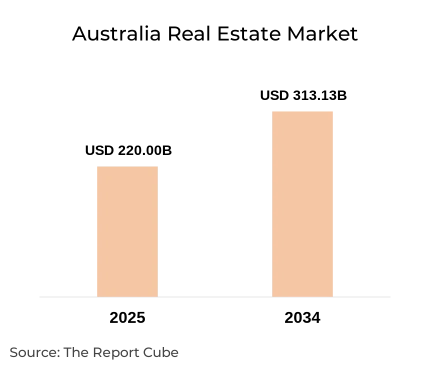
The Australia Real Estate Market is anticipated to register a CAGR of 4.00% during 2026-2034. The market size was valued at USD 220 billion in 2025 and is projected to reach USD 313.13 billion by 2034. The market continues to demonstrate structural resilience, supported by strong population growth, urbanization, and long-term housing demand across major metropolitan regions. Residential assets remain the backbone of the sector, while commercial and industrial properties are benefiting from economic diversification and infrastructure investment.
Australia’s real estate landscape is shaped by favorable immigration trends, limited land availability in key cities, and sustained government focus on housing supply. Demand remains strong across owner-occupied and rental segments, driven by affordability pressures and shifting household preferences. Institutional investment has increased steadily, particularly in logistics, mixed-use developments, and build-to-rent housing, reflecting evolving risk-adjusted return expectations.
Additionally, digitization of property transactions, data-driven valuation models, and professional property management practices are improving market transparency. These factors, combined with consistent regulatory oversight and mature financing systems, position the Australia Real Estate Market for stable, long-term expansion through 2034.
Australia Real Estate Market Recent Developments
- 2025: Goodman Group expanded its logistics portfolio in Sydney to support rising e-commerce warehousing demand.
- 2025: Mirvac Group launched a large-scale mixed-use residential precinct in Melbourne’s inner suburbs.
Government Initiatives & Policies
- National Housing Accord: Federal initiative targeting the construction of one million new homes by 2029.
- Housing Australia Future Fund: Program supporting social and affordable housing development nationwide.
Australia Real Estate Market Dynamics
Key Driver: Population Growth and Urban Concentration
Strong population growth remains the primary driver of the Australia Real Estate Market. Net overseas migration rebounded sharply, exceeding 400,000 new residents in recent years, intensifying demand for housing and rental properties. Major cities such as Sydney, Melbourne, and Brisbane continue to absorb the majority of population inflows, placing sustained pressure on residential supply. This imbalance between supply and demand has supported long-term price appreciation and stable occupancy rates across residential and mixed-use developments. Infrastructure investment linked to population growth further stimulates commercial and industrial real estate demand, reinforcing the sector’s growth momentum.
Book your FREE 30-minute expert consultation today
Contact UsIndustry Trends: Institutionalization and Build-to-Rent Expansion
A key trend shaping the market is the increasing institutionalization of real estate assets. Superannuation funds, REITs, and global investors are expanding exposure to residential rental portfolios, logistics parks, and data-driven commercial assets. Build-to-rent housing has gained traction as affordability challenges push households toward long-term renting. This trend improves rental stock quality and stabilizes cash flows for investors. Sustainability-led design, energy-efficient buildings, and smart property management systems are becoming standard expectations, further influencing asset valuation and tenant preferences.
Major Challenge: Housing Affordability and Cost Pressures
Housing affordability remains a persistent challenge across the Australia Real Estate Market. Rising land prices, construction costs, and financing expenses have increased barriers to home ownership, particularly for first-time buyers. In parallel, higher interest rates have reduced borrowing capacity, moderating transaction volumes in certain segments. Developers face margin pressure due to labor shortages and material inflation, slowing project completions. These factors collectively constrain supply responsiveness, intensifying affordability concerns and increasing regulatory scrutiny.
Opportunity: Infrastructure-Led and Regional Growth Corridors
Significant opportunities are emerging from infrastructure-led development and regional growth corridors. Government investment in transport, healthcare, and education infrastructure is unlocking new residential and commercial hubs beyond capital cities. Regions in Queensland, Western Australia, and outer metropolitan zones are attracting both residents and investors seeking affordability and yield. Industrial real estate linked to logistics, renewable energy, and advanced manufacturing presents further upside, positioning the market for diversified growth through the forecast period.
Australia Real Estate Market Segment-wise Analysis
By Type:
- Residential
- Commercial
- Industrial
- Retail
Residential real estate dominates the market by type, accounting for approximately 62% of total market value in 2025. This leadership reflects persistent housing demand driven by population growth and limited urban land supply. Detached housing and medium-density apartments form the core of residential assets, while industrial real estate is the fastest-growing sub-segment, supported by logistics and e-commerce expansion. Commercial offices are stabilizing, while retail assets are gradually repositioning toward mixed-use formats.
By Business Model:
- Sales
- Rental
- Lease
- REITs
The rental business model leads the market, holding an estimated 44% share in 2025. Rising home prices and affordability constraints have increased long-term renting across urban and suburban regions. Institutional rental portfolios and professionally managed assets are gaining prominence, improving tenant retention and income stability. REITs continue to attract capital due to liquidity and diversified exposure, while sales-driven models remain sensitive to interest rate movements.
Regional Projection of Australia Real Estate Industry
- New South Wales
- Victoria
- Queensland
- Western Australia
New South Wales leads the Australia Real Estate Market, contributing approximately 34% of total market value in 2025. Sydney’s role as a financial and economic hub sustains demand across residential, commercial, and industrial segments. However, Queensland is emerging as a high-growth region, driven by interstate migration and infrastructure investment. Victoria maintains strong fundamentals, while Western Australia benefits from resources-driven economic stability.
Need insights for a specific region within this market?
Request Regional DataWhy Choose This Report?
- Provides a comprehensive overview of the overall market analysis, encompassing key trends, consumer behavior analysis, and risk assessment to support strategic decision-making.
- Provides accurate, up-to-date insights into market size, segmentation, and emerging opportunities, helping to minimize risk & capitalizing on growth.
- Gives deep understanding of target audience preferences, investment habits, and communication channels for enhanced product development & marketing effectiveness.
- Delivers competitive analysis & benchmarking, uncovering the strengths & weaknesses of market competitors to guide strategies.
- Consolidate comprehensive market intelligence, reducing reasoning & streamlining research efforts.
- Facilitates customized market segmentation & risk mitigation strategies, fine-tuned to the business objectives.
- Aids in identifying both market challenges & untapped opportunities within the industry to drive long-term business growth.
- Provides valuable information based on actual customer data & search trends.
Table of Contents
- Introduction
- Objective of the Study
- Product and Category Definition
- Market Segmentation
- Study Variables
- Research Methodology
- Secondary Data Points
- Breakdown of Secondary Sources
- Primary Data Points
- Breakdown of Primary Interviews
- Secondary Data Points
- Executive Summary
- Market Dynamics
- Drivers
- Challenges
- Opportunity Assessment
- Recent Trends and Developments
- Regulatory and Policy Landscape
- Australia Real Estate Market Overview (2021-2034)
- Market Size, By Value (AUD Billion)
- Market Share, By Type
- Residential
- Commercial
- Industrial
- Retail
- Land
- Market Share, By Business Model
- Sales
- Rental
- Lease
- Strata
- REITs
- Market Share, By Channel Type
- Agency
- Developer
- Online Portals
- Market Share, By Customer
- Owner-Occupiers
- Local Investors
- Foreign Investors
- Institutional Buyers
- Market Share, By Region
- New South Wales
- Victoria
- Queensland
- Western Australia
- Rest of Australia
- Market Share, By Company
- Revenue Shares
- Competition Characteristics
- Revenue Shares & Analysis
- New South Wales Market
- Market Size, By Value (AUD Billion)
- Market Share, By Segment
- Market Share, By Business Model
- Market Share, By Channel Type
- Market Share, By Customer Segment
- Market Share, By Region/Metro Group
- Market Share, By Area
- Sydney Metro
- Greater Sydney
- Regional NSW
- Victoria Market
- Market Size, By Value (AUD Billion)
- Market Share, By Segment
- Market Share, By Business Model
- Market Share, By Channel Type
- Market Share, By Customer Segment
- Market Share, By Region/Metro Group
- Market Share, By Area
- Melbourne Metro
- Greater Melbourne
- Regional Victoria
- Queensland Market
- Market Size, By Value (AUD Billion)
- Market Share, By Segment
- Market Share, By Business Model
- Market Share, By Channel Type
- Market Share, By Customer Segment
- Market Share, By Region/Metro Group
- Market Share, By Area
- Brisbane Metro
- Gold Coast
- Sunshine Coast
- Regional Queensland
- Western Australia Market
- Market Size, By Value (AUD Billion)
- Market Share, By Segment
- Market Share, By Business Model
- Market Share, By Channel Type
- Market Share, By Customer Segment
- Market Share, By Region/Metro Group
- Market Share, By Area
- Perth Metro
- Greater Perth
- Regional WA
- Competitive Outlook and Company Profiles
- Goodman Group
- Company Overview
- Portfolio Profile
- Strategic Alliances/Partnerships
- Recent Developments
- Scentre Group
- Company Overview
- Portfolio Profile
- Strategic Alliances/Partnerships
- Recent Developments
- Stockland
- Company Overview
- Portfolio Profile
- Strategic Alliances/Partnerships
- Recent Developments
- Mirvac Group
- Company Overview
- Portfolio Profile
- Strategic Alliances/Partnerships
- Recent Developments
- GPT Group
- Company Overview
- Portfolio Profile
- Strategic Alliances/Partnerships
- Recent Developments
- Vicinity Centres
- Company Overview
- Portfolio Profile
- Strategic Alliances/Partnerships
- Recent Developments
- Charter Hall Group
- Company Overview
- Portfolio Profile
- Strategic Alliances/Partnerships
- Recent Developments
- Dexus
- Company Overview
- Portfolio Profile
- Strategic Alliances/Partnerships
- Recent Developments
- Lendlease Group
- Company Overview
- Portfolio Profile
- Strategic Alliances/Partnerships
- Recent Developments
- Metricon Homes
- Company Overview
- Portfolio Profile
- Strategic Alliances/Partnerships
- Recent Developments
- Others
- Goodman Group
- Contact Us and Disclaimer
Top Key Players & Market Share Outlook
- Goodman Group
- Scentre Group
- Stockland
- Mirvac Group
- GPT Group
- Vicinity Centres
- Charter Hall Group
- Dexus
- Lendlease Group
- Metricon Homes
- Others
Frequently Asked Questions






