



Build Your Custom Market Intelligence Report
Customize Your ReportIndia Real Estate Market Insights & Analysis
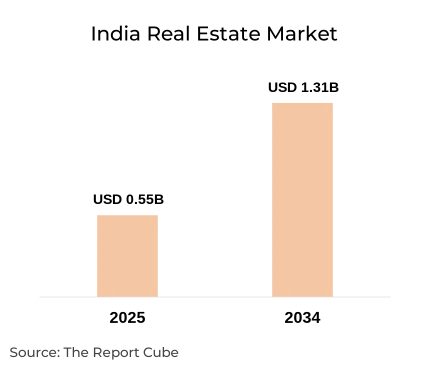
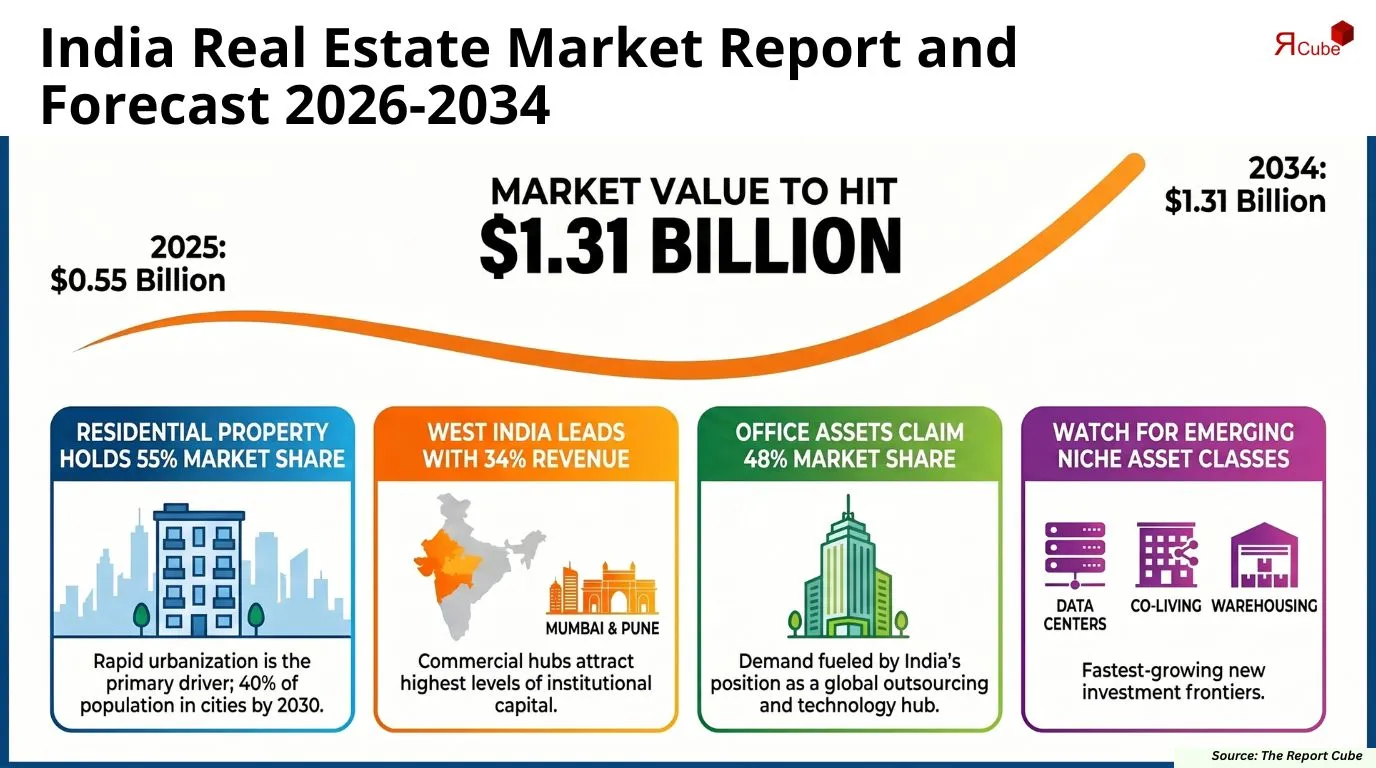
The India Real Estate Market is anticipated to register a CAGR of 10.10% during 2026-2034. The market size was valued at USD 0.55 billion in 2025 and is projected to reach USD 1.31 billion by 2034. India’s real estate sector remains a cornerstone of national economic development, supported by rapid urbanization, demographic expansion, and sustained infrastructure investments. Increasing household formation, rising disposable incomes, and aspirational homeownership trends continue to drive long-term demand across residential and commercial segments.
Over the past decade, the market has transitioned toward greater transparency and institutional participation following regulatory reforms such as RERA, GST standardization, and digitization of land records. These changes have improved buyer confidence and attracted domestic as well as foreign capital into large-scale developments. Residential real estate continues to dominate overall transaction volumes, while commercial assets such as office parks and mixed-use developments are gaining traction due to India’s expanding service economy.
Furthermore, emerging asset classes including data centers, co-living, and warehousing are reshaping the investment landscape. Developers are increasingly focusing on sustainable construction, smart infrastructure, and integrated townships to align with evolving consumer expectations. Together, these structural and demand-side factors position the India Real Estate Market for robust and resilient growth through 2034.
India Real Estate Market Recent Developments
- 2025: DLF Ltd announced the launch of a premium mixed-use residential project across major metro cities.
- 2025: Godrej Properties expanded its affordable housing portfolio in Tier II cities to strengthen regional presence.
Government Initiatives & Policies
- Pradhan Mantri Awas Yojana (PMAY): Government housing initiative supporting affordable residential development nationwide.
- National Infrastructure Pipeline: Program accelerating urban infrastructure and commercial real estate development.
India Real Estate Market Dynamics
Key Driver: Rapid Urbanization and Housing Demand Expansion
Rapid urbanization remains the primary driver of the India Real Estate Market. By 2030, over 40% of India’s population is expected to reside in urban areas, creating sustained demand for housing, office spaces, and supporting infrastructure. Migration toward employment hubs has significantly increased the need for affordable and mid-income residential units. Additionally, government-backed housing schemes and easier access to home financing have enabled first-time buyers to enter the market. Interest rate stability and flexible payment plans further stimulate residential absorption rates, particularly in metropolitan and Tier II cities, reinforcing steady growth momentum.
Book your FREE 30-minute expert consultation today
Contact UsIndustry Trends: Institutionalization and Rise of New Asset Classes
The Indian real estate sector is witnessing increasing institutionalization, with private equity funds, REITs, and pension funds actively investing in income-generating assets. Office spaces, logistics parks, and warehousing facilities are emerging as preferred investment avenues due to stable rental yields. Data centers and co-working spaces are expanding rapidly, supported by digital transformation and flexible work models. Sustainability-driven development is also gaining prominence, with green-certified buildings becoming more attractive to tenants and investors, shaping long-term industry evolution.
Major Challenge: High Land Costs and Regulatory Complexity
Despite strong demand, high land acquisition costs and regulatory complexity remain significant challenges for developers. Land availability in prime urban locations is limited, resulting in escalating prices that impact project viability. Lengthy approval processes and compliance requirements often delay project timelines and increase costs. Smaller developers face financial constraints in adapting to regulatory and funding pressures, leading to market consolidation. These factors collectively restrain supply-side efficiency and affect affordability in key urban markets.
Opportunity: Growth of Tier II and Tier III Cities
Tier II and Tier III cities present a compelling growth opportunity for the India Real Estate Market. Improved connectivity, expanding industrial corridors, and government-led infrastructure investments are accelerating real estate demand beyond major metros. Housing affordability, lower land costs, and rising employment opportunities make these regions attractive to both developers and homebuyers. Commercial developments such as IT parks, retail centers, and logistics hubs are increasingly moving into these cities, offering diversified growth prospects through 2034.
India Real Estate Market Segment-wise Analysis
By Property:
- Residential
- Commercial
- Industrial
- Retail
- Hospitality
Residential real estate leads the India Real Estate Market, accounting for nearly 55% of total market share in 2025. Strong housing demand across affordable and mid-income categories drives this dominance. Urban population growth, nuclear family trends, and government incentives continue to support residential development. Commercial properties follow, supported by office leasing demand from IT, BFSI, and global capability centers. Industrial and retail segments are steadily expanding, benefiting from manufacturing growth and organized retail penetration.
By Asset Class:
- Office
- Warehousing
- Data Centers
- Co-Living
- Co-Working
Office assets dominate the asset class segment, holding approximately 48% market share in 2025. Demand is fueled by India’s strong position as a global outsourcing and technology hub. Warehousing and logistics assets are growing rapidly, driven by e-commerce expansion and supply chain modernization. Data centers represent a high-growth niche, supported by cloud adoption and digital services. Co-living spaces are gaining popularity among young professionals seeking flexible and affordable urban housing solutions.
Regional Projection of India Real Estate Industry
- North India
- South India
- West India
- East India
West India leads the India Real Estate Market, contributing approximately 34% of total revenue in 2025. Cities such as Mumbai, Pune, and Ahmedabad benefit from strong commercial activity, financial services concentration, and infrastructure investments. The region attracts significant institutional capital and continues to see high residential absorption rates. South India follows closely, supported by IT-driven office demand, while North India remains strong in residential development across NCR markets.
Need insights for a specific region within this market?
Request Regional DataWhy Choose This Report?
- Provides a comprehensive overview of the overall market analysis, encompassing key trends, consumer behavior analysis, and risk assessment to support strategic decision-making.
- Provides accurate, up-to-date insights into market size, segmentation, and emerging opportunities, helping to minimize risk & capitalizing on growth.
- Gives deep understanding of target audience preferences, investment habits, and communication channels for enhanced product development & marketing effectiveness.
- Delivers competitive analysis & benchmarking, uncovering the strengths & weaknesses of market competitors to guide strategies.
- Consolidate comprehensive market intelligence, reducing reasoning & streamlining research efforts.
- Facilitates customized market segmentation & risk mitigation strategies, fine-tuned to the business objectives.
- Aids in identifying both market challenges & untapped opportunities within the industry to drive long-term business growth.
- Provides valuable information based on actual customer data & search trends.
Table of Contents
- Introduction
- Objective of the Study
- Product and Category Definition
- Market Segmentation
- Study Variables
- Research Methodology
- Secondary Data Points
- Breakdown of Secondary Sources
- Primary Data Points
- Breakdown of Primary Interviews
- Secondary Data Points
- Executive Summary
- Market Dynamics
- Drivers
- Challenges
- Opportunity Assessment
- Recent Trends and Developments
- Regulatory and Policy Landscape
- India Real Estate Market Overview (2020-2035)
- Market Size, By Value (USD Billion)
- Market Share, By Property
- Residential
- Commercial
- Industrial
- Retail
- Hospitality
- Market Share, By Asset Class
- Office
- Warehousing
- Data Centers
- Co-Living
- Co-Working
- Market Share, By Buyer Type
- End Users
- Investors
- Institutional
- NRIs
- Market Share, By Funding Source
- Bank Finance
- NBFC Finance
- Private Equity
- REIT Capital
- Market Share, By Region
- North India
- South India
- East India
- West India
- Central India
- Market Share, By Company
- Competition Characteristics
- Revenue Shares & Analysis
- North India Real Estate Market
- Market Size, By Value (USD Billion)
- Market Share, By Segment
- Market Share, By Asset Class
- Market Share, By Buyer Type
- Market Share, By Funding Source
- Market Share, By Region/Country Group
- Market Share, By Key Cities
- Delhi NCR
- Gurugram
- Noida
- Chandigarh
- Jaipur
- South India Real Estate Market
- Market Size, By Value (USD Billion)
- Market Share, By Segment
- Market Share, By Asset Class
- Market Share, By Buyer Type
- Market Share, By Funding Source
- Market Share, By Region/Country Group
- Market Share, By Key Cities
- Bengaluru
- Hyderabad
- Chennai
- Kochi
- Rest of South India
- West India Real Estate Market
- Market Size, By Value (USD Billion)
- Market Share, By Segment
- Market Share, By Asset Class
- Market Share, By Buyer Type
- Market Share, By Funding Source
- Market Share, By Region/Country Group
- Market Share, By Key Cities
- Mumbai
- Pune
- Ahmedabad
- Surat
- Rest of West India
- East India Real Estate Market
- Market Size, By Value (USD Billion)
- Market Share, By Segment
- Market Share, By Asset Class
- Market Share, By Buyer Type
- Market Share, By Funding Source
- Market Share, By Region/Country Group
- Market Share, By Key Cities
- Kolkata
- Bhubaneswar
- Ranchi
- Patna
- Rest of East India
- Central India Real Estate Market
- Market Size, By Value (USD Billion)
- Market Share, By Segment
- Market Share, By Asset Class
- Market Share, By Buyer Type
- Market Share, By Funding Source
- Market Share, By Region/Country Group
- Market Share, By Key Cities
- Bhopal
- Indore
- Raipur
- Nagpur
- Rest of Central India
- Competitive Outlook and Company Profiles
- DLF Ltd
- Company Overview
- Project Portfolio
- Strategic Alliances/Partnerships
- Recent Developments
- Godrej Properties
- Company Overview
- Project Portfolio
- Strategic Alliances/Partnerships
- Recent Developments
- Macrotech Developers (Lodha)
- Company Overview
- Project Portfolio
- Strategic Alliances/Partnerships
- Recent Developments
- Prestige Estates
- Company Overview
- Project Portfolio
- Strategic Alliances/Partnerships
- Recent Developments
- Oberoi Realty
- Company Overview
- Project Portfolio
- Strategic Alliances/Partnerships
- Recent Developments
- Sobha Ltd
- Company Overview
- Project Portfolio
- Strategic Alliances/Partnerships
- Recent Developments
- Brigade Group
- Company Overview
- Project Portfolio
- Strategic Alliances/Partnerships
- Recent Developments
- Prestige Estates Projects
- Company Overview
- Project Portfolio
- Strategic Alliances/Partnerships
- Recent Developments
- L&T Realty
- Company Overview
- Project Portfolio
- Strategic Alliances/Partnerships
- Recent Developments
- Tata Housing
- Company Overview
- Project Portfolio
- Strategic Alliances/Partnerships
- Recent Developments
- Anant Raj Ltd
- Company Overview
- Project Portfolio
- Strategic Alliances/Partnerships
- Recent Developments
- Others
- DLF Ltd
- Contact Us and Disclaimer
Top Key Players & Market Share Outlook
- DLF Ltd
- Godrej Properties
- Macrotech Developers (Lodha)
- Prestige Estates
- Oberoi Realty
- Sobha Ltd
- Brigade Group
- Prestige Estates Projects
- L&T Realty
- Tata Housing
- Anant Raj Ltd
- Others
Frequently Asked Questions