




Build Your Custom Market Intelligence Report
Customize Your ReportPhilippines Real Estate Market Insights & Analysis
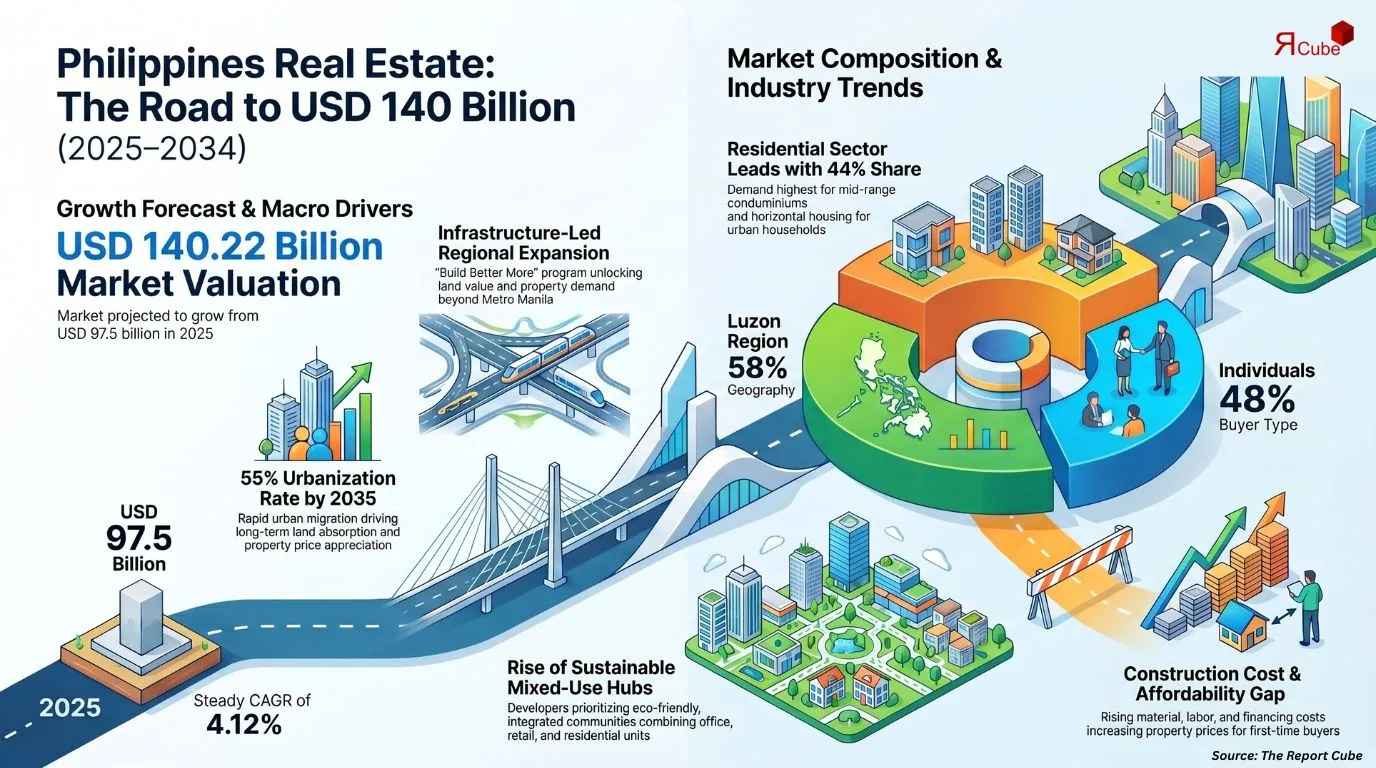
The Philippines Real Estate Market is anticipated to register a CAGR of 4.12% during 2026-2034. The market size was valued at USD 97.5 billion in 2025 and is projected to reach USD 140.22 billion by 2034. The market continues to demonstrate stable growth fundamentals, supported by steady urbanization, infrastructure-led economic development, and a resilient domestic demand base. Rising population density in key metropolitan areas, combined with sustained housing demand from middle-income households, has positioned real estate as a long-term investment-driven sector within the Philippine economy.
In addition, government-backed infrastructure programs are improving regional connectivity, unlocking land value beyond traditional urban cores. Expanding transport corridors, industrial parks, and township developments are stimulating demand across residential, commercial, and mixed-use formats. Real estate developers are increasingly adopting integrated development models that combine residential units with offices, retail spaces, and lifestyle amenities, enhancing asset utilization and long-term revenue stability.
Moreover, overseas Filipino worker inflows and remittance-backed investments continue to play a critical role in market liquidity. Digital property platforms, flexible payment schemes, and pre-selling strategies are further broadening buyer access. Collectively, these dynamics ensure that the Philippines Real Estate Market remains structurally strong and investment-attractive through 2034.
Philippines Real Estate Market Recent Developments
- 2025: Ayala Land accelerated township expansion projects in emerging provincial growth centers.
- 2025: Megaworld Corporation launched new mixed-use developments targeting mid-income urban buyers.
Government Initiatives & Policies
- Build Better More Program: Accelerates infrastructure investments to support real estate and regional development.
- Philippine Housing Roadmap: Aims to reduce housing backlog through public-private collaboration.
Philippines Real Estate Market Dynamics
|
Market Dynamics |
Impact Level |
Impact Analysis |
|---|---|---|
|
Infrastructure Expansion and Urban Migration |
High |
Expanding transport and logistics infrastructure is increasing property demand, boosting land values, and driving residential and commercial development in urban and secondary cities. |
|
Shift Toward Mixed-Use and Sustainable Developments |
Medium |
Developers are focusing on integrated and eco-friendly projects to attract modern buyers, improve asset value, and increase long-term project absorption. |
|
Affordability Constraints and Rising Construction Costs |
High |
Increasing material, labor, and financing costs are raising property prices, reducing affordability for middle- and low-income buyers, and impacting housing accessibility. |
|
Growing Investment from REITs |
Medium |
REIT investments are improving capital inflow, market transparency, and liquidity, supporting expansion in commercial real estate projects. |
|
Rising Demand from OFW Buyers |
Medium |
Overseas Filipino worker remittances are supporting steady residential property demand, especially in condominiums and land investments. |
Key Driver: Infrastructure Expansion and Urban Migration
Large-scale infrastructure development remains the primary driver of the Real Estate Market in Philippines. Ongoing investments in highways, rail systems, airports, and logistics hubs are reshaping urban growth patterns and expanding viable real estate corridors. Urban migration continues as employment opportunities concentrate in economic zones and metropolitan regions, driving sustained demand for residential housing and commercial spaces. Approximately 55% of the population is expected to reside in urban areas by 2035, directly influencing land absorption rates and property price appreciation. Infrastructure-led accessibility is also increasing land value in secondary cities, encouraging developers to diversify portfolios beyond Metro Manila.
Opportunity: Growing Investment from REITs and OFW Buyers
Real estate investment trusts and overseas Filipino worker investors present strong growth opportunities for the market. REIT structures are attracting institutional capital into income-generating commercial assets, improving market liquidity and transparency. Meanwhile, OFW remittances continue to support residential purchases, particularly in condominium and land segments. Stable foreign remittance inflows, coupled with long-term investment horizons, provide developers with a reliable demand base, supporting sustained project launches through the forecast period.
Book your FREE 30-minute expert consultation today
Contact UsIndustry Trends: Shift Toward Mixed-Use and Sustainable Developments
A key trend shaping the market is the growing preference for mixed-use and sustainability-focused developments. Developers are increasingly integrating residential, office, retail, and hospitality components within single master-planned communities to optimize land utilization and reduce buyer travel dependency. Sustainability features such as energy-efficient designs, green open spaces, and smart building technologies are becoming standard, particularly in premium and mid-income projects. These developments enhance long-term asset value while aligning with evolving buyer preferences for lifestyle-centric living environments, strengthening project absorption rates.
Major Challenge: Affordability Constraints and Rising Construction Costs
Affordability remains a significant challenge for the Philippines Real Estate Market, particularly in urban residential segments. Rising construction material costs, labor shortages, and higher financing expenses have increased project development costs, translating into higher property prices. This limits access for first-time buyers and lower-income households, widening the housing backlog. Developers are responding through smaller unit sizes and flexible payment schemes; however, maintaining profitability while addressing affordability pressures remains a delicate balance, especially for mass housing projects.
Philippines Real Estate Market Segment-wise Analysis
By Property:
- Residential
- Commercial
- Industrial
- Mixed-Use
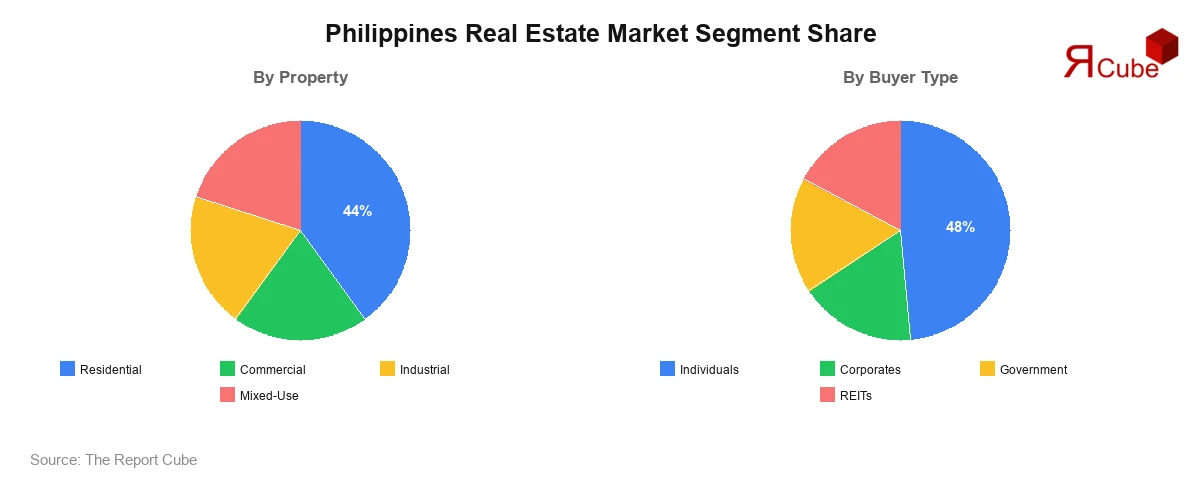
The residential segment leads the Philippines Real Estate Market, accounting for approximately 44% of total market value in 2025. Strong demand from urban households, OFW investors, and young professionals continues to drive unit sales, particularly in mid-range condominiums and horizontal housing developments. Residential properties benefit from flexible financing options and pre-selling strategies, ensuring consistent absorption. Commercial and mixed-use properties follow, supported by office demand from business process outsourcing firms and integrated township developments.
By Buyer Type:
- Individuals
- Corporates
- Government
- REITs
Individual buyers dominate the market by buyer type, representing nearly 48% market share in 2025. This segment is driven by owner-occupiers, small-scale investors, and OFW-funded purchases. Corporates and REITs play a growing role, particularly in commercial and office developments, as income-generating assets gain popularity. Government participation remains focused on socialized housing and infrastructure-linked developments, indirectly supporting private sector growth.
Regional Projection of Philippines Real Estate Industry
- Luzon
- Visayas
- Mindanao
- Metro Manila
Luzon leads the Philippines Real Estate Market, contributing approximately 58% of total market revenue in 2025. This dominance is driven by Metro Manila and adjacent growth corridors, where infrastructure density, employment concentration, and population growth remain strongest. The region continues to attract large-scale residential and commercial developments, supported by strong purchasing power and investor confidence. Meanwhile, the Western region is emerging as a high-growth zone, benefiting from tourism-driven developments and industrial expansion.
Need insights for a specific region within this market?
Request Regional DataWhy Choose This Report?
- Provides a comprehensive overview of the overall market analysis, encompassing key trends, consumer behavior analysis, and risk assessment to support strategic decision-making.
- Provides accurate, up-to-date insights into market size, segmentation, and emerging opportunities, helping to minimize risk & capitalizing on growth.
- Gives deep understanding of target audience preferences, investment habits, and communication channels for enhanced product development & marketing effectiveness.
- Delivers competitive analysis & benchmarking, uncovering the strengths & weaknesses of market competitors to guide strategies.
- Consolidate comprehensive market intelligence, reducing reasoning & streamlining research efforts.
- Facilitates customized market segmentation & risk mitigation strategies, fine-tuned to the business objectives.
- Aids in identifying both market challenges & untapped opportunities within the industry to drive long-term business growth.
- Provides valuable information based on actual customer data & search trends.
Table of Contents
- Introduction
- Objective of the Study
- Product and Category Definition
- Market Segmentation
- Study Variables
- Research Methodology
- Secondary Data Points
- Breakdown of Secondary Sources
- Primary Data Points
- Breakdown of Primary Interviews
- Secondary Data Points
- Executive Summary
- Market Dynamics
- Drivers
- Challenges
- Opportunity Assessment
- Recent Trends and Developments
- Regulatory and Policy Landscape
- Philippines Real Estate Market Overview (2020-2034)
- Market Size, By Value (USD Billion)
- Market Share, By Property
- Residential
- Commercial
- Industrial
- Land
- Mixed-Use
- Hospitality
- Market Share, By Buyer Type
- Individuals
- Corporates
- Government
- REITs
- OFW Investors
- Market Share, By Transaction Mode
- Primary Sales
- Secondary Sales
- Leasing
- Market Share, By Region
- Luzon
- Visayas
- Mindanao
- Metro Manila
- Market Share, By Company
- Competition Characteristics
- Revenue Shares & Analysis
- Luzon Real Estate Market
- Market Size, By Value (USD Billion)
- Market Share, By Property Segment
- Market Share, By Buyer Type
- Market Share, By Transaction Mode
- Visayas Real Estate Market
- Market Size, By Value (USD Billion)
- Market Share, By Property Segment
- Market Share, By Buyer Type
- Market Share, By Transaction Mode
- Mindanao Real Estate Market
- Market Size, By Value (USD Billion)
- Market Share, By Property Segment
- Market Share, By Buyer Type
- Market Share, By Transaction Mode
- Metro Manila Real Estate Market
- Market Size, By Value (USD Billion)
- Market Share, By Property Segment
- Market Share, By Buyer Type
- Market Share, By Transaction Mode
- Competitive Outlook and Company Profiles
- SM Prime Holdings
- Company Overview
- Property Portfolio
- Strategic Alliances/Partnerships
- Recent Developments
- Ayala Land
- Company Overview
- Property Portfolio
- Strategic Alliances/Partnerships
- Recent Developments
- Megaworld Corporation
- Company Overview
- Property Portfolio
- Strategic Alliances/Partnerships
- Recent Developments
- Robinsons Land
- Company Overview
- Property Portfolio
- Strategic Alliances/Partnerships
- Recent Developments
- Filinvest Land
- Company Overview
- Property Portfolio
- Strategic Alliances/Partnerships
- Recent Developments
- Vista Land
- Company Overview
- Property Portfolio
- Strategic Alliances/Partnerships
- Recent Developments
- Federal Land
- Company Overview
- Property Portfolio
- Strategic Alliances/Partnerships
- Recent Developments
- Rockwell Land
- Company Overview
- Property Portfolio
- Strategic Alliances/Partnerships
- Recent Developments
- Century Properties
- Company Overview
- Property Portfolio
- Strategic Alliances/Partnerships
- Recent Developments
- Cebu Landmasters
- Company Overview
- Property Portfolio
- Strategic Alliances/Partnerships
- Recent Developments
- Others
- SM Prime Holdings
- Contact Us and Disclaimer
Top Key Players & Market Share Outlook
- SM Prime Holdings
- Ayala Land
- Megaworld Corporation
- Robinsons Land
- Filinvest Land
- Vista Land
- Federal Land
- Rockwell Land
- Century Properties
- Cebu Landmasters
- Others
Frequently Asked Questions






