




Build Your Custom Market Intelligence Report
Customize Your ReportIndonesia E-commerce Logistics Market Insights & Analysis
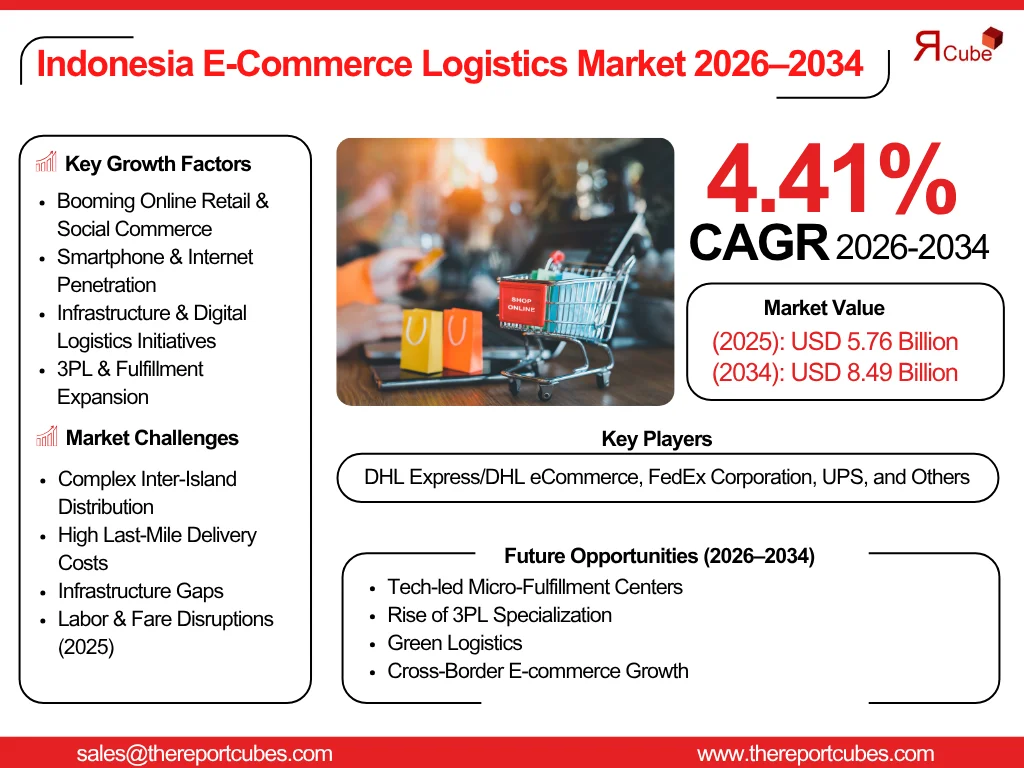
The Indonesia E-commerce Logistics Market is anticipated to register a CAGR of 4.41% during 2026-2034. The Indonesia E-commerce Logistics Market size was valued at USD 5.76 billion in 2025 and is projected to reach USD 8.49 billion by 2034. This growth reflects Indonesia’s rapidly expanding digital economy, supported by rising internet penetration, increasing smartphone adoption, and a growing base of online shoppers across both urban and semi-urban regions.
Indonesia’s unique archipelagic geography plays a critical role in shaping logistics demand, making efficient e-commerce logistics a strategic necessity rather than an operational support function. As online marketplaces, direct-to-consumer brands, and social commerce platforms continue to scale, logistics providers are increasingly required to deliver faster, more reliable, and cost-efficient services. Consequently, the Indonesia E-commerce Logistics Market is evolving toward integrated logistics models that combine transportation, warehousing, and last-mile delivery under unified service offerings.
Furthermore, competitive intensity among domestic and international logistics players is driving investments in automation, route optimization, and fulfillment infrastructure. These developments, combined with supportive digital trade policies and expanding cross-border e-commerce, position the Indonesia E-commerce Logistics Market for sustained and structurally sound growth throughout the forecast period.
Indonesia E-commerce Logistics Market Recent Developments
- 2025: J&T Express Indonesia expanded automated sorting hubs to support growing same-day delivery volumes.
- 2025: DHL Express Indonesia enhanced cross-border e-commerce logistics solutions for SME exporters.
Government Initiatives & Policies
- National Logistics Ecosystem (NLE): Program aimed at improving logistics efficiency and reducing delivery costs.
- Indonesia Digital Economy Roadmap: Policy framework supporting e-commerce, logistics digitization, and MSME participation.
Indonesia E-commerce Logistics Market Dynamics
Key Driver: Rapid Expansion of E-commerce Platforms Across Urban and Tier-2 Cities
The primary driver of the Indonesia E-commerce Logistics Market is the rapid expansion of e-commerce platforms beyond major metropolitan areas into tier-2 and tier-3 cities. As online shopping adoption deepens, logistics demand has shifted from centralized delivery models toward decentralized networks capable of serving geographically dispersed consumers. This transition has significantly increased demand for regional distribution centers, last-mile delivery partners, and flexible transportation services. Moreover, rising order frequency, smaller basket sizes, and higher customer expectations for delivery speed have made logistics performance a key competitive differentiator. As a result, logistics providers are increasingly aligning their operational strategies with the growth trajectories of major e-commerce platforms, reinforcing market expansion.
Book your FREE 30-minute expert consultation today
Contact UsIndustry Trends: Integration of Technology-Driven Fulfillment and Last-mile Solutions
A defining trend in the Indonesia E-commerce Logistics Market is the integration of technology-driven fulfillment and last-mile delivery solutions. Logistics companies are deploying real-time tracking, route optimization tools, and automated warehousing systems to improve delivery accuracy and reduce transit times. This trend is closely linked to the growth of same-day and next-day delivery services, particularly in densely populated regions. Additionally, partnerships between e-commerce platforms and logistics providers are becoming more strategic, enabling shared infrastructure and data-driven demand forecasting. These trends collectively enhance service reliability while supporting scalability, which is essential in a market characterized by fluctuating order volumes and seasonal demand spikes.
Major Challenge: Infrastructure Gaps and High Logistics Costs Outside Java
Despite strong growth prospects, infrastructure limitations remain a major challenge for the Indonesia E-commerce Logistics Market, particularly outside Java. Limited road connectivity, port congestion, and uneven warehouse availability in regions such as Kalimantan, Sulawesi, and Eastern Indonesia increase delivery times and operating costs. These challenges directly impact last-mile efficiency and restrict service standardization across regions. Furthermore, fuel price volatility and labor costs add pressure to logistics margins. Addressing these constraints requires long-term investments and close coordination between public and private stakeholders, making infrastructure development a critical determinant of future market performance.
Opportunity: Rising Cross-border E-commerce and SME Participation
The increasing participation of small and medium enterprises in cross-border e-commerce presents a significant opportunity for the Indonesia E-commerce Logistics Market. As Indonesian sellers access regional and global marketplaces, demand for integrated cross-border logistics, customs clearance, and international fulfillment services is rising. Logistics providers that can offer end-to-end solutions, including documentation support and reverse logistics, are well-positioned to capture this growth. This opportunity is further strengthened by government initiatives aimed at boosting exports through digital channels, creating a favorable environment for long-term market expansion.
Indonesia E-commerce Logistics Market Segment-wise Analysis
By Service Type:
- Transportation Services
- Warehousing Services
- Last-mile Delivery
- Fulfillment Services
- Value-added Services
Last-mile delivery dominates the Indonesia E-commerce Logistics Market, accounting for an estimated 38% of total service-based revenue. This dominance reflects the critical role of final delivery in customer satisfaction and repeat purchases. As order volumes grow and delivery windows shorten, e-commerce platforms increasingly rely on specialized last-mile providers to maintain service quality. Transportation and warehousing services remain essential supporting segments, particularly as fulfillment centers move closer to end consumers to reduce delivery times and costs.
By Business Model:
- Business-to-Consumer
- Business-to-Business
- Consumer-to-Consumer
The Business-to-Consumer model leads the Indonesia E-commerce Logistics Market, contributing approximately 64% of total shipments. This is directly linked to the rapid growth of online retail platforms and direct-to-consumer brands. As consumer expectations evolve, logistics providers are tailoring solutions to support higher delivery frequency, returns management, and flexible delivery options, reinforcing the dominance of this segment.
Regional Projection of Indonesia E-commerce Logistics Industry
- Java
- Sumatra
- Kalimantan
- Sulawesi
- Eastern Indonesia
Java leads the Indonesia E-commerce Logistics Market, accounting for nearly 58% of total market share. This leadership is driven by high population density, advanced infrastructure, and the concentration of major e-commerce fulfillment hubs. Jakarta and surrounding regions serve as primary logistics gateways, enabling faster delivery cycles and cost efficiencies. While Sumatra and Kalimantan are witnessing steady growth, infrastructure investments and expanding regional warehouses are expected to gradually rebalance market share, supporting more inclusive national logistics development over the forecast period.
Top Companies in Indonesia E-commerce Logistics Market
Ask Our Lead Analyst a Question About This Report
Contact UsWhy Choose This Report?
- Provides a comprehensive overview of the overall market analysis, encompassing key trends, consumer behavior analysis, and risk assessment to support strategic decision-making.
- Provides accurate, up-to-date insights into market size, segmentation, and emerging opportunities, helping to minimize risk & capitalizing on growth.
- Gives deep understanding of target audience preferences, investment habits, and communication channels for enhanced product development & marketing effectiveness.
- Delivers competitive analysis & benchmarking, uncovering the strengths & weaknesses of market competitors to guide strategies.
- Consolidate comprehensive market intelligence, reducing reasoning & streamlining research efforts.
- Facilitates customized market segmentation & risk mitigation strategies, fine-tuned to the business objectives.
- Aids in identifying both market challenges & untapped opportunities within the industry to drive long-term business growth.
- Provides valuable information based on actual customer data & search trends.
Table of Contents
- Introduction
- Objective of the Study
- Product and Category Definition
- Market Segmentation
- Study Variables
- Research Methodology
- Secondary Data Points
- Breakdown of Secondary Sources
- Primary Data Points
- Breakdown of Primary Interviews
- Secondary Data Points
- Executive Summary
- Market Dynamics
- Drivers
- Challenges
- Opportunity Assessment
- Recent Trends and Developments
- Regulatory and Policy Landscape
- Indonesia E-commerce Logistics Market Overview (2021-2034)
- Market Size, By Value (USD Billion)
- Market Share, By Service Type
- Transportation Services
- Warehousing Services
- Last-mile Delivery
- Fulfillment Services
- Value-added Services
- Market Share, By Business Model
- Business-to-Consumer
- Business-to-Business
- Consumer-to-Consumer
- Market Share, By Shipment Destination
- Domestic Shipments
- Cross-border Shipments
- Market Share, By Delivery Speed
- Same-day Delivery
- Next-day Delivery
- Standard Delivery
- Market Share, By E-commerce Platform
- Marketplace Platforms
- Direct-to-Consumer Brands
- Social Commerce Channels
- Market Share, By Region
- Java
- Sumatra
- Kalimantan
- Sulawesi
- Eastern
- Market Share, By Company
- Revenue Shares and Analysis
- Competitive Landscape
- Java Region E-commerce Logistics Market
- Market Size, By Value (USD Billion)
- Market Share, By Service Type
- Market Share, By Business Model
- Market Share, By Shipment Destination
- Market Share, By Delivery Speed
- Market Share, By E-commerce Platform
- Sumatra Region E-commerce Logistics Market
- Market Size, By Value (USD Billion)
- Market Share, By Service Type
- Market Share, By Business Model
- Market Share, By Shipment Destination
- Market Share, By Delivery Speed
- Market Share, By E-commerce Platform
- Kalimantan Region E-commerce Logistics Market
- Market Size, By Value (USD Billion)
- Market Share, By Service Type
- Market Share, By Business Model
- Market Share, By Shipment Destination
- Market Share, By Delivery Speed
- Market Share, By E-commerce Platform
- Sulawesi Region E-commerce Logistics Market
- Market Size, By Value (USD Billion)
- Market Share, By Service Type
- Market Share, By Business Model
- Market Share, By Shipment Destination
- Market Share, By Delivery Speed
- Market Share, By E-commerce Platform
- Eastern Indonesia Region E-commerce Logistics Market
- Market Size, By Value (USD Billion)
- Market Share, By Service Type
- Market Share, By Business Model
- Market Share, By Shipment Destination
- Market Share, By Delivery Speed
- Market Share, By E-commerce Platform
- Competitive Outlook and Company Profiles
- JNE Express
- Company Overview
- Product Portfolio
- Strategic Alliances/Partnerships
- Recent Developments
- J&T Express Indonesia
- Company Overview
- Product Portfolio
- Strategic Alliances/Partnerships
- Recent Developments
- SiCepat Ekspres Indonesia
- Company Overview
- Product Portfolio
- Strategic Alliances/Partnerships
- Recent Developments
- Ninja Xpress Indonesia
- Company Overview
- Product Portfolio
- Strategic Alliances/Partnerships
- Recent Developments
- POS Indonesia
- Company Overview
- Product Portfolio
- Strategic Alliances/Partnerships
- Recent Developments
- TIKI Indonesia
- Company Overview
- Product Portfolio
- Strategic Alliances/Partnerships
- Recent Developments
- Wahana Prestasi Logistik
- Company Overview
- Product Portfolio
- Strategic Alliances/Partnerships
- Recent Developments
- SAP Express
- Company Overview
- Product Portfolio
- Strategic Alliances/Partnerships
- Recent Developments
- DHL Express Indonesia
- Company Overview
- Product Portfolio
- Strategic Alliances/Partnerships
- Recent Developments
- FedEx Indonesia
- Company Overview
- Product Portfolio
- Strategic Alliances/Partnerships
- Recent Developments
- Others
- JNE Express
- Contact Us and Disclaimer
Top Key Players & Market Share Outlook
- JNE Express,
- J&T Express Indonesia,
- SiCepat Ekspres Indonesia,
- Ninja Xpress Indonesia,
- POS Indonesia,
- TIKI Indonesia,
- Wahana Prestasi Logistik,
- SAP Express,
- DHL Express Indonesia,
- FedEx Indonesia,
- Others,
Frequently Asked Questions






