



Build Your Custom Market Intelligence Report
Customize Your ReportAsia Pacific Air Conditioners Market Key Highlights
By Product Type:
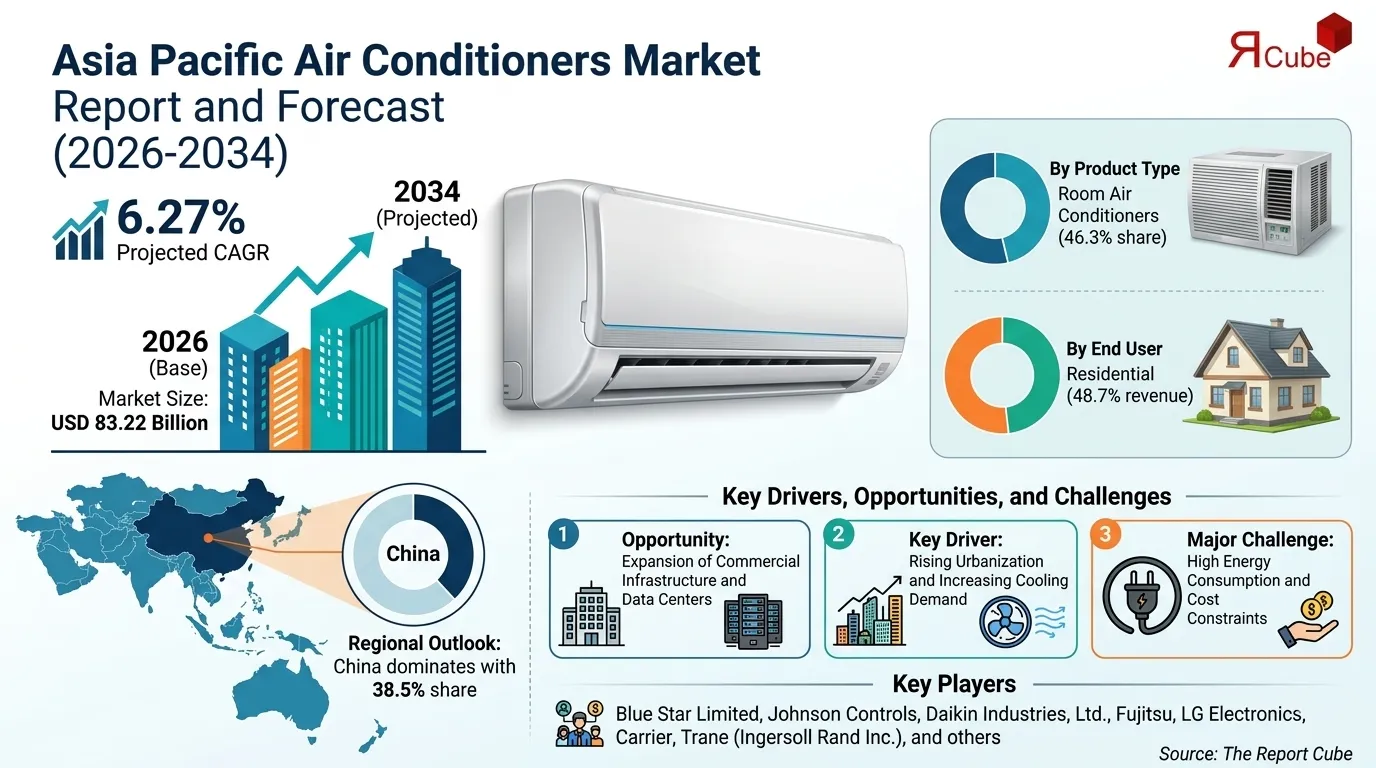
Room Air Conditioners segment leads the market with 46.3% share.
By End User:
Residential segment dominates the market with 48.7% of revenue.
Regional Outlook:
China region dominates the Asia Pacific Air Conditioners market with 38.5% share.
Asia Pacific Air Conditioners Market Insights & Analysis
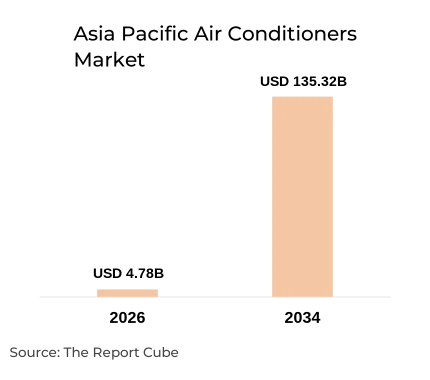
The Asia Pacific Air Conditioners Market is anticipated to register a CAGR of around 6.27% during the forecast period 2026-2034. The market size is valued at USD 83.22 billion in 2026 and is projected to reach USD 135.32 billion by 2034. Growth momentum across the Asia Pacific air conditioners market is being shaped by rapid urban expansion, rising disposable income, and increasing exposure to extreme weather patterns. Countries such as India, China, and Southeast Asian nations are witnessing a steady surge in residential construction, contributing to higher demand for room air conditioners. In parallel, commercial infrastructure development including data centers, retail hubs, and healthcare facilities continues to boost large-scale HVAC installations.
Investment trends further highlight the shift toward energy-efficient and smart cooling systems. Governments across the region are promoting low global warming potential refrigerants and higher energy rating standards, which is encouraging manufacturers to innovate. Leading companies such as Daikin Industries, Ltd. and LG Electronics are focusing on inverter technology and AI-enabled cooling systems. Additionally, supply chain localization and capacity expansion across Asia Pacific are improving product accessibility and pricing competitiveness, strengthening the overall market growth outlook.
Asia Pacific Air Conditioners Market Impact Analysis
| Factor | Type | Specific Impact on Market | Magnitude | Business Implication |
|---|---|---|---|---|
| Rapid Urbanization & Infrastructure Development | Market | 55%+ urban population by 2030 drives residential demand | High | Scale capacity for urban projects; target megacities |
| Rising Disposable Incomes Across Emerging Markets | Consumer | Middle-class growth shifts AC from luxury to necessity | High | Develop mid-range products for emerging consumers |
| Climate Change & Extreme Weather Patterns | Environmental | Prolonged heatwaves increase cooling as health essential | High | Position ACs as health products; boost service networks |
| Energy Efficiency Standards Harmonization (ASEAN) | Regulatory | Minimum EER 2.9W/W & CSPF 3.08 W/W by 2020 standards | High | Ensure regional compliance; achieve MEPS certification |
| Shift to Inverter & Smart AC Technology | Technological | Inverter AC cuts energy 30-40%; IoT integration grows | High | Prioritize inverter portfolio; integrate AI controls |
| China Market Dominance & Manufacturing Hub | Market | China holds largest share; robust manufacturing base | High | Leverage China supply chain; explore partnerships |
| India Fast-Growth Trajectory | Market | Fastest-growing segment; high temps & urbanization fuel | High | Establish strong India presence; localize offerings |
| Room AC Segment Dominance (~64% Share) | Market | Split AC systems lead due to compact urban housing needs | High | Focus on split AC innovation & compact designs |
| R-410A Refrigerant Phase-Out & R-32 Adoption | Regulatory | Jan 2026 phase-out mandates eco-friendly refrigerants | High | Transition to R-32 systems; phase out R-410A stock |
| Government Climate Targets & GWP Regulations | Regulatory | Low-GWP refrigerant push aligns with climate goals | Medium | Invest in low-GWP refrigerant R&D early |
| Commercial Infrastructure Expansion | Market | Data centers, malls, hospitals drive large HVAC installs | Medium | Target B2B commercial segments; offer VRF systems |
| Intense Multi-Brand Competition | Competitive | Daikin, LG, Blue Star compete on price & innovation | High | Differentiate via innovation; avoid price wars only |
| Supply Chain Localization Strategies | Market | Domestic production improves pricing & accessibility | Medium | Build regional manufacturing; reduce import dependency |
| Consumer Shift to Energy-Efficient Products | Consumer | High-efficiency models preferred; up to 40% energy cut | High | Promote high star ratings; communicate ROI clearly |
Asia Pacific Air Conditioners Market Dynamics
Key Driver: Rising Urbanization and Increasing Cooling Demand
Urban population growth across Asia Pacific continues to accelerate, with over 55% of the region’s population expected to reside in urban areas by 2030. This shift is directly influencing the Asia Pacific air conditioners market size, as dense urban housing increases the need for efficient indoor cooling. Residential demand, especially for split AC systems, is expanding due to compact housing structures and affordability improvements.
Furthermore, rising temperatures and longer summer durations are strengthening the need for cooling solutions. Countries such as India and Indonesia have recorded temperature increases of nearly 1.2°C over the past decade, pushing demand for energy-efficient air conditioners. This trend is expected to sustain strong market growth and demand across both residential and commercial sectors.
Book your FREE 30-minute expert consultation today
Contact UsIndustry Trends: Adoption of Smart and Energy-Efficient Technologies
A noticeable transformation in the Asia Pacific air conditioners market trends is the integration of smart technologies. AI-enabled cooling systems, IoT connectivity, and remote operation features are gaining popularity among consumers. These features allow users to optimize energy consumption, improving efficiency and lowering electricity bills.
Manufacturers are also focusing on inverter-based systems and eco-friendly refrigerants such as R32 and R290. These innovations align with evolving regulatory frameworks and environmental goals. As a result, the market share of advanced and sustainable air conditioning systems is steadily increasing across developed and emerging economies.
Major Challenge: High Energy Consumption and Cost Constraints
While demand continues to rise, energy consumption remains a key concern in the Asia Pacific air conditioners market. Air conditioning units contribute significantly to peak electricity loads, especially during summer months. This creates pressure on power infrastructure in developing economies.
Additionally, high upfront costs of advanced energy-efficient systems can limit adoption among price-sensitive consumers. Although long-term savings are substantial, initial investment barriers still affect purchasing decisions. This challenge highlights the need for affordable financing options and government incentives to drive adoption.
Opportunity: Expansion of Commercial Infrastructure and Data Centers
The rapid growth of commercial infrastructure presents strong opportunities for the Asia Pacific air conditioners market growth. Expansion in sectors such as IT, retail, and healthcare is increasing demand for centralized and ducted cooling systems. Data centers, in particular, require high-performance cooling solutions to maintain operational stability.
In addition, rising foreign investments and industrial development are boosting demand for large-scale HVAC installations. This trend is expected to create lucrative opportunities for manufacturers offering advanced cooling technologies tailored for commercial applications.
Asia Pacific Air Conditioners Market Segment-wise Analysis
By Product Type:
- Chillers
- Room Air Conditioners
- Cassette Air Conditioners
- Packaged Air Conditioners
- Ducted Split Systems
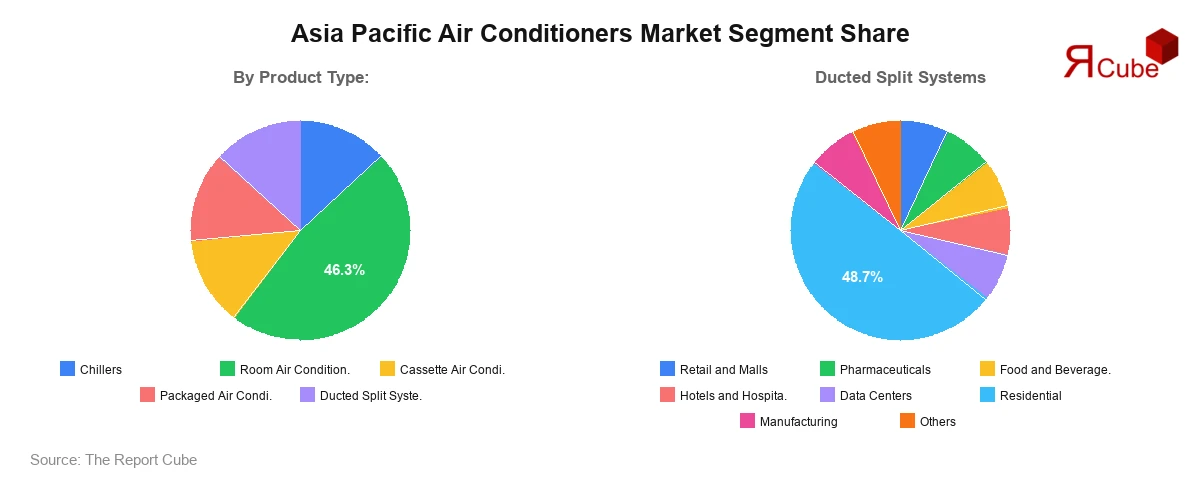
Among these, the room air conditioners segment holds the largest Asia Pacific air conditioners market share, accounting for approximately 46.3% of total revenue. This dominance is driven by strong residential demand, particularly in emerging economies such as India and Vietnam. Split AC units within this category are witnessing higher adoption due to their energy efficiency and ease of installation.
Market data indicates that nearly 68% of new residential AC purchases in urban Asia Pacific are split systems. Additionally, ongoing product innovations such as inverter technology and smart connectivity features are further supporting segment growth. Increasing affordability and financing options have also enabled wider consumer access, strengthening demand across middle-income households.
By End User:
- Retail and Malls
- Pharmaceuticals
- Food and Beverage
- Hotels and Hospitality
- Data Centers
- Offices
- Manufacturing
- Residential
- Educational Institutions
- Hospitals and Healthcare
- Others
The residential segment leads the market with a revenue share of around 48.7%, driven by increasing household penetration of air conditioning systems. Rising disposable income and changing lifestyle preferences are encouraging consumers to invest in advanced cooling solutions. In urban areas, nearly 6 out of 10 households are expected to own at least one air conditioner by 2030.
Moreover, government initiatives promoting energy-efficient appliances are supporting this segment’s growth. The demand for compact, low-noise, and smart-enabled air conditioners is particularly strong among younger consumers, contributing to sustained expansion of this segment within the Asia Pacific air conditioners market.
Regional Projection of Asia Pacific Air Conditioners Industry
- China
- India
- South Korea
- Japan
- Indonesia
- Thailand
- Vietnam
- Australia
China dominates the Asia Pacific air conditioners market with an estimated share of 38.5%. The country’s leadership is supported by its strong manufacturing ecosystem, high domestic demand, and widespread urbanization. China produces over 45% of the world’s air conditioning units, making it a key hub for both production and consumption.
Government policies promoting energy-efficient appliances and green buildings have accelerated the adoption of advanced cooling systems. Additionally, rising middle-class income and rapid expansion of smart homes are contributing to consistent market growth. The presence of major manufacturers and continuous technological advancements further reinforce China’s leading position in the regional market.
Asia Pacific Air Conditioners Market Countries Analysis
The Asia Pacific air conditioners market shows strong regional variation driven by altitude, climate conditions, and urban development across coastal, Andean, and tropical regions.
| Country | Demand Level | Key Areas | System Dominance | Core Demand Logic | Growth Nature |
|---|---|---|---|---|---|
| China | Extremely High | Tiers 1–3 cities, coastal belt | Split, multi split, VRF | Huge base, rising urban incomes | Scale plus steady penetration |
| India | Very High | Metro and Tier 2–3 clusters | Split AC, low window share | Hot climate, low current penetration | Fastest room AC volume growth |
| South Korea | High | Seoul, Busan, dense apartments | Smart split and multi split | Tech savvy, comfort and smart control | Upgrade and replacement led |
| Japan | High | Tokyo, Osaka, mature housing | Inverter split, multi split | Mature market, efficiency focus | Premium efficiency upgrades |
| Indonesia | Very High | Jakarta, Surabaya, new housing | Wall split, basic commercial | Hot humid climate, urbanisation | Strong first time buying wave |
| Thailand | Very High | Bangkok, resort cities | Split, light commercial systems | Tourism and 24x7 cooling use | Stable, tourism linked growth |
| Vietnam | High | Hanoi, Ho Chi Minh City | Room split, emerging VRF | Rising middle class, heat | Rapid penetration expansion |
| Australia | High | Sydney, Melbourne, hot inland | Ducted, split, VRF commercial | Harsh summers, large homes | Steady residential and office build |
Government Initiatives & Policies
- India Cooling Action Plan (ICAP) Phase II: Introduced to improve energy efficiency and reduce cooling demand by 20% by 2030.
- China Green Cooling Action Plan 2025 Update: Focuses on promoting eco-friendly refrigerants and boosting energy-efficient AC adoption across residential and commercial sectors.
Asia Pacific Air Conditioners Industry Recent Developments
- 2025: Blue Star Limited launched a new lineup of 125 room AC models aligned with updated BEE standards. The company also expanded its production capacity to 1.4 million units, scalable to 1.8 million, to address rising regional demand and strengthen supply capabilities.
- 2025: Samsung introduced Bespoke AI WindFree air conditioners featuring AI Energy Mode, delivering up to 30% energy savings by analyzing usage patterns. This innovation targets growing demand for smart and efficient residential cooling solutions.
- 2025: LG Electronics launched its Essential Series designed for Asia Pacific climates, incorporating corrosion-resistant technology and compliance with updated energy standards, reinforcing its regional manufacturing strategy.
- 2025: Johnson Controls strengthened its Asia Pacific operations by appointing new leadership to accelerate HVAC and smart building solutions, targeting rapid urban and commercial infrastructure growth.
Need insights for a specific region within this market?
Request Regional DataWhy Choose This Report? {{UNCHANGED template}}
- Provides a comprehensive overview of the overall market analysis, encompassing key trends, consumer behavior analysis, and risk assessment to support strategic decision-making.
- Provides accurate, up-to-date insights into market size, segmentation, and emerging opportunities, helping to minimize risk & capitalizing on growth.
- Gives deep understanding of target audience preferences, investment habits, and communication channels for enhanced product development & marketing effectiveness.
- Delivers competitive analysis & benchmarking, uncovering the strengths & weaknesses of market competitors to guide strategies.
- Consolidate comprehensive market intelligence, reducing reasoning & streamlining research efforts.
- Facilitates customized market segmentation & risk mitigation strategies, fine-tuned to the business objectives.
- Aids in identifying both market challenges & untapped opportunities within the industry to drive long-term business growth.
- Provides valuable information based on actual customer data & search trends.
Table of Contents
- Introduction
- Objective of the Study
- Product and Category Definition
- Market Segmentation
- Study Variables
- Research Methodology
- Secondary Data Points
- Breakdown of Secondary Sources
- Primary Data Points
- Breakdown of Primary Interviews
- Secondary Data Points
- Executive Summary
- Market Dynamics
- Emerging Opportunities
- Adoption Trends
- Demand Drivers
- Disruption Analysis (Challenges)
- Industry Analysis and Strategic Insights
- Supply and Value Chain Analysis
- Pricing Analysis
- Go-To-Market Strategy
- BCG Matrix
- Recent Trends and Developments
- Import and Export Analysis
- Regulatory and Policy Landscape
- Region-wise Policies
- Government Initiatives
- Asia Pacific Air Conditioners Market Overview and Forecast Analysis (2021-2034)
- Market Size, By Value, By Growth Rate (CAGR / USD Billion)
- Market Share, By Product Type
- Chillers
- Water-cooled Chillers
- Air-cooled Chillers
- Other Chillers
- Room Air Conditioners
- Split AC
- Split AC up to 1 Ton
- Split AC 1 Ton to 1.5 Ton
- Split AC above 1.6 Ton to 2 Ton
- Split AC above 2 Ton
- Window AC
- Window AC up to 1 Ton
- Window AC 1 Ton to 2 Ton
- Window AC above 2 Ton
- Split AC
- Cassette Air Conditioners
- Cassette AC up to 2 Tons
- Cassette AC 2.1 to 4 Tons
- Cassette AC 4.1 to 5 Tons
- Cassette AC above 5 Tons
- Packaged Air Conditioners
- Packaged AC up to 5 Tons
- Packaged AC 6 to 10 Tons
- Packaged AC 11 to 20 Tons
- Packaged AC above 20 Tons
- Ducted Split Systems
- VRF Systems
- Ducted Split AC up to 5 Tons
- Ducted Split AC 6 to 10 Tons
- Ducted Split AC 11 to 20 Tons
- Ducted Split AC above 20 Tons
- Others (Air Handling Units (AHU) / Fan Coil Units (FCU), etc.)
- Chillers
- Market Share, By Refrigerant Type
- R290
- R410A
- R32
- R1234ze / R1234yf
- R134a
- Other Refrigerants
- Market Share, By Distribution Channel
- Multi-brand Stores
- Online
- Direct Sales
- Authorized Dealers and Distributors
- Market Share, By End User
- Retail and Malls
- Pharmaceuticals
- Food and Beverage
- Hotels and Hospitality
- Data Centers
- Offices
- Manufacturing
- Residential
- Educational Institutions
- Hospitals and Healthcare
- Others
- Market Share, By Country
- China
- India
- South Korea
- Japan
- Indonesia
- Thailand
- Vietnam
- Australia
- Market Share, By Company
- Revenue Shares and Analysis
- Competitive Landscape
- China Air Conditioners Market Overview and Forecast Analysis (2021-2034)
- Market Size, By Value, By Growth Rate (CAGR / USD Billion/Million)
- Market Share, By Product Type
- Market Share, By Refrigerant Type
- Market Share, By Distribution Channel
- Market Share, By End User
- India Air Conditioners Market Overview and Forecast Analysis (2021-2034)
- Market Size, By Value, By Growth Rate (CAGR / USD Billion/Million)
- Market Share, By Product Type
- Market Share, By Refrigerant Type
- Market Share, By Distribution Channel
- Market Share, By End User
- South Korea Air Conditioners Market Overview and Forecast Analysis (2021-2034)
- Market Size, By Value, By Growth Rate (CAGR / USD Billion/Million)
- Market Share, By Product Type
- Market Share, By Refrigerant Type
- Market Share, By Distribution Channel
- Market Share, By End User
- Japan Air Conditioners Market Overview and Forecast Analysis (2021-2034)
- Market Size, By Value, By Growth Rate (CAGR / USD Billion/Million)
- Market Share, By Product Type
- Market Share, By Refrigerant Type
- Market Share, By Distribution Channel
- Market Share, By End User
- Indonesia Air Conditioners Market Overview and Forecast Analysis (2021-2034)
- Market Size, By Value, By Growth Rate (CAGR / USD Billion/Million)
- Market Share, By Product Type
- Market Share, By Refrigerant Type
- Market Share, By Distribution Channel
- Market Share, By End User
- Thailand Air Conditioners Market Overview and Forecast Analysis (2021-2034)
- Market Size, By Value, By Growth Rate (CAGR / USD Billion/Million)
- Market Share, By Product Type
- Market Share, By Refrigerant Type
- Market Share, By Distribution Channel
- Market Share, By End User
- Vietnam Air Conditioners Market Overview and Forecast Analysis (2021-2034)
- Market Size, By Value, By Growth Rate (CAGR / USD Billion/Million)
- Market Share, By Product Type
- Market Share, By Refrigerant Type
- Market Share, By Distribution Channel
- Market Share, By End User
- Australia Air Conditioners Market Overview and Forecast Analysis (2021-2034)
- Market Size, By Value, By Growth Rate (CAGR / USD Billion/Million)
- Market Share, By Product Type
- Market Share, By Refrigerant Type
- Market Share, By Distribution Channel
- Market Share, By End User
- Competitive Analysis, 2026
- Market Share of Key Players
- Competitive Mapping for Each Segment and Companies Operating Regionally
- China Air Conditioner Companies Share and Competitive Analysis, 2026
- India Air Conditioner Companies Share and Competitive Analysis, 2026
- South Korea Air Conditioner Companies Share and Competitive Analysis, 2026
- Japan Air Conditioner Companies Share and Competitive Analysis, 2026
- Indonesia Air Conditioner Companies Share and Competitive Analysis, 2026
- Thailand Air Conditioner Companies Share and Competitive Analysis, 2026
- Vietnam Air Conditioner Companies Share and Competitive Analysis, 2026
- Australia Air Conditioner Companies Share and Competitive Analysis, 2026
- Company Profile (Partial List)
- Blue Star Limited
- Company Overview
- Product Portfolio
- Strategic Alliances/Partnerships
- Recent Developments
- Johnson Controls
- Company Overview
- Product Portfolio
- Strategic Alliances/Partnerships
- Recent Developments
- Daikin Industries, Ltd.
- Company Overview
- Product Portfolio
- Strategic Alliances/Partnerships
- Recent Developments
- Fujitsu
- Company Overview
- Product Portfolio
- Strategic Alliances/Partnerships
- Recent Developments
- LG Electronics
- Company Overview
- Product Portfolio
- Strategic Alliances/Partnerships
- Recent Developments
- Carrier
- Company Overview
- Product Portfolio
- Strategic Alliances/Partnerships
- Recent Developments
- Trane (Ingersoll Rand Inc.)
- Company Overview
- Product Portfolio
- Strategic Alliances/Partnerships
- Recent Developments
- Samsung
- Company Overview
- Product Portfolio
- Strategic Alliances/Partnerships
- Recent Developments
- Airedale International Air Conditioning Ltd.
- Company Overview
- Product Portfolio
- Strategic Alliances/Partnerships
- Recent Developments
- Mitsubishi Electric Corporation
- Company Overview
- Product Portfolio
- Strategic Alliances/Partnerships
- Recent Developments
- Others (Partial List)
- Blue Star Limited
- Contact Us and Disclaimer
Top Key Players & Market Share Outlook
- Blue Star Limited
- Johnson Controls
- Daikin Industries, Ltd.
- Fujitsu
- LG Electronics
- Carrier
- Trane (Ingersoll Rand Inc.)
- Samsung
- Airedale International Air Conditioning Ltd.
- Mitsubishi Electric Corporation
Frequently Asked Questions