



Build Your Custom Market Intelligence Report
Customize Your ReportJapan Air Conditioners Market Key Highlights
By Product Type:
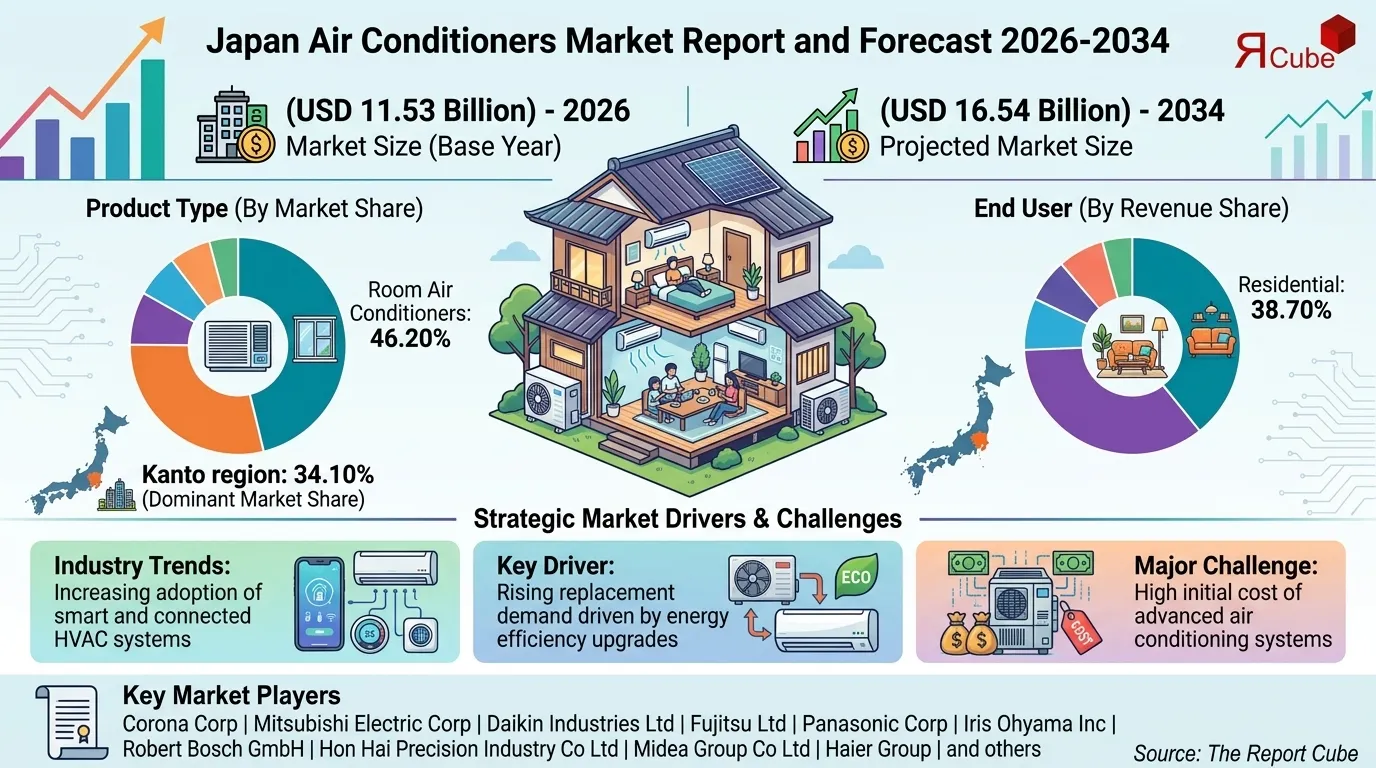
Room Air Conditioners segment leads the market with 46.20%.
By End User:
Residential segment dominates the market with 38.70% of revenue.
Regional Outlook:
Kanto region dominates the Japan Air Conditioners market with 34.10% share.
Japan Air Conditioners Market Insights & Analysis
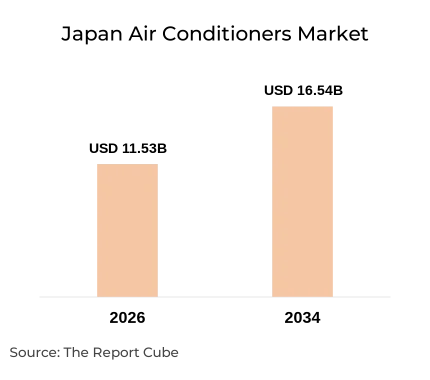
The Japan Air Conditioners Market is anticipated to register a CAGR of around 4.61% during the forecast period 2026-2034. The market size is valued at USD 11.53 billion and is projected to reach USD 16.54 billion by 2034. Japan continues to show stable demand for air conditioning systems, supported by rising summer temperatures and an aging building stock requiring energy-efficient upgrades. Market trends indicate growing interest in inverter-based room air conditioners, which improve energy savings and reduce electricity costs. Leading companies such as Daikin Industries Ltd and Mitsubishi Electric Corp are actively introducing advanced models aligned with 2027 energy standards, encouraging replacement demand across urban households.
Investment activity remains focused on smart HVAC technologies, where IoT-enabled systems allow remote monitoring and predictive maintenance. Government policies promoting carbon neutrality by 2050 are pushing manufacturers toward eco-friendly refrigerants and high-efficiency systems. Demand is also rising from data centers and healthcare facilities, where precise climate control is essential. Industry share is further influenced by renovation projects in Tokyo and surrounding regions, where older infrastructure is being upgraded with modern cooling systems, strengthening long-term market expansion.
Japan Air Conditioners Market Impact Analysis
| Factor | Type | Specific Impact | Magnitude | Strategic Implication |
|---|---|---|---|---|
| Extreme Market Maturity | Market Structure | Near-saturation in residential AC adoption | High | Growth driven by replacement & upgrades, not new buyers |
| Dominance of Mini-Split & Multi-Split Systems | Structural Driver | Compact housing favors ductless systems | High | Product innovation remains within split ecosystem |
| Top Runner Energy Efficiency Standards | Regulatory Driver | Forces continuous improvement in efficiency performance | High | Shortens replacement cycles |
| Heat Pump Expansion (Cooling + Heating) | Technology Shift | Systems serve dual-purpose HVAC needs | High | Standalone AC gradually integrates into hybrid HVAC |
| Urban Density & Compact Living Spaces | Structural Constraint | Limits adoption of large centralized systems | High | Wall-mounted & multi-split systems dominate |
| Smart HVAC & Automation Integration | Technology Driver | High adoption of IoT-enabled climate systems | Medium–High | Competition shifts toward smart ecosystems |
| Data Centers & Precision Cooling Demand | Growth Driver | AI and digital infrastructure require advanced cooling | High | High-margin commercial HVAC expansion |
| Aging Population & Indoor Comfort Focus | Demographic Driver | Higher demand for stable indoor climate control | Medium–High | Premium comfort systems gain traction |
Japan Air Conditioners Market Dynamics
Key Driver: Rising replacement demand driven by energy efficiency upgrades
Japan’s air conditioner demand is strongly influenced by replacement cycles rather than first-time installations. A large portion of residential units installed before 2015 are being replaced with energy-efficient inverter systems. This shift is driven by higher electricity costs and stricter efficiency regulations introduced by the government. Consumers are increasingly prioritizing long-term savings, which supports the growth of premium air conditioning products across urban regions.
Manufacturers are aligning product development with evolving efficiency benchmarks, leading to faster adoption of advanced technologies. The introduction of models compliant with fiscal 2027 standards is accelerating replacement demand. Smart features such as occupancy sensors and AI-based cooling optimization are gaining traction, further supporting market growth and increasing product differentiation among leading brands.
Book your FREE 30-minute expert consultation today
Contact UsIndustry Trends: Increasing adoption of smart and connected HVAC systems
Smart air conditioners are becoming a key trend in Japan, with growing consumer preference for connected home solutions. Integration with mobile applications and home automation platforms is allowing users to monitor and control cooling systems remotely. This trend aligns with Japan’s strong smart home adoption rate, particularly in urban apartments and newly constructed residential units.
Commercial sectors such as offices and retail spaces are adopting centralized HVAC systems with IoT integration for energy management. Data-driven cooling systems help reduce operational costs while improving performance. Companies are investing in cloud-based HVAC monitoring platforms, enabling predictive maintenance and reducing downtime, which is especially valuable in data centers and healthcare facilities.
Major Challenge: High initial cost of advanced air conditioning systems
Advanced air conditioning systems, particularly VRF and smart-enabled units, come with higher upfront costs, which can limit adoption among price-sensitive consumers. While long-term savings are evident, the initial investment remains a barrier, especially in smaller residential setups and rural areas. This pricing challenge affects overall market penetration in certain segments.
Additionally, installation complexity and maintenance requirements for advanced systems increase total ownership costs. Skilled labor shortages in HVAC installation services further add to operational challenges. These factors may slow down adoption rates, particularly among small businesses and older residential properties that require significant infrastructure upgrades.
Opportunity: Expansion of demand from data centers and healthcare infrastructure
Japan’s growing digital economy is driving demand for data centers, which require highly efficient and reliable cooling systems. Air conditioning demand in this segment is rising steadily, as temperature control directly impacts server performance and operational stability. This creates strong opportunities for precision cooling solutions and advanced HVAC technologies.
Healthcare infrastructure expansion is another key opportunity area. Hospitals and pharmaceutical facilities require strict climate control, supporting demand for high-performance air conditioning systems. Manufacturers focusing on specialized solutions for these sectors are likely to gain market share, as reliability and energy efficiency remain critical decision factors.
Japan Air Conditioners Market Segment-wise Analysis
By Product Type:
- Chillers
- Room Air Conditioners
- Cassette Air Conditioners
- Packaged Air Conditioners
- Ducted Split Systems
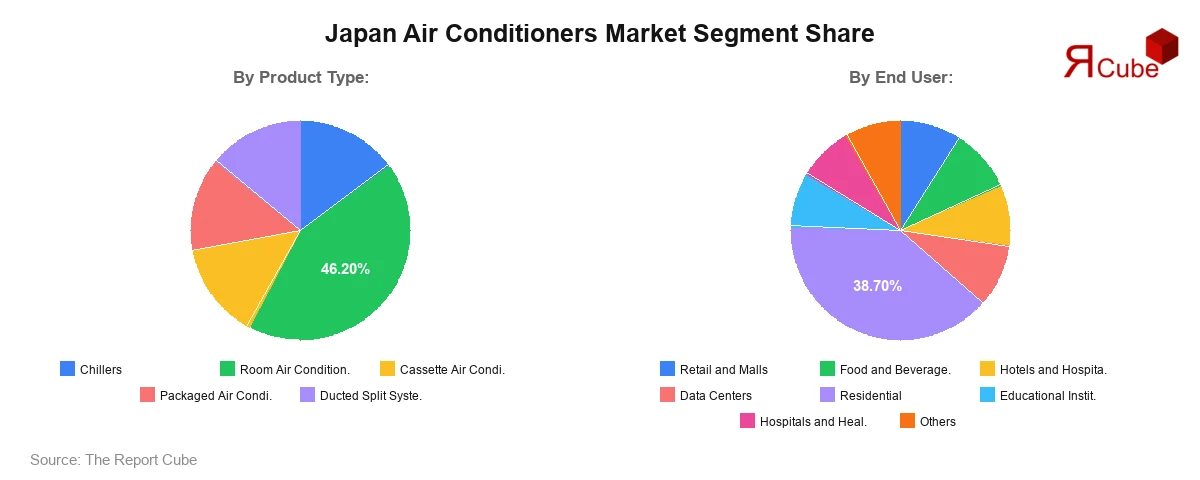
Room Air Conditioners hold the leading market share of 46.20%, driven by strong residential demand across Japan. Split AC systems dominate within this segment due to their energy efficiency, compact design, and ease of installation. Units ranging between 1 Ton to 1.5 Ton are widely preferred in urban apartments due to space constraints and optimal cooling performance. Increasing adoption of inverter technology has further strengthened this segment’s growth, as consumers seek lower electricity consumption and quieter operation.
By End User:
- Retail and Malls
- Pharmaceuticals
- Food and Beverage
- Hotels and Hospitality
- Data Centers
- Offices
- Manufacturing
- Residential
- Educational Institutions
- Hospitals and Healthcare
- Other
The residential segment dominates with 38.70% market share, supported by consistent replacement demand and rising adoption of smart air conditioning systems. Urban households are increasingly investing in high-efficiency units due to rising electricity prices and environmental awareness. Demand is particularly strong in metropolitan areas such as Tokyo, where apartment living drives the need for compact and efficient cooling solutions. Government incentives for energy-efficient appliances also contribute to higher adoption rates in this segment.
Regional Projection of Japan Air Conditioners Industry
- Hokkaido
- Tohoku
- Kanto
- Shikoku
- Others
Kanto region leads the market with 34.10% share, driven by high population density and strong urban infrastructure. Tokyo and surrounding cities account for a significant portion of air conditioner demand due to residential and commercial expansion. The region’s hot and humid summers increase the need for efficient cooling systems, supporting consistent product demand.
Commercial establishments, including offices and retail spaces, contribute significantly to regional market size. Renovation projects and smart building initiatives are further boosting the adoption of advanced HVAC systems. The presence of major manufacturers and distribution networks in Kanto also enhances product availability, strengthening the region’s dominance in the overall market.
Japan Air Conditioners Market Regional Impact Analysis
| Region | Market Role | Demand Characteristics | Key Growth Drivers | Constraints | Strategic Insight |
|---|---|---|---|---|---|
| Hokkaido | Heating-Dominant Market | Low AC penetration but rising summer cooling demand | Heat pump adoption, rising temperatures, tourism infrastructure | Extremely cold winters limit standalone AC relevance | Growth driven by hybrid HVAC (heating + cooling), not pure AC sales |
| Tohoku | Emerging Hybrid Market | Moderate AC usage with strong heating dependency | Urban redevelopment, retrofit of aging housing stock | Lower population density and slower economic growth | Replacement-driven demand with gradual AC penetration increase |
| Kanto | Primary Demand Hub | Highest AC usage intensity (residential + commercial) | Urban density (Tokyo), smart buildings, commercial HVAC demand | Space constraints and high installation costs | Drives largest share of national HVAC demand (~35%+) :contentReference[oaicite:0]{index=0} |
| Shikoku | Climate-Driven Market | High cooling demand due to warm, humid conditions | Rising temperatures, residential adoption, small urban centers | Limited industrial and commercial base | Residential-led demand with growing usage intensity |
| Other Regions (Kansai, Chubu, Kyushu) | Balanced High-Value Markets | Strong mix of residential + commercial HVAC demand | Industrial activity, urban clusters (Osaka, Nagoya), tourism | Market maturity in major cities | Upgrade-driven growth with strong commercial HVAC expansion |
Need insights for a specific region within this market?
Request Regional DataGovernment Initiatives & Policies
- Top Runner Program 2025 Update: Japan’s Ministry of Economy, Trade and Industry revised efficiency benchmarks for air conditioners to improve energy performance.
- Green Growth Strategy 2026: Focuses on carbon neutrality through energy-efficient appliances and eco-friendly refrigerants.
Japan Air Conditioners Industry Recent Developments
- 2025: Mitsubishi Heavy Industries Thermal Systems announced the launch of new 2026 S Series residential air conditioners with capacities up to 8.0 kW. These models meet Japan’s fiscal 2027 energy-efficiency standards, supporting premium segment demand and accelerating replacement cycles across households.
Why Choose This Report?
- Provides a comprehensive overview of the overall market analysis, encompassing key trends, consumer behavior analysis, and risk assessment to support strategic decision-making.
- Provides accurate, up-to-date insights into market size, segmentation, and emerging opportunities, helping to minimize risk & capitalizing on growth.
- Gives deep understanding of target audience preferences, investment habits, and communication channels for enhanced product development & marketing effectiveness.
- Delivers competitive analysis & benchmarking, uncovering the strengths & weaknesses of market competitors to guide strategies.
- Consolidate comprehensive market intelligence, reducing reasoning & streamlining research efforts.
- Facilitates customized market segmentation & risk mitigation strategies, fine-tuned to the business objectives.
- Aids in identifying both market challenges & untapped opportunities within the industry to drive long-term business growth.
- Provides valuable information based on actual customer data & search trends.
Table of Contents
- Introduction
- Objective of the Study
- Product and Category Definition
- Market Segmentation
- Study Variables
- Research Methodology
- Secondary Data Points
- Breakdown of Secondary Sources
- Primary Data Points
- Breakdown of Primary Interviews
- Secondary Data Points
- Executive Summary
- Market Dynamics
- Emerging Opportunities
- Adoption Trends
- Demand Drivers
- Disruption Analysis (Challenges)
- Industry Analysis and Strategic Insights
- Supply and Value Chain Analysis
- Pricing Analysis
- Go-to-Market Strategy
- BCG Matrix
- Recent Trends and Developments
- Import and Export Analysis
- Regulatory and Policy Landscape
- Region-wise Policies
- Government Initiatives
- Japan Air Conditioners Market Overview and Forecast Analysis (2021-2034)
- Market Size, By Value, By Growth Rate (CAGR/JPY Billion)
- Market Share, By Product Type
- Chillers
- Water-cooled Chillers
- Air-cooled Chillers
- Other Chillers
- Room Air Conditioners
- Split AC
- Up to 1 Ton
- 1 Ton to 1.5 Ton
- Above 1.6 to 2 Ton
- Above 2 Ton
- Window AC
- Up to 1 Ton
- 1 Ton to 2 Ton
- Above 2 Ton
- Split AC
- Cassette Air Conditioners
- Up to 2 Tons
- 2.1 to 4 Tons
- 4.1 to 5 Tons
- Above 5 Tons
- Packaged Air Conditioners
- Up to 5 Tons
- 6 to 10 Tons
- 11 to 20 Tons
- Above 20 Tons
- Ducted Split Systems
- VRF Systems
- Up to 5 Tons
- 6 to 10 Tons
- 11 to 20 Tons
- Above 20 Tons
- Others (Air Handling Units / Fan Coil Units, etc.)
- Chillers
- Market Share, By Refrigerant Type
- R290
- R410A
- R32
- R1234ze / R1234yf
- R134a
- Others
- Market Share, By Distribution Channel
- Multi-brand Stores
- Online
- Direct Sales
- Authorized Dealers and Distributors
- Market Share, By End User
- Retail and Malls
- Pharmaceuticals
- Food and Beverage
- Hotels and Hospitality
- Data Centers
- Offices
- Manufacturing
- Residential
- Educational Institutions
- Hospitals and Healthcare
- Other
- Market Share, By Region
- Hokkaido
- Tohoku
- Kanto
- Shikoku
- Others
- Market Share, By Company
- Revenue Shares and Analysis
- Competitive Landscape
- Hokkaido Air Conditioners Market Overview and Forecast Analysis (2021-2034)
- Market Size, By Value, By Growth Rate (CAGR/JPY Billion)
- Market Share, By Product Type
- Market Share, By Refrigerant Type
- Market Share, By Distribution Channel
- Market Share, By End User
- Tohoku Air Conditioners Market Overview and Forecast Analysis (2021-2034)
- Market Size, By Value, By Growth Rate (CAGR/JPY Billion)
- Market Share, By Product Type
- Market Share, By Refrigerant Type
- Market Share, By Distribution Channel
- Market Share, By End User
- Kanto Air Conditioners Market Overview and Forecast Analysis (2021-2034)
- Market Size, By Value, By Growth Rate (CAGR/JPY Billion)
- Market Share, By Product Type
- Market Share, By Refrigerant Type
- Market Share, By Distribution Channel
- Market Share, By End User
- Shikoku Air Conditioners Market Overview and Forecast Analysis (2021-2034)
- Market Size, By Value, By Growth Rate (CAGR/JPY Billion)
- Market Share, By Product Type
- Market Share, By Refrigerant Type
- Market Share, By Distribution Channel
- Market Share, By End User
- Competitive Analysis, 2026
- Market Share of Key Players
- Competitive Mapping for Each Segment and Companies Operating By Region
- Hokkaido Air Conditioners Companies Share and Competitive Analysis, 2026
- Tohoku Air Conditioners Companies Share and Competitive Analysis, 2026
- Kanto Air Conditioners Companies Share and Competitive Analysis, 2026
- Shikoku Air Conditioners Companies Share and Competitive Analysis, 2026
- Company Profile (Partial List)
- Corona Corp
- Company Overview
- Product Portfolio
- Strategic Alliances/Partnerships
- Recent Developments
- Mitsubishi Electric Corp
- Company Overview
- Product Portfolio
- Strategic Alliances/Partnerships
- Recent Developments
- Daikin Industries Ltd
- Company Overview
- Product Portfolio
- Strategic Alliances/Partnerships
- Recent Developments
- Fujitsu Ltd
- Company Overview
- Product Portfolio
- Strategic Alliances/Partnerships
- Recent Developments
- Panasonic Corp
- Company Overview
- Product Portfolio
- Strategic Alliances/Partnerships
- Recent Developments
- Iris Ohyama Inc
- Company Overview
- Product Portfolio
- Strategic Alliances/Partnerships
- Recent Developments
- Robert Bosch GmbH
- Company Overview
- Product Portfolio
- Strategic Alliances/Partnerships
- Recent Developments
- Hon Hai Precision Industry Co Ltd
- Company Overview
- Product Portfolio
- Strategic Alliances/Partnerships
- Recent Developments
- Midea Group Co Ltd
- Company Overview
- Product Portfolio
- Strategic Alliances/Partnerships
- Recent Developments
- Haier Group
- Company Overview
- Product Portfolio
- Strategic Alliances/Partnerships
- Recent Developments
- Others (Partial List)
- Corona Corp
- Contact Us and Disclaimer
Top Key Players & Market Share Outlook
- Corona Corp
- Mitsubishi Electric Corp
- Daikin Industries Ltd
- Fujitsu Ltd
- Panasonic Corp
- Iris Ohyama Inc
- Robert Bosch GmbH
- Hon Hai Precision Industry Co Ltd
- Midea Group Co Ltd
- Haier Group
- Others
Frequently Asked Questions






