



Build Your Custom Market Intelligence Report
Customize Your ReportGhana HVAC Market Insights & Analysis
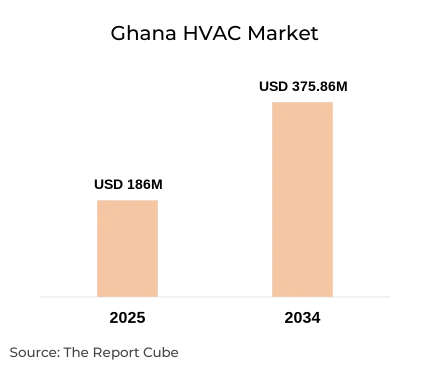
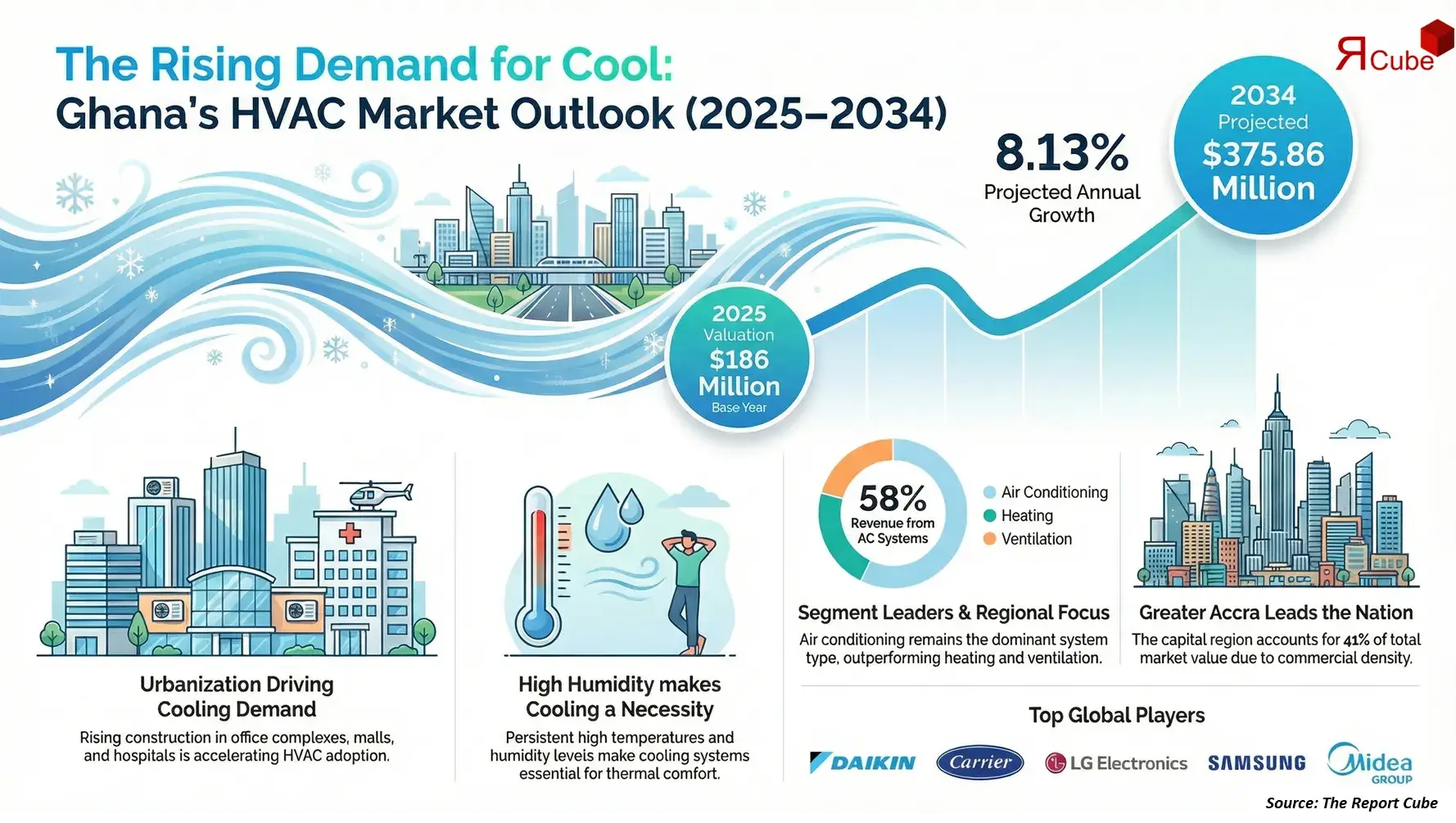
The Ghana HVAC Market is anticipated to register a CAGR of 8.13% during 2026-2034. The market size was valued at USD 186 million and is projected to reach USD 375.86 million by 2034. This strong growth trajectory is driven by rapid urbanization, rising construction activity, and increasing demand for thermal comfort across residential, commercial, and institutional buildings. Ghana’s expanding middle class, coupled with higher disposable incomes and improved access to electricity, is accelerating the adoption of air conditioning and ventilation systems, particularly in urban centers.
Growth is further supported by rising commercial infrastructure development, including office complexes, shopping malls, hotels, hospitals, and educational institutions. Climate conditions characterized by high temperatures and humidity make cooling systems a necessity rather than a luxury in many parts of the country. Additionally, growing awareness of indoor air quality and energy-efficient cooling solutions is influencing purchasing decisions. Government investment in healthcare, education, and public infrastructure is also creating sustained demand for modern HVAC systems, positioning the Ghana HVAC market for steady expansion through the forecast period.
Ghana HVAC Market Recent Developments
- 2025: LG Electronics expanded inverter-based air conditioning solutions targeting commercial buildings in Accra.
- 2025: Daikin Industries strengthened its distributor network to support VRF system adoption in Ghana.
Government Initiatives & Policies
- Ghana National Energy Efficiency Action Plan: Promotes energy-efficient cooling and appliance standards.
- Ghana Infrastructure Development Program: Supports public building construction across healthcare and education sectors.
Ghana HVAC Market Dynamics
Key Driver: Urbanization and Rising Cooling Demand
The primary driver of the Ghana HVAC market is accelerating urbanization and rising demand for cooling solutions. Cities such as Accra, Kumasi, and Takoradi are witnessing increased residential and commercial construction, boosting demand for air conditioning systems. Rising temperatures and humidity levels further reinforce the need for reliable cooling solutions in homes, offices, and retail spaces. As living standards improve, consumers increasingly prioritize comfort, driving higher penetration of split and packaged air conditioning systems.
Major Challenge: High Upfront Costs and Power Reliability
A major challenge facing the market is the relatively high upfront cost of HVAC systems and concerns around electricity reliability. Energy-intensive cooling equipment can increase operating expenses for households and businesses. In some regions, power supply inconsistencies limit adoption of larger HVAC systems. These factors encourage price sensitivity and favor affordable, energy-efficient models, posing challenges for premium system penetration.
Industry Trends: Shift Toward Energy-efficient and Inverter-based Systems
An important trend shaping the market is the growing preference for energy-efficient and inverter-based HVAC systems. Consumers and businesses are increasingly aware of electricity costs and are opting for solutions that reduce energy consumption. Inverter split ACs, VRF systems, and energy-efficient chillers are gaining traction in commercial applications. Demand for air purification and dehumidification features is also increasing, driven by health awareness.
Opportunity Ahead: Commercial Buildings and Institutional Infrastructure
Strong opportunities exist in commercial real estate and institutional infrastructure development. New hotels, hospitals, educational facilities, and office complexes require integrated HVAC systems with advanced ventilation and air quality control. Government and private sector investment in these segments offers significant growth potential for suppliers providing reliable, energy-efficient, and scalable HVAC solutions through 2034.
Ghana HVAC Market Impact Analysis
| Factor | Type | Specific Impact on Market | Magnitude | Business Implication |
|---|---|---|---|---|
| Strong construction and commercial real estate growth | Demand Driver | Steady HVAC demand from offices malls banks and hospitality | High | Prioritise project sales and key developer relationships |
| Rising temperatures and need for indoor comfort | Demand Driver | Higher cooling loads in urban centres and coastal cities | High | Focus on room and light commercial systems in hot zones |
| Energy efficiency standards and MEPS enforcement | Regulatory Driver | Phaseout of inefficient and used imported HVAC units | High | Shift portfolio to inverter and high efficiency platforms |
| Ghana Green Cooling and low GWP roadmap | Environmental Driver | Push for green cooling and climate friendly refrigerants | High | Invest in low GWP tech and market sustainability benefits |
| Price sensitive demand and affordability constraints | Market Constraint | Customers favour durable yet low upfront cost systems | Medium | Develop value engineered lines and flexible finance offers |
| Shift toward energy efficient and smart solutions | Technological Driver | Growing interest in IoT controls and smart thermostats | Medium | Bundle connectivity and controls as upsell differentiators |
| Dominance of decentralised cooling solutions | Market Structure | Packaged and split systems preferred over large chillers | Medium | Align product mix to modular and easily deployed units |
| Import dependence for equipment and components | Market Constraint | Exposure to currency logistics and lead time volatility | Medium | Diversify sourcing and explore phased local assembly |
| Growing focus on indoor air quality and comfort | Consumer Driver | Higher demand for reliable cooling in workplaces | Medium | Position IAQ and comfort features in B2B value stories |
| Promotion through regional HVAC trade exhibitions | Market Behavior | Events create visibility for new efficient solutions | Low | Use expos for lead generation and partner expansion |
Ghana HVAC Market Segment-wise Analysis
By System Type:
- Heating Systems
- Ventilation Systems
- Air Conditioning (AC) Systems
- Integrated HVAC Systems
Air conditioning systems dominate the Ghana HVAC market, accounting for approximately 58% of total market revenue in 2025. High ambient temperatures and humidity drive widespread adoption of room air conditioners and packaged AC systems across residential and commercial spaces. Integrated HVAC systems, while smaller in share, are growing rapidly in large commercial and institutional projects.
By Equipment Type:
- Cooling Equipment
- Heating Equipment
- Ventilation & Air Quality Equipment
Cooling equipment represents the largest equipment segment, contributing nearly 64% of total market demand in 2025. Room air conditioners, particularly split ACs, are the most widely used products. Ventilation and air quality equipment is gaining momentum as awareness of indoor air quality improves in offices, healthcare facilities, and public buildings.
Regional Projection of Ghana HVAC Industry
- Greater Accra
- Ashanti
- Western & Western North
- Eastern
- Northern & Upper Regions
- Others
Greater Accra leads the Ghana HVAC market, accounting for approximately 41% of total market value in 2025. The region’s concentration of commercial buildings, high-income households, hotels, and corporate offices drives strong demand for HVAC systems. Ashanti follows, supported by urban expansion and growing commercial activity in Kumasi.
Ghana HVAC Market Regional Analysis
The Ghana HVAC market differs by region, climate, and income.
| Cluster | Demand Level | Key Areas | System Dominance | Core Demand Logic | Growth Nature |
|---|---|---|---|---|---|
| Greater Accra | Very High | Accra, Tema, airport–port belt | Split, multi‑split, light VRF | Urban heat, dense offices, retail | Mixed new and replacement demand |
| Ashanti | High | Kumasi metro and peri‑urban | Room splits in homes, small VRF | Growing middle class and services | Rapid first‑time AC penetration |
| Western & Western North | Medium–High | Takoradi, Sekondi, oil–gas strip | Split AC in homes, packaged units | Port, oil, mining and coastal heat | Project‑linked, cyclical growth |
| Eastern | Medium | Koforidua, Accra commuter towns | Basic splits, few central systems | Spillover from Accra and education | Steady, affordability‑driven rise |
| Northern & Upper Regions | Low–Medium | Tamale, Bolgatanga, Wa corridors | Standalone splits, room units | Hot climate but low electrification | Slow, reliant on grid and incomes |
Why Choose This Report?
- Provides a comprehensive overview of the overall market analysis, including climate-driven demand and construction trends.
- Provides accurate, up-to-date insights into market size, segmentation, and emerging growth opportunities.
- Gives deep understanding of consumer and commercial HVAC adoption patterns.
- Delivers competitive analysis & benchmarking of global and regional HVAC manufacturers.
- Consolidates comprehensive market intelligence, reducing research time & strategic uncertainty.
- Facilitates customized segmentation & risk mitigation strategies aligned with market realities.
- Aids in identifying both market challenges & untapped opportunities.
- Provides valuable insights based on actual infrastructure development and energy efficiency trends.
Table of Contents
- Introduction
- Objective of the Study
- Product/Category Definition
- Market Segmentation
- Study Variables
- Research Methodology
- Secondary Data Points
- Breakdown of Secondary Sources
- Primary Data Points
- Breakdown of Primary Interviews
- Secondary Data Points
- Executive Summary
- Market Dynamics
- Drivers
- Challenges
- Opportunity Assessment
- Recent Trends and Developments
- Policy and Regulatory Landscape
- Ghana HVAC Market Overview (2020-2034)
- Market Size, By Value (USD Million)
- Market Share, By System Type
- Heating Systems
- Ventilation Systems
- Air Conditioning (AC) Systems
- Integrated HVAC Systems
- Market Share, By Equipment Type
- Cooling Equipment
- Room Air Conditioners
- Window AC
- Split AC
- Floor-standing AC
- Cassette AC
- Packaged AC
- VRF / VRV Systems
- Chillers
- Air Coolers
- Cooling Towers
- Room Air Conditioners
- Heating Equipment
- Heat Pumps
- Furnaces
- Boilers
- Unit Heaters
- Ventilation & Air Quality Equipment
- Air-handling Units (AHUs)
- Ventilation Fans
- Energy Recovery Ventilators
- Air Filters
- Dehumidifiers
- Air Purifiers
- Cooling Equipment
- Market Share, By Refrigerant Type
- R-410A
- R-32
- R-22 and Others
- Market Share, By Implementation Type
- New Installations
- Retrofit & Replacement
- Market Share, By End User
- Residential
- Commercial
- Offices
- Retail & Shopping Malls
- Hospitality (Hotels & Restaurants)
- Industrial & Manufacturing
- Healthcare
- Education
- Data Centers & IT Facilities
- Transport Hubs (Airports, Bus Terminals, etc.)
- Others
- Market Share, By Sales Channel
- Direct Sales
- Authorized Dealers & Distributors
- Online / E-commerce
- Market Share, By Region (Ghana)
- Greater Accra
- Ashanti
- Western & Western North
- Eastern
- Northern & Upper Regions
- Others
- Market Share, By Company
- Revenue Shares
- Competitive Landscape
- Competitive Outlook & Company Profiles
- Daikin Industries, Ltd.
- Company Overview
- Product Portfolio (Residential & Commercial AC)
- Presence & Distribution in Ghana
- Key Projects
- Recent Developments
- Carrier Global Corporation
- Company Overview
- Chillers, Packaged Units & Splits
- Local Partners & Reference Installations
- Recent Developments
- LG Electronics
- Company Overview
- Room AC & VRF Portfolio
- Retail & Project Presence in Ghana
- Recent Developments
- Samsung Electronics
- Company Overview
- Residential & Commercial AC Range
- Channel & Service Network
- Recent Developments
- Midea Group
- Company Overview
- AC & HVAC Products
- Presence in Ghanaian Market
- Recent Developments
- Mitsubishi Electric Corporation
- Company Overview
- VRF, Multi-split & Commercial Systems
- Key Local Projects
- Recent Developments
- Gree Electric Appliances Inc.
- Company Overview
- Room & Commercial AC Portfolio
- Distribution & After-sales in Ghana
- Recent Developments
- Panasonic Corporation
- Company Overview
- AC & IAQ Solutions
- Presence in West Africa
- Recent Developments
- York (Johnson Controls)
- Company Overview
- Chillers & Large HVAC Systems
- Key Commercial & Industrial Projects
- Recent Developments
- Trane Technologies
- Company Overview
- Chillers, Rooftops & Controls
- Major Installations in Ghana
- Recent Developments
- Others
- Daikin Industries, Ltd.
- Contact Us / Disclaimer
Top Key Players & Market Share Outlook
- Daikin Industries, Ltd.
- Carrier Global Corporation
- LG Electronics
- Samsung Electronics
- Midea Group
- Mitsubishi Electric Corporation
- Gree Electric Appliances Inc.
- Panasonic Corporation
- York (Johnson Controls)
- Trane Technologies
- Others
Frequently Asked Questions






