



Build Your Custom Market Intelligence Report
Customize Your ReportLibya HVAC Market Insights & Analysis
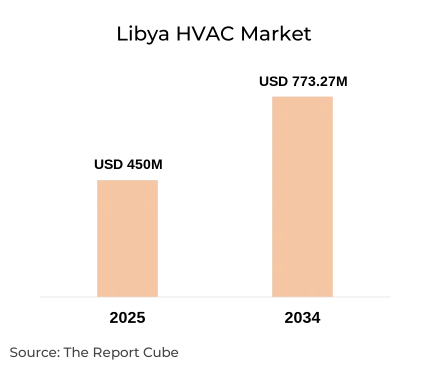
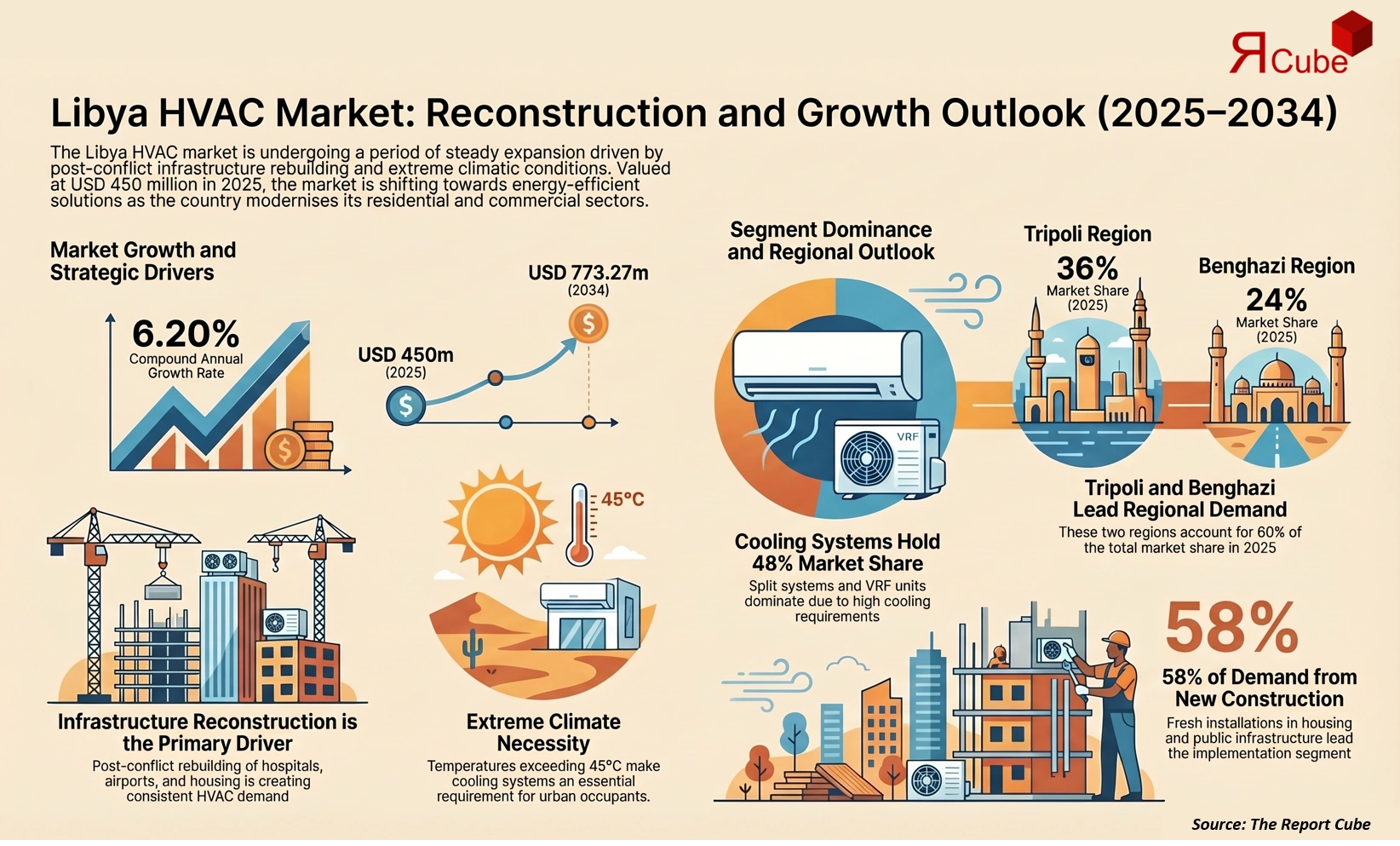
The Libya HVAC Market is anticipated to register a CAGR of 6.20% during 2026-2034. The market size was valued at USD 450 Million in 2025 and is projected to reach USD 773.27 Million by 2034. The Libya HVAC market is gradually gaining momentum as infrastructure rebuilding, urban population growth, and energy modernization initiatives continue across the country. Increasing demand for reliable indoor climate control in residential, commercial, and institutional buildings is shaping steady market expansion.
Libya’s climatic conditions, characterized by extreme heat and arid environments, have made cooling systems a necessity rather than a luxury. Rising investments in housing developments, hospitals, airports, and commercial complexes are driving HVAC adoption, particularly in urban centers such as Tripoli and Benghazi. Additionally, post-conflict reconstruction activities are accelerating demand for energy-efficient HVAC solutions that can reduce electricity load while improving indoor comfort.
Government-backed infrastructure rehabilitation programs and foreign-funded construction projects are further supporting market stability. As electricity availability improves and grid modernization progresses, HVAC penetration is expected to increase across both new construction and retrofit segments. International manufacturers are also strengthening distributor partnerships in Libya to capture growing demand. The market outlook remains positive, supported by rising awareness of indoor air quality, increasing adoption of ventilation systems, and gradual improvements in regulatory and trade environments.
Libya HVAC Market Recent Developments
- 2025: LG Electronics expanded its HVAC distributor network in North Africa, improving product availability in Libyan commercial projects.
- 2025: Daikin Industries introduced energy-efficient VRF systems targeting large-scale infrastructure redevelopment projects in Libya.
Government Initiatives & Policies
- Libya National Infrastructure Reconstruction Program: Focuses on rebuilding hospitals, housing, and public facilities, increasing HVAC demand.
- Renewable Energy and Energy Efficiency Strategy: Supports efficient cooling technologies to reduce national electricity consumption.
Libya HVAC Market Impact Analysis
| Factor | Type | Specific Impact on Market | Magnitude | Business Implication |
|---|---|---|---|---|
| Extreme summer temperatures and arid climate zones | Environmental | Drives essential demand for cooling in most buildings | High | Position HVAC as necessity and ensure peak‑season capacity |
| Post‑conflict reconstruction and infrastructure revival | Market | Boosts HVAC needs in housing, health and transport assets | High | Target public projects and PPPs with packaged HVAC solutions |
| Urbanisation in Tripoli, Benghazi and key corridors | Market | Concentrates installations in expanding urban real estate | High | Prioritise dealer networks and service hubs in core cities |
| Rising electricity tariffs and grid reliability issues | Consumer | Shifts preference to efficient and grid‑friendly systems | Medium | Promote inverter, VRF and load‑reducing design options |
| Growing policy and investor focus on efficiency | Regulatory | Encourages adoption of higher‑efficiency HVAC equipment | Medium | Align portfolio with codes and seek green‑project tenders |
| Limited availability of skilled HVAC technicians | Competitive | Constrained quality of installation and ongoing maintenance | Medium | Invest in training, certification and service partnerships |
| High initial capex for modern HVAC installations | Market | Slows penetration in cost‑sensitive residential segments | Medium | Offer staged upgrades, financing and value‑engineered lines |
| Adoption of smart and efficient HVAC technologies | Technological | Gradually increases share of advanced units in new builds | Medium | Bundle controls, remote monitoring and energy‑saving features |
| Political and economic instability affecting projects | Environmental | Creates swings in construction and HVAC investment cycles | Medium | Diversify client base and phase commitments to large sites |
| Regional and global supplier presence in Libya HVAC | Competitive | Introduces variety but heightens price and margin pressure | Medium | Compete on reliability, lifecycle cost and localised support |
Libya HVAC Market Dynamics
Key Driver: Infrastructure Reconstruction and Rising Urban Cooling Demand
Infrastructure reconstruction remains the primary driver of the Libya HVAC market. Post-conflict rebuilding of residential housing, healthcare facilities, airports, and government buildings has created consistent demand for HVAC systems. Urbanization rates in Tripoli and Benghazi continue to rise, with urban households accounting for over 70% of electricity consumption in 2024. Extreme summer temperatures, often exceeding 45°C, further increase reliance on cooling systems. Additionally, public and private developers increasingly prioritize HVAC installations during project planning to ensure occupant comfort and equipment protection. Growth in commercial real estate, including offices, retail centers, and hospitality facilities, is also accelerating HVAC adoption. As electricity grid reliability improves, HVAC usage is expanding beyond premium developments into mid-income residential projects, reinforcing long-term market growth.
Book your FREE 30-minute expert consultation today
Contact UsIndustry Trends: Shift Toward Energy-Efficient and Modular HVAC Systems
Energy efficiency is emerging as a defining trend in the Libya HVAC market. Rising electricity costs and grid constraints have encouraged developers to adopt inverter-based cooling systems, VRF solutions, and modular air handling units. In 2024, energy-efficient HVAC units accounted for an estimated 38% of total installations, a share expected to surpass 50% by 2030. Manufacturers are increasingly offering climate-adapted systems designed for high ambient temperatures and dusty environments. Demand for ventilation systems and air purifiers is also growing, driven by heightened awareness of indoor air quality in hospitals and educational institutions. Modular HVAC installations that allow phased capacity expansion are gaining traction in commercial projects, supporting flexible infrastructure development.
Major Challenge: Power Supply Limitations and Import Dependency
Unreliable electricity supply remains a significant challenge for the Libya HVAC market. Frequent power outages and limited grid coverage in certain regions restrict continuous HVAC operation, discouraging adoption in rural and southern areas. Additionally, Libya’s heavy reliance on imported HVAC equipment exposes the market to currency fluctuations, logistics delays, and trade disruptions. Import duties and transportation costs can increase system prices by up to 20%, limiting affordability for smaller developers. Limited availability of skilled technicians for installation and maintenance further constrains market efficiency. Addressing these challenges will require sustained investments in power infrastructure and workforce development.
Opportunity: Retrofit Projects and Healthcare Infrastructure Expansion
Retrofit projects present a strong growth opportunity for the Libya HVAC market. A large share of existing buildings rely on outdated or inefficient cooling systems, creating demand for replacements and upgrades. Hospitals and clinics undergoing modernization are increasingly adopting advanced ventilation and air purification systems to meet health standards. Retrofit HVAC projects accounted for nearly 42% of total installations in 2024, highlighting their importance. International aid-funded healthcare and education projects further support demand for reliable HVAC solutions. Manufacturers offering durable, energy-efficient retrofit-friendly systems are well positioned to capitalize on this expanding opportunity.
Libya HVAC Market Segment-wise Analysis
By Equipment Type:
- Cooling Systems
- Heating Systems
- Ventilation Systems
- Air Handling Units
- Air Purifiers
Cooling systems dominate the Libya HVAC market, accounting for approximately 48% of total market share in 2025. The country’s extreme climatic conditions make air conditioners and chillers essential across residential and commercial buildings. Split AC systems remain the most widely adopted due to affordability and ease of installation, while VRF systems are gaining traction in commercial developments. Ventilation systems represent a fast-growing sub-segment, driven by healthcare and institutional demand, capturing nearly 18% market share. Air purifiers are gradually emerging, particularly in hospitals and offices, supported by rising awareness of indoor air quality.
By Implementation:
- New Construction
- Retrofit Projects
New construction projects lead the implementation segment, contributing nearly 58% of total HVAC demand in 2025. Ongoing housing reconstruction, commercial developments, and public infrastructure projects continue to drive fresh installations. However, retrofit projects are growing at a faster pace, supported by the need to replace inefficient systems in existing buildings. Retrofit HVAC installations are particularly prominent in government buildings and healthcare facilities, where energy efficiency upgrades are prioritized. By 2034, retrofit projects are expected to narrow the gap with new construction, supported by energy-saving initiatives and cost reduction benefits.
Regional Projection of Libya HVAC Industry
- Tripoli Region
- Benghazi Region
- Western Libya
- Eastern Libya
- Southern Libya
The Tripoli Region leads the Libya HVAC market, accounting for approximately 36% of total market share in 2025. As the political and economic hub, Tripoli hosts the highest concentration of residential, commercial, and healthcare infrastructure projects. Strong urbanization, higher income levels, and greater access to electricity drive HVAC adoption in the region. Benghazi follows with around 24% market share, supported by reconstruction initiatives and expanding commercial activities. Western and Eastern Libya collectively contribute nearly 30%, while Southern Libya remains underpenetrated due to infrastructure limitations. Regional disparities highlight opportunities for long-term expansion as infrastructure investment broadens nationwide.
Libya HVAC Market Regional Analysis
The Libya HVAC market is shaped by heat, rebuilding, and grids.
| Cluster | Demand Level | Key Areas | System Dominance | Core Demand Logic | Growth Nature |
|---|---|---|---|---|---|
| Tripoli Region | Very High | Tripoli, urban outskirts | Split & VRF systems | Capital projects and dense housing | Reconstruction and upgrades |
| Benghazi Region | High | Benghazi metro zones | Split and light commercial | Rebuilding of core city assets | Reconstruction‑led expansion |
| Western Libya | Moderate | Coastal towns, oil support | Split and package units | Oil support, housing and retail | Project and capex dependent |
| Eastern Libya | Moderate | Corridors beyond Benghazi | Split and small VRF | Secondary cities and services | Gradual grid‑linked growth |
| Southern Libya | Low | Desert towns, remote sites | Room AC and basic splits | Extreme heat but weak grids | Underpenetrated, long term |
Need insights for a specific region within this market?
Request Regional DataWhy Choose This Report?
- Provides a comprehensive overview of the overall market analysis, encompassing key trends, consumer behavior analysis, and risk assessment to support strategic decision-making.
- Provides accurate, up-to-date insights into market size, segmentation, and emerging opportunities, helping to minimize risk & capitalizing on growth.
- Gives deep understanding of target audience preferences, investment habits, and communication channels for enhanced product development & marketing effectiveness.
- Delivers competitive analysis & benchmarking, uncovering the strengths & weaknesses of market competitors to guide strategies.
- Consolidate comprehensive market intelligence, reducing reasoning & streamlining research efforts.
- Facilitates customized market segmentation & risk mitigation strategies, fine-tuned to the business objectives.
- Aids in identifying both market challenges & untapped opportunities within the industry to drive long-term business growth.
- Provides valuable information based on actual customer data & search trends.
Table of Contents
- Introduction
- Objective of the Study
- Product and Category Definition
- Market Segmentation
- Study Variables
- Research Methodology
- Secondary Data Points
- Breakdown of Secondary Sources
- Primary Data Points
- Breakdown of Primary Interviews
- Secondary Data Points
- Executive Summary
- Market Dynamics
- Drivers
- Challenges
- Opportunity Assessment
- Recent Trends and Developments
- Regulatory and Policy Landscape
- Libya HVAC Market Overview (2021-2034)
- Market Size, By Value (USD Million)
- Market Share, By Equipment Type
- Cooling Systems
- Heating Systems
- Ventilation Systems
- Air Handling Units
- Air Purifiers
- Market Share, By Implementation
- New Construction
- Retrofit Projects
- Market Share, By Demand Type
- OEM Sales
- Aftermarket
- Market Share, By End User
- Residential
- Commercial
- Industrial
- Healthcare
- Transport/Logistics
- Market Share, By Region
- Tripoli Region
- Benghazi Region
- Western Libya
- Eastern Libya
- Southern Libya
- Market Share, By Company
- Revenue Shares
- Competitive Landscape
- Competitive Outlook and Company Profiles
- Daikin Industries
- Company Overview
- Product Portfolio
- Strategic Alliances/Partnerships
- Recent Developments
- Carrier Global
- Company Overview
- Product Portfolio
- Strategic Alliances/Partnerships
- Recent Developments
- LG Electronics
- Company Overview
- Product Portfolio
- Strategic Alliances/Partnerships
- Recent Developments
- Samsung Electronics
- Company Overview
- Product Portfolio
- Strategic Alliances/Partnerships
- Recent Developments
- Trane Technologies
- Company Overview
- Product Portfolio
- Strategic Alliances/Partnerships
- Recent Developments
- Midea Group
- Company Overview
- Product Portfolio
- Strategic Alliances/Partnerships
- Recent Developments
- Johnson Controls
- Company Overview
- Product Portfolio
- Strategic Alliances/Partnerships
- Recent Developments
- Mitsubishi Electric
- Company Overview
- Product Portfolio
- Strategic Alliances/Partnerships
- Recent Developments
- Hitachi Cooling
- Company Overview
- Product Portfolio
- Strategic Alliances/Partnerships
- Recent Developments
- Blue Star Limited
- Company Overview
- Product Portfolio
- Strategic Alliances/Partnerships
- Recent Developments
- Others
- Daikin Industries
- Contact Us and Disclaimer
Top Key Players & Market Share Outlook
- Daikin Industries
- Carrier Global
- LG Electronics
- Samsung Electronics
- Trane Technologies
- Midea Group
- Johnson Controls
- Mitsubishi Electric
- Hitachi Cooling
- Blue Star Limited
- Others
Frequently Asked Questions