



Build Your Custom Market Intelligence Report
Customize Your ReportNew Zealand Air Conditioners Market Key Highlights
By Product Type:
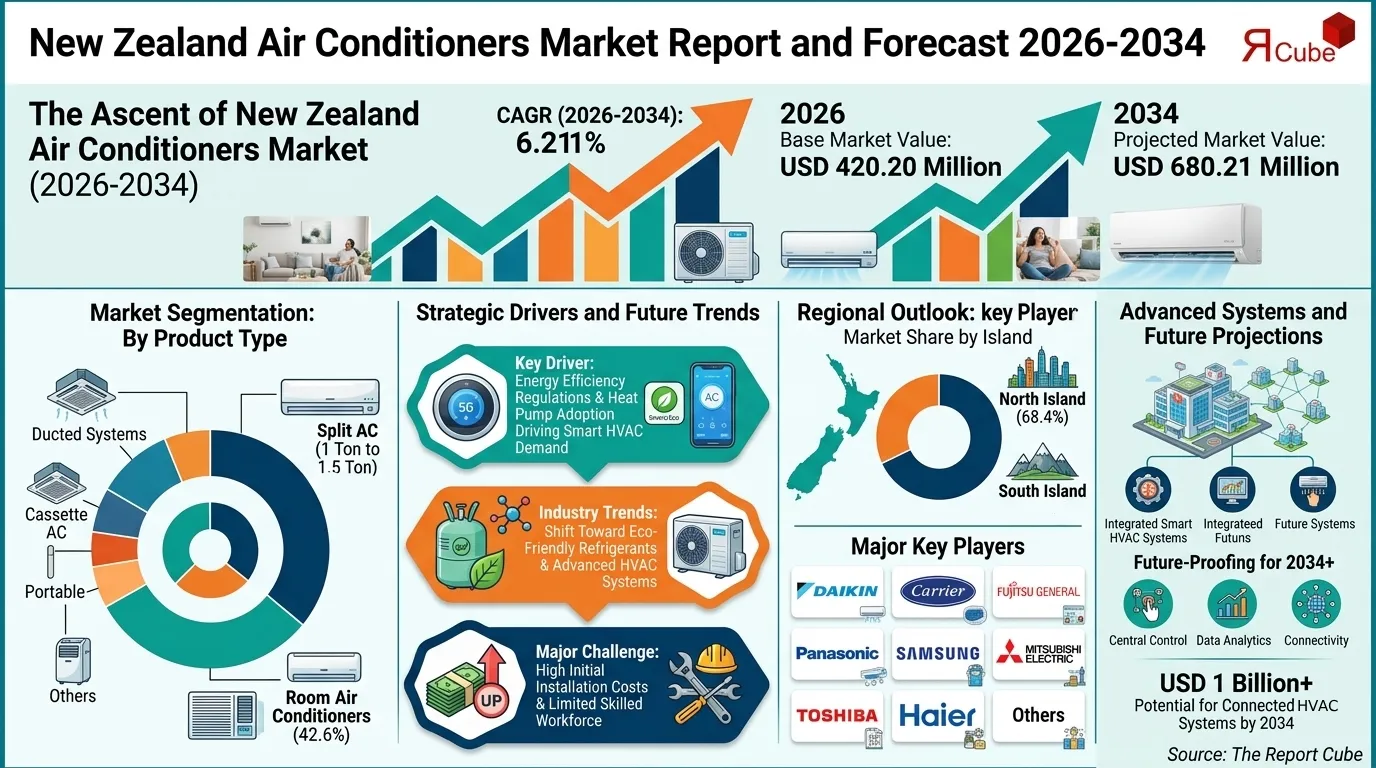
Room Air Conditioners segment leads the market with 42.6% share.
By Product Type:
Split AC (1 Ton to 1.5 Ton) segment dominates the market with 36.8% of revenue.
Regional Outlook:
North Island region dominates the New Zealand Air Conditioners market with 68.4% share.
New Zealand Air Conditioners Market Insights & Analysis
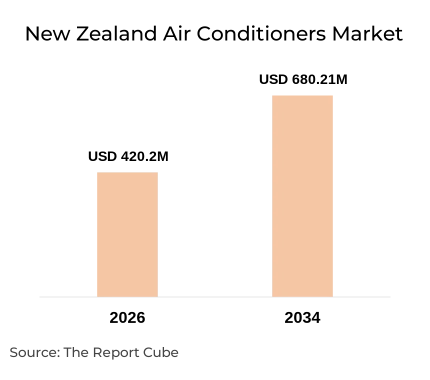
The New Zealand Air Conditioners Market is anticipated to register a CAGR of around 6.21% during the forecast period 2026-2034. The market size is valued at USD 420.20 million and is projected to reach USD 680.21 million by 2034. Growing residential construction activity, rising awareness of indoor air quality, and increasing adoption of energy-efficient cooling systems are shaping the New Zealand air conditioners market size and growth. Industry data from 2025 shows that over 58% of newly built homes in urban regions are equipped with heat pump-based air conditioning systems, reflecting strong demand trends.
Market expansion is further supported by government-backed energy efficiency programs and incentives promoting low-emission appliances. Companies are investing in smart cooling technologies, with connected air conditioners gaining traction across Auckland and Wellington. Competitive benchmarking indicates that brands are focusing on inverter technology, eco-friendly refrigerants, and AI-enabled climate control. Increasing summer temperature variations and a 12% rise in commercial HVAC installations in 2025 highlight sustained demand growth. The New Zealand air conditioners market share is also influenced by product innovation, particularly in ducted systems and VRF technologies used in commercial spaces.
New Zealand Air Conditioners Market Impact Analysis
| Factor | Type | Specific Impact on Market | Magnitude | Business Implication |
|---|---|---|---|---|
| Dominance of Heat Pumps (Cooling + Heating) | Market Structure | Most households prefer dual-purpose HVAC systems | High | Standalone AC demand remains limited |
| Mild Climate Conditions | Structural Factor | Lower need for cooling compared to tropical regions | Medium | Seasonal and moderate AC demand |
| Urbanization & Residential Construction Growth | Demand Driver | New housing developments require HVAC systems | High | Growth in residential installations |
| Energy Efficiency Regulations (MEPS) | Regulatory Driver | Mandatory efficiency standards for HVAC systems | High | Shift toward high-efficiency inverter systems |
| High Electricity Costs | Market Constraint | Encourages energy-efficient usage and systems | Medium | Preference for efficient heat pump systems |
| Growth in Commercial Buildings | Demand Driver | Cooling demand in offices, retail, and healthcare | Medium–High | Increase in VRF and rooftop systems |
| Sustainability & Renewable Energy Adoption | Policy Driver | Integration with solar-powered HVAC systems | Medium | Opportunity for green HVAC solutions |
| Import-Driven Market | Market Structure | Major reliance on global manufacturers | High | Strong competition among global brands |
New Zealand Air Conditioners Market Dynamics
Key Driver: Energy Efficiency Regulations and Heat Pump Adoption Driving Smart HVAC Demand
Rising electricity costs and stricter sustainability standards are accelerating the adoption of energy-efficient HVAC systems across New Zealand’s urban centres, particularly Auckland, Wellington, and Christchurch. In Auckland, where residential density and cooling demand are highest, households are increasingly shifting toward inverter-based heat pump systems that reduce energy consumption by nearly 30% compared to conventional units. This transition is further supported by the updated 2025 building energy codes, which mandate higher efficiency standards for new residential and commercial developments, particularly in the North Island, where HVAC installations are more concentrated.
The shift toward smart and connected systems is also gaining traction in urban regions such as Auckland and Wellington, where higher-income households are adopting automation-driven appliances. Around 35% of urban households now prefer Wi-Fi-enabled air conditioning systems, enabling remote operation and optimized energy usage based on occupancy patterns. This trend is particularly visible in newly constructed homes, where integrated smart home ecosystems and heat pump installations are increasingly standard, reinforcing demand for AI-enabled HVAC systems with improved performance and lower operating costs.
Book your FREE 30-minute expert consultation today
Contact UsIndustry Trends: Shift Toward Eco-Friendly Refrigerants and Advanced HVAC Systems
Industry trends indicate a steady transition toward low global warming potential refrigerants such as R32 and R290. These refrigerants are gaining popularity due to regulatory support and environmental benefits. In 2025, more than 40% of new installations utilized R32-based systems, reflecting a strong shift in the New Zealand air conditioners market trends.
Another emerging trend is the adoption of ducted split systems and VRF solutions in commercial buildings. Businesses are increasingly investing in centralized cooling systems for better efficiency and cost savings. This trend is boosting the market share of advanced HVAC solutions across retail, healthcare, and office infrastructure segments.
Major Challenge: High Initial Installation Costs and Limited Skilled Workforce
High upfront costs associated with advanced air conditioning systems remain a key barrier in the New Zealand air conditioners market growth. Premium systems such as VRF and ducted units require significant investment, which limits adoption among small households and businesses. Installation costs can account for up to 25% of total system expenses.
Another challenge is the shortage of skilled HVAC technicians, especially in remote regions. This leads to delays in installation and maintenance services, affecting customer satisfaction. Limited technical expertise also restricts the adoption of advanced systems, slowing down overall market expansion.
Opportunity: Expansion of Smart Cities and Green Building Initiatives
Growing investment in smart city infrastructure and green building projects is creating strong opportunities for the New Zealand air conditioners market. Government initiatives promoting energy-efficient buildings are driving the demand for advanced HVAC solutions. Nearly 45% of commercial projects in 2026 are expected to incorporate smart climate control systems.
In addition, rising renovation activities in residential sectors are opening new revenue streams. Consumers are upgrading older cooling systems to energy-efficient models, boosting replacement demand. This trend supports long-term market growth and creates opportunities for manufacturers offering innovative and sustainable solutions.
New Zealand Air Conditioners Market Segment-wise Analysis
By Product Type:
- Chillers
- Room Air Conditioners
- Cassette Air Conditioners
- Packaged Air Conditioners
- Ducted Split Systems
Room air conditioners lead the New Zealand air conditioners market share, accounting for approximately 42.6% of total revenue in 2026. Within this category, split AC units dominate due to their energy efficiency, ease of installation, and affordability. The 1 Ton to 1.5 Ton segment alone contributes nearly 36.8% of total sales, driven by strong residential demand. Increasing urbanization and apartment living trends are further boosting this segment. In addition, the rising adoption of inverter technology and eco-friendly refrigerants is enhancing product performance and attracting environmentally conscious consumers, supporting sustained segment growth.

By Refrigerant Type:
- R290
- R410A
- R32
- R1234ze / R1234yf
- R134a
- Other Refrigerants
R32 refrigerant dominates the New Zealand air conditioners market with an estimated 38.2% share, driven by its lower environmental impact and higher energy efficiency. Its adoption has increased significantly due to regulatory pressure to phase out high global warming refrigerants like R410A. R290 is also gaining traction, especially in eco-friendly applications, with a growth rate exceeding 8% annually. Manufacturers are actively shifting toward sustainable refrigerants to align with environmental standards and consumer preferences, which is further accelerating segment growth and innovation in the market.
Regional Projection of New Zealand Air Conditioners Industry
-
Auckland Region
-
Wellington Region
-
Christchurch Region (South Island)
-
Upper North Island Region (Waikato & Bay of Plenty)
-
Lower South Island Region (Otago & Southland)
The Auckland region leads the New Zealand air conditioners market, driven by the country’s highest population concentration and strongest residential construction activity. Warmer and more humid conditions compared to other regions increase the need for year-round climate control, particularly in high-density apartment developments and suburban housing projects. This has resulted in strong adoption of heat pumps and split air conditioning systems, especially in newly built homes where energy-efficient HVAC solutions are standard. Continuous inward migration and urban expansion further reinforce Auckland’s position as the primary demand hub for air conditioning systems in New Zealand.
New Zealand Air Conditioners Market Regional Analysis
The New Zealand air conditioners market shows regional variation driven by urban concentration, climate conditions, and construction activity across major cities and island regions.
| Region | Demand Level | Key Cities | Climate Profile | Primary Driver | Preferred AC Type | Growth Outlook |
|---|---|---|---|---|---|---|
| Auckland Region | High | Auckland | Warmest climate in NZ | Population density & housing demand | Heat pumps & Split AC | Strong growth |
| Wellington Region | Medium | Wellington | Moderate climate | Commercial & government infrastructure | Heat pumps | Moderate growth |
| Christchurch (South Island) | Medium-High | Christchurch | Cooler but dry summers | Reconstruction & urban development | Heat pumps & ducted systems | Strong growth |
| Upper North Island (Waikato & Bay of Plenty) | Medium | Hamilton, Tauranga | Mild to warm climate | Residential expansion | Heat pumps | Moderate growth |
| Lower South Island (Otago & Southland) | Low-Medium | Dunedin, Queenstown | Cool climate | Limited cooling requirement | Heating-focused HVAC | Slow growth |
Need insights for a specific region within this market?
Request Regional DataGovernment Initiatives & Policies
- Energy Efficiency and Conservation Authority Program: Promotes energy-efficient appliances including heat pumps through incentives and awareness programs.
- Building Code Updates 2025: Strengthens energy performance requirements for residential and commercial buildings, encouraging adoption of efficient HVAC systems.
New Zealand Air Conditioners Industry Recent Developments
- 2026: Samsung launched its AI Smart GEO WindFree Heat Pump System in New Zealand, offering advanced AI-based cooling, improved energy efficiency, and promotional pricing, which boosted consumer adoption of smart and connected air conditioning solutions nationwide.
Why Choose This Report?
- Provides a comprehensive overview of the overall market analysis, encompassing key trends, consumer behavior analysis, and risk assessment to support strategic decision-making.
- Provides accurate, up-to-date insights into market size, segmentation, and emerging opportunities, helping to minimize risk & capitalizing on growth.
- Gives deep understanding of target audience preferences, investment habits, and communication channels for enhanced product development & marketing effectiveness.
- Delivers competitive analysis & benchmarking, uncovering the strengths & weaknesses of market competitors to guide strategies.
- Consolidate comprehensive market intelligence, reducing reasoning & streamlining research efforts.
- Facilitates customized market segmentation & risk mitigation strategies, fine-tuned to the business objectives.
- Aids in identifying both market challenges & untapped opportunities within the industry to drive long-term business growth.
- Provides valuable information based on actual customer data & search trends.
Table of Contents
- Introduction
- Objective of the Study
- Product and Category Definition
- Market Segmentation
- Study Variables
- Research Methodology
- Secondary Data Points
- Breakdown of Secondary Sources
- Primary Data Points
- Breakdown of Primary Interviews
- Secondary Data Points
- Executive Summary
- Market Dynamics
- Emerging Opportunities
- Adoption Trends
- Demand Drivers
- Disruption Analysis (Challenges)
- Industry Analysis & Strategic Insights
- Supply/Value Chain Analysis
- Pricing Analysis
- Go-To-Market (GTM) Strategy
- BCG Matrix
- Recent Trends and Developments
- Import and Export Analysis
- Regulatory and Policy Landscape
- Region-wise policies
- Government Initiatives
- New Zealand Air Conditioners Market Overview and Forecast Analysis (2021-2034)
- Market Size, By Value, By Growth Rate (CAGR/USD Million)
- Market Share, By Product Type
- Chillers
- Water-cooled Chillers
- Air-cooled Chillers
- Other Chillers
- Room Air Conditioners
- Split AC
- Up to 1 Ton
- 1 Ton to 1.5 Ton
- Above 1.6 to 2 Ton
- Above 2 Ton
- Window AC
- Up to 1 Ton
- 1 Ton to 2 Ton
- Above 2 Ton
- Split AC
- Cassette Air Conditioners
- Up to 2 Tons
- 2.1 to 4 Tons
- 4.1 to 5 Tons
- Above 5 Tons
- Packaged Air Conditioners
- Up to 5 Tons
- 6 to 10 Tons
- 11 to 20 Tons
- Above 20 Tons
- Ducted Split Systems
- VRF Systems
- Up to 5 Tons
- 6 to 10 Tons
- 11 to 20 Tons
- Above 20 Tons
- Others (Air Handling Units / Fan Coil Units, etc.)
- Chillers
- Market Share, By Refrigerant Type
- R290
- R410A
- R32
- R1234ze / R1234yf
- R134a
- Others
- Market Share, By Distribution Channel
- Multi-brand stores
- Online
- Direct sales
- Authorized dealers and distributors
- Market Share, By End User
- Retail and malls
- Pharmaceuticals
- Food and beverage
- Hotels and hospitality
- Data centers
- Offices
- Manufacturing
- Residential
- Educational institutions
- Hospitals and healthcare
- Other
- Market Share, By Region
-
Auckland Region
-
Wellington Region
-
Christchurch Region (South Island)
-
Upper North Island Region (Waikato & Bay of Plenty)
-
Lower South Island Region (Otago & Southland)
-
- Market Share, By Company
- Revenue Shares & Analysis
- Competitive Landscape
- Competitive Analysis, 2026
- Market Share of Key Players
- Competitive Mapping for Each Segment and Companies Operating Regionally
- North Island Air Conditioners Companies Share & Competitive Analysis, 2026
- South Island Air Conditioners Companies Share & Competitive Analysis, 2026
- Company Profile (Partial List)
- Carrier (AHI Carrier)
- Company Overview
- Product Portfolio
- Strategic Alliances/Partnerships
- Recent Developments
- Fujitsu General
- Company Overview
- Product Portfolio
- Strategic Alliances/Partnerships
- Recent Developments
- Samsung
- Company Overview
- Product Portfolio
- Strategic Alliances/Partnerships
- Recent Developments
- Panasonic
- Company Overview
- Product Portfolio
- Strategic Alliances/Partnerships
- Recent Developments
- Daikin
- Company Overview
- Product Portfolio
- Strategic Alliances/Partnerships
- Recent Developments
- Mitsubishi Electric
- Company Overview
- Product Portfolio
- Strategic Alliances/Partnerships
- Recent Developments
- Toshiba
- Company Overview
- Product Portfolio
- Strategic Alliances/Partnerships
- Recent Developments
- Haier
- Company Overview
- Product Portfolio
- Strategic Alliances/Partnerships
- Recent Developments
- Others (Partial List)
- Carrier (AHI Carrier)
- Contact Us and Disclaimer
Top Key Players & Market Share Outlook
- Carrier (AHI Carrier)
- Fujitsu General
- Samsung
- Panasonic
- Daikin
- Mitsubishi Electric
- Toshiba
- Haier
- Others
Frequently Asked Questions






