Australia Robotaxi Market to Reach USD 102.54 Billion by 2034, as Federal AV Framework Delay, Brisbane 2032 Deadline & Solid-State LiDAR Cost Shifts Reshape Deployment Strategy
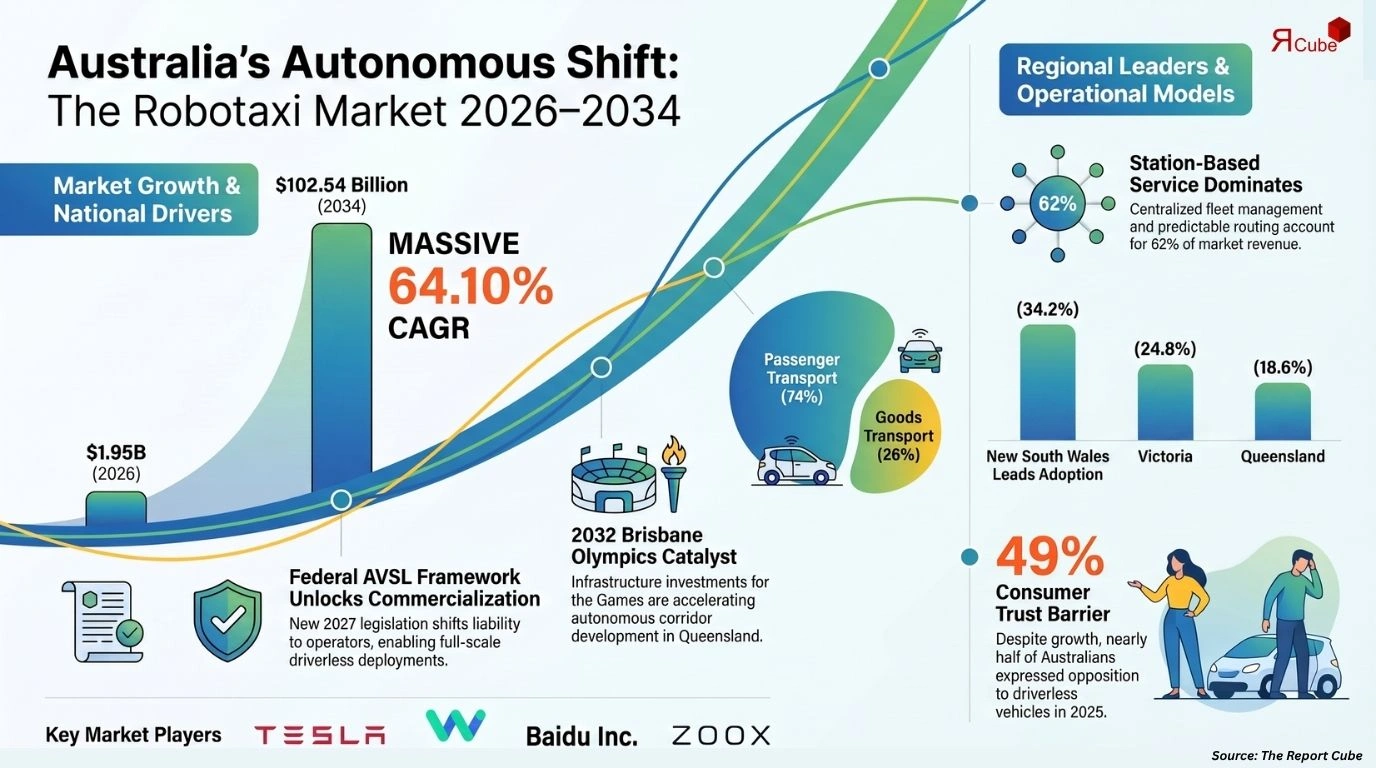
A new study by The Report Cube on the Australia Robotaxi Market finds the sector entering its most consequential planning window yet, with international operators circling Sydney and Brisbane for entry while the country's regulatory architecture runs a year behind commercial ambition. The market was valued at USD 1.95 billion in 2026, is projected to grow at a CAGR of 64.10%, and should reach USD 102.54 billion by 2034.
Key Dynamics Affecting the Australia Robotaxi Market
On 21 November 2025, Australian Transport Ministers agreed to allow the conditional deployment of automated vehicles from 2027 in selected locations, with full national readiness dependent on each state updating its legislation. That one-decision shift matters because it moved Australia from consultation to a fixed operational timeline - even if the timeline itself remains state-by-state patchwork. The National Transport Commission had been targeting 2026 for its Automated Vehicle Safety Law (AVSL); that deadline was missed. Full end-to-end federal AV regulation is now committed for 2027 at the earliest, meaning 2025–2026 has effectively become the lobbying and positioning window, not the launch window.
Waymo has moved faster than most expected given the regulatory gap. The company engaged lobbying firm GRACosway to represent its interests at both federal and state levels, and FOI-released documents show Waymo requested a confidential briefing with Federal Infrastructure Minister Catherine King in late 2024 to outline its plans for Australia. Transport NSW confirmed it is in contact with Waymo as the company begins the process of testing its vehicles on NSW roads. Waymo has reportedly begun searching for a Sydney office. The company's global safety record is not irrelevant context here: its vehicles logged 204 million kilometres through late 2024 with 90% fewer serious injury crashes than human-driven vehicles.
The Brisbane 2032 Olympic and Paralympic Games are creating a hard infrastructure deadline that purely commercial timelines would not. The Australian government has committed up to AUD 3.435 billion in venue infrastructure projects across Queensland. Speakers at the National Future Transport Summit in Brisbane in September 2025 stated that autonomous cars without human drivers could be operating on Australian roads in time for the Games. Queensland's government has launched AV corridor consultations and a trial on the south-east freeway corridor is anticipated in 2026. For operators and platform developers, Brisbane 2032 is the most concrete near-term anchor for deployment planning in the entire Australian market.
The EV-robotaxi link is tighter than it looks. Electric vehicles accounted for 84.9% of global robotaxi fleet composition in 2025, and Australia now has over 5,800 public charging locations including 900+ DC fast charger sites. The federal government has separately allocated AUD 40 million toward EV charging infrastructure under the Net Zero Plan. The economics are straightforward: at AUD 4–5 per 100 km for home charging versus AUD 15–18 for petrol, electric robotaxi fleet operators face structurally lower per-kilometre costs than ICE-based alternatives - which matters more at scale when driver labour is removed from the equation.
Sensor cost compression is the technical story that commercial projections often omit. Solid-state LiDAR units are replacing expensive rotational sensor arrays on production AV platforms, with Wood Mackenzie analysts describing 2026 as the turning point for autonomous vehicles globally - projecting the global AV fleet to grow to ten times its current size by 2030. Lower sensor costs reduce the capital required per vehicle, which directly affects the economics of operating an Australian robotaxi fleet in a market where commercial permits don't yet exist and early operators face uncertain return timelines.
Need Specific Data, Let’s Customize the Report for You
Request CustomizationWhich of the Segments, Under Propulsion Type Classification, Influences the Market Share?
Across Application, the Australia Robotaxi Industry is segmented as:
- Passenger Transport
- Goods Transport
Passenger transport dominates the application segment with an estimated 74% market share, reflecting the primary commercial case for autonomous vehicles as urban mobility solutions. Sydney and Melbourne rank among the most navigable cities globally for AV deployment due to consistent road infrastructure and defined urban zones. NSW's Transport department has already approved multiple driverless shuttle pilots, with the CBD and airport corridors flagged as priority commercial zones. Rising demand from commuters, growing acceptance among younger demographics, and platform integration with ride-hailing services are sustaining investment into passenger-oriented autonomous mobility services across New South Wales.
Goods transport represents approximately 26% market share and is emerging as a strategically important application, particularly in Western Australia and NSW where autonomous freight vehicle trials on longer-range corridors are progressing. The segment benefits from regulatory flexibility — freight operations in industrial zones face fewer public safety objections than passenger transport — and from the operational economics of 24/7 driverless delivery cycles. Investment from logistics companies and AV operators in last-mile autonomous delivery is expected to accelerate this segment's growth substantially through 2034, particularly as the AVSL framework extends permissions beyond passenger applications.
Regional Analysis: Australia Robotaxi Market
- New South Wales
- Victoria
- Queensland
- Western Australia
- South Australia
- Rest of Australia
New South Wales leads on regulatory engagement and near-term operator interest - Waymo's discussions with Transport NSW make it the most likely site of Australia's first passenger robotaxi trial under a formal approval. Victoria follows closely, with the state's Future Transport Strategy identifying autonomous vehicles as a priority and several suburban corridor trials already approved. Queensland is growing fastest in strategic significance: the Brisbane 2032 Olympics deadline is compressing what would otherwise be a decade-long deliberation into a six-year infrastructure sprint. South Australia holds a distinct regulatory advantage as the first state to have passed AV-specific road rules, giving it an earlier institutional learning curve than its peers.
Company Profile: Leading Australia Robotaxi Market Players
The competitive picture in Australia is not yet a market - it is a lobbying and regulatory positioning contest, with the actual deployment race set to begin once AVSL-aligned state permits are issued. Operators are investing in regulatory engagement, mapping, and local partnerships rather than fleet assets, because no commercial passenger robotaxi approval has been granted. Waymo stands apart in terms of local activity: it has engaged government relations representation, held ministerial briefings, and established transport authority contact in NSW. Its Waymo Driver technology has completed over 20 million driverless rides globally, which gives it data-backed safety arguments that few competitors can replicate in any jurisdiction.
Key players include: Waymo LLC (Alphabet Inc.), Tesla Inc., Baidu Apollo Go, Pony.ai Inc., Zoox Inc. (Amazon), and Others.
Questions Answered in the Australia Robotaxi Market Research Report
- What is the current market size & future growth forecast underlined in the Australia Robotaxi Market research report?
- Which major factors are driving the rapid expansion of the Australia Robotaxi Industry across major regions?
- What emerging trends are restructuring the competitive landscape according to the latest market insights?
- How is consumer demand evolving, and what impact does it have on the Australia Robotaxi Market growth?
- Which leading companies are dominating the Australia Robotaxi Industry, and what strategies are they adopting?
- What technological advancements are influencing product adoption & market penetration?
- How does the report evaluate regional performance & identify high-growth market opportunities?
- What challenges & risks could potentially affect market stability, according to the research findings by the analysts?