Australia In Vitro Diagnostics Market to Witness Steady Expansion with CAGR of 5.60% & USD 2.53 Billion by 2034
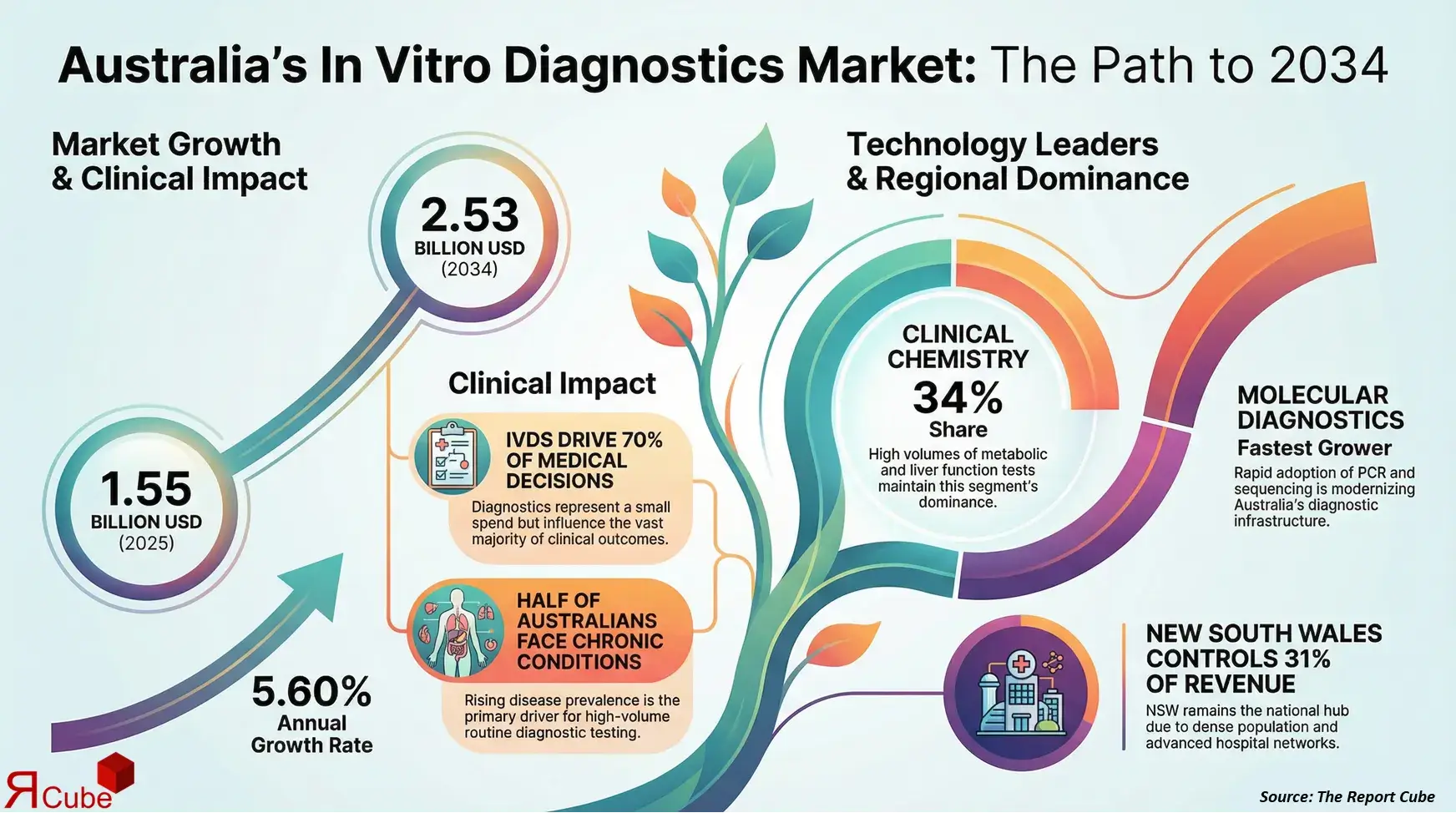
As per the recent research study by The Report Cube, the Australia In Vitro Diagnostics Market Research Report highlights that the industry is destined for sturdy growth during 2026–2034, influenced by increasing demand for early disease detection, rising chronic disease incidence, and the growing integration of advanced diagnostic technologies across healthcare systems. The market is predicted to record a CAGR of about 5.60% (2026-34), further valued at nearly USD 1.55 billion in 2025, and estimated to reach about USD 2.53 billion by 2034.
In vitro diagnostics (IVD) play an essential role in modern healthcare by enabling accurate disease detection, monitoring treatment progress, and supporting clinical decision-making. These diagnostic solutions include reagents, instruments, and software utilized to perform tests on biological samples like blood, tissue, and urine. Also, as healthcare systems continue to emphasize preventive medicine & early diagnosis, the demand for reliable & high-performance diagnostic solutions is gradually increasing in hospitals, laboratories, and diagnostic centers across Australia.
Moreover, Australia’s advanced healthcare infrastructure & well-established pathology networks substantially support the growth of the IVD industry. Further, public & private healthcare institutions are progressively investing in automated laboratory systems & advanced molecular diagnostic technologies to enhance testing efficiency & accuracy. Along with this, the increasing elderly population & growing burden of chronic diseases like diabetes, cardiovascular disorders, and cancer are solidifying the requirement for regular diagnostic testing & monitoring.
Furthermore, technological innovation & advancement are also reshaping the diagnostic landscape in Australia. The adoption of molecular diagnostics, next-generation sequencing technologies, and automated immunoassay systems is enhancing laboratory productivity & diagnostic precision.
Key Dynamics Affecting the Australia In Vitro Diagnostics Market
- Increasing prevalence of chronic diseases, such as diabetes, cancer, and cardiovascular disorders, surges the demand for routine diagnostic testing & disease monitoring.
- Rising awareness regarding preventive healthcare & early disease detection inspires individuals to undergo regular medical screening & diagnostic tests.
- Mounting adoption of advanced diagnostic technologies like molecular diagnostics, immunoassays, and automated laboratory systems enhances diagnostic efficiency & accuracy.
- Development of digital health platforms & connected laboratory technologies supports faster data management & improved clinical decision-making.
- Several government initiatives that promote healthcare innovation & diagnostic research motivate laboratories to adopt advanced testing technologies.
Need Specific Data, Let’s Customize the Report for You
Request CustomizationWhich of the segments, under Technology Classification, influences the Market Share?
Across the Technology, the Australia In Vitro Diagnostics Industry is segmented as:
- Immunoassay
- Clinical Chemistry
- Hematology
- Molecular Diagnostics
Clinical chemistry remains one of the core technologies in the Australia IVD Market, commanding about 34% of global diagnostic revenues or market share, owing to its extensive usage in metabolic, liver, renal, and electrolyte testing. Following this, Immunoassays are also observed to grab the potential share in the present years. It is widely applied in infectious disease, hormone, and oncology diagnostics, while molecular diagnostics & hematology support specialized & genetic testing.
Regional Coverage: Australia In Vitro Diagnostics Market
- New South Wales
- Victoria
- Queensland
- Western Australia
Geographically, New South Wales dominates the Australia In Vitro Diagnostics Industry due to its huge population base, progressive healthcare infrastructure, and strong presence of diagnostic laboratories & research institutions. The region experiences high testing volumes & benefits from strong healthcare investment. Moreover, Victoria also contributes considerably owing to its strong biomedical research ecosystem, while Queensland continues to rise as a promising region with expanding healthcare infrastructure & growing diagnostic awareness.
Company Profile: Leading Australia In Vitro Diagnostics Market Players
The leading market companies support Australia’s diagnostic ecosystem via advanced testing platforms, laboratory automation technologies, and innovative diagnostic solutions that enhance healthcare efficiency & patient outcomes. Some of the key players are: Roche Diagnostics, Abbott Laboratories, Siemens Healthineers, Thermo Fisher Scientific, Danaher Corporation, Becton Dickinson, bioMérieux SA, Sysmex Corporation, QIAGEN NV, Bio-Rad Laboratories, and Others.
Roche Diagnostics stands out as the prominent innovator across the Australia In Vitro Diagnostics Market, solidifying diagnostic capabilities via advanced molecular testing systems, immunoassay platforms, and automated laboratory solutions that improve diagnostic accuracy & workflow efficiency.
Questions Answered in the Australia In Vitro Diagnostics Market Research Report
- What is the current market size & future growth forecast outlined in the Australia In Vitro Diagnostics Market research report?
- Which major factors are driving the rapid expansion of the Australia In Vitro Diagnostics Industry across major regions?
- What emerging trends are restructuring the competitive landscape according to the latest market insights?
- How is consumer / end-user demand evolving, and what impact does it have on the Australia In Vitro Diagnostics Market growth?
- Which leading companies are dominating the Australia In Vitro Diagnostics Industry, and what strategies are they adopting?
- What technological advancements are influencing product adoption & market penetration?
- How does the report evaluate regional performance & identify high-growth market opportunities?
- What challenges & risks could potentially affect market stability, according to the research findings by the analysts?