Welding Gas Market to See Robust Expansion with CAGR of 5.5% & USD 5.67 Billion by 2034
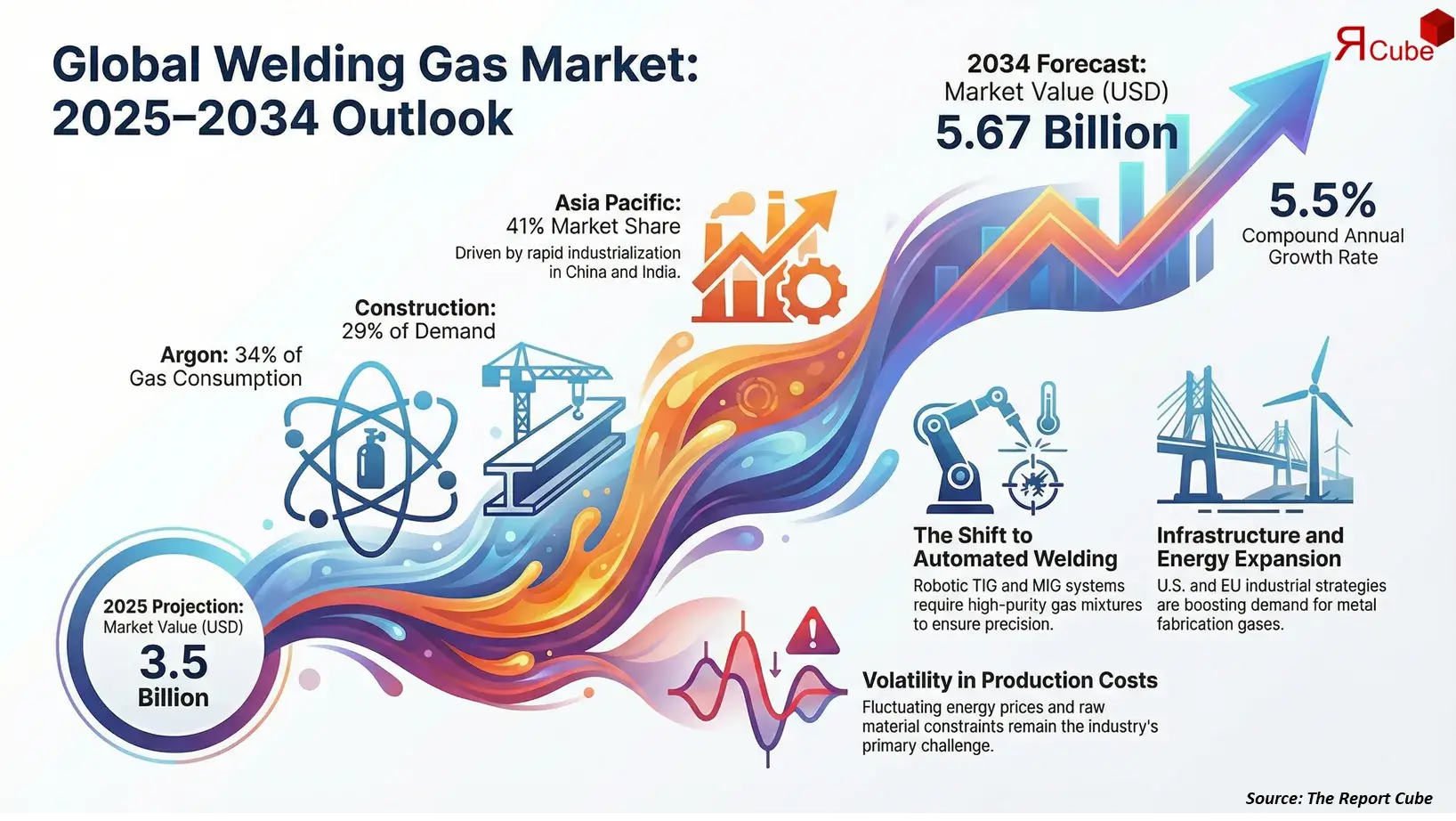
In line with the latest research findings by The Report Cube, the Global Welding Gas Market Research Report underlines that the industry is destined for considerable growth throughout 2026–2034, instigated by augmenting industrial manufacturing, infrastructure growth, and rising metal fabrication activities globally. The market is anticipated to register a CAGR of around 5.5% during 2026-2034, further valued at USD 3.5 billion in 2025, and estimated to reach USD 5.67 billion by 2034.
Welding gases are crucial industrial inputs deployed in various welding & cutting processes to stabilize arcs, shield molten metal from atmospheric contamination, and improve the strength & quality of welded joints. These gases are broadly used across industries like construction, automotive manufacturing, shipbuilding, aerospace, heavy machinery, and energy infrastructure. Further, as global industrialization continues to accelerate & infrastructure projects grow, the market demand for welding gases is surging steadily across both developed & developing economies.
Moreover, the soaring acceptance of advanced welding technologies, such as automated & robotic welding systems, has further strengthened the demand for high-purity welding gases. These technologies need consistent gas quality & optimized gas mixtures to ensure enhanced welding precision, reduced defects, and greater production efficiency. Subsequently, manufacturers are progressively investing in reliable gas supply systems & specialized shielding gases that improve welding productivity while minimizing operational costs.
Key Dynamics Affecting the Global Welding Gas Market
- Quick industrialization & expanding production activities across developing economies are substantially upscaling the demand for welding gases in metal fabrication, machinery production, and industrial assembly processes.
- Large-scale infrastructure development projects, such as bridges, railways, highways, commercial buildings, and energy facilities, are driving the consumption of welding gases in structural steel fabrication & construction operations.
- Increasing automotive production worldwide is motivating manufacturers to adopt MIG & TIG welding techniques, which need shielding gases like argon & carbon dioxide to ensure precise & high-strength weld joints.
- The growing adoption of robotic & automated welding systems in modern manufacturing facilities is boosting the requirement for high-purity gases that support stable arcs, consistent weld quality, and enhanced production efficiency.
- Growing emphasis on sustainable & energy-efficient manufacturing processes is inspiring industries to adopt optimized gas mixtures that minimize emissions, enhance welding performance, and minimize material wastage.
Need Specific Data, Let’s Customize the Report for You
Request CustomizationWhich of the segments, under Gas Type Classification, influences the Market Share?
Across the Gas Type, the Global Welding Gas Industry is segmented as:
- Argon
- Carbon Dioxide
- Oxygen
- Helium
- Hydrogen
- Gas Mixtures
- Other Welding Gases
Argon grabs the foremost market share of about 34% due to its widespread usage as a shielding gas in MIG & TIG welding processes. Argon’s inert characteristics prevent oxidation during welding, resulting in cleaner welds & enhanced structural strength. Its compatibility with a broad range of metals, such as aluminum, stainless steel, and titanium, makes it one of the most widely utilized welding gases across manufacturing & fabrication industries.
Regional Coverage: Global Welding Gas Market
- North America
- Europe
- Asia-Pacific
- Middle East & Africa
- South America
Geographically, Asia-Pacific leads with a potential market share of nearly 41% across the Global Welding Gas Market in 2025. The region’s headship is majorly instigated by rapid industrialization, increasing manufacturing bases, and large-scale infrastructure development in countries such as China, India, Japan, and South Korea. Surging automotive production, rising shipbuilding activities, and increasing investments in construction & heavy engineering sectors further reinforce the region’s demand for welding gases.
Company Profile: Leading Global Welding Gas Market Players
The leading market companies support the global industrial ecosystem by delivering high-purity industrial gases, developing advanced gas distribution infrastructure, and offering specialized welding gas mixtures that improve operational efficiency & weld quality. Some of the key players operating in the market include Linde plc, Air Liquide, Air Products and Chemicals Inc., Messer Group, Nippon Sanso Holdings Corporation, SIAD Group, Air Water Inc., Gulf Cryo, Taiyo Nippon Sanso Corporation, and Airgas (an Air Liquide company), among others.
Linde plc stands out as a potential innovator in the Welding Gas Market, solidifying industrial production via advanced gas technologies, integrated gas supply systems, and specialized shielding gas solutions intended to enhance welding efficiency & productivity across diverse industries.
Questions Answered in the Global Welding Gas Market Research Report
- What is the current market size & future growth forecast outlined in the Global Welding Gas Market research report?
- Which major factors are driving the rapid expansion of the Global Welding Gas Industry across major regions?
- What emerging trends are restructuring the competitive landscape according to the latest market insights?
- How is consumer / end-user demand evolving, and what impact does it have on the Global Welding Gas Market growth?
- Which leading companies are dominating the Global Welding Gas Industry, and what strategies are they adopting?
- What technological advancements are influencing product adoption & market penetration?
- How does the report evaluate regional performance & identify high-growth market opportunities?
- What challenges & risks could potentially affect market stability, according to the research findings by the analysts?