



Build Your Custom Market Intelligence Report
Customize Your ReportGlobal Welding Gas Market Insights & Analysis
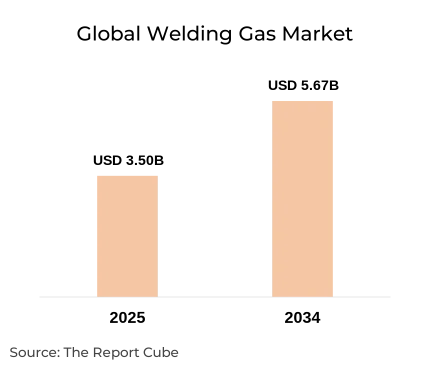
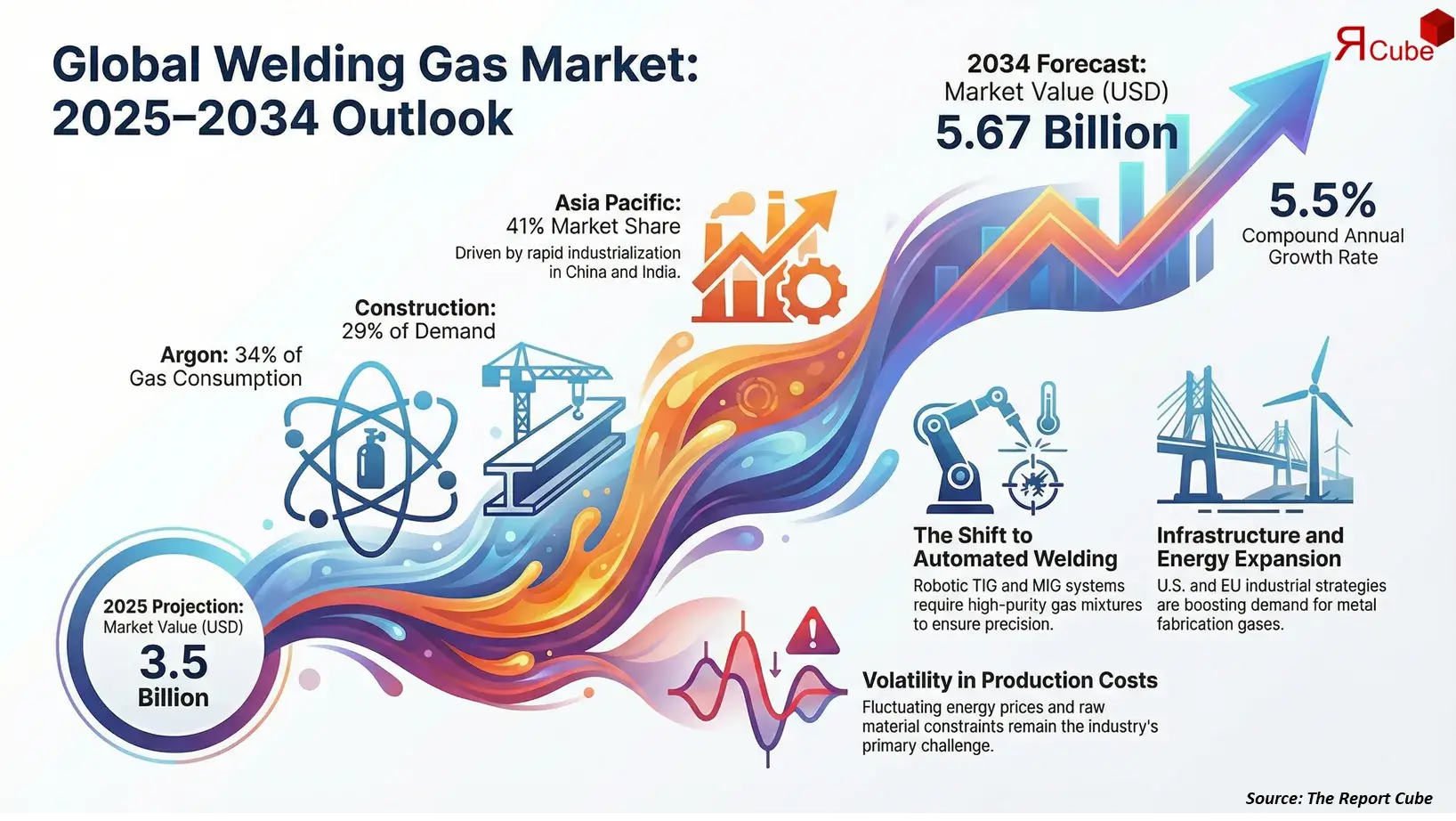
The Global Welding Gas Market is anticipated to register a CAGR of 5.5% during 2026-2034. The market size was valued at USD 3.5 billion in 2025 and is projected to reach USD 5.67 billion by 2034. The welding gas industry plays a foundational role in modern manufacturing, construction, and heavy engineering activities by enabling high-quality, precise, and durable welding operations across diverse applications.
Rising industrialization, expanding infrastructure projects, and the steady growth of automotive, shipbuilding, and metal fabrication sectors are driving sustained demand for welding gases worldwide. Shielding gases such as argon, carbon dioxide, and mixed gas blends are increasingly preferred due to their ability to enhance weld strength, reduce spatter, and improve operational efficiency. As industries pursue higher productivity and automated welding solutions, the need for consistent gas quality and reliable supply chains has intensified.
Additionally, global emphasis on cleaner and safer industrial processes is influencing the adoption of advanced welding techniques that rely heavily on optimized gas mixtures. Major gas suppliers are investing in on-site generation systems, bulk storage solutions, and digital monitoring to improve supply reliability. Together, these interconnected factors position the Global Welding Gas Market for stable and technology-driven expansion through the forecast period.
Global Welding Gas Market Recent Developments
- 2025: Linde plc expanded its on-site welding gas generation solutions for large-scale metal fabrication facilities.
- 2025: Air Liquide launched advanced argon-based gas mixtures to improve efficiency in automated welding systems.
Government Initiatives & Policies
- U.S. Infrastructure Investment and Jobs Act: Supports construction and metal fabrication demand, indirectly boosting welding gas consumption.
- EU Industrial Strategy: Promotes advanced manufacturing and sustainable industrial gases usage across Europe.
Global Welding Gas Market Dynamics
Key Driver: Expanding Industrial Manufacturing and Infrastructure Development
The expansion of industrial manufacturing and infrastructure development is a primary driver of the Global Welding Gas Market. Rapid urbanization and public infrastructure investments across Asia Pacific, the Middle East, and parts of Africa are increasing demand for steel structures, pipelines, and heavy machinery, all of which require extensive welding operations. Automotive production alone accounts for a significant share of welding gas consumption, with each vehicle requiring hundreds of individual welds. As manufacturers shift toward lightweight materials and precision welding, demand for high-purity shielding gases continues to rise. These trends are interconnected with global industrial output growth, reinforcing consistent market demand.
Book your FREE 30-minute expert consultation today
Contact UsIndustry Trends: Shift Toward Automated and High-Precision Welding Processes
A major trend shaping the Global Welding Gas Market is the rapid adoption of automated and robotic welding systems. Industries are increasingly deploying MIG/MAG and TIG welding robots to enhance productivity, reduce defects, and ensure consistent weld quality. Automated systems require precisely controlled gas flow and specialized gas mixtures, driving demand for premium welding gases. This trend is closely linked with Industry 4.0 initiatives, where digital monitoring and smart gas management systems optimize consumption and reduce wastage. As automation adoption grows, suppliers are aligning product portfolios with advanced welding requirements.
Major Challenge: Volatility in Raw Material and Energy Costs
Volatility in raw material availability and energy prices presents a notable challenge for the Global Welding Gas Market. The production of industrial gases is energy-intensive, making suppliers vulnerable to fluctuations in electricity and natural gas prices. Additionally, helium and argon supply constraints can disrupt pricing stability and delivery schedules. These cost pressures often translate into higher prices for end users, particularly small and mid-sized fabricators. Managing these challenges requires long-term supply contracts, energy-efficient production technologies, and diversified sourcing strategies.
Opportunity: Growth of Renewable Energy and Oil & Gas Projects
The expansion of renewable energy infrastructure and ongoing oil and gas projects offers a strong opportunity for the Global Welding Gas Market. Wind towers, solar mounting structures, pipelines, and LNG facilities require extensive welding during construction and maintenance phases. High-integrity welds are critical in these applications, increasing reliance on specialized gas mixtures. As global energy transition investments accelerate, welding gas suppliers can capitalize on long-term supply agreements and customized solutions tailored to energy-sector requirements.
Global Welding Gas Market Segment-wise Analysis
By Gas Type:
- Argon
- Carbon Dioxide
- Oxygen
- Helium
- Hydrogen
- Gas Mixtures
- Other Welding Gases
Argon dominates the Global Welding Gas Market by gas type, accounting for approximately 34% of total consumption in 2025. Its inert properties make it essential for TIG and MIG welding applications requiring clean and precise welds. Carbon dioxide follows closely due to its cost-effectiveness in MIG/MAG welding, particularly in construction and metal fabrication. Gas mixtures are gaining share as industries seek improved arc stability and reduced post-weld cleaning, linking this segment’s growth with automation and quality-focused manufacturing trends.
By End-Use Industry:
- Construction
- Automotive
- Shipbuilding
- Aerospace
- Oil and Gas
- Metal Fabrication
- Others
Construction leads the Global Welding Gas Market by end-use industry, contributing nearly 29% of overall demand. Large-scale infrastructure projects, commercial buildings, and bridges require continuous welding operations, sustaining high gas consumption. The automotive sector follows, driven by mass production and increasing use of robotic welding. These industries are interconnected, as infrastructure expansion also stimulates demand for vehicles, machinery, and fabricated metal components, reinforcing cumulative market growth.
Regional Projection of Global Welding Gas Industry
- North America
- Europe
- Asia Pacific
- Middle East and Africa
- South America
Asia Pacific leads the Global Welding Gas Market, holding an estimated 41% market share in 2025. Rapid industrialization, large-scale infrastructure development, and expanding automotive manufacturing in China, India, and Southeast Asia are key growth drivers. North America follows, supported by stable construction activity and technological advancements in welding automation. Europe remains a mature but innovation-driven market, while the Middle East and Africa benefit from energy and infrastructure investments, collectively shaping global demand dynamics.
Need insights for a specific region within this market?
Request Regional DataWhy Choose This Report?
- Provides a comprehensive overview of the overall market analysis, encompassing key trends, consumer behavior analysis, and risk assessment to support strategic decision-making.
- Provides accurate, up-to-date insights into market size, segmentation, and emerging opportunities, helping to minimize risk & capitalizing on growth.
- Gives deep understanding of target audience preferences, investment habits, and communication channels for enhanced product development & marketing effectiveness.
- Delivers competitive analysis & benchmarking, uncovering the strengths & weaknesses of market competitors to guide strategies.
- Consolidate comprehensive market intelligence, reducing reasoning & streamlining research efforts.
- Facilitates customized market segmentation & risk mitigation strategies, fine-tuned to the business objectives.
- Aids in identifying both market challenges & untapped opportunities within the industry to drive long-term business growth.
- Provides valuable information based on actual customer data & search trends.
Table of Contents
- Introduction
- Objective of the Study
- Product and Category Definition
- Market Segmentation
- Study Variables
- Research Methodology
- Secondary Data Points
- Breakdown of Secondary Sources
- Primary Data Points
- Breakdown of Primary Interviews
- Secondary Data Points
- Executive Summary
- Market Dynamics
- Drivers
- Challenges
- Opportunity Assessment
- Recent Trends and Developments
- Regulatory and Policy Landscape
- Global Welding Gas Market Overview (2021-2034)
- Market Size, By Value (USD Billion)
- Market Share, By Gas Type
- Argon
- Carbon Dioxide
- Oxygen
- Helium
- Hydrogen
- Gas Mixtures
- Other Welding Gases
- Market Share, By Process
- MIG/MAG Welding
- TIG Welding
- Flux‑Cored Welding
- Plasma Welding
- Other Welding Processes
- Market Share, By Storage Mode
- Cylinders
- Bulk
- Onsite Generation
- Market Share, By End‑Use Industry
- Construction
- Automotive
- Shipbuilding
- Aerospace
- Oil and Gas
- Metal Fabrication
- Others
- Market Share, By Region
- North America
- Europe
- Asia Pacific
- Middle East and Africa
- South America
- Market Share, By Company
- Revenue Shares & Analysis
- Competitive Landscape
- North America Welding Gas Market
- Market Size, By Value (USD Billion)
- Market Share, By Gas Type
- Market Share, By Process
- Market Share, By Storage Mode
- Market Share, By End‑Use Industry
- Market Share, By Country
- United States
- Canada
- Mexico
- Europe Welding Gas Market
- Market Size, By Value (USD Billion)
- Market Share, By Gas Type
- Market Share, By Process
- Market Share, By Storage Mode
- Market Share, By End‑Use Industry
- Market Share, By Country
- Germany
- France
- United Kingdom
- Italy
- Spain
- Rest of Europe
- Asia Pacific Welding Gas Market
- Market Size, By Value (USD Billion)
- Market Share, By Gas Type
- Market Share, By Process
- Market Share, By Storage Mode
- Market Share, By End‑Use Industry
- Market Share, By Country
- China
- India
- Japan
- South Korea
- Australia
- Rest of Asia Pacific
- Middle East and Africa Welding Gas Market
- Market Size, By Value (USD Billion)
- Market Share, By Gas Type
- Market Share, By Process
- Market Share, By Storage Mode
- Market Share, By End‑Use Industry
- Market Share, By Country
- Saudi Arabia
- United Arab Emirates
- South Africa
- Rest of Middle East and Africa
- South America Welding Gas Market
- Market Size, By Value (USD Billion)
- Market Share, By Gas Type
- Market Share, By Process
- Market Share, By Storage Mode
- Market Share, By End‑Use Industry
- Market Share, By Country
- Brazil
- Argentina
- Rest of South America
- Competitive Outlook and Company Profiles
- Linde plc
- Company Overview
- Product Portfolio
- Strategic Alliances/Partnerships
- Recent Developments
- Air Liquide
- Company Overview
- Product Portfolio
- Strategic Alliances/Partnerships
- Recent Developments
- Air Products and Chemicals, Inc.
- Company Overview
- Product Portfolio
- Strategic Alliances/Partnerships
- Recent Developments
- Messer Group
- Company Overview
- Product Portfolio
- Strategic Alliances/Partnerships
- Recent Developments
- Nippon Sanso Holdings
- Company Overview
- Product Portfolio
- Strategic Alliances/Partnerships
- Recent Developments
- SIAD Group
- Company Overview
- Product Portfolio
- Strategic Alliances/Partnerships
- Recent Developments
- Air Water Inc.
- Company Overview
- Product Portfolio
- Strategic Alliances/Partnerships
- Recent Developments
- Gulf Cryo
- Company Overview
- Product Portfolio
- Strategic Alliances/Partnerships
- Recent Developments
- Taiyo Nippon Sanso (Regional Subsidiaries)
- Company Overview
- Product Portfolio
- Strategic Alliances/Partnerships
- Recent Developments
- Airgas (an Air Liquide company)
- Company Overview
- Product Portfolio
- Strategic Alliances/Partnerships
- Recent Developments
- Others
- Linde plc
- Contact Us and Disclaimer
Top Key Players & Market Share Outlook
- Linde plc
- Air Liquide
- Air Products and Chemicals, Inc.
- Messer Group
- Nippon Sanso Holdings
- SIAD Group
- Air Water Inc.
- Gulf Cryo
- Taiyo Nippon Sanso (Regional Subsidiaries)
- Airgas (an Air Liquide company)
- Others
Frequently Asked Questions






